British Columbia’s world-class fleet

The British Columbia Wildfire Service and its six regional fire centers coordinate the province’s wildfire suppression efforts in Canada’s southwestern province using strategies the service has developed over its 121-year history. One of its key strategies is an aviation fleet and program that makes the U.S. look like amateurs by comparison.

Western Canada forests are dense and often inaccessible from the ground, so the province relies heavily on its aerial firefighting program to keep fires from burning into huge mega-fires. The job of conducting aerial attacks has become more challenging in recent years due to hotter weather, lower humidity, longer and smokier fire seasons, and an ever-present load of fuels to feed fires. A recent report by the Prince George Citizen helps explain what Michael Benson knows from experience.


Before he joined Conair Aerial Firefighting this spring as the company’s director of business development, Michael Benson spent 17 years flying with the B.C. Wildfire Service as an air attack officer. For seven of those years he led the provincial airtanker program.

“From my perspective, British Columbia has the most advanced airtanker program in the world,” Benson declares, “and the power of the fleet is immense.”

From his base in Abbotsford, he explains that B.C. has a lot of planes and a lot of speed. “It’s quite an amazing fleet. Most people in B.C. just don’t know how fortunate we are to have such a mighty fleet and a competent wildfire agency managing the fleet.”

Conair Aerial Firefighting has 70 firefighting aircraft, 29 of which are based in B.C. alone. It is the world’s largest privately owned fixed-wing aerial firefighting fleet, operating in Canada, the U.S., Australia, and France.
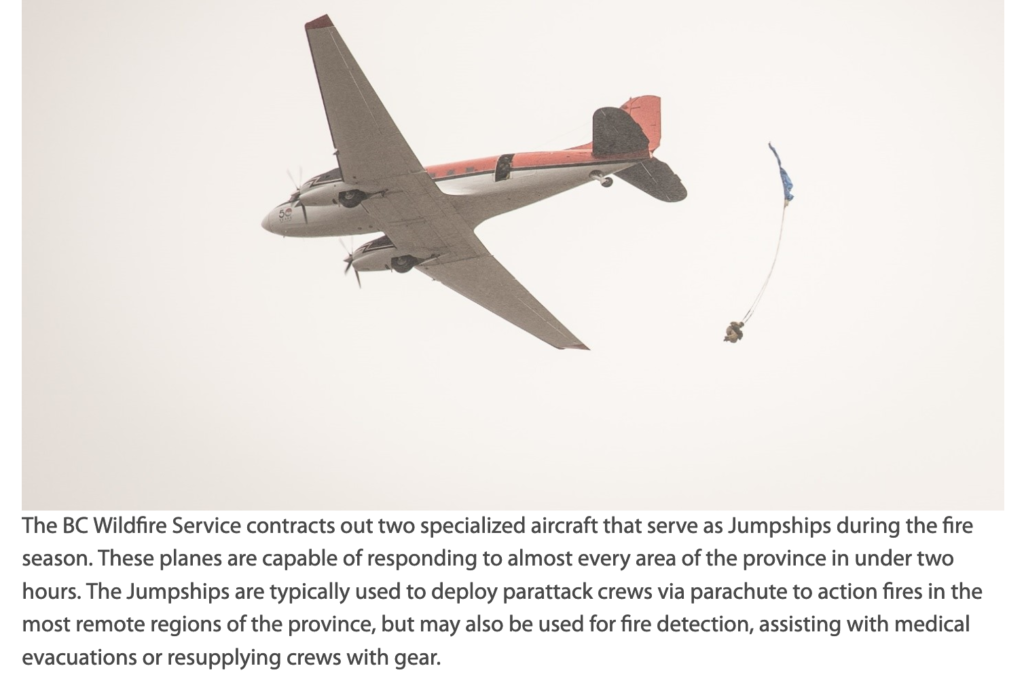
Parattack jump ship

Benson says other provinces are having to catch up to B.C.’s firefighting equipment and labor force capacity. Fire season started earlier this year in Alberta, Saskatchewan, Ontario, Quebec, and Nova Scotia — and more countries are facing similar wildfire battles brought on by climate change.

“One of the characteristics of this year is it wasn’t just B.C. that was busy; much of Canada was busy at the same time, and that creates some real challenges in that resources are shared across Canada,” said Benson. “Because the demand was so high nationally, it was difficult for any agency to free up their resources and help another agency. We have been lucky that in the USA it’s been an unusually slow season for them, so there has been some added capacity for them to come up to Canada.”

Five of the most destructive fire seasons ever in B.C. occurred during the past 10 years. Amphibious waterbombers that scoop from lakes or rivers are now often used alongside land-based tankers loaded with retardant — one of several adaptations B.C. has made in its fire aviation program. The scoopers fly over the fire to dump water and foam directly while the airtankers skirt the perimeter with retardant. Once those firelines are complete, the land-based tanker is free to go to another fire, while the waterbombers continue to dump water to cool the fire for ground crews.

Prince George is the base for five Conair aircraft for part of the season — a Cessna 208 Grand Caravan birddog that’s used to coordinate aerial attacks and provide air traffic control, plus four Air Tractor AT-802AF Fire Boss waterbombers. Benson says they work well together and it’s not uncommon to get 10 or 12 aircraft on one fire.
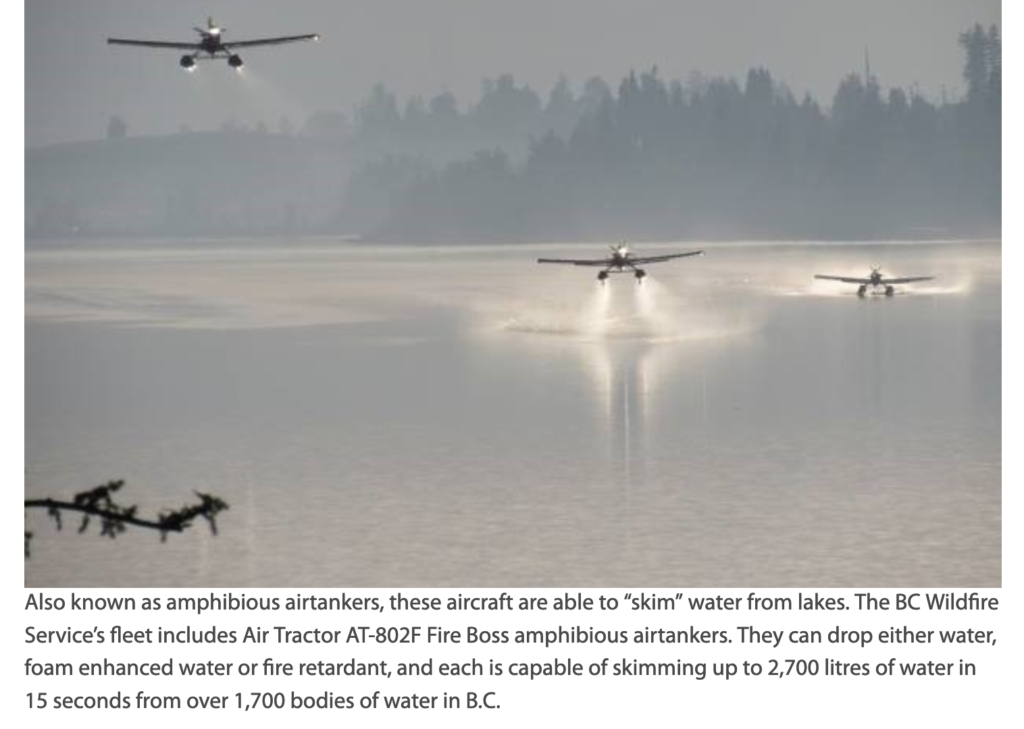
Fire Boss trio

“For me, I think it’s the coolest job out there,” he says. “Working for an airtanker program you can effect change in a short period of time because the power of the fleet is incredible. The capability to have 15 or 20 airplanes on your fire in a short period of time gives you the chance to contain the fire and buy time for the hard-working ground firefighters to arrive and actually extinguish the fire.”
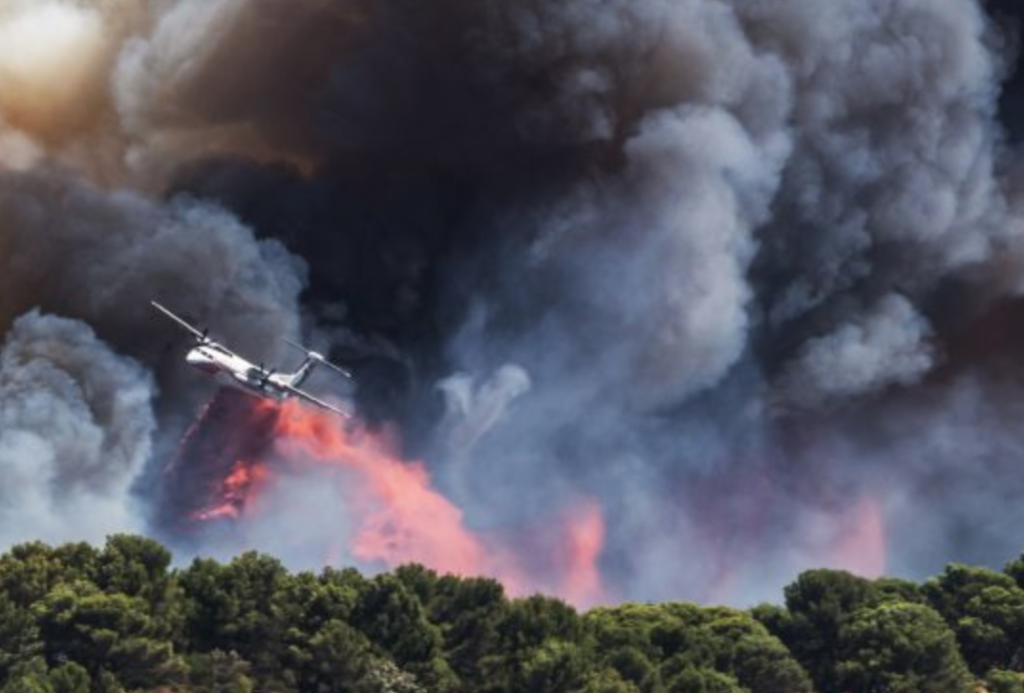
Conair Dash 8
Conair Dash 8

At its base in Abbotsford, Conair takes De Havilland Dash 8-400 twin-engine turboprops — commonly used for passenger flights — and in 75 days converts them into airtankers that can deliver 10,000-litre payloads — about 2650 gallons.

They offer more than double the fuel efficiency of other more traditional large tankers, and the loaded cruising speed for a Dash 8 is 360 knots (well over 400 mph), faster than most jets over short distances. First introduced as an airtanker in 2020 in Australia, there are now 19 Dash 8-400s flying firefighting missions around the world. Eight are owned and operated by France — built in Canada by Conair — with the rest operating in Conair’s fleet, four of which are on contract in B.C. this fire season.

Check out these videos on Vimeo:
Conair’s Tactics and Training Centre
Conair’s Changing Tactics
Conair’s Dash 8-400 Airtanker

Bridger buying Bighorn Airways fleet

Bridger Aerospace, one of the country’s largest aerial firefighting companies, is purchasing Bighorn Airways’ fleet of 12 aircraft used for smokejumping and special mission transport for government agencies. The transaction, valued at $39 million, is expected to close by the end of September, financed through a combination of cash and stock.

“This expands our aerial firefighting services to new mission critical areas,” said Tim Sheehy, CEO at Bridger. “Bighorn provides year-round logistics for the Department of Defense. From providing aircraft and flight crews in support of the smokejumper program, to flying missions in the North Pole region of Alaska, Bighorn adds to what is now the largest specialty wildfire aviation fleet in the country. We are honored to welcome Bighorn to the Bridger family.”

Bridger Aerospace

Bighorn Airways was founded in 1947 with three planes working aerial spray operations for local ranchers. The company grew into Wyoming’s largest aviation service provider, with aircraft and helicopter charter service, aerial spraying, and full FBO services including aircraft refueling, maintenance, and avionics service.

Based in Sheridan, Bighorn has a fleet of 12 aircraft including three Dash-8 planes (De Havilland Canada DHC-8s) with a 7500 lb. payload capacity, a range of 1200 miles, and capability of low-level flights. Bighorn also operates four Casa 212-200 and five Dornier 228-200 twin turboprops capable of short takeoff and landings.

“Mountain flying is a very demanding skill set, you got to spend years learning how to fly safely in the mountains,” Sheehy, who flies Bridger’s Super Scooper, recently told KHQ-TV. “Amphibious aviation is a very specific skill set, people will spend years learning how to be high-speed boat drivers and pilots at the same time.” Sheehy said aerial firefighting combines all those skill sets together.

Bridger Aerospace, started by Sheehy in 2014 after nearly a decade as a Navy SEAL, has contracts with agencies in both the U.S. and Canada, and has two scoopers currently at Coeur d’Alene airport flying for the Forest Service.

Dash 8-400AT airtanker finally gets FAA approval

Aero-Flite announced earlier this month that the Federal Aviation Administration (FAA) has issued a Supplemental Type Certificate (STC) on the Dash 8-400AT airtanker. Based in Spokane, Aero-Flite has shown an ongoing interest in the U.S. certification of the airtanker version of the Dash-8 airliner.

Currently operating AVRO RJ-85 and Canadair CL-415 airtankers, Aero-Flite plans to expand their fleet. scramble.nl reported that with the new STC, Aero-Flite hopes to add two Dash 8-400ATs to its fleet before the end of the year. This FAA approval will allow U.S.-registered Dash 8-400ATs to fly aerial firefighting missions across all states.

The Aero-Flite airtankers will be operating under a long-term, multiyear contract with the State of Washington.

Aero-Flite photo
Aero-Flite photo

“Two of Aero-Flite’s Dash 8-Q400AT airtankers are currently on an exclusive use contract with Washington State,” said Brock Hindman, chief pilot of the Dash 8-400AT program at Aero-Flite. He said they’re operating with a cooperator agreement with the USFS and offering the airtanker to the Forest Service and to other states as the fleet grows.

Hindman said Canadian firefighting company Conair and the French Securité Civile have for years used firefighting versions of the Dash-8. “Conair has been converting the Dash 8-400 into an airtanker since 2005,” he said, “and has been operating them in Australia since 2020 — and in Canada and Alaska since 2022. With this recent FAA approval, Aero-Flite can now register our own airtankers in the U.S. and operate them under contract with government agencies.” He said Aero-Flite provides crews, maintenance, and insurance for the Dash 8 operations, working out of its Spokane hangars.

“Each Q400AT has a captain and a first officer operating the aircraft, supported by two aircraft mechanics on the ground, plus partner fuelers and loaders at each tanker base.” Hindman said the crews travel between tanker bases as needed. In 2022 the Q400AT operated in Washington and assisted in Oregon and Idaho.

Aero-Flite photo
Aero-Flite photo

Chris Niemann, general manager at Aero-Flite, told AirMed&Rescue, “The Dash offers greater flexibility and responsiveness than larger airtankers, while still providing a comparable payload capacity. It can operate from shorter runways at higher elevations, positioned in smaller airtanker bases located closer to where wildfires occur — meaning a fast response to the fire and back. Plus, they burn significantly less fuel than a Type 1larger airtanker, resulting in much lower operational costs while delivering a similar punch to the fire.”

Alaska sends hotshots and airtanker to Alberta

The Alaska Division of Forestry and Fire Protection (DOF) has sent resources to the Canadian province of Alberta, where agency information officer Lily Coyle says they’re dealing with an unusually intense early wildfire season.

Tanker 544

“They declared a state of emergency over this past weekend,” Coyle told Alaska Public Media (PBS). “On Saturday they had over 100 wildfires spreading out of control. Their Premier Danielle Smith deemed it an unprecedented crisis.”

Aerial Fire Magazine reported that at least 29,000 Albertans have been forced from their homes in the north and central regions of the province. Fire managers in Alberta have made large resource requests for outside assistance, including the airtanker and hotshot crew from Alaska. The Northwest Compactstrong intergovernmental agreement known as the Northwest Compact allows Alaska and other states and provinces to request or share resurces internationally.

Considering Alaska’s delayed snowmelt, late spring, and recent widespread moisture, the DOF made available Airtanker 544 — a Conair Dash 8 – 400
AT Airtanker — and the Pioneer Peak Hotshots, both based in Palmer. Tanker 544 departed for Alberta on May 9. Pioneer Peak IHC has extensive experience in managing fires, and the crew has completed their required 80 hours of pre-season training. The 23-person crew left Tuesday, May 9 in a smokejumper aircraft.

“Alberta was a significant contributor to the Alaska response effort last season,” said DOF Chief of Fire and Aviation Norm McDonald. “Supporting their efforts this spring is an excellent example of not only national but the international cooperation it takes to manage fires during extreme conditions. As we are just beginning the Alaska fire season with our late breakup, we will continue to monitor fire behavior and our own fire protection needs.”

Pioneer Peak Hotshots
Pioneer Peak Hotshot Crew after completing their annual 80-hour spring training in front of Pioneer Peak in Palmer, Alaska. Photo courtesy of Pioneer Peak Hotshots

Coyle said Alaska fire agencies often send resources outside the state in the fall, but she said the spring deployment is very unusual. “This is the first time we’ve sent a crew to Canada in May,” she said. “Our late fire season, coupled with the early drought conditions that Alberta is facing — that just set us up for this pretty unprecedented situation.”

On the federal side, Alaska Fire Service public affairs specialist Beth Ipsen said no resources have yet been sent to Alberta, but the agency has two hotshot crews that will be finishing training this week and may be available for deployment.