Conair has produced a short video documenting the history of the company. Jeff Berry, Director of Business Development, described it for us:
“2020 is Conair’s 51st fire season supporting wildfire control agencies around the world. We put together a video celebrating those 50 past seasons celebrating all the hard work and innovation that has gone into each and every season.
“The video titled ‘Roots and Wings’ highlights 50 years of Conair’s history in 5 minutes! Those interested in aircraft history and/or aerial firefighting will enjoy the vintage footage from the 1960’s and 70’s through to the present day.”
Above: the Air Tractor display at the Aerial Firefighting conference.
Here are a few notes that I scribbled in a notebook at the Aerial Firefighting conference in Sacramento this week. This is Part One — I will post Part Two later.
Air Tractor
Mike Schoenau, an Air Tractor dealer out of Tulare, CA, said a new single engine air tanker is being flight tested now. The model name is AT-1002 and will hold up to 1,000 gallons. You will be able to purchase one for yourself for about $2.5 Million.
Fire Boss The Bureau of Land Management has not released their list of SEATs on contract this year, many of which will be the amphibious Fire Boss, a variant of the Air Tractor 802. Fire Boss doesn’t know if they will be converting the new AT-1002 1,000-gallon SEAT to use floats.
10 Tanker
RIck Hatton of 10 Tanker Air Carrier.
Their fourth converted DC-10, Tanker 914, will be ready to fight fire this summer. Rick Hatton, the President and CEO of 10 Tanker Air Carrier, said their approval by the Interagency Airtanker Board came to the end of its six-year term, so they retook the grid test in December. Their three DC-10s averaged about 300 hours on fires in 2017, which is more than usual.
I got into a long detailed conversation with Mr. Hatton about how their retardant delivery system can maintain a constant flow, adjusting for the amount of retardant in the tank, drop height, and speed. It usually drops at 150 knots and 200 feet.
Hours per CL-415
As we reported yesterday, Shawna Legarza, the USFS Director of Fire and Aviation, said the two CL-415 scooping air tankers that were on USFS contract in 2017 each had over 400 hours of fire flight time. Due to a reduction in the firefighting budget, the two scoopers had to be cut this year from the exclusive use list. At least a couple are still on a CWN contract, but they may or may not be available if the USFS Calls them When Needed.
Columbia Keith Saylor, Columbia’s Director of Commercial Operations, said the company will have three Type 1 helicopters, CH-47 Chinooks, on exclusive use contract this year. Two have internal tanks and one will use an external bucket.
Conair Shawn Bethel, Conair’s Director, International Business Development, said the external tank on the Q400 can be removed in about three hours by 9 to 12 workers. They recently received a contract to supply six Q400’s to France’s Securite Civile (Department of Civil Defense and Emergency Preparedness).
The Q400 MR can carry up to 10,000 liters (2,600 gallons) of water or retardant. In addition to the nine S-2’s and two Q-400’s, France also has twelve CL-415’s and 40 helicopters.
The Conair Group has purchased six Q400 MR aircraft from Bombardier which it will convert into multirole air tankers for France’s Securite Civile (Department of Civil Defence and Emergency Preparedness). Fire Aviation first covered France’s decision to acquire six Q400s in July, 2017, but now we have confirmation that Conair will purchase the aircraft, convert them into multirole air tankers, and then transfer them to Securite Civile.
The Q400 MR can carry up to 10,000 liters (2,600 gallons) of water or retardant. The “MR” stands for multirole, meaning the aircraft can be converted in a few hours to carry 64 passengers.
In a medevac configuration it can accommodate six stretchers along with the necessary nurses stations and life support equipment, or it can transport 9 tons of cargo.
For several years Securite Civile has been pondering what to do about replacing their nine S-2’s that are approaching their structural life limit of 25,000 hours, according to the agency. Their plans announced in 2016 were to retire the S-2’s between 2018 and 2022 which would require a two-year extension of the type certificate. The goal was to acquire aircraft that could carry more water or retardant, would reduce operating costs, and would be multi-role.
France considered the CL-415 water-scooping amphibious tanker formerly made by Bombardier, but it is no longer in production with the program being sold to Viking Air Limited in 2016. Viking is considering manufacturing them again, but for now they are providing service and support for the CL-215’s and CL-415’s operating around the world.
Securite Civile has operated two Q-400 air tankers since 2005, so retiring the S-2’s and acquiring more Q-400’s will reduce the complexity of the maintenance and operation of their fleet.
In addition to the nine S-2’s and two Q-400’s, France also has eleven or twelve CL-415’s and 40 helicopters.
Here is the automatic translation of the text in the following tweet by the Minister of the Interior:
I was involved this summer, with the fires that have affected our country: I just signed the acquisition of 6 Multirole aircraft for civil security. ✅ We renew our fleet air for fire fighting & project forces and material.
If you do not see the photos in the tweet below, click HERE.
?️✈️ Je m’y étais engagé cet été, lors des incendies qui ont touché notre pays : je viens de signer l’acquisition de 6 avions-multimissions pour la sécurité civile.<br
notre flotte aérienne pour lutter contre les incendies & projeter forces et matériels. pic.twitter.com/LOqurlkGOv
Above: T-10 (a BAe-146), another BAe-146, and an RJ85 (center) at La Grande, OR. Photo by Josh Annas.
The number of RJ85 and BAe-146 air tankers continues to grow. According to BAE Systems there are likely to be 18 of the aircraft that are operational by later this year and there are four more in various levels of conversion.
The two quad-jet aircraft are similar — both are made by BAE — and can carry up to about 3,000 gallons of retardant utilizing gravity to empty the tanks.
During the 2016 wildfire season the 14 in-service BAe 146-200s and Avro RJ85s of Neptune Aviation and Conair/Aero-Flite flew a combined total of over 5,800 tanker missions, dropping in excess of 12.5 million gallons of retardant.
A further eight BAe 146/Avro RJs are under conversion, with four scheduled to enter service during 2017.
Neptune Aviation’s fleet of seven BAe 146s flew a total of 2,880 hours on airtanker operations in the United States and Canada. Dan Snyder, Neptune’s Chief Operating Officer explained: “We are a US national resource. Wherever the US Forest Service has the need or request we can and do get dispatched”.
He added: “The yearly utilization average per aircraft varies greatly from year to year based on the fire season. Some years it is 200 hours per aircraft; others it can be 400 hours per aircraft. Fire operations in a day vary greatly as well. Some days there are no flights; some days only one. Sometimes it can be up to 10-15 missions a day. The distance to the fire, weather, and fire activity all affect this number.”
Seven of Neptune’s BAe 146s are under Exclusive Use Contracts with the USFS, along with four P2V Neptunes. An additional BAe-146 is contracted to CAL FIRE in California.
More recently, one of Neptune’s BAe 146s was on an assignment in Chile for several weeks.
Neptune has acquired and is converting a further two BAe 146-200s into airtankers to be ready for this year’s fire season.
Conair of Abbotsford, Canada, and its US subsidiary Aero-Flite, has a total of seven Avro RJ85s in service as airtankers, with an eighth aircraft under conversion ready for the 2017 fire season.
Four of Conair/Aeroflite’s RJ85s are earmarked for the 2017 Exclusive Use Contract with the USFS.
Jeff Berry, Conair’s Director of Business Development, stated that by early November the seven in-service aircraft had flown more than 430,000 km in support of wildfire operations on hundreds of fires in the United States and Canada during 2016. He added: “That is equivalent to a distance greater than 10 times around the world and the volume of retardant delivered to control wildfires was greater than the volume of six Olympic swimming pools.”
In addition, one of Conair’s RJ85s was recently deployed during the down under summer under contract to the State of Victoria to help in suppressing bushfires.
The Victoria Country Fire Authority in Australia has a story about Conair pilot Ray Horton, one of the pilots flying the company’s Avro RJ85 during the summer bushfire season.
****
“Canadian pilot Ray Horton has travelled the long way around to fight bushfires in Victoria.
One of the world’s most respected aerial firefighters, Ray and the aircraft he flies – the Large Air Tanker ‘RJ’ – have become a welcome sight in Victoria’s skies over the past three summers.
So how did this one time “city slicker from Vancouver” find himself in Tambo Crossing [map], the Mallee and points in between?
His story begins in Canada’s Arctic North. The young pilot was building his hours in 40-below conditions, doing some “fantastic fun flying” as he puts it.
Then, one summer, he found himself flying supplies into the fire camps that are a base for summer firefighting in the Arctic summer.
Bomber 391, an RJ85, at Avalon, Victoria. Photo by Avalon Airport.
It was the season that changed Ray’s life.
In quick time, he had a job with Conair, the Canadian aerial firefighting operator whose aircraft and pilots work fire seasons in North America, Europe and Australia.
He started in the Bird Dog – the observer aircraft that guides the larger air tankers to fires and coordinates aerial attack with ground crews. After that, it was 10 years flying the tankers themselves, many of them 1950’s US military aircraft repurposed for aerial firefighting.
Antsy for a change, Ray spent 10 years as an Air Canada captain. But civilian life was not for him.
“I had been spoiled fighting forest fires,” reflects Ray. “Once fire gets in your blood, there is always the challenge of trying to win. I had a tough time letting go of the challenge.”
Ray re-joined Conair and in 2014 arrived for his first fire season in Victoria. He’s returned every season since with RJ, the ‘next generation’ Large Air Tanker with which he’s been deeply involved since the aircraft’s infancy.
A veteran of fires seasons around the world, Ray had one word about the challenges of Victorian conditions – “Wind.”
“Most of the time when we are chasing fires in Victoria it is because of high winds and the high temperatures – they seem to come together,” says Ray.
“In North America, sure we get high winds. But then you’ll get a slew of thunderstorms come through. They may start 50 fires overnight. But then the wind will die down and you methodically get to as many fires as you can.
“Here in Victoria, that same storm will come through but with really high winds. Then you have your fuel types – the eucalyptus and others. The fires run much faster here – much, much faster.”
The other major difference, Ray believes, is the sheer number of volunteers working the fire ground in Victoria.
“That is something we just don’t see in North America. We don’t see the volunteer crews you have here. It’s amazing what Australia can do, particularly in Victoria with CFA and the number of volunteers.
“Here, we will typically see crews on the ground by the time we get to the fires. In North America, there are only so many crews to go around.”
Air crew and ground crew as one is a theme emphasised by Ray and his aerial crew colleagues.
“We know that we don’t put fires out,” stresses Ray. “We are here to allow the firies to get in and to support them. Hopefully we can make the difference that allows them to catch the fire.
“Our challenge – and the one we are called in for – is to put the water or retardant where the ground crews need it. When there are high winds and high heat, the challenge is really on us.
“Put it this way, it’s a long way to fly not to make any difference.” “
File photo of an Air Tractor 802-F. Air Tractor photo.
The investigators concluded that a wing stalled either independently or in combination with an encounter with a wing-tip vortex generated by another aircraft.
Below is the TSB’s Summary of the incident:
An Air Tractor AT-802A on amphibious floats (registration C-GXNX, serial number AT- 802A-0530), operating as Tanker 685, was carrying out wildfire management operations during daylight near Chantslar Lake, British Columbia. Three similar aircraft were working as a group with Tanker 685, which was second in line on a touch-and-go to scoop water from Chantslar Lake. Upon liftoff, control was lost and the aircraft’s right wing struck the water. The aircraft water-looped, and the floats and their support structure separated from the fuselage. The aircraft remained upright and slowly sank.
The pilot received minor injuries, egressed from the cockpit, and inflated the personal flotation device being worn. The third aircraft in the formation jettisoned its hopper load as it continued its takeoff and remained in the circuit. The fourth aircraft jettisoned its hopper load, rejected its takeoff, and taxied to pick up the accident pilot. There was sufficient impact force to activate the on-board 406- megahertz emergency locator transmitter, but the search-and-rescue satellite system did not detect a signal from the emergency locator transmitter until the wreckage was being recovered 6 days later.
The TSB’s findings, in part:
1. A wing stalled either independently or in combination with an encounter with a wing-tip vortex generated by the lead aircraft. This caused a loss of control moments after liftoff, and resulted in the right-hand wing tip contacting the water and in a subsequent water-loop.
2. The operator’s standard takeoff procedures did not specify a liftoff speed for scooping operations. Lifting off below the published power-off stall speed contributed to a loss of control at an altitude insufficient to permit a recovery.
3. The takeoff condition, with the aircraft heavy, its speed below the published power-off stall speed, and a high angle-of-attack contributed to the loss of control.
4. An understaffed management structure during organizational changes likely led to excessive workload for existing managers. This contributed to risks, contained within the standard operating procedures, not being addressed through the operator’s safety management system, resulting in continued aircraft operations below published minimum airspeed limitations.
The report states that Conair hired a safety manager and a company check pilot for the Fire Boss fleet before the 2015 spring training season started. And, Conair adopted a risk mitigation plan for 2015–2016, applicable to the company’s AT-802 fleet. The plan addresses issues mentioned in the TSB report, plus an additional issue identified in-house.
The year following the August 14, 2014 crash on Chantslar Lake there were three incidents that we are aware of that involved Conair AT-802’s:
2015, April 11: An engine failure on Air Tanker 699, an Air Tractor AT-802A, during training resulted in damage to a float upon landing. The incident occurred April 11, 2015 on Harrison Lake, BC, 33 nm NNE of Abbotsford.
Above: a Q400 drops retardant. The image is from the Conair video below.
The Conair Group is currently converting at least one additional RJ85 airliner into an air tanker at their facility in Abbotsford, British Columbia and also plans to make enhancements to the Q400. The company already operates approximately four RJ85s, and two Q400s have been used in France for over 10 years.
The Q400 can carry up to 2,642 US gallons and can be reconfigured into a cargo role in a few hours.
Conair Group Inc. is currently producing its fifth and sixth next-generation RJ85 air-tanker, supplementing the five it currently has in operation in the U.S. and Australia.
The next-generation RJ85 will supplement B.C.’s current fleet of air-tankers on a pilot basis this summer. The addition of the aircraft ahead of the 2016 wildfire season will allow the BC Wildfire Service to evaluate its cost and effectiveness and help inform future procurement decisions.
Conair Group Inc. has also signed a memorandum of understanding with CAE to build a Level D simulator training program for RJ85 pilots in B.C. Companies like Conair Group Inc. currently have to send pilots to Zurich, Switzerland to receive similar training, and this facility will reduce costs and increase access to more world-class, mission-based rehearsal scenarios.
In addition to the various initiatives with the RJ85, Conair Group Inc. has started to make enhancements to the Bombardier Q400 cargo combination aircraft. Two Q400s have been built for the Government of France and the planned conversions will increase the aircraft’s versatility for the global market.
Steve Thomson, Minister of Forests, Lands and Natural Resource Operations –
“Wildfire management will always rely on a fleet of dependable aircraft to assist the men and women on the ground who extinguish the fires. The pilot program with Conair will provide us meaningful information as we look ahead to future procurement decisions.”
The video below shows water and retardant drops by the RJ85 and the Q400.

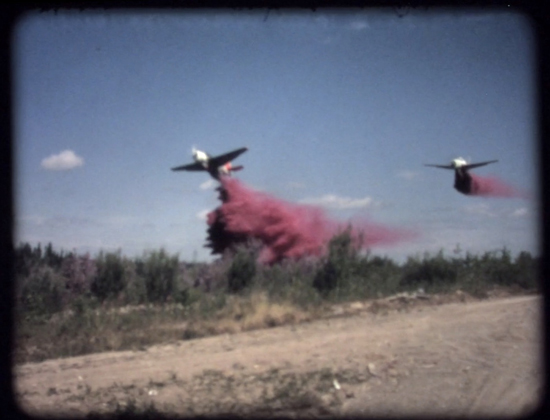

 The Bureau of Land Management has not released their list of SEATs on contract this year, many of which will be the amphibious Fire Boss, a variant of the Air Tractor 802.

 Keith Saylor,
 Shawn Bethel,


