Coulson Aviation has signed a memorandum of understanding with the government of Argentina that will enable the country “to analyse and, eventually, develop as a whole, an air combat division” for suppressing wildfires.
The Secretary for Logistics and Military Coordination for Emergencies, Walter Ceballos, made the announcement on his Facebook page on June 15.
In the photos above, Wayne Coulson, the CEO and President of Coulson Aviation, is wearing a white shirt and a light blue tie. Mr. Ceballos is next to him in the brown suit.
Google’s automatic translation of the text in the above post:
I am grateful to the CANADA CCC programme which allowed the ministry of defence to be linked to Coulson Aviation, a specialized company and certified in air fire operations. We signed a memorandum of understanding to analyse and, eventually, develop as a whole, an air combat division, with the FAA’s hr and operational operations to serve the national plan to fight fire.
We checked with Britt Coulson, Vice President of Aviation, who explained that the company “is in the final stages of negotiations with Argentina to [provide] a turnkey fleet of command and control, fixed wing, and rotary wing assets” as well as a full training program. If the agreement is consummated, the aircraft would be on contract, owned and operated by Coulson.
Mr. Ceballos is also interested in the Russian-made amphibious Be-200 air tanker and has pinned the following at the top of his Twitter account:
Twitter’s automatic translation of the above text:
Visit to Beriev to evaluate B200 (Multiflight Amphibious Plane).
In addition to having three operational C-130-type air tankers and a fourth one on the way, Coulson has purchased six 737-300’s from Southwest Airlines and intends to convert at least some of them into air tankers. One has been painted and has started the conversion process.
One of Coulson’s 737’s — the first one to be painted and to start the air tanker conversion process.
Coulson Aviation is adding not only additional air tankers to its fleet, but is branching out into a different model of aircraft. The company has purchased six 737-300s and intends to convert them into 4,000-gallon “Fireliner” airtankers. Britt Coulson said they saw an opportunity when Southwest Airlines made a decision to replace their 737-300s with the new 737-Max. Because the FAA only allows Southwest pilots to fly two of the 737s with the same rating, the airline opted to sell the 737-300s even though they have a relatively low number of hours in the sky.
The first conversion has started, with a freshly painted 737 scheduled to roll out of the paint shop in Spokane on May 22, 2017. The next step is to add the gravity-based tanks that will have the same technology used on their C-130s.
The airtanker is being designed as a multi-use aircraft with the ability to haul passengers. Mr. Coulson said, “With a full retardant load and 4.5 hours of fuel we are so far under max gross weight we are going to leave the full interior and galleys in even when just in airtanker mode.”
The company likes the three C-130s they have already converted to airtankers, but finding additional C-130s for the civilian market is very difficult.
A 737 will be able to use some tanker bases that larger aircraft, like the C-130, can’t, with a wingspan that is about 38 feet shorter.
Mr. Coulson said they expect to begin installing the retardant system in June with a completion date of December of this year. When that is complete they will start on another. The first conversion will be done by Coulson Aircrane Canada.
While Coulson’s three C-130-type air tankers were all together in Reno last month for carding by the U.S. Forest Service and pilot training the company took the opportunity to grab some photos of the aircraft while they were flying in formation.
They are all variants of Lockheed’s C-130 platform — Tanker 131 is a C-130Q while Tankers 132 and 133 are L-382G’s. Tanker 133, the newest addition to the fleet, just became operational a couple of weeks ago.
Scroll down to see how Dan Megna got the photos.
To take the photos Coulson rented an OV-10 that conveniently has a small compartment in the rear. Professional photographer Dan Megna sat in that tiny space to get the shots.
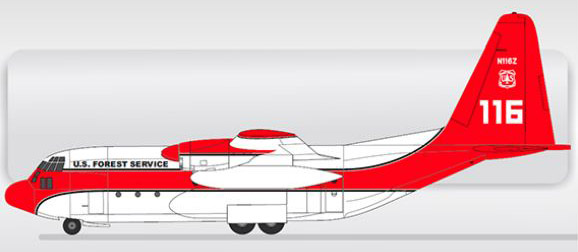
This is the US Forest Service approved paint design that will be used on the seven HC-130H air tankers acquired from the Coast Guard.
After a solicitation process that dragged on for almost two years, the U.S. Air Force has awarded the contract to build and install retardant delivery systems for up to seven of the seven HC-130H aircraft that are being transferred from the Coast Guard to the U.S. Forest Service.
The Coulson Group announced today that they received the contract. In one sense this is not unexpected because the company has installed and successfully operated two similar systems in C-130s — Tanker 131 and Tanker 132. In another sense, it is a surprise after the Government Accountability Office denied the company’s protest of the terms of the request for proposals in August of 2015.
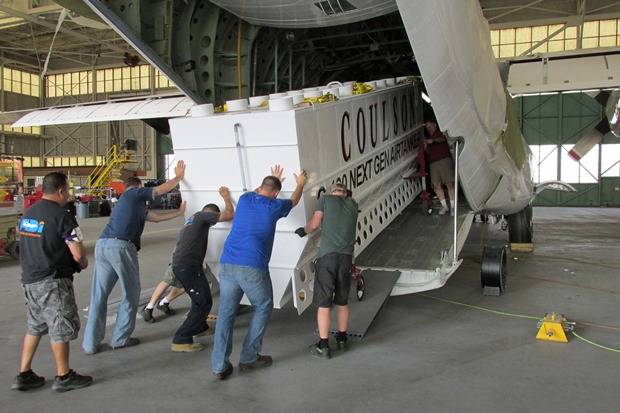
Coulson’s retardant tank being removed or installed in one of their air tankers, T-131, in 2013. Coulson photo.
“We are excited to have the opportunity to work with the United States Air Force to provide them with state of the art retardant aerial delivery systems (RADS) for their fleet of C-130s,” says Wayne Coulson, CEO and President of Coulson Aviation.
The 3,800-gallon (3,500 gallons dispensable payload) retardant system will be gravity-based with retardant tanks that can be quickly removed, making it possible for the air tankers to also haul cargo or passengers.
One of the seven HC-130H aircraft began working out of McClellan Air Field near Sacramento last summer. Since it did not have a permanent retardant tank it borrowed one of the Forest Service’s eight Modular Airborne FireFighting Systems (MAFFS) that can be inserted into the cargo hold of a military C-130 to provide a surge capacity of air tankers during a time of heavy wildfire activity. The MAFFS pump the 3,000 gallons of retardant out of a pipe through the door using compressed air, rather than letting it drop out of the belly with the assistance of gravity as is done with conventional air tankers.
The Air Force is responsible for the retrofitting and performing the heavy maintenance that must be completed before the seven HC-130Hs are finally turned over to the USFS over the next three years. This contract is for the installation of one trial “kit”, one verification kit, and three production kits. There is an option for the installation of two additional production kits.
Coulson Aviation has 25 years of experience in aerial fire suppression and they operate both Type 1 helicopters and large fixed wing air tankers. Coulson is one of the few companies to hold multi-country aerial firefighting contracts, including Canada, the United States, and Australia.
Tanker 131, a C-130Q. Photo November 23 in Edmonton by Matt Ralph.
Air Tanker 131 (N130FF), Coulson’s C-130Q, arrived in Hawaii on Thursday after completing the first leg of its trip to Victoria, Australia. It is under contract with Emergency Management Victoria for their summer bushfire season, along with Conair’s Tanker 162, an RJ85, (N355AC).
Two other air tankers are already down under working for New South Wales, T-910 (N612AX) a DC-10 operated by 10 Tanker Air Carrier, and Coulson’s Tanker 132, an L-382G (N405LC) which is a civilian stretched version of a C-130.
Tanker 131 just received a new retardant tank and a redesigned “Next Gen Smart Controller” to operate the retardant delivery system.
The new retardant tank for Tanker 131 is on the right. The original tank is on the left. Photo by Matt Ralph.
The newer tank holds about 500 gallons more than the original tank and should enable an average retardant load of 4,200 USG and a maximum capacity of about 4,500 USG, according to Britt Counson. Tanker 132, an L-382G, also has the new version of the tank system.
(UPDATED November 19, 2015. Scroll down to see the updated information.)
****
Air tankers was one of the topics discussed today in a Washington D.C. hearing convened by the Senate Committee on Energy and Natural Resources. Richard B. Zerkel, President of Lynden Air Cargo, was one of six witnesses who testified, two of whom brought up issues about firefighting aircraft.
One of Mr. Zerkel’s main points in his prepared testimony was the “double standard” used by the U.S. Forest Service in managing their government owned air tankers and privately owned air tankers. The USFS will not operate the seven HC-130H air tankers obtained from the Coast Guard according to Federal Aviation Administration regulations as Part 121 air carrier aircraft, but will instead fly them as public use aircraft. This allows them to make up their own standards, or, as they announced, use procedures created by the Coast Guard who will advise the USFS about maintenance of the aircraft. (Fire Aviation wrote about this issue in September, 2015.)
Mr. Zerkel, in referring to the first of the USFS HC-130Hs which began spraying retardant on fires this summer, described it as “equipped with the obsolete MAFFS II dispersant system and operated without appropriate FAA oversight.” The MAFFS system uses compressed air to force the retardant out of the 3,000-gallon tank. Spraying the liquid, rather than allowing gravity to let it fall from the tank, breaks up the retardant into small droplets which does not penetrate tree canopies as well as a conventional gravity-powered system. The plans are to eventually replace the MAFFS tanks with conventional gravity systems, but the Air Force, the agency converting the aircraft into air tankers, has been dithering about the contracts for the retardant system since July of 2014, without any result so far.
Mr. Zerkel argued that the federal fire aviation fleet should operate their aircraft under the same standards they require of their contractors, FAA Part 121. The Chair of the Committee, Senator Lisa Murkowski from Alaska, the state in which Lynden Air Cargo is based, agreed, saying the current system “is absolutely unacceptable. You go with your highest standard.”
Lynden Air Cargo has skin in the game. The company took one of their seven L-382 cargo planes, a civilian version of the Hercules C-130, and spent $4.5 million, according to Mr. Zerkel, to retrofit it as an air tanker and train personnel to fly and maintain it. That aircraft is leased to Coulson who operates it as Air Tanker 132, currently on a firefighting contract in New South Wales, Australia. It was disqualified from competing for the USFS next-gen Version 2 air tanker contract earlier this year because part of the Supplemental Type Certificate had not been awarded from the Federal Aviation Administration by the USFS deadline, which was a couple of months before the contracts were awarded.
Mr. Zerkel said, “The commercial aerial firefighting industry is entirely capable of providing all of the Forest Service’s Large Air Tanker requirements at considerably less expense than the current planned use of C-130H aircraft.” And further, “The non-regulated, public aircraft format, proposed for the government owned large air tanker fleet is inherently less safe than the rigorous standards the commercial fleet must adhere to and has set an unfair double standard.
Another witness from Alaska brought up the issue of inconsistent “carding”, or qualification of fire aviation assets. John “Chris” Maisch, the Alaska State Forester who was also representing the National Association of State Foresters, provided some examples of problems with “carding” individual pilots and aviation platforms.
Colorado sent its multi-mission fire detection and mapping aircraft, which was approved by the Forest Service in its Region 2, to Oregon where it had to be carded again by Forest Service Region 6.
A state of Alaska contract helicopter based out of California had been carded at the beginning of the fire season by the Forest Service and had to be re-carded by the Department of Interior’s Office of Aircraft Services when it reported to Alaska for work.
UPDATE: On November 19, 2015 we heard from Richard B. Zerkel, President of Lynden Air Cargo, who testified at the hearing. He wanted to make it clear that he does not recommend that the U.S. Forest Service operate their air tankers under CFR Part 121. But he would like to see them under CFR Part 137 Agricultural Aircraft Operations that covers aerial dispensing. Failing that, Mr. Zerkel thinks they should at least be required to obtain Supplemental Type Certificates for all modifications and document any maintenance and or operational training which should then be available to the general public.


 Coulson Aviation is adding not only additional air tankers to its fleet, but is branching out into a different model of aircraft. The company has purchased six 737-300s and intends to convert them into 4,000-gallon “Fireliner” airtankers. Britt Coulson said they saw an opportunity when Southwest Airlines made a decision to replace their 737-300s with the new 737-Max. Because the FAA only allows Southwest pilots to fly two of the 737s with the same rating, the airline opted to sell the 737-300s even though they have a relatively low number of hours in the sky.