In Oregon, drone crashes, starts wildfire


Warning: Trying to access array offset on value of type bool in /home/customer/www/wildfiretoday.com/public_html/wp-content/themes/jupiterx/lib/api/image/functions.php on line 61

Deprecated: ltrim(): Passing null to parameter #1 ($string) of type string is deprecated in /home/customer/www/wildfiretoday.com/public_html/wp-content/themes/jupiterx/lib/api/utilities/functions.php on line 206

Deprecated: preg_replace(): Passing null to parameter #3 ($subject) of type array|string is deprecated in /home/customer/www/wildfiretoday.com/public_html/wp-content/themes/jupiterx/lib/api/image/class-image-editor.php on line 177

Warning: Undefined array key "extension" in /home/customer/www/wildfiretoday.com/public_html/wp-content/themes/jupiterx/lib/api/image/class-image-editor.php on line 179

Deprecated: preg_match(): Passing null to parameter #2 ($subject) of type string is deprecated in /home/customer/www/wildfiretoday.com/public_html/wp-includes/functions.php on line 3089

Deprecated: is_file(): Passing null to parameter #1 ($filename) of type string is deprecated in /home/customer/www/wildfiretoday.com/public_html/wp-includes/class-wp-image-editor-gd.php on line 95

Deprecated: preg_match(): Passing null to parameter #2 ($subject) of type string is deprecated in /home/customer/www/wildfiretoday.com/public_html/wp-includes/class-wp-image-editor-gd.php on line 95

Deprecated: ltrim(): Passing null to parameter #1 ($string) of type string is deprecated in /home/customer/www/wildfiretoday.com/public_html/wp-includes/formatting.php on line 4558

Above: The burned drone. Photo by Cameron Austin-Connolly

(Originally published on Wildfire Today July 11, 2018)

A small drone started a vegetation fire when it crashed near Springfield, Oregon this week. On July 10 Cameron Austin-Connolly was flying his drone over a field when a large unleashed dog left its owner, ran and jumped on him. The impact knocked the controller out of his hands and the drone immediately went out of control and crashed. As you can see in the video (that Mr. Austin-Connolly gave us permission to use) within about three seconds the still operating camera recorded flames.

You can also see two dogs running at Mr. Austin-Connolly.

He wrote on his Facebook page:

My drone crashes and when I go to look for it I saw smoke and flames so I called 911. Springfield FD quickly showed up and put out the flames. They even returned my drone and gopro. The Fire Marshall said that was their first drone fire.

In case you’re wondering about the reaction of the dogs’ owner, Mr. Austin-Connolly said he just kept walking and didn’t say anything.

Mr. Austin-Connolly told us, “it is a hand built first person view drone, or FPV done. Some people also call them racing drones since they are fast.”

He said it was using a lithium polymer, or “lipo”, battery.

Most small consumer-sized drones use lithium ion batteries, while racing drones generally operate with lithium polymer batteries.
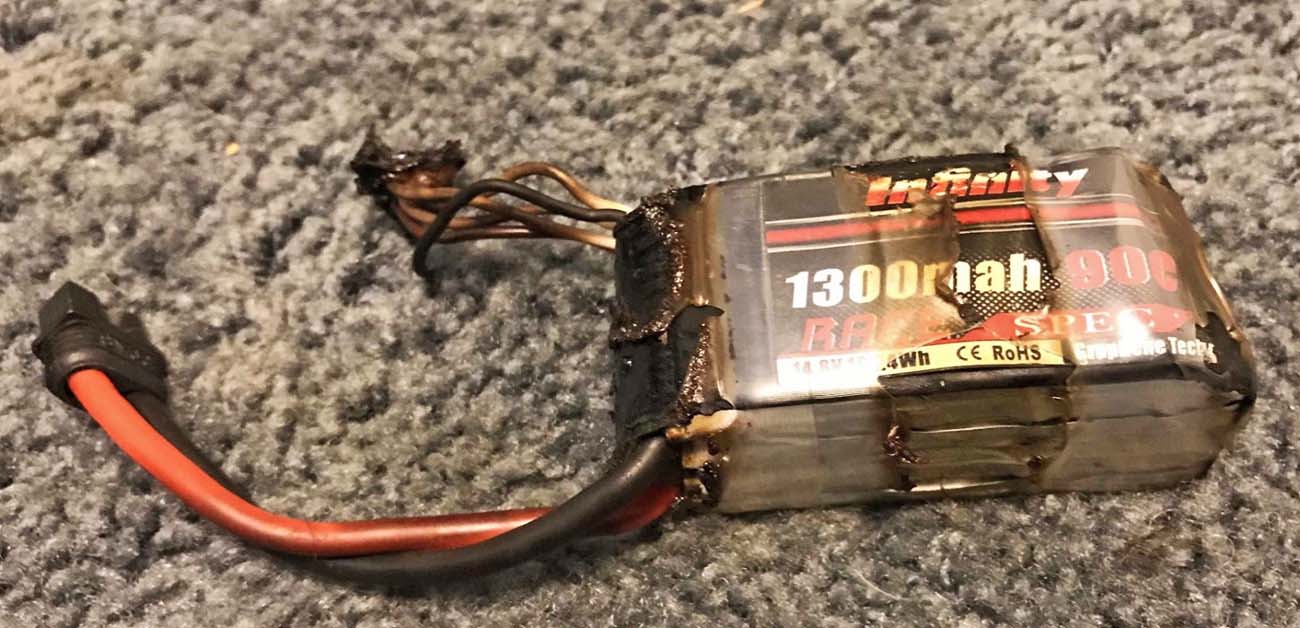
The battery that was in the drone. The label says: “Infinity, 1300 MAH, race spec”. Photo by Cameron Austin-Connolly

In March we wrote about the crash of a drone that started a 335-acre fire on the Coconino National Forest in Northern Arizona. Few details about that drone were available, except that it was about 16″ x 16″.  The comments by our readers developed a great deal of information about rechargeable batteries and the possibility of them catching fire. We also learned about several other drone crashes that started fires.

In May we published an article about the fact that electric vehicles with lithium-ion batteries present a complex and hazardous situation for firefighters responding to a vehicle accident.

The fact is, there are many examples of both lithium ion and lithium polymer batteries catching fire. There is no doubt that when a lithium ion battery is subject to an impact, a short circuit can occur in one or more of the cells, creating heat which may ignite the chemicals inside the battery. This can spread to the adjoining cells and lead to the condition known as “thermal runaway” in which the fire escalates. If as in a vehicle, there are thousands of batteries, it can be extremely difficult to extinguish the blaze. And worse, it can reignite days or weeks later.

When compact fluorescent light bulbs were introduced they saved energy but were slow to get fully bright and many people thought the color of the light was unpleasant. I knew then that it was immature lighting technology. There were going to be better options. Now LED bulbs save even more energy, come in various light temperatures (colors), and illuminate at near full brightness immediately. For now, they are expensive, but will still pay for themselves in three to five years.

Lithium ion and lithium polymer batteries are the fluorescent bulbs of battery technology. They are too heavy, don’t hold enough power, and they too often catch fire. No one wants to be on an airplane when flames erupt from an e-cigarette, cell phone, wireless headphones, or laptop computer, all of which can ignite even when turned off.

So until that next major step in battery technology occurs, what do we do about drones? Is the risk so low that we should not be concerned? When land managers enact fire restrictions during periods of high wildfire danger, do we also prohibit the use of drones? Should drones ever be allowed over vegetation in a fire-prone environment during wildfire season? And what about the hundreds of drones owned and operated by the Department of the Interior that flew 5,000 missions last year? Not all are battery operated, but some are.

We thank Mr. Austin-Connolly for providing the information, photos, and the video. When we asked, he said, “If my experience can be helpful I’m all for it.”

Thanks and a tip of the hat go out to Kelly.
Typos or errors, report them HERE.

Remembering the crews of Air Tankers 123 and 130

air tanker 130 memorial
Screenshot from the KOLO TV video.

KOLO TV has a very nice four-minute video tribute to the crew that was killed June 17, 2002 when their C-130A air tanker, Tanker 130, crashed while fighting a wildfire near Walker, California killing all three on board. It includes a short interview conducted minutes before the accident with Steve Wass, one of the pilots. The other two crew members were Craig LaBare and Mike Davis. The video has the well-known footage of the wings falling off the air tanker as it crashed just after making a drop.

A month after the crash of T-130, a P4Y-2 Privateer, T-123, crashed while maneuvering over a fire near Estes Park, Colorado. Both pilots, Ricky Schwartz and Milt Stollak were killed.

Tanker 123 crash near Estes Park, CO, July 18, 2002
Tanker 123 crash near Estes Park, CO, July 18, 2002. Credit: Matt Inden – Special to The News

The NTSB determined that the cause of both crashes was in‑flight structural failure due to fatigue cracking in the wings, and that maintenance procedures had been inadequate to detect the cracking.

These accidents changed aerial firefighting. The Forest Service banned certain models of old war birds and developed new contract specifications regarding inspections and stress monitoring. During the next ten years the large air tanker fleet atrophied, shrinking from 44 on exclusive use contracts in 2002 to 9 in 2012. Not much was done to restore the program until eight days after two pilots were killed in crashes of two P2V air tankers on the same day in 2012  — the Forest Service issued contracts for seven “next generation” air tankers manufactured in the 1980s and 1990s, taking a small step toward partially rebuilding the fleet. As the fire season began in 2018, 13 large air tankers were on federal exclusive use contracts.

memorial at Greybull, Wyoming air tanker crashes 2002
A memorial at Greybull, Wyoming for the crashes of two air tankers in 2002, T-123 and T-130.

Empty water bucket contributed to New Zealand helicopter crash

New Zealand’s Transport Accident Investigation Commission (TAIC) has determined that an empty water bucket contributed to the cause of a fatal helicopter crash on February 14, 2017.

David Steven Askin was piloting a helicopter for Way To go Heliservices working on a wildfire near Christchurch when it went down in the Port Hills.

Steve Askin
Steve Askin. Way To Go Heliservices photo.

The TAIC determined that a cable from the water bucket struck the tail of the Eurocopter AS350-BA.

The TAIC explained:

In the early afternoon, one of the helicopters, a Eurocopter AS350 ‘Squirrel’, registered ZK-HKW, crashed while the pilot was returning to the dipping pond to refill the firefighting ‘monsoon’ bucket. The helicopter was destroyed and the pilot was killed. Evidence shows that the likely cause of the crash was the empty monsoon bucket swung back into the tail rotor, damaging the tail rotor and causing the loss of the vertical stabiliser from the tail boom. After the loss of the vertical stabiliser, the helicopter gradually rolled to the right and descended until it struck the ground.

The TAIC’s investigation was aided by video from a camera mounted on the aircraft which showed the bucket swinging up toward the tail as the helicopter was enroute to a dip site.

Below is an excerpt from the Stuff website:

An abbreviated mayday call was heard by several pilots about 2.05pm, but it was not clear which radio frequency the call was made on.

The air attack supervisor asked for a role call of all aircraft involved. Askin did not respond.

After a brief search, another pilot found the wreckage of Askin’s helicopter on a steep slope near the head of a gully east of Sugarloaf.

According to TAIC’s report, the helicopter had struck a steep, tussock-covered slope. Main rotor strikes on the slope indicated the helicopter had tumbled further down the slope.

TAIC recommended several solutions, including using heavy ballast slings, and having someone monitor the operation from the ground.

Thanks and a tip of the hat go out to Chad.
Typos or errors, report them HERE.

One dead after helicopter makes emergency landing in South Korea

A firefighting helicopter crew member died Monday during operations in the Gangwon Province of South Korea.

According to The Korean Times, the man “passed out as the aircraft made an emergency landing in Samcheok.” He was pronounced deceased after he was transferred to an area hospital, and early indications suggest the helicopter was forced to land after striking a high-tension power line.

At least 60 helicopters and 10,000 people have been mobilized for firefighting efforts in three areas, and residents across the region were urged to evacuate, the Korea JoonGang Daily reported. 

Fire monitoring helicopter crashes in Russia, reportedly killing three

A helicopter used for monitoring wildfires crashed May 4 in the Russian republic of Bashkortostan, according to TASS which received information from regional emergency services. Three people were on board when it went down 30 kilometers south of the community of Inzer in the Beloretsk district. The reports are that there were no survivors.

Below is an excerpt from TASS:

The helicopter belonged to the Lightair company. The news it went missing came at 14:20 Moscow time. The helicopter had left Bashkortostan’s capital Ufa for Beloretsk. The distress signal from its emergency beacon was picked up by a satellite rescue system. The local office of the Investigative Committee has launched a probe.

Our sincere condolences go out to the family, friends, and coworkers.

Firefighting helicopter goes down in Florida lake

Marion County Sheriff Office

Above: photo by Marion County Sheriff’s Office.

A Marion County Sheriff’s Office helicopter went down in a lake during water bucket operations on a wildfire in Florida Tuesday at about 6:30 p.m. In his last radio transmission pilot Sgt. John Rawls said he was going down, then after the helicopter rolled over at least once he exited the ship and swam about 50 yards to shore.

Only the tip of one rotor blade sticking out of the water is visible at the lake now, according to officials. The Sheriff’s Office said the helicopter experienced a malfunction as it was refilling the water bucket.

The Florida Forest Service and Marion County Fire Rescue assisted Sheriff deputies in making a path to the lake with heavy equipment in order to reach the pilot. Sgt. Rawls was transported to the hospital and is currently in stable condition.

The NE 212th Street Road fire is in Marion County, Florida about 20 miles northeast of Ocala. It has been burning for about a month.

map fire helicopter crash florida
Map showing the approximate location of the fire that the helicopter was working on when it crashed.

Sgt. Rawls has been with the Marion County Sheriff’s Office since 1998. He is also an Army helicopter pilot veteran who served during Operation Iraqi Freedom.

“Our pilot is OK and, though he does have some injuries, he should be fine,” said Sheriff Billy Woods. “The Marion County Fire Rescue and the Florida Forest Service did an outstanding job in helping us get to our pilot out there in order to get him to the hospital, and I want to thank each of them for the services that they provided to us. We are extremely grateful to everyone who worked tirelessly to make sure Sgt. Rawls got the emergency care he needed.”

Firefighting pilot killed in New Zealand helicopter crash

A helicopter pilot was killed February 14 while working on a fire in New Zealand. David Steven Askin was flying the aircraft at a wildfire when it went down in Christchurch’s Port Hills.

Mr. Askin was a pilot and instructor for Way To Go Heliservices, a company based in Rangiora, New Zealand.

Steve Askin
Steve Askin. Way To Go Heliservices photo.

Previously he had been a member of New Zealand’s Special Air Service, a special forces unit of the Army.  He served in Afghanistan and was wounded in a firefight with the Taliban after his unit came to the aid of Afghan police when they were attacked at the InterContinental Hotel in Kabul in a five-hour battle.

Police, the Civil Aviation Authority, and the Transport Accident Investigation Commission are investigating the crash.

There are reports that 15 helicopters were fighting the recent wildfires near Christchurch that have burned 600 hectares (1,483 acres).

Our sincere condolences go out to Mr. Askin’s family, friends, and coworkers.

Thanks and a tip of the hat go out to Chris.

Typos or errors, report them HERE.