Two killed when helicopter crashes while working on a prescribed fire in Mississippi

(UPDATED at 9:55 a.m. CDT, March 31, 2015)

A helicopter crashed in southern Mississippi on March 30, 2015, killing two people who were working on a prescribed fire. Mario Rossilli, spokesperson for the U.S. Forest Service, said one of the deceased worked for the USFS and the other was the pilot of the helicopter under contract with the USFS. The person that was injured was also a USFS employee. Their names have not been released.

This video has a little more information than the one we posted on Monday.

WLOX.com – The News for South Mississippi

****

Originally published at 9:03 p.m. CDT, March 30, 2015 Two people were killed and one was injured March 30 when a helicopter crashed while working on a prescribed fire on the Desoto National Forest in southern Mississippi. Below is an excerpt from NBC news: 

The helicopter, a Bell 206L-1, went down about 3 p.m. (4 p.m. ET) near Saucier, about 25 miles northwest of Biloxi, the National Transportation Safety Board confirmed. The NTSB said it would lead the investigation. “We do have two confirmed fatalities,” Harrison County Fire Chief Pat Sullivan told reporters. The third crew member was airlifted to the University of South Alabama Medical Center in Mobile, he said. The men were contract workers who were monitoring a controlled burn of about 800 acres in De Soto National Forest, authorities said.

  From WLOX:

An eyewitness told WLOX News he saw the chopper working the fire, and could tell something didn’t seem right. “The helicopter was circling around the fire and within the next couple of minutes I saw it. It was landing on purpose, but it sounded like a little maybe in distress. But then shortly there after a rescue came in and was wanting to know how to get back there,” said Earnest Richardson Junior. “You could tell something was wrong at the end of it, but I didn’t know it was that bad. It kinda looked like he was almost landing for a minute. But like I said, I’m not sure because it circled around the fire. I thought maybe he was trying to land.”

Our sincere condolences go out to their families and co-workers.

Thanks and a tip of the hat go out to Kevin.

Helicopter pilot killed in crash in South Africa

South African Police ServiceThe South African Police Service issued the following statement about the firefighting helicopter pilot that died in the line of duty while working on a fire Saturday, March 7:

****

“Western Cape Provincial Commissioner, Lieutenant General Arno Lamoer has conveyed his sincere condolences on the passing of Colonel Hendricks Willem Marais who died when his helicopter crashed while water bombing a fire in the Cape Point Nature Reserve.

Colonel Marais worked as the first unit commander of the South African Police Service’ Airwing in Cape Town. He retired in 2004 at the age of 60. His former colleagues described him as a remarkable human being who was always prepared to help others. Colonel Marais was sworn in to the SAPS in 1990.

Lt General Lamoer remembers Col Marais as a pilot with strong work ethic, who was dedicated to his work. “He was affectionately called Bees and trained a number of police members with the Airwing environment. What an incredible human being he was. You could not miss his positive spirit. Our thoughts and prayers are with his wife, family and colleagues. He will be sorely missed. On behalf of the SAPS family we say may his Soul rest in peace.”

****

Our sincere condolences go out to Colonel’s family and co-workers.

MAFFS pilot talks about landing without a nose wheel

MAFFS hard landing
The MAFFS 3 air tanker experienced a hard landing at Hill Air Force Base, Utah, Aug. 17, 2014 following an in flight emergency. There were no injuries and only minor damage to the aircraft. Photo supplied by Hill AFB, Utah. (click to enlarge)

More details are coming to light regarding the Modular Airborne FireFighting System C-130 that landed August 17 without the nose wheel fully extended.

Maj. Derik George, a C-130 pilot with the Air Force Reserve Command’s 302nd Airlift Wing was part of the crew that recently received the Air Mobility Command Chief of Safety Aircrew of Distinction Award for their efforts following a landing gear malfunction while fighting fires in southern Utah.

The MAFFS C-130 crew was attempting to land at Hill Air Force Base, Utah after conducting aerial firefighting missions in southern Utah Aug. 17, 2014 when Maj. Jack Berquist, aircraft commander, and George, co-pilot, realized the nose landing gear was not functioning properly.

“As we were approaching to land, Maj. Berquist, who was flying, asked for the gear down. After lowering the landing gear we got an unsafe gear indication in the nose,” said George.

The crew stayed in the traffic pattern at Hill and started on their emergency procedures. There are three ways to get the nose landing gear down but none of them worked. They called a Lockheed Martin engineer and test pilot but neither call fixed the problem. The U.S. Forest Service sent a lead plane to see if that pilot could determine what was wrong from flying underneath the aircraft, but again, nothing helped. After more than three hours of circling the airfield, the crew determined they had no other choice but to attempt a landing.

“At that point we said, ‘well, we are out of options, we are just going to land with the nose gear up.’ We called the tower, and they were able to put foam on the runway, that way it would arrest any fire that might start. We ran our checklists again, making sure we hadn’t forgotten anything. Jack Berquist was flying, he did a fantastic job. I don’t think he could’ve done any better. He held the nose up as long as possible and was able to get the nose on the ground in the foam,” said George.

The aircraft came to a stop and the tower let the crew know a small fire started under the nose. The crew shut everything down and egressed to a safe area. The emergency crews on the ground quickly put the fire out.

“The most rewarding thing of the whole day was how well the crew worked together,” said George, who has nearly 1,500 C-130 and more than 3,700 total flight hours. “The navigator was Active Duty, I was a Reservist. The other four crew members were Wyoming Air National Guard. It was very seamless. Everybody knew exactly what to do. MAFFS crews are some of the most highly experienced and best trained crews in the Air Force.”

The efforts by the MAFFS 3 crew resulted in the safe return of six airmen and only minor damage to a $37 million aircraft.

“Other than the fact that there was a mechanical malfunction, which is pretty rare, there was nothing that surprised me about this event. We look for top notch people, we train hard. They tried ‘A,’ they tried ‘B,’ they tried ‘C,’ and they ended up having to do ‘D,'” said Lt. Col. Luke Thompson, 302nd AW chief of aerial firefighting. “It all worked, just the way it should have.”

Besides Berquist, Goebel and George, the other crew members were flight engineer Tech. Sgt. Damian Hoffmann, and load masters, Master Sgts. Brandon York and Christian Reese.

Four C-130 wings perform the MAFFS mission, each providing two MAFFS-capable aircraft and the air and ground crews needed to operate them. They are the 145th Airlift Wing, North Carolina Air National Guard; 146th Airlift Wing, California Air National Guard; 153rd Airlift Wing, Wyoming Air National Guard; and the 302nd Airlift Wing, Air Force Reserve Command, in Colorado.

Helicopter crashes into New Zealand river

Helicopter crash Marlborough Fire New Zealand
A helicopter crashed while fighting a fire near Marlborough in New Zealand. Photo from Radio New Zealand.

A firefighting helicopter crashed into a river February 5 while attempting to fill a water bucket in a swift current.

Below is an excerpt from an article at Radio New Zealand:

A helicopter battling the Marlborough blaze crashed into the Wairau River about 11am, leaving the pilot in a stable condition in Wairau Hospital. The 47-year-old local pilot was refilling a monsoon bucket from the Wairau River at about 11am when the chopper went down, landing in shallow water. He was not seriously injured and was able to walk out of the wreckage.

Precision Helicopters chief pilot Matt Newton said the pilot was about 3m about the river when he got into trouble.

“Yeah, he just was loading the bucket out of the river and the river was flowing pretty fast and it pulled the bucket back and one of the ropes hooked around the back of his skid and he couldn’t keep up with it,” he told Checkpoint.

“It was just unfortunate but very lucky that he’s okay, that’s the main thing. We’re just grateful.”

Mr Newton said the pilot tried to untangle the rope but the strong river current dragged the bucket downstream and pulled the helicopter to the ground.

The crash scene is about 300m from the edge of the fire at Onamalutu, which has a perimeter stretching 11km.

There is a report that the helicopter was a Hughes 369HS.

The video below has a couple of still images of the helicopter. Even though the second annoying pop-up does not have a visible “X” which will remove it, hover your mouse over the box and the “X” will appear.

Another wildfire in New Zealand, west of Blenheim, was fought by 11 helicopters and 60 firefighters on the ground, according to a report by Radio New Zealand..

Note from Bill: I would be curious to hear any advice from helicopter pilots about filling a water bucket in a river with a swift current. Is there a safe way to do it? Is the length of the line an important factor in that situation? Have you ever tried to fly along with the current, or is that safe?

Thanks and a tip of  the hat go out to Nate.

Summary of air tanker use, 2014

There were more requests for large air tankers (LATs) in 2014 than in any of the last 18 years. That is one of the facts in the 2014 version of the Wildland Fire Summary and Statistics put together by the National Interagency Fire Center.

We used data from the report to update statistics that we have been collecting over the years, including the chart below.

Graph, request for large air tankers

One of the more interesting trends is the number of requests for LATs that cannot be filled, referred to as Unable to Fill, or UTF. After reaching a high of 48 percent in 2012, it declined to 21 and then 12 percent in the next two years even as the number of requests for LATs was increasing.

One thing we don’t know is how many Incident Commanders needed air tankers but didn’t bother to request them because they knew that none were available.

Acres burned in wildfires

Two stats for 2014 indicate there would be a reduced urgent need for air tankers. The number of acres burned in the 48 contiguous states in 2014, 3.4 million, was significantly below the 10 year average of 5.7 million. And the number of structures burned, 1,953 was less than the 10 year average of 3,098.

At the beginning of 2014 there were 10 LATs on exclusive use contracts. By the end of the year there were 17 — eight were added and Minden’s P2V had a landing gear problem (see below) which took it out of service indefinitely. The additional air tankers on exclusive use contracts included:

  • 2 RJ-85s from Aero Flite;
  • 2 MD-87s from Erickson Aero Tanker;
  • 1 DC-10 from 10 Tanker Air Carrier; and
  • 3 BAe-146s from Neptune

In the list of eight additional air tankers listed above, the DC-10 and the three BAe-146s were brought into service as “additional equipment” on a 1-year temporary basis under an exclusive use contract awarded in 2013. Due to a change in Department of the Interior procurement policies, this will not be done again in 2015.

Minden was awarded a Next-Gen contract for a BAe-146 in 2013, but never delivered the aircraft. Recently the USFS terminated the contract for default.

MAFFS 3 hard landing
The MAFFS 3 air tanker experienced a hard landing at Hill Air Force Base on August 17. There were no injuries. Photo supplied by the Air Force, originally from Fox 13.

One air tanker was borrowed in 2014 from Canada for 10 days. Saskatchewan provided a Convair 580 and a TurboCommander 690 Bird Dog beginning on July 21. The air tanker group was in place until July 30, when it returned to Canada following a recall from Saskatchewan due to increased fire activity there.

Two Modular Airborne FireFighting System aircraft, C-130s from the military, were activated on July 20 and positioned at Boise. MAFFS 3 experienced a hard landing at Hill AFB when they had a problem with the nose landing gear. While no injuries occurred, the damage ended the service of MAFFS 3 for 2014, but MAFFS1 remained until August 24. MAFFS units provided retardant delivery to the Great Basin, Northwest and Northern Rocky Geographic Areas while employed from July 20 through August 24, delivering a total of 244,406 gallons while conducting 97 sorties. This is down from 2013 when 576 sorties were flown delivering 1,387,881 gallons of retardant.

Other notable aircraft mishaps or crashes in 2014:

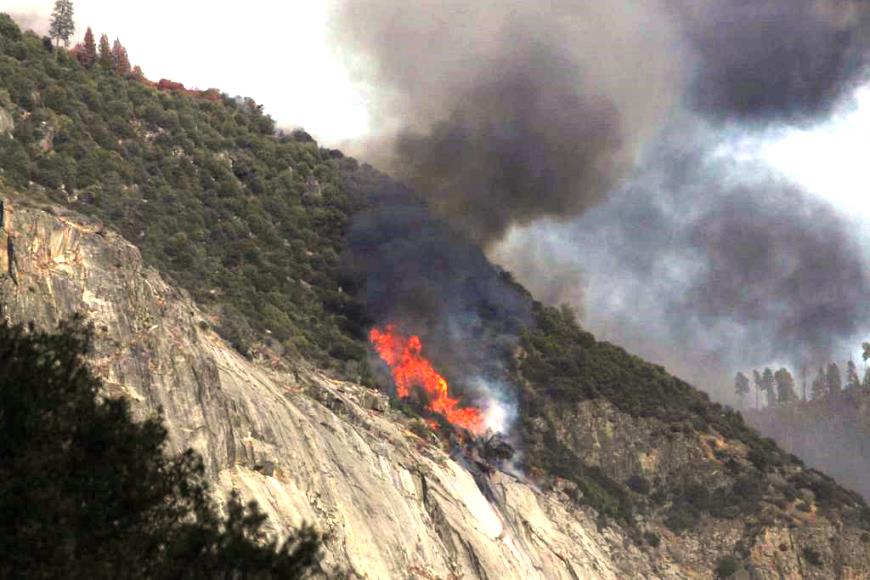
  • Pilot Geoffrey “Craig” Hunt was killed when his S-2T air tanker impacted the ground while he was attempting to make his second retardant drop on the Dog Rock Fire October 7 near Yosemite National Park in California.
  • An air attack fixed wing aircraft, an Aero Commander 500, overshot the runway while landing at Wilcox, AZ on July 2.
  • Tanker 73, one of CAL FIRE’s 23 S-2Ts, had a problem while landing at Hemet-Ryan Airport Friday, October 3 in southern California. The preliminary information indicated that it was a landing gear issue.
  • A Bell 206-L3 made a crash landing into a river May 29 while recertifying for water bucket operations near Missoula, Montana.
  • On June 15, Minden’s P2V, Tanker 48, was substantially damaged when the nose wheel landing gear collapsed during landing roll at the Fresno Yosemite International Airport (FAT), Fresno, California.
  • On October 4 an air attack aircraft ran off the runway at Nevada County Airport near Grass Valley, California.
  • An air attack plane under contract to the Department of the Interior crashed May 17 at Fort Huachuca, Arizona. The Rockwell Aero Commander 500S impacted the ground shortly after takeoff. The aircraft was on an orientation flight for a new pilot on the air attack contract. Two company employees, but no agency personnel, were on board. There was an unconfirmed report that one person died several days later.

NTSB report on the crash of Tanker 11

Air Tanker 45
Air Tanker 45, similar to Tanker 11, on final to drop on the Whoopup Fire near the South Dakota/Wyoming state line in 2011. Photo by Bill Gabbert.

The National Transportation Safety Board probable cause report on the June 3, 2012 crash of Tanker 11 concluded that while preparing to drop retardant on the White Rock fire near the Utah/Nevada state line, the flight crewmembers “did not properly compensate for the wind conditions while maneuvering”. The aircraft impacted the ground before it reached the location for the intended drop, causing the death of pilots Todd Tompkins and Ron Chambless.

A photographer got some pictures of the tanker as it was attempting to make the drop (below). It is likely that the pilots jettisoned the retardant when it became obvious they were too low.

tanker 11 crash
Tanker 11 before the crash. Photo from NTSB.

The P2V, operated by Neptune Aviation, was about to make its second drop on the fire that day. Shortly before the crash it made a dry run over the target area, then when lining up for the drop on the next pass took a different path, which was lower, and made a wider right turn, according to the report.

T11 flight pathThe same day that Tanker 11 crashed, another P2V, Tanker 55 operated by Minden, had a mechanical failure and landed at Minden, Nevada with a main landing gear not fully extended. The aircraft was heavily damaged, but there were no serious injuries. The landing was recorded on video.

In June of this year Tanker 48, another Minden P2V, landed with a collapsed nose gear. Thankfully there were no reported injuries.

We covered the 2012 accidents on Wildfire Today (before Fire Aviation was created).

On June 26, 2010 air tanker 44, a P2V operated by Neptune Aviation also experienced a hydraulic failure upon landing, had no brakes, and went off the runway at Rocky Mountain Metropolitan Airport (JeffCo) in Colorado (map). Both pilots self-evacuated and were walking around when the fire apparatus arrived to put out a fire in one of the engines. Neptune repaired the aircraft and put it back into service.

The NTSB released a nine-page Factual Report on the crash of Tanker 11. Below is the complete text of the one-page probable cause report, released September 24, 2014:

****

14 CFR Public Use
Accident occurred Sunday, June 03, 2012 in Modena, UT
Probable Cause Approval Date: 09/24/2014
Aircraft: LOCKHEED P2V-7, registration: N14447
Injuries: 2 Fatal.

NTSB investigators either traveled in support of this investigation or conducted a significant amount of investigative work without any travel, and used data obtained from various sources to prepare this public aircraft accident report.

Tanker 11 departed the tanker base to conduct its second fire retardant drop of the day in the same location. Upon arriving in the fire traffic area, Tanker 11 followed the lead airplane into the drop zone, which was located in a shallow valley 0.4 mile wide and 350 feet deep. The lead airplane flew a shallow right turn onto final and then dropped to an altitude of 150 feet above the valley floor while approaching the intended drop zone. While making the right turn onto final behind the lead airplane, Tanker 11’s right wing tip collided with terrain, which resulted in a rapid right yaw and subsequent impact with terrain. The wreckage created a 1,088-foot-long debris field, and a postimpact fire ensued.

Two witnesses took photographs of the accident sequence photos, and an examination of these photographs showed that the lead airplane was positioned ahead of the tanker throughout the flight; however, the orientation of the lead airplane compared to the orientation of Tanker 11 indicated that Tanker 11 did not directly follow the lead airplane’s path to the final drop course. Rather, it was about 700 feet left of the lead airplane’s path and made a wider right turn as it attempted to align with the final drop course. The accident flight crewmembers had previously flown nearly the same exact drop and the lead pilot cautioned them about tailwind conditions during the flight; however, the wider turn suggests that they did not properly compensate for the wind conditions while maneuvering. In addition, the previous flight was conducted at an altitude above the ridgeline. GPS evidence indicates that the accident flight was conducted below the ridgeline, which would have made it more difficult to detect the rising terrain during the wider turn. A review of the airplane’s cockpit voice recorder audio information revealed that the flight crew did not recognize or attempt to correct the reduced clearance between Tanker 11 and the rising terrain until about 2 seconds before impact.

The National Transportation Safety Board determines the probable cause(s) of this accident as follows:

  • The flight crew’s misjudgment of terrain clearance while maneuvering for an aerial application run, which resulted in controlled flight into terrain. Contributing to the accident was the flight crew’s failure to follow the lead airplane’s track and to effectively compensate for the tailwind condition while maneuvering.


NTSB: S-2T that crashed may have struck a tree

S-2T air tanker crash
Site of the S-2T air tanker crash. Photo by Ken Yager.

In a preliminary report that was released Tuesday night, the National Transportation Safety Board said the S-2T air tanker that crashed near Yosemite National Park in California on October 7 may have struck a tree which broke off a part of the aircraft’s wing.

Two other firefighting aircraft were in the area at the time. A lead plane preceded the air tanker into the drop area but that pilot did not see the crash. However the crew of an air attack ship overhead did, and they told the NTSB that the S-2T may have struck a tree, causing part of a wing to break off.

Both aircrews reported that there was smoke in the area, but visibility was good.

The air tanker was stationed at the air tanker base at Hollister, California, and had been dispatched to the Dog Rock fire. The airplane arrived on scene, made one drop on the fire, then proceeded to the Columbia Airport to be reloaded with fire retardant before it returned and made its final flight. Pilot Geoffrey “Craig” Hunt died in the accident.

A resident in the area of the crash site told us that locals took quite a few photos and a video that will help the NTSB’s investigation. They are unwilling to release the imagery to the public until after the investigation is complete.

It will be many more months before the NTSB releases their final report.

CAL FIRE Director Ken Pimlott issued the following statement regarding the NTSB’s preliminary information on the crash.

“Aerial firefighting is not simply flying from one airport to another. The wildland firefighting environment is a challenging one, both on the ground and in the air,” said Chief Ken Pimlott, director of CAL FIRE. “We look forward to the final NTSB report to see if we can use the findings to help mitigate the inherent dangers of the job. We owe that to Craig, who traded his life in an effort to protect the lives of others.”

NTSB has tentatively ruled out mechanical issues as cause of T-81 crash

CAL FIRE Director Ken Pimlott
CAL FIRE Director Ken Pimlott addresses the media on October 10, 2014, concerning the status of the investigation into the crash of Tanker 81 on October 7. On the left in the white shirt is NTSB investigator Josh Cawthra. Over Director Pimlott’s right shoulder is CAL FIRE Chief Pilot Bill Payne.

In a press conference on Friday an investigator for the National Transportation Safety Board said they have tentatively ruled out mechanical issues as the primary cause of the October 7 crash of the air tanker on the Dog Rock Fire near Yosemite National Park in California.

Pilot Geoffrey “Craig” Hunt was killed when the S-2T air tanker impacted the ground while he was attempting to make his second retardant drop on the fire.

NTSB investigator Josh Cawthra said that while it is early in the investigation which will take six to eight months to complete, mechanical or fatigue issues do not appear to be factors in the crash. In addition, he said they have received no reports of turbulence in the drop area. They expect to have a preliminary report available on the NTSB website within about five days.

The investigators began by conducting an aerial recon over the crash site to become familiar with the very steep terrain and the extent of the debris field. After the fire activity had diminished, they documented it from the ground.

The team has completed the on-scene portion of the investigation but they still need to recover, reconstruct, and examine some portions of the wreckage which are scattered over an area about 1/4 mile long. There is still some active fire in the area, and they will be working with CAL FIRE and the National Park Service to remove the aircraft parts after the fire has cooled down.

The investigators will be looking at “man, machine, and the environment”, Mr. Cathra said, and:

This accident is extremely tragic. We have a community that was threatened by a wildland fire, there were evacuations being done. These pilots put their life on the line. They were out there in a very — it’s a controlled environment, but yet there is also an amount of risk. And it is something that affects everybody as a whole. We get to know these pilots as well throughout the year. Our primary mission with the NTSB is to figure out what happened, why it happened, and how we can prevent this from ever occurring again.

Director Ken Pimlott said beginning today, Friday, CAL FIRE will start transitioning their tanker pilots back into their aircraft, after having been grounded since immediately after the accident. Each of them will be evaluated, but some, he said, will require more time to deal with the tragedy than others.

He recognized and thanked the U.S. Forest Service for providing air tankers to cover the state of California while the 22 remaining S-2Ts were not available. Providing that coverage was made less complicated by the lack of wildfire activity in the rest of the United States.

In the video of the press conference below, the people you will see, in the order of  appearance, are:

  1. Daniel Berlant, CAL FIRE Information Officer
  2. Ken Pimlott, CAL FIRE Director
  3. Josh Cawthra, NTSB Investigator
  4. Bill Payne, CAL FIRE Chief Pilot, and
  5. Daniel Berlant, CAL FIRE Information Officer

FAA releases preliminary cause of S-2T crash

Geoffrey "Craig" Hunt
Geoffrey “Craig” Hunt. Image courtesy of Mr. Hunt’s family.

The Federal Aviation Administration’s web site lists the preliminary cause of the crash of Tanker 81, an S-2T, as a “wing striking a tree”. That is consistent with information we have from witnesses of the accident.

The Fresno Bee reported that Keith Halloway, a spokesman for NTSB which is the lead investigating agency, said Wednesday evening that the board may have a preliminary report next week, but determining a probable cause for the crash could take 12 to 18 months.

The pilot of the S-2T that died in the air tanker crash on October 7 was Geoffrey “Craig” Hunt, age 62, of San Jose. He was a 13-year veteran pilot with DynCorp International which has the contract to maintain and operate the 23 S-2T air tankers for CAL FIRE. Mr. Hunt was attempting to drop retardant on the Dog Rock Fire near Yosemite National Park in California when the accident occurred.

More information:

Geoffrey "Craig" Hunt
Geoffrey “Craig” Hunt. Photo courtesy of Mr. Hunt’s family.

Pilot in Yosemite crash identified

crash site
The crash site a few minutes after impact. Much of the wreckage fell down the rock face, with some of it landing on the highway below. Photo by Ken Yager.

The pilot of the S-2T that died in the air tanker crash on October 7 has been identified as Geoffrey “Craig” Hunt, age 62, of San Jose. He was a 13 year veteran pilot with DynCorp International. DynCorp has the contract to maintain and operate the 23 S-2T air tankers for CAL FIRE. Mr. Hunt was attempting to drop retardant on the Dog Rock Fire near Yosemite National Park in California when the accident occurred.

Geoffrey "Craig" Hunt.
Geoffrey “Craig” Hunt.

“We continue to mourn the tragic loss of Craig,” said Chief Ken Pimlott, CAL FIRE director. “We know wildland firefighting is an inherently dangerous job, but Craig made the ultimate sacrifice.”

“Our thoughts and prayers are with Craig’s family during this difficult time,” said Jeff Cavarra, program director for DynCorp.

Mr. Hunt’s body was watched over Tuesday night by fire and rescue personnel and was recovered Wednesday morning. A National Park Service honor guard then transferred Mr. Hunt to CAL FIRE personnel.

Immediately after the crash, CAL FIRE grounded their remaining air tankers, which is standard procedure after a serious accident.

A graphic photo of the flaming wreckage falling down the steep slope has been posted at a rock climbing forum.

The S-2T air tanker, registration number N449DF, was designated Tanker 81, one of 23 S-2Ts that are maintained and flown by DynCorp for CAL FIRE. The agency also has one spare that is used to fill in as needed when an aircraft is undergoing maintenance. CAL FIRE hires their own pilots for their 11 UH-1H Super Huey helicopters, but they are also maintained by DynCorp.

The last time a CAL FIRE air tanker crashed was in 2001, when two tankers collided while fighting a fire in Mendocino County, killing both pilots, Daniel Berlant, spokesperson for CAL FIRE said.

The agency had another plane crash in 2006, when a battalion chief and a pilot were killed in the crash of an air attack plane in Tulare County.

The S-2 first flew in 1952 and the U.S. Navy discontinued the use of them in 1976. They were used for detecting enemy ships and submarines and for dropping torpedoes. The ones currently being used by CAL FIRE were converted from piston to turbine engines between 1999 and 2005. Some media outlets are incorrectly reporting that the Tanker that crashed on Tuesday was built in 2001. That may be the date that it was converted to turbine engines and was given the new model name S-2F3 Turbo Tracker. They are now commonly referred to as S-2T, with the “T” standing for turbine engine.

More information about the crash and the Dog Rock Fire is at Wildfire Today.

Our sincere condolences go out to the family, friends, and coworkers of Mr. Hunt.