Smokejumper aircraft, Short Bros SD3-60 Sherpa, N145Z
Dylan Phelps sent us these photos that he captured at various Northern California airports in the first part of September as our firefighters were going up against one of the most vicious wildfire seasons on record.
Thanks Dylan!
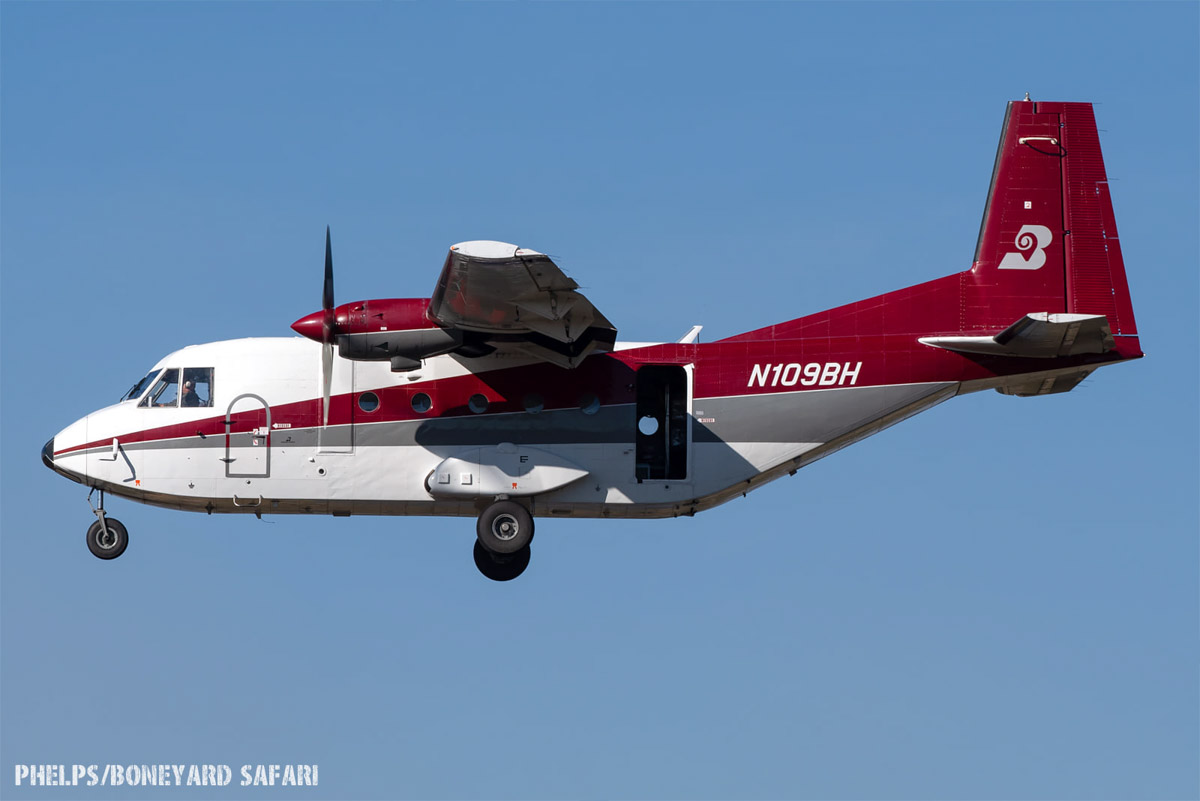
T-103, MD-87, N293EA, Photo by Dylan Phelps Smokejumper aircraft, Construcciones Aeronauticas C-212-CC, N109BH, photo by Dylan Phelps SEAT, Air Tractor AT-802A, N349AS, Photo by Dylan Phelps MAFFS 1, C-130, photo by Dylan Phelps MAFFS 6, C-130, photo by Dylan Phelps Fire retardant mixing plant, photo by Dylan Phelps T-52, Convair CV-580, C-FKFA, photo by Dylan Phelps
Above: MAFFS 1, normally based at Cheyenne, on approach at Fresno International Airport August 5, 2017. Photo by L.S. Braun.
(Originally published at 7:40 p.m MDT August 6, 2017)
L.S. Braun took photos of all three Modular Airborne FireFighting System (MAFFS) aircraft that are currently activated. The C-130’s were approaching Runway 29R at Fresno International Airport on August 5.
Thanks L.S. Braun!
C-130’s can be converted temporarily to a 3,000-gallon air tanker in a few hours by installing the MAFFS unit. In the United States they are used in a surge capacity when additional air tankers are needed to supplement the existing contracted aircraft.
MAFFS 5, based at Colorado Springs, but is seen landing at Fresno, August 5, 2017. Photo by L.S. Braun. MAFFS 8, based at Reno, but is seen landing at Fresno, August 5, 2017. Photo by L.S. Braun.
There were more requests for large air tankers (LATs) in 2014 than in any of the last 18 years. That is one of the facts in the 2014 version of the Wildland Fire Summary and Statistics put together by the National Interagency Fire Center.
We used data from the report to update statistics that we have been collecting over the years, including the chart below.
One of the more interesting trends is the number of requests for LATs that cannot be filled, referred to as Unable to Fill, or UTF. After reaching a high of 48 percent in 2012, it declined to 21 and then 12 percent in the next two years even as the number of requests for LATs was increasing.
One thing we don’t know is how many Incident Commanders needed air tankers but didn’t bother to request them because they knew that none were available.
Two stats for 2014 indicate there would be a reduced urgent need for air tankers. The number of acres burned in the 48 contiguous states in 2014, 3.4 million, was significantly below the 10 year average of 5.7 million. And the number of structures burned, 1,953 was less than the 10 year average of 3,098.
At the beginning of 2014 there were 10 LATs on exclusive use contracts. By the end of the year there were 17 — eight were added and Minden’s P2V had a landing gear problem (see below) which took it out of service indefinitely. The additional air tankers on exclusive use contracts included:
2 RJ-85s from Aero Flite;
2 MD-87s from Erickson Aero Tanker;
1 DC-10 from 10 Tanker Air Carrier; and
3 BAe-146s from Neptune
In the list of eight additional air tankers listed above, the DC-10 and the three BAe-146s were brought into service as “additional equipment” on a 1-year temporary basis under an exclusive use contract awarded in 2013. Due to a change in Department of the Interior procurement policies, this will not be done again in 2015.
Minden was awarded a Next-Gen contract for a BAe-146 in 2013, but never delivered the aircraft. Recently the USFS terminated the contract for default.
The MAFFS 3 air tanker experienced a hard landing at Hill Air Force Base on August 17. There were no injuries. Photo supplied by the Air Force, originally from Fox 13.
One air tanker was borrowed in 2014 from Canada for 10 days. Saskatchewan provided a Convair 580 and a TurboCommander 690 Bird Dog beginning on July 21. The air tanker group was in place until July 30, when it returned to Canada following a recall from Saskatchewan due to increased fire activity there.
Two Modular Airborne FireFighting System aircraft, C-130s from the military, were activated on July 20 and positioned at Boise. MAFFS 3 experienced a hard landing at Hill AFB when they had a problem with the nose landing gear. While no injuries occurred, the damage ended the service of MAFFS 3 for 2014, but MAFFS1 remained until August 24. MAFFS units provided retardant delivery to the Great Basin, Northwest and Northern Rocky Geographic Areas while employed from July 20 through August 24, delivering a total of 244,406 gallons while conducting 97 sorties. This is down from 2013 when 576 sorties were flown delivering 1,387,881 gallons of retardant.
Other notable aircraft mishaps or crashes in 2014:
Pilot Geoffrey “Craig” Hunt was killed when his S-2T air tanker impacted the ground while he was attempting to make his second retardant drop on the Dog Rock Fire October 7 near Yosemite National Park in California.
Tanker 73, one of CAL FIRE’s 23 S-2Ts, had a problem while landing at Hemet-Ryan Airport Friday, October 3 in southern California. The preliminary information indicated that it was a landing gear issue.
A Bell 206-L3 made a crash landing into a river May 29 while recertifying for water bucket operations near Missoula, Montana.
On June 15, Minden’s P2V, Tanker 48, was substantially damaged when the nose wheel landing gear collapsed during landing roll at the Fresno Yosemite International Airport (FAT), Fresno, California.
An air attack plane under contract to the Department of the Interior crashed May 17 at Fort Huachuca, Arizona. The Rockwell Aero Commander 500S impacted the ground shortly after takeoff. The aircraft was on an orientation flight for a new pilot on the air attack contract. Two company employees, but no agency personnel, were on board. There was an unconfirmed report that one person died several days later.
In addition to the news about the MD-87 and DC-10 air tankers we posted on Sunday (and updated today), there is also news about four or five other models of air tankers.
RJ-85s
Aero Flite’s two RJ-85s are now fully qualified and on contract. They are tankers 160 and 161, both piloted by initial attack qualified crews.
CV-580
Three CV-580s are in the lower 48 on loan from the state of Alaska. There was one more and a birdog that was borrowed from Canada, but they returned last week.
MAFFS
Last week the two C-130 Modular Airborne FireFighting System (MAFFS) at the Channel Islands National Guard base in California were activated by the governor of California to help deal with wildfires in the northern part of the state. Two MAFFS from Cheyenne, Wyoming (MAFFS 1 & 3) had previously been activated and have mostly been working out of Boise, but last weekend their temporary home was the tanker base at Helena Regional Airport in Montana.
MAFFS 1 and 3 at Helena Regional Airport last weekend. Photo by Jeff Wadekamper.
On August 1, 17 California National Guard helicopters were also activated to assist with the fires in the state.
CL-215/415
The CL-415 and the two CL-215s late last week were working out of Deer Park Washington.
MAFFS aircraft at Cheyenne, April 30, 2014, MAFFS numbers 0, 1, and 3
Yesterday I visited the Wyoming Air National Guard facility at Cheyenne Regional Airport during the annual training and certification/recertification for the Modular Airborne FireFighting System (MAFFS) units from Cheyenne, Wyoming and Charlotte, North Carolina. Each unit supplies two C-130H3 aircraft that can carry the 3,000-gallon fire retardant system when they are needed to help suppress wildfires, supplementing the United States’ atrophied fleet of large air tankers which has declined from 44 in 2002 to 9 this year.
The training includes classroom and airborne sessions, actually dropping, in this case, water, however, very strong winds required cancellation of the practice drops Wednesday. They hope the weather improves so they can get off the ground today.
Lt. Col. Alan Brown of the Wyoming Air National Guard stands at the rear of a MAFFS unit inside a C-130H3. Loadmasters sit in the two chairs to the right of Col. Brown. The retardant is pumped out of the pipe in the lower half of the orange paratroop door. The upper pipe in the door allows outside air to enter the tank as the retardant exits, if compressed air is not used to push the retardant out of the tank. Lt. Col. Alan Brown, of the Wyoming Air National Guard, is seen near the two air compressors at the front end of a MAFFS unit. If the compressors are working properly, which is not always the case, it takes about 30 minutes to refill the two compressed air tanks, which push the retardant out of the tanks. A specially-built ground-based air compressor sometimes meets the MAFFS aircraft at their temporary base and can refill the tanks in about 14 minutes. Lt. Col. Alan Brown of the Wyoming Air National Guard holds a MAFFS retardant release control.
In the photo above and the video below, Lt. Col. Alan Brown of the Wyoming Air National Guard shows and explains how a hand-held control can be used by the loadmasters in a Modular Airborne FireFighting System (MAFFS) air tanker to release the 3,000 gallons of fire retardant, if for some reason the pilots, who normally trigger the release with an identical controller, are unable to perform that function. The video was filmed by Bill Gabbert for FireAviation.com on April 30, 2014 in Cheyenne, Wyoming. Continue reading
Photos taken by Tech Sgt. Jeffrey Allred at Boise July 28, 2013 of two Modular Airborne FireFighting System (MAFFS) C-130 air tankers from the Wyoming and North Carolina Air National Guard units.