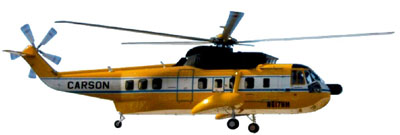
File photo of a Croman helicopter taken in 2014. This is not the helicopter that experienced the hard landing August 19, 2015. Photo by Bill Gabbert.
At approximately 7:15 p.m. PT on August 19, a Croman S-61A helicopter working on the Eldorado Fire eight miles southeast of Unity, Oregon experienced a hard landing. The incident occurred on the west portion of the fire near King Creek in the vicinity of a medical unit serving firefighters on the line.
According to the Oregon Department of Forestry (ODF), two persons were on board. When the helicopter came to rest, both exited the helicopter and signaled that they were unhurt by waving to the medical unit. While no significant injuries were apparent, both individuals were transported by ambulance to St. Alphonsus Ontario Medical Center for further evaluation.
Below is an excerpt from an article in the Baker City Herald:
…Gary Wiltrout, 67, of Boise, said he and his co-pilot Scott Talada, 65, of Baker City, had been flying for about six hours on Wednesday dumping water on the Eldorado fire when the engine failure occurred about 7:15 p.m.
They were taking water from a pond known as Murphy’s dip, near Highway 26 leaving Unity. Wiltrout said that up to that point, there was no indication there was anything wrong with the helicopter.“We had just picked up a bucket of water, then the engine rpm changed and we started losing altitude,” Wiltrout said. “I got rid of the water right away.”
Then, they lost an engine.
“I tried to make it out with one engine,” Wiltrout said.
The FAA reports there was “substantial damage” to the aircraft.
The helicopter has a Call When Needed contract with the U.S. Forest Service, but at the time of the accident it was working under the operational control of the ODF on one of their fires.
A single engine air tanker crashed in a lake in British Columbia Friday afternoon, July 10. The Air Tractor 802-F Fire Boss amphibious air tanker was scooping water from Puntzi Lake (map) at about 2:15 p.m. when the Conair plane had some sort of difficulty and sank. The pilot was not injured, according to Bill Yearwood with Transportation Safety Board.
Mr. Yearwood said,“We are quite familiar with the aircraft and its operation and there is no information to suggest there’s been any problems in advance of this.”
The fire that the aircraft was working on is on the west side of Puntzi Lake, about 130 kilometers (81 miles) west of Williams Lake. At the last report it had burned about 1,200 hectares (2,965 acres).
The pointer marks the location of Puntzi Lake, the site of the air tanker crash in British Columbia.
This was the 4th crash or serious incident involving a Conair single engine air tanker in the last 13 months.
An engine failure on Conair’s Air Tanker 699, an Air Tractor AT-802A, during training resulted in damage to a float upon landing. The incident occurred April 11, 2015 on Harrison Lake, BC, 33 nm NNE of Abbotsford.
A Conair Air Tractor 802-F Fireboss crashed and and sank August 14, 2014 while scooping water on Chantslar Lake in British Columbia, Canada about 30 kilometers west of Puntzi Mountain. Jeff Berry of Conair said the pilot was able to exit the Single Engine Air Tanker, but was held overnight in a hospital in William’s Lake and released Friday morning.
File photo of one of Conair’s AT-802F Fire Boss air tankers. Photo by Peter Unmuth.
The Lone Peak Hotshots are conducting a fundraising effort to build a memorial to honor the two pilots that were killed when a P2V, Tanker 11, crashed while working on the White Rock Fire near the Utah/Nevada border in 2012. The NTSB investigation concluded that Pilots Todd Tompkins and Ron Chambless died when the aircraft crashed while maneuvering to make their second drop on the fire that day.
Kris Bruington, the Superintendent of the Lone Peak Hotshot crew, sent us a message asking that we encourage our readers to help establish the memorial. Here is an excerpt from his email:
****
“On June 03, 2012, tragedy struck the fire and aviation community. The Missoula-based Tanker 11 piloted by Captain Todd Neal Tompkins, 48, of Boise, Idaho and Co-Pilot Ronnie Edwin Chambless, 40, of Boise, Idaho had been working on the east flank of the White Rock Fire on the Utah-Nevada border west of Cedar City, Utah. Tanker 11 was on approach for the second retardant drop of the day on our Division, when it crashed. Neither pilot survived.
“The crew is leading the effort to raise funds for a memorial to honor both Todd and Ronnie. We will facilitate the tribute and will provide the bulk of the hard labor necessary to install the memorial and improve the site. Two 5′ tall granite Obelisks engraved with the names of the two fallen comrades, and featuring a color image of Tanker 11 will be placed at the crash site.
“I know each year we all are asked to donate in some way to memorials and those in time of need. If you are in a position to be able to help with a monetary donation for this memorial, it would be greatly appreciated. If at the least you could pass this message on to others, that would be of tremendous help as well.
On June 16, 2015 Steve Metheny, the former Vice President of Carson Helicopters, was sentenced to 12 years and 7 months in prison for falsifying documents that led to the crash of a helicopter in 2008 that killed 9 people.
(Originally published at 7:29 a.m. MT, June 15, 2015)
Two men will be sentenced Monday and Tuesday of this week for charges related to a helicopter accident that killed nine pilots and firefighters. The 2008 crash of the Sikorsky S-61N helicopter occurred on the Iron 44 Fire (or Iron Complex) on the Shasta-Trinity National Forest near Weaverville, California.
Killed were the pilot-in-command, a U.S. Forest Service check pilot, and seven firefighters. The copilot and three firefighters were seriously injured. The helicopter was operated by Carson Helicopters, Inc. of Grants Pass, Oregon.
The sentencing hearing for Steven Metheny, 44, the former Vice President of Carson Helicopters, will be held at 9 a.m. today, June 15 in federal court in Medford, Oregon. He pleaded guilty to one count each of filing a false statement and of conspiracy to commit mail and wire fraud while submitting documents to obtain $20 million in firefighting contracts with the U.S. Forest Service. He could be sentenced to 25 years in prison and fines amounting to $250,000.
The sentencing hearing for Levi Phillips, 45, the former maintenance chief of Carson Helicopters, will occur on Tuesday, June 16. He pleaded guilty to a single charge of fraud and now faces up to 20 years in prison and up to $250,000 in fines. He agreed to cooperate with authorities in the case against Mr. Metheny.
Killed in the crash were pilot Roark Schwanenberg, 54; USFS check pilot Jim Ramage, 63; and firefighters Shawn Blazer, 30; Scott Charlson, 25; Matthew Hammer, 23; Edrik Gomez, 19; Bryan Rich, 29; David Steele, 19; and Steven “Caleb” Renno, 21. The copilot and three other firefighters were seriously injured.
The Register Guard has an interesting article about the family of firefighter Scott Charlson, and how they had a difficult decision to make about attending Mr. Metheny’s hearing or the college graduation of Mr. Charlson’s brother. Both begin at 9 a.m. on Monday.
According to the National Transportation Safety Board, there was “intentional wrong-doing” by Carson Helicopters that under-stated the weight of the helicopter and over-stated its performance in the documents they provided to the U.S. Forest Service when bidding on their firefighting contract. The NTSB estimated that the actual empty weight of the helicopter was 13,845 pounds, while Carson Helicopters stated in their contract proposal that the weight was 12,013 pounds. For the purpose of load calculations on the day of the crash, the pilot assumed the weight to be 12,408 pounds, which was 1,437 pounds less than the actual weight estimated by the NTSB.
The NTSB determined that for the mission of flying the firefighters off the helispot that day, the helicopter was already over the allowable weight even without the seven firefighters on board.
In a statement sent to sentencing judge Ann Aiken, Nina Charlson, the mother of fallen firefighter Scott Charlson, wrote:
Steve Methany’s hands are all over this tragedy. For the Defense lawyer and Steve Methany to say the criminal actions of Steve Methany had nothing to do with the Iron 44 tragedy is another boldface disgusting lie.
The maximum sentence possible within the US Federal Court of Law should be served to Steven Methany because of his criminal actions which resulted in the horrific deaths of 9 men one of which was my son Scott Charlson. Our family will never be okay because of this tragedy.
“The lone occupant of a firefighting plane that crashed Friday afternoon [May 22, 2015] in northern Alberta has died, a company spokesman confirmed.
Jeff Berry of Conair Aerial Firefighting told Postmedia Network that the plane, an AT-802 Fireboss amphibious water bomber, crashed just after 4:30 p.m. MDT, about 40 km north of Cold Lake near the Saskatchewan border.
Crews are fighting an out-of-control 300 ha wildfire in the area, in the vicinity of Burnt Lake, Alta., near the CFB Cold Lake’s weapons range and an Imperial Oil facility.
Berry said the 37-year old pilot was no stranger to fighting wildfires.
“This was his fourth season, so he was well-experienced,” Berry said.
Berry said the single-seater plane was relatively new, built in 2009.
File photo of one of Conair’s AT-802F Fire Boss air tankers. Photo by Peter Unmuth.
He expressed his condolences to the friends and family of the pilot, and expressed his gratitude to Alberta Environment and Sustainable Resource Development (ESRD) and Cold Lake Search and Rescue for their quick response.
The Transportation Safety Board of Canada was sending an investigation team, expected to arrive Saturday morning, TSB spokesman Julie Leroux confirmed.
Cold Lake is about 230 km northeast of Edmonton.”
****
Our sincere condolences go out to the the pilot’s family, friends, and to Conair.
The fire is in the Cold Lake Weapons Range, 40 km (25 miles) north of Cold Lake near Burnt Lake, and has burned approximately 3000 hectares (7400 acres).
The Hungry Hill fire, started when a logging helicopter crashed, has burned about 70 acres in the northeast corner of Washington. The fire is burning in a logged area, and firefighters are challenged by rolling logs. Two additional Type 1 crews arriving today should enhance their progress.
A helicopter prepares to drop water on the Hungry Hill Fire. InciWeb photo, May 8, 2015.
****
(Originally published at 12:20 p.m. MDT May 8, 2015)
On May 7 a helicopter working on a logging operation in the northeast corner of Washington crashed and started a fire. A spokesperson for the Forest Service said the 30-year old female pilot was rescued and is in stable condition at a hospital in Colville.
The crash of the UH-1 helicopter, at about 5:45 p.m., occurred on the Colville National Forest, 26 miles northwest of Colville, Washington and 7 miles south of the Canadian border.
A witness said the helicopter had just lifted off with a load of logs when there was a loud popping noise before it crashed.
The crash started what has become a 50-acre fire named Hungry Hill. It is being fought by 100 firefighters.
Two firefighters died when a helicopter crashed in South Africa on April 22, killing the pilot Darrel Rea (39) and crewmember Jastun Visagie (23).
A company spokesperson said, “While landing at the fire scene in strong winds the Bell UH-1H (Huey) impacted a mountainside in Bain’s Kloof close to Wellington”. They were landing in order to configure the helicopter to drop water.
Working on Fire Aviation CEO Johan Heine said: “We are saddened by the loss of a very experienced pilot and crew member and wish to extend our heartfelt condolences to families as well as colleagues and the firefighting fraternity”.
“Mr Rea‚ who was the chief pilot for WoF Aviation‚ had total helicopter flying time experience in excess of 3‚300 hours and had worked for WoF Aviation for the last eight years. All WoF pilots are recruited‚ selected and trained to the highest international standards‚” Heine said. Visagie joined Working on Fire in 2013.
WoF Aviation has been engaged in Aerial Fire Fighting in South Africa since 1986.
According to their website, WoF is a government-funded, job-creation program focusing on Intergrated Fire Management in South Africa. WoF fire fighters are recruited from marginalised communities and trained in fire awareness and education, prevention and fire suppression skills. These young men and women form veld and forest fire fighting ground crews, stationed at bases around the country to help stop the scourge of wildfire which costs the South African economy billions of rands annually.
Our sincere condolences go out to the families and co-workers of Mr. Rea and Mr. Visagie.
Funeral services were held Saturday for the two firefighters who were killed in the March 30 crash of a helicopter that was being used on a prescribed fire in southern Mississippi.
Below is an excerpt from an article at WLOX:
WIGGINS, MS (WLOX) – First Baptist Church in Wiggins has a capacity of 300 people. For Steve Cobb’s memorial service on Saturday, there were 500 in the sanctuary.
This followed the more than 1,000 who attended the four-hour visitation on Friday.
People came from all over the state and country to find comfort and encouragement from one another and to try to understand how the long-time U.S. Forest Service employee died too soon.
The funeral service for pilot Brandon Ricks was also held Saturday in his hometown of Blanchard, Oklahoma.
The lone survivor, Brendan Mullen, continues to recover at the University of South Alabama Medical Center’s burn unit in Mobile.
The investigation into the crash by multiple agencies will likely last months if not a year or more.
Many attending the service were members of the U.S. Forest Service. The service was broadcast outside the church so that the message of his legacy could be heard loud and clear to everyone.
Below is information released by the incident management team that is helping to manage the helicopter crash incident in Mississippi.
****
On Monday, March 30, 2015, a helicopter assisting with a controlled burn on the De Soto National Forest crashed killing two firefighters and injuring a third. Killed were Brandon Ricks, 40, of Oklahoma, a pilot for T&M Aviation of Abbeville, Louisiana and Steve Cobb, 55, of Wiggins, Mississippi, an engineering technician for De Soto National Forest. Injured was Brendan Mullen, 42, a supervisory forestry technician from Helena National Forest in Montana.
Our hearts go out to the families and friends of Brandon Ricks and Steve Cobb and we wish a rapid recovery for Brendan Mullen. Cards or letters of support to the Cobb family can be sent to De Soto Ranger District at 654 West Frontage Road. Wiggins, MS 39577. We will post information on how to send condolences to the Ricks family when we receive it.
Brendan Mullen is recovering with burns on approximately 15 percent of his body. He is stable and will require skin grafts. Cards and letters of support for him can be sent to Helena National Forest, ATTN: Helena Aviation Center, 2880 Skyway Drive, Helena, MT 59602. You can also follow his progress and wish him well at CaringBridge.
The Regional Forester arrived to meet with Desoto District employees. Critical Response Protocol Teams arrived to assist employees. ASC Benefits Counselors have been assigned to assist affected employees/families. The helicopter fuselage has been removed from the site. The Southern Area (Red) Type 1 Incident Management Team is providing facilitation/coordination and information flow between the Critical Stress Protocol Teams and Forest employees.
The Team will continue to provide facilitation, coordination, and information flow between the National Forests in Mississippi and the Desoto Ranger District with the National Transportation Safety Board, Critical Response Protocol Teams, Albuquerque Service Center and local law enforcement, fire department and affected businesses. The Red Team will initiate planning for memorial service tentatively scheduled for Friday and Saturday, April 3 and 4.
****
(Originally published at 11:48 a.m. MDT, April 1, 2015)
In addition to the ongoing investigation by the National Transportation Safety Board, Stephanie Johnson, a spokesperson for the U. S. Forest Service, said the agency has dispatched three teams to manage the helicopter crash incident in southern Mississippi on the Desoto National Forest.
Two were killed in the crash, pilot Brandon Wicks of T & M Aviation, and Stephen W. Cobb of the USFS. Supervisory Forestry Technician Brendan Mullen of the USFS was injured and transported to a hospital.
A short version of Mike Dueitt’s Type 1 Incident Management Team was ordered on March 30. Typically on an incident like this an IMT will handle operational details, as well as work with the families of the victims to plan the final arrangements including in some cases a memorial service that might be attended by a large number of people.
A Critical Response Protocol team will be reviewing the accident to determine if there are any lessons to be learned.
And finally, a Critical Incident Stress team will assist employees and others in recovering emotionally from the tragedy.
Two people were killed and one was injured March 30 when a helicopter crashed while working on a prescribed fire on the Desoto National Forest in southern Mississippi.