
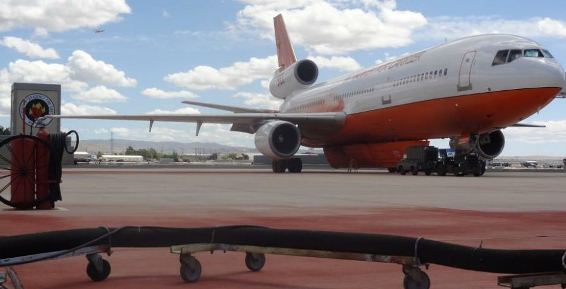
The “BLM-National Interagency Fire Center” posted this photo on their Facebook page today, with the caption:
T-911, a DC-10 Very Large Airtanker (VLAT), staged at NIFC after its assignment on the Church Camp Fire in Utah.

The “BLM-National Interagency Fire Center” posted this photo on their Facebook page today, with the caption:
T-911, a DC-10 Very Large Airtanker (VLAT), staged at NIFC after its assignment on the Church Camp Fire in Utah.
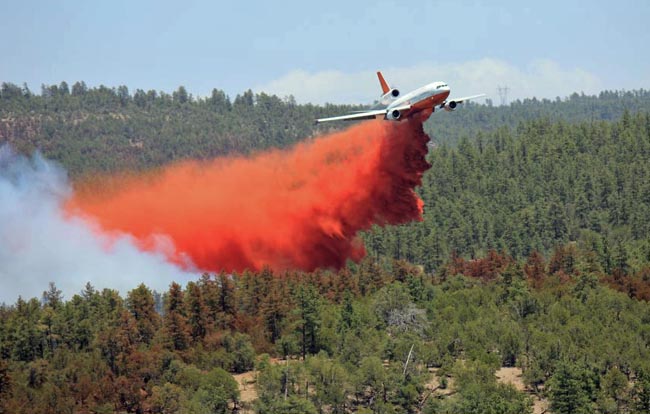
One of 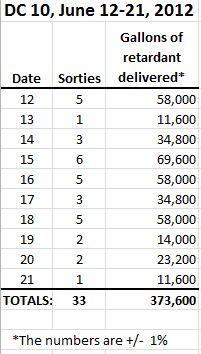 the DC-10 air tankers has dropped about 373,600 gallons of retardant during 33 sorties on seven wildfires in Arizona and New Mexico over the last 10 days. The fires were: Little Bear fire, 257 fire, Grand fire, Poco fire, Six Shooter fire, Fox fire, and 177 fire. They were all in Arizona except the Little Bear which was in New Mexico.
Eight of the nine air tankers currently on exclusive use contracts with the U.S. Forest Service are 50+ year old P2Vs designed for maritime patrol. Their average retardant load is 1,948 gallons according to a 2007-2009 air tanker study. If all of those 373,600 gallons the DC-10 dropped in those 10 days had been delivered by a P2V it would have taken about 192 round trips to the fires.
The U.S. Forest Service has a call when needed contract with one of the two DC-10 air tankers. Yesterday and today the pilots are on mandatory days off, making it unavailable. The USFS is not interested in awarding exclusive use contracts for the DC-10 or the 747 air tankers. The 747 can carry 20,000 gallons of retardant, more than 10 times more than a P2V, while the DC-10 almost always carries 11,600 gallons, more than five times the average load of a P2V.
We originally posted this video shot by KASA TV of the DC-10 dropping on June 14, but in case you missed it….
(the video is no longer available)
Thanks go out to Trish and Ian.


The U.S. Forest Service has activated the Call When Needed contract for one of the DC-10 Very Large Air Tankers and has also called in three more air tankers from Canada, CV-580s borrowed from the Canadian Interagency Forest Fire Centre. The DC-10 carries 11,600 gallons of retardant, five times more than the CV-580 which holds a maximum of 2,100 gallons.
The CV-580s are modified Convair CV-340 or CV-440 aircraft manufactured between 1947 and 1954 which have had the piston engines replaced by turbo-props.
On June 6 the USFS announced they were borrowing two CV-580s, and they have been working on the High Park fire in Colorado, reloading at the Rocky Mountain Metro Airport. Now there are a total of five CV-580s temporarily in the lower 48 states; one borrowed from the state of Alaska and four from the Canadian Interagency Forest Fire Centre. Those five plus the DC-10 which may be hired for only a short time as well, bring the total of large air tankers under the control of the USFS, counting two S-2Ts, to 17 — for now.
CAL FIRE recently reached out to the USFS and allowed the federal agency to arrange to bring on two S-2T CAL FIRE air tankers one month earlier than they would have come on duty otherwise. These two aircraft will only be used in California. An S-2T carries 1,200 gallons of retardant, 10% of the capacity of a DC-10.
To summarize the current 17 large or very large air tankers that are currently available:
We talked with Rick Hatton of 10 Tanker Air Carrier who told us that one of their DC-10s, Tanker 911, will be airborne this afternoon en route to Phoenix and will be available there for fire duty tomorrow, Tuesday. Only one of their two DC-10s is on a CWN contract, since it is not economically feasible for them to have two large expensive airplanes with crews available, when there is no guarantee that either will be used. Mr. Hatton is hopeful that both will receive exclusive use contracts when the USFS’s “next-gen” contracts are announced. That announcement was expected in May.
A Call When Needed contract can fit into the business model of the owner of a helicopter nicely, if their main source of earning income is passenger transport, TV news and traffic reporting, agricultural spraying, construction, or other uses. But an air tanker is a huge investment for a piece of equipment that is single-use; dropping retardant on wildfires. If they are not used for that, they sit, earning nothing, while the pilots and mechanics may sit too, but might still be earning a salary. That can’t go on forever.
In the aftermath of Sunday’s tragic air tanker accidents in which two pilots working for Neptune Aviation were killed, and a second air tanker made an emergency landing on disabled landing gear, the U.S. Forest Service announced today that they have “shored up” the air tanker fleet by temporarily adding some aircraft. They are arranging for two CV-580 air tankers to become available on a temporary basis. One is under contract with the state of Alaska and the other is being borrowed from the Canadian Interagency Fire Centre. The CV-580s can carry 2,100 gallons of retardant, about the same as the P2Vs that currently comprise eight of the nine air tankers on exclusive use contracts with the USFS, but they are speedier, cruising 115 mph faster than the P2Vs.
CAL FIRE reached out to the USFS and allowed the federal agency to arrange to bring on two CAL FIRE air tankers, presumably S-2Ts, one month earlier than they would have come on duty otherwise. These two aircraft will be used in California. An S-2T carries 1,200 gallons of retardant.
The USFS is also bringing on five large Type 1 helicopters earlier than previously scheduled.
When I saw the headline on the USFS news release announcing they were “shoring up” the air tanker fleet, I wondered if they were finally announcing that they have awarded multiple contracts for “new generation” air tankers. The solicitation for the next-gen air tankers closed in February, but as usual, the U.S. Forest Service office of Fire and Aviation Management has difficulty making decisions. There was also the possibility that they were going to announce exclusive use contracts or call when needed activations for the very large air tankers, such as the DC-10’s or the 747, but that did not happen either.
This “shoring up” tactic is smoke and mirrors — a band-aid on a serious case of analysis-paralysis cancer in the agency. It is simply a distraction from the real issue.
We have tried to find out the details of the USFS’ solicitation for a sixth air tanker study, which closed April 20, but calls to Kellan Logan, the USFS contracting officer in charge of the solicitation, have not been returned.
UPDATE AT 9:13 a.m. MT, June 7:
We heard from Mr. Logan today about the sixth air tanker study, which has been awarded.

(This article was updated on September 14 to reflect that there are now eight Convair CV-580 air tankers working temporarily in lower 48 States.)
The U. S. Forest Service is apparently feeling the heat from the public and politicians about the agency’s management, or lack thereof, of the large air tanker fleet, which through neglect has dwindled from the 44 we had in 2002 to the 11 large air tankers currently on exclusive use contracts. The decline began with the crash of two very old military surplus air tankers in 2002, which prompted the permanent grounding of similar antiques. But in the nine years since those crashes, nothing significant has been accomplished to rebuild the fleet.
This morning there were 11 air tankers on exclusive use contracts, plus 12 hired temporarily on a day basis (including one DC-10) and six or seven military C-130 MAFFS on a temporary assignment. There were no federal large air tankers in the states of New Mexico, Arizona, Colorado, Wyoming, South Dakota, Minnesota, Montana, or Washington. I wonder if the firefighters on the ground in those states know they will get no large air tanker support for the initial attack of fires?
Here is a statement that was issued around September 8, 2011 by the U. S. Forest Service. Our comments are embedded in red.
==================
Statement from US Forest Service Chief Tom Tidwell on Aircraft Support for Texas, Other Wildfires Throughout the Country
The Forest Service is working hard right now with our federal, state and local partners to combat fires in Texas, California and several other states. I want to assure the public that the Forest Service has ample aircraft strategically placed around the country to support on-the-ground teams combating this year’s wildfires. Our current available airplane fleet includes: “Ample aircraft”? One of the many USFS air tanker studies shows that we should work toward a goal of 32 large air tankers on exclusive use contracts. Now we have 11.
All of these assets support the more than 16,000 federal firefighters (10,500 are Forest Service), and 1000 Forest Service firefighting engines.
The Forest Service takes the safety of our employees and contractors seriously and we insist on maintaining stringent airworthiness standards that were developed after two airtankers crashed in 2002, resulting in the loss of both crews. The Forest Service does not take shortcuts on safety. No responsible person is saying waiting more than nine years to make a decision about how to rebuild the air tanker fleet is taking a “shortcut”.

Updated at 8:30 p.m. MT, June 9, 2011: A damage assessment of the fire’s run through Greer last night revealed that 22 houses burned. More information. And the size of the fire has been revised again. Wednesday morning it was reported by the incident management team to be 389,000 acres, then Thursday morning, 348,235, and later on Thursday, 386,690 acres and for the first time, some degree of containment: 5%.
Information from the IMTeam released tonight:
Dozer line construction took place along Highway 260 going west from Eagar to Highway 373 junction; then southeast to Greer Lake in prep for burnout for tonight’s operational period. Firefighters are prepping with dozer line in the south end of Greer Valley heading southwest to Highway 273 at Sheep’s Crossing for an additional burnout. Dozer line will take place on the east side of Escudilla Mountain extending southeast towards Luna, New Mexico for burnout. All fuel moistures are extremely low.
Updated at 4:01 p.m. MT, June 9, 2011: Replaced map of north portion of Wallow fire with updated version.
Updated at 2:57 p.m. MT, June 9, 2011: Added a new type of map, showing Fire Radiative Power, or fire intensity.
Updated at 11:56 a.m. MT, June 9, 2011: An update from the incident management team posted at InciWeb at 11:00 a.m. MT included information about evacuations, and this information:
=================
Updated at 9:22 a.m. MT, June 9, 2011: added information about the 747 and DC-10 air tankers.
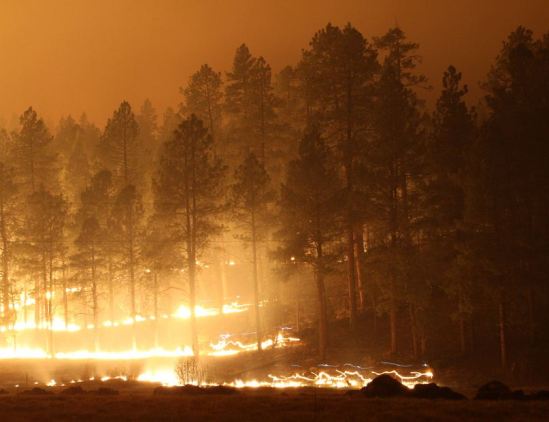
The Wallow fire burned through the small unincorporated community of Greer, Arizona Wednesday evening. Greer has a population of about 177 people and some tourist lodges. The incident management team posted this at InciWeb at approximately 10:00 p.m. Wednesday:
Fire has gone through Greer. We do not know the extent of the damage at this time. Firefighters are on scene in Greer conducting structure protection activities.
The last acreage reported was 389,000, a figure supplied by the incident management team Wednesday morning. That will no doubt be revised upward later today. They are reporting that the fire is 0% contained.
Very Large Air Tankers
KPHO, the CBS television station in Phoenix, reported on Wednesday that Evergreen’s 747 Supertanker was going to be used:
PHOENIX — Fire officials said they are bringing in a Boeing 747 supertanker that is retrofitted to drop a mile-long line of fire retardant.
Evergreen International Aviation said the supertanker has more than eight times the drop capability and twice the speed of any other federal air tanker currently fighting fires.
That report, even though it was picked up by numerous web sites and spread around the internet like, uh, wildfire, is incorrect. Wildfire Today talked with Steven Daniels who leads the 747 Supertanker program at Evergreen and he said the 747 is not being dispatched. As we reported yesterday in a story about the use of Very Large Air Tankers, the U.S. Forest Service is not interested in agreeing to an exclusive use contract with Evergreen or 10 Tanker Air Carrier for their 747 or the DC-10 air tankers.
However, Rick Hatton, the CEO of 10 Tanker Air Carrier, told Wildfire Today Thursday at 9:30 a.m. MT that one of their two DC-10 Very Large Air Tankers, Tanker 911, was en route to Phoenix Mesa Gateway airport to work on the fires. They still do not have any kind of a contract with the USFS, so they are being activated through a Call When Needed contract the company has with CalFire. This is the same methodology used when the DC-10 was used in Texas a few weeks ago. The other DC-10, Tanker 910, is on a fire assignment in Canada.
More information about the Wallow fire
Scroll down to see more information and the latest maps of the Wallow fire. We will update the maps on Thursday as new data is available.
Cal Fire and the U. S. Forest Service are finalizing their contracts for very large air tankers for this year. Here is what we have been told by the two agencies.

The two DC-10’s, operated by 10 Tanker Air Carrier
Cal Fire will have one on an exclusive use contract, and one on a call when needed (CWN) contract. The USFS will have one on a CWN contract. One of these DC-10’s is currently on a contract in Australia, but it should be ending soon. It has only been used on one fire so far this Australian summer.

747 operated by Evergreen
The USFS will have it on a CWN contract. It appears that Cal Fire will also have it on a CWN contract, but this is not yet certain.

Martin Mars operated by Coulson Flying Tankers
At this time neither Cal Fire nor the USFS have any plans to contract for this aircraft this year. Last year the USFS had it on an exclusive use contract for 2-3 months, stationed at Lake Elsinore in southern California.
The DC-10, designated as air tanker 910 and operated by 10 Tanker Air Carrier out of Victorville, California, is on contract for a second year to CalFire. It was used this weekend in northern California on some of the fires in Tehama County. Instead of reloading at Victorville as usual, it filled it’s 12,000 gallon tanks at CalFire’s air tanker base at McClellan. The company is also building a second DC-10 air tanker.
Evergreen International Aviation of Oregon expects to have their 747 air tanker under contract with the U.S. Forest Service within the next 2-5 weeks. It will carry 20,000 gallons and can cruise at mach .85, or 600 mph.
Here is a 19-second video of the DC-10 making a drop on the Humbolt fire near Chico, CA a week or two ago. Turn up the sound so you can hear the audio. The sound of those jet engines from an air tanker will be hard to get used to. When I first started fighting fire, some of the air tankers used the huge radial engines that have a sound you will hear no other place. Another big step was putting turbine engines in the smoke jumper’s DC-3; hard to get used to. Now jets dropping on fires? What’s next? Saturn 5 rockets carrying 1,000,000 gallons of retardant?