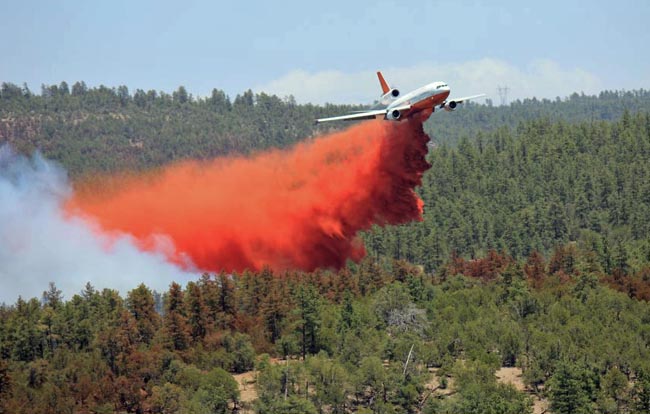
10 Tanker Air Carrier’s two DC-10 Very Large Air Tankers. Photo: 10 Tanker
The two DC-10 air tankers operated by 10 Tanker Air Carrier have dropped more retardant this year than the seven to eight Modular Airborne FireFighting System (MAFFS) C-130 aircraft flown by the military. The DC-10s have dropped, according to 10 Tanker, 2.408 million gallons through August 27 during 215 flights for an average of 11,200 gallons per flight.The MAFFS, according to the August 29 Government Security News, have dropped 2.153 million gallons through August 24, employing 899 flights to do so. This indicates an average of 2,394 gallons per flight for the MAFFS aircraft.
The DC-10s have a Call When Needed contract with the U.S. Forest Service and are only activated when the USFS decides to use them. This year one of them, Tanker 911, was called up (these dates are approximate) June 11 and released on June 16. It was reactivated around August 3 and the second DC-10, Tanker 910, was put on active duty on approximately August 7.
One of the eight MAFFS C-130s crashed July 1, 2012 while dropping on the White Draw fire west of Hot Springs, South Dakota, killing four crewpersons and injuring two. While the military has many C-130s, there were only eight of the second generation MAFFS2 units which can be loaded into the cargo hold of the aircraft making it possible for it to hold up to 3,000 gallons of fire retardant. And of course the crew can’t be replaced, only substituted.
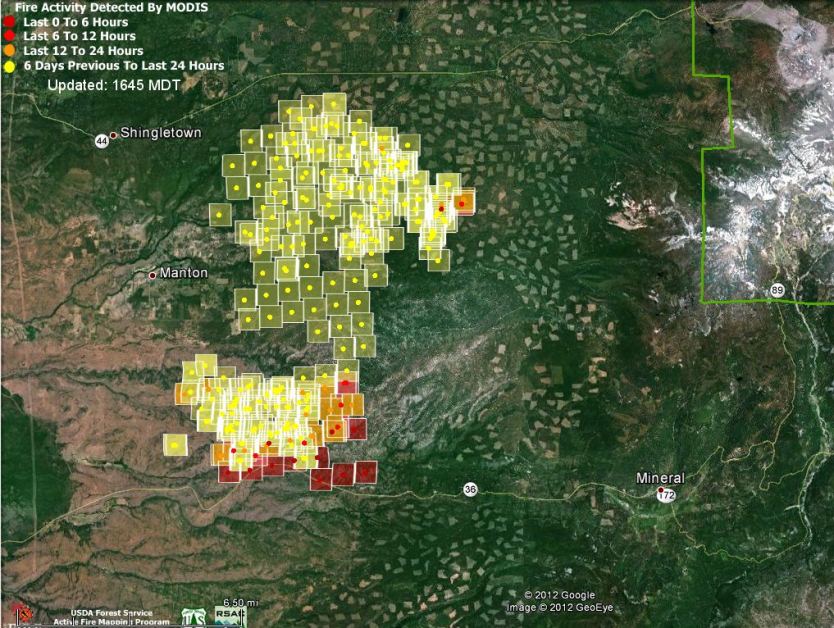
Map of Ponderosa Fire, showing heat detected by a satellite at 2:15 p.m. PT, August 21, 2012. MODIS/Google (click to enlarge)
(Updated at 6:48 p.m PT, August 21, 2012)
The Ponderosa Fire, 22 miles northeast of Red Bluff, California, has grown to 21,506 acres as of Tuesday afternoon. At 6:15 p.m today CAL FIRE increased the number of structures reported as destroyed to 50, which is 43 more than they reported this morning and yesterday. Another 200 structures remain threatened. The fire is burning in a mix of grass, brush, and heavy timber and is being called 40 percent contained.
The above map shows that as of 2:15 p.m. PT today most of the heat detected by a satellite was on the south side of the fire near Highway 36. Keep in mind that the locations depicted were identified from hundreds of miles above the earth, so there can be errors by up to a mile or so.
The fire continues to burn to the east and south in the Battle Creek Drainage.
The areas that are evacuated were confirmed by CAL FIRE for the following areas in Manton, Shingletown & Viola:
Forward Rd at Graham to the C Line
Forward Mill Rd from Rock Creek Rd to Forward Camp Rd
Rock Creek Rd from Manton Rd to Long Hay Flat Rd
All of Long Hay Flat Rd and Woodcutter Way
Southside of Highway 44 from Viola to Brush Oak
Northside of Hwy 44 from Viola to Alward
Hazen Rd area and South Power House Rd south of Manton
Hwy 44 at Brush Oak east to and including Viola, Plateau Pines, Starlight Pines and Lake McCumber area
South side of Hwy 44 from Viola to Brush Oak and on the north side of Hwy 44 from Viola to Alward
Evacuation warnings have been issued for Hwy 36 from Ponderosa Sky Ranch to Lassen Lodge communities.
Resources assigned to the fire include 2,133 personnel, 278 engines, 38 hand crews, 11 helicopters, and 53 dozers
“TurtleSloth” uploaded this video yesterday showing of one of the DC-10 very large air tankers dropping near Highway 36 on the Ponderosa fire.
“Her cards were up,” said mother Claire Veseth, 55, a nurse in this college town. “It was an act of God.”
Los Angeles City FD adds another helicopter to its fleet
The Los Angeles City Fire Department is leasing an Erickson Air Crane for four months. This baby has a forward-pointing water cannon designed for high-rise fires. It can fill its tank two different ways, by the usual hover-and-draft mode, or by lowering a pipe and scooping water as it flies at speed over a large water source.
42 uncontained large fires in the US
After having 70 uncontained large fires in the country on Wednesday, that number is now down to 40. The number of incident management teams committed, including Type 1, Type 2, NIMO, and Area Command, has declined from 31 to 28. Six military MAFFS C-130s are still actively working out of Boise and Sacramento.
Smoke from wildfires
The smoke map shows dense smoke in Idaho and also an interesting area of dense smoke over the Atlantic east of Maine.
Wildfire smoke map, 6:36 p.m. MT, August 18, 2012. NOAA (click to enlarge)
USFS issues RFI for Very Large Air Tankers
The U.S. Forest Service has issued a Request for Information which could lead to Call When Needed contracts for Very Large Air Tankers beginning next year continuing through 2015. 10 Tanker Air Carrier currently has a CWN contract for their two DC-10s, but it remains to be seen if any company with VLATs can succeed financially if they are only used for 60 to 100 hours each year, with no guarantees of ANY income. Evergreen in the past has not been interested in signing up their 20,000-gallon 747 Super Tanker on a CWN contract. The RFI specifies that the aircraft must be able to hold at least 10,000 gallons. The USFS expects to issue a Request for Proposals later in the year which they think could lead to one to three VLATs under CWN contracts in 2013. Or… it could lead to none.
The Elko Daily Free Press reported that the 16,000-acre Willow Fire is now the main priority for the BLM’s Elko district. It’s burning north of Battle Mountain; resources on the fire include one of 10 Tanker Air Carrier’s DC-10 aircraft. Most of the fires in Nevada have not been updated on Inciweb since the middle of July, except for the Lake Fire Complex, which comprises the 162-acre Lake Fire and the 42-acre Murphy Fire on the Bridgeport District of the Humboldt-Toiyabe National Forest. Those fires are just south of Wellington, Nevada, and north of Bridgeport, California. The fires started early Sunday afternoon; both are at about 80 percent containment. The Elko Daily Free Press reported on Monday that 11 major fires were burning in north and central Nevada. A 7,000-acre fire southeast of Alamo was at zero containment, another north of Battle Mountain was at 5,000 acres, and a 3,000-acre fire near there was threatening structures. East of Denio, another fire had reached 3,000 acres.
According to the newspaper report, smaller fires were active 31 miles northwest of Winnemucca, 20 miles northwest of Battle Mountain, 22 miles southeast of Winnemucca, 5 miles southeast of Winnemucca, 25 miles southwest of Winnemucca, 55 miles northwest of Winnemucca, and 65 miles northwest of Winnemucca.
The fires were started Sunday afternoon by lightning.
The 20-Mile Fire northwest of Montello likely won’t be aggressively fought from the ground because thunderstorms and heavy rain in steep terrain last month made entry to the fire area impossible. According to fire managers, mopup, rehab, and demob have been delayed by impassible roads. The fire is 98 percent contained at just over 13,000 acres.
Tanker 911 dropping on the Poco Fire in Arizona, June 15, 2012. Photo by Ian James.
The U.S. Forest Service has activated one of the DC-10 air tankers twice this year to supplement the fleet of nine exclusive use air tankers available to help firefighters suppress wildfires. But now, for the first time since the Oak Glen fire in 2009, both of 10 Tanker Air Carrier’s DC-10s are working at the same time. On Tuesday both Tanker 910 and Tanker 911 were assigned to fires on which they were the sole air tankers working the fires.
Rick Hatton, President of 10 Tanker Air Carrier, told Wildfire Today:
While this is not the exclusive use contracting we seek, we are hopeful that the contribution two DC 10s will make toward effective fire suppression this season will convince the authorities that multiple 10s should become a permanent part of the future fleet.
The DC-10 always carries 11,600 gallons of retardant and does not have to reduce their load based on density altitude (air temperature and elevation) like all other air tankers. The P2Vs which comprise eight of the nine air tankers now being used on exclusive use use contracts can only carry about 2,000 gallons. The newer next generation air tankers, three of which will begin working on fires later this year if a contract dispute can be settled, have a 3,000-gallon capacity. One BAe-146 that has been operated by Neptune Aviation since last fall can also hold up to 3,000 gallons.
The DC-10 is classified as a “Very Large Air Tanker” and its size makes it impossible to be accommodated at most air tanker facilities. However, it can reload with retardant at eight bases in the western United States, has a cruising speed of 564 mph, and has a capacity equal to almost six P2Vs. A P2V cruises at 225 mph.
DC-10 Tanker 911 on the Robbers Fire in California July 15, 2012. Photo by David Wilson. (Click to see a larger version.)
With the DC-10 being activated again, I am reminded of the shortage of air tankers during the Myrtle fire in the Black Hills of South Dakota a few weeks ago, which during the first six hours had no large air tankers. On the radio a conversation between two people in the Operations section could be heard discussing the no-show of the air show. I could sense the frustration in their voices. One of them suggested that they consider requesting the DC-10 Very Large Air Tanker, but they did not know with certainty the nearest air tanker base where it could land and reload with retardant.
They knew that the aircraft is too large for most of the dozens of air tanker bases, since it has a wing span of around 160 feet and a weight of about a half million pounds. The physical layout of the bases and the runway, taxiways, and ramps at the airports are not designed for the size and weight of such a large air tanker.
However, there are eight bases that can accommodate the DC-10 in the western United States, according to Pam Baltimore, an Acting Public Affairs Officer for the U.S. Forest Service in Washington D.C.
SBD – San Bernardino, CA
MCC – McClellen – CA (Sacramento)
MWH – Moses Lake, WA
BOI – Boise, ID
IWA – Mesa-Gateway, AZ (Phoenix)
HIF – Hill AFB, UT
HLN – Helena, MT
CPR – Casper, WY
When contemplating using a DC-10 air tanker on a fire, aviation personnel consider, in addition to the cost per delivered gallon, the fact that it can cruise at 564 MPH, and the retardant capacity of 11,600 gallons, equivalent to almost six P2V or four BAe-146 air tankers, which carry about 2,000 and 3,000 gallons, respectively.
DC-10 Tanker 911, July 2, 2012 on the Shingle fire in Utah. Photo by Scott G. Winterton (Click to see a larger version.)
The DC-10 Very Large Air Tanker has been activated again. The crew is returning to their base at Victorville, California and will fly the aircraft to Boise to be activated on Saturday.
The fire season in Montana is heating up and today’s Situation Report showed six new large fires in the state. On Thursday a cold front with very strong winds moved across the area and undoubtably had a significant effect on the existing fires.
The DC-10 can carry 11,600 gallons of retardant, about six times more than the P2V air tanker which comprises 8 of the 9 large air tankers currently active under long term contracts. The ship worked on fires for several weeks, receiving very good performance evaluations, before being released from active duty on June 16.
The DC-10 has only been offered a call when needed contract by the U.S. Forest Service, rather than a full-time exclusive use contract. The agency expects the aircraft to be available when they need it, but its owner, 10 Tanker Air Carrier, has said that after this year they will have to shut it down permanently if it is not awarded an exclusive use contract or activated on a regular basis .
DC-10 Tanker 911, July 2, 2012 on the Shingle fire in Utah. Photo by Scott G. Winterton (Click to see a larger version.)
The DC-10 Very Large Air Tanker, Tanker 911, was released June 16 from their Call When Needed assignment by the U.S. Forest Service and sent home, told they were no longer needed. Here are some photos of the aircraft in action over the last couple of weeks on the Shingle Fire in Utah and the Robbers Fire in California. Click on the photos to see larger versions.
Between July 9 and 16 Tanker 911 flew 11 sorties and dropped approximately 127,600 gallons of retardant on the following fires in Oregon, California, and Idaho: Sites, Long Draw, Stout, Miller Homestead, Robbers, and Calf.
Earlier we reported that the DC-10 dropped 373,600 gallons on 33 sorties from June 12 through June 21. If all of those 373,600 gallons had been delivered by a P2V it would have taken about 192 round trips to the fires.
HERE is a link to a video news report about the air tanker from a TV station in Sacramento.
DC-10 Tanker 911, July 2, 2012 on the Shingle fire in Utah. Photo by Scott G. Winterton DC-10 Tanker 911 on the Robbers Fire in California July 15, 2012. Photo by David Wilson. (Click to see a larger version.) DC-10 Tanker 911 on the Robbers fire in California, July 15, 2012. Photo by David Wilson. (Click to see a larger version.)
A reporter for 9news.com in Colorado, in the video below, asked Secretary of Agriculture Tom Vilsack who supervises the U.S. Forest Service, why the very large air tankers like the two DC-10s or the 747 have not been used on fires in Colorado. His answers revolved around “every fire is different” and “it’s complicated”.
747 air tanker dropping during a test in Arizona. Evergreen photo.
Evergreen International Aviation, the company that built the 20,000-gallon air tanker, or “Supertanker” as they call it, has released a statement that attempts to answer some of the many questions they have received asking why the U.S. Forest Service refuses to use the 747 air tanker, which carries about 10 times more than a P2V. The company says they have never received an explanation from the USFS, but speculates that contracting requirements favoring small businesses may be the reason.
The USFS only offered the two companies with Very Large Air Tankers call when needed contracts, not exclusive use contracts. Without any guaranteed income, Evergreen turned the offer down, while 10 Tanker Air Carrier is struggling to remain in business after accepting a CWN contract for one of their two DC-10 air tankers, which is used only rarely by the USFS.
Evergreen International Aviation Statement Concerning the Supertanker
We felt compelled to release this statement due to the overwhelming amount of calls we have received concerning the availability of the Evergreen Supertanker. We at Evergreen are saddened by the fire devastation now taking place in many Western US states. For over 60 years, we have supported the US Forest Service in its important mission to battle and control fires, and it is our desire to continue this rich history of service. While our helicopters continue to work fires for the State of Alaska under State contracts, unfortunately, our Boeing 747 Supertanker Very Large Air Tanker (VLAT) aircraft awaits activation with the US Forest Service.
We have never been told why we have not been activated by the US Forest Service, so we can only speculate as to why we face this outcome:
1. We were offered a Call-When-Needed (CWN) contract a few years ago by the US ForestService (proving our technical viability), but we were never called into action resulting in a multi-million dollar loss to our company as we were required to maintain and have flight crew available should we be called. The only contact that will sustain a VLAT program is an Exclusive-Use contract, which provides an income stream to sustain the program even if the asset is not utilized. We invested over $50M to develop this asset in the firm belief that we could better control fires as we proved in Israel and Mexico under CWN contracts that we could afford to offer at the time.
2. There have been recent changes to the US Forest Service procurement policies. Today,only small businesses are eligible for contract awards concerning airtanker assets; Evergreen is not a small business and, therefore, is excluded from consideration for any award.
3. The US Forest Service’s specification for Next Generation Air Tanker aircraft limits tanksize to 5,000 gallons. The Supertanker’s tanks hold about 20,000 gallons, which is considered outside the USFS specification. The USFS just awarded contracts to four small businesses with aircraft equipped with these smaller tanks, and excluded the Evergreen Supertanker. Since World War II, tank capacities have been in the 3,000 to 5,000 gallon range, yet continue to face the growing threat from mega fires today. We believe the Supertanker represents an overwhelming response to this growing threat.
Please contact your state representatives in Washington DC to demand an examination of their current procurement policies concerning VLAT aircraft. The US Forest Service says it best: “Only YOU can prevent forest fires.”
Evergreen International Aviation, Inc., Tel: 503.472.9361