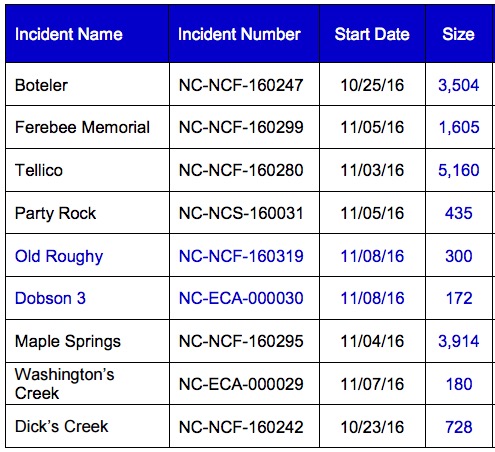
Information and maps of five wildfires in Georgia and North Carolina, Nov. 14, 2016

fire maps Georgia, North Carolina, South Carolina, Tennessee

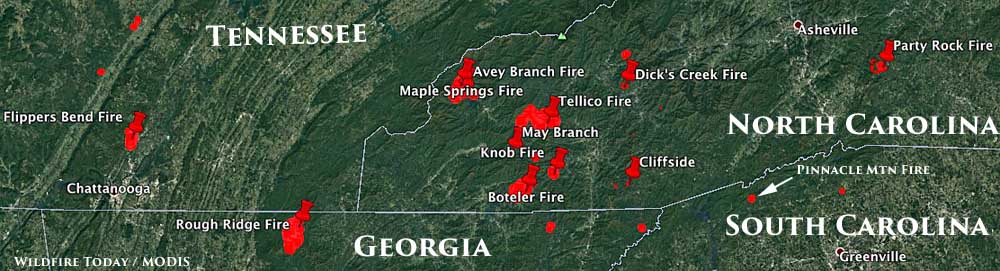
Above: The map shows the location of some of the larger wildfires currently burning in Georgia, North Carolina, South Carolina, and Tennessee.

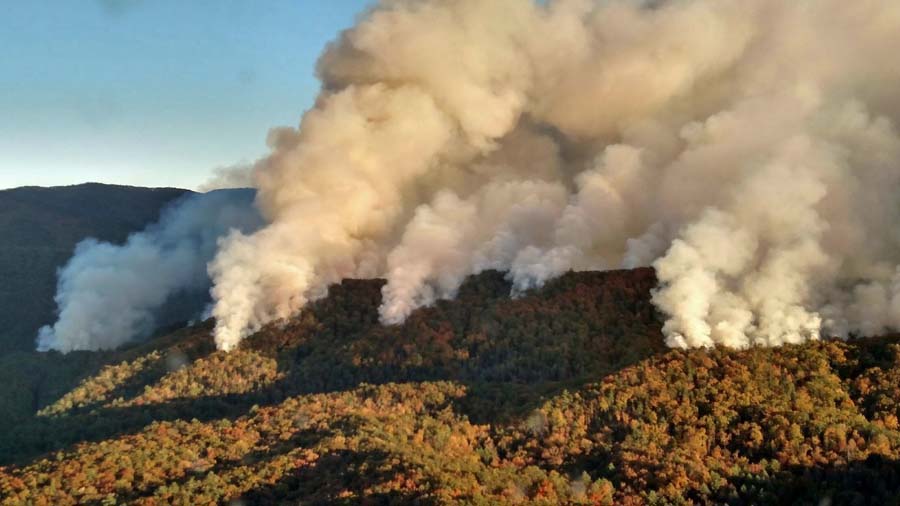
There are still dozens of wildfires burning in the southern United States, primarily in Georgia, North Carolina, South Carolina, and Tennessee. Firefighters have slowed the progress of many of them but others are still spreading. The weather on Sunday was not quite as conducive to extreme fire behavior, but most areas are still extremely dry and have not had significant precipitation in weeks.

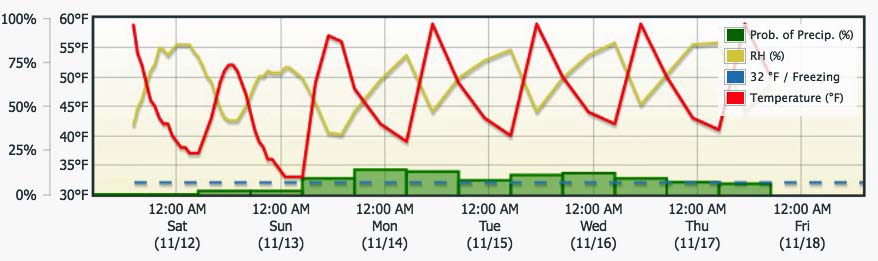
The weather forecast for the Asheville, NC area through Saturday, November 12, calls for more of the same weather — moderate winds, daily high temperatures in the 60s, and relative humidities in the 80s at night and the 30s in the afternoon.

Below are some statistics for the active fires in the Southern Geographic Area:

  • 73 active fires
  • 109,563 cumulative acres
  • 103 hand crews assigned
  • 242 engines
  • 19 helicopters
  • 3,492 personnel

Here is a look at five of the more active blazes:

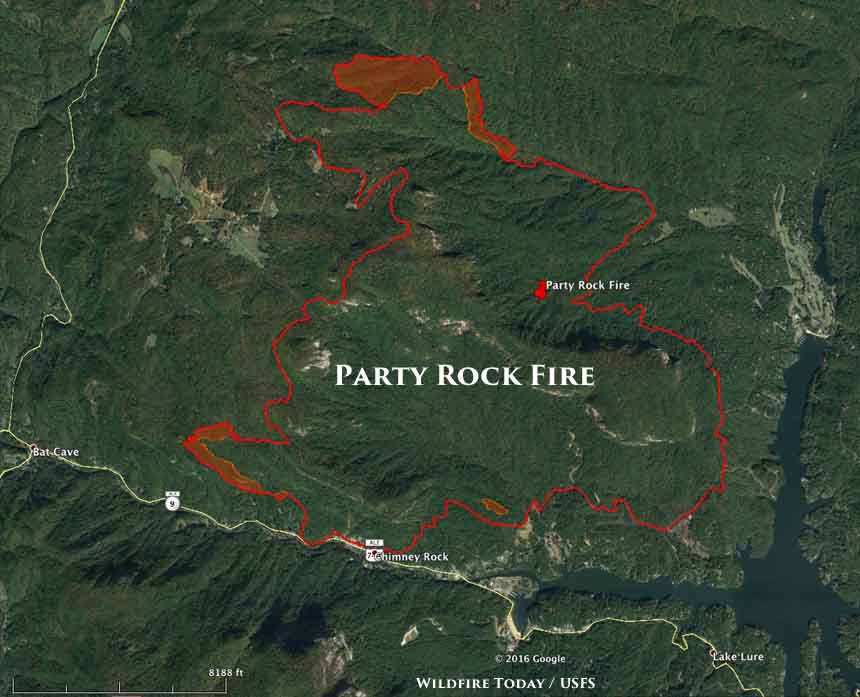
Party Rock Fire
map party rock fire
Map of the perimeter of the Party Rock Fire at 11 p.m. ET November 13, 2016.

The Party Rock Fire has been burning just north of Lake Lure, North Carolina since November 5. It has blackened 3,457 acres and required evacuations in the Chimney Rock community. On Saturday and Sunday it grew by 574 acres, with most of the additional acres being on the southwest and northwest sides.

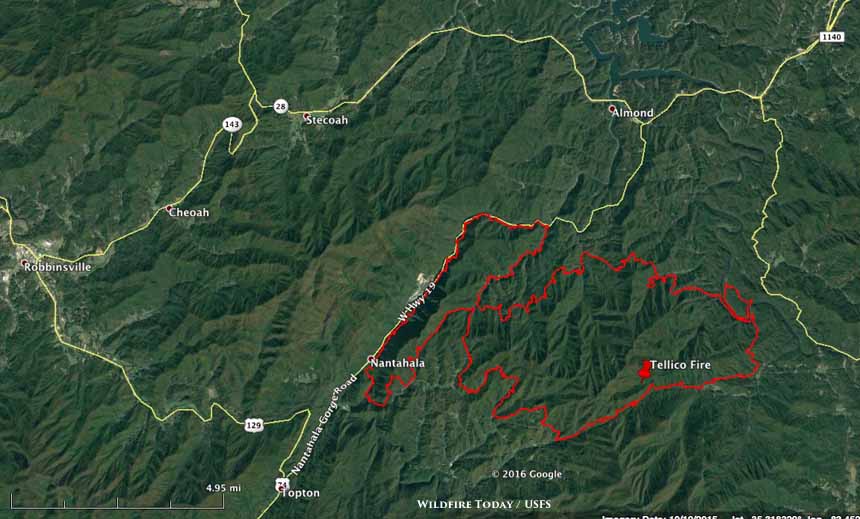
Tellico Fire
map Tellico Fire
Map of the perimeter of the Tellico Fire at 11 p.m. ET November 13, 2016.

The Tellico Fire three miles south of Almond, North Carolina expanded by 3,791 acres over the weekend and now stretches across 13,676 acres after merging with another fire, the Ferebee Fire. It spotted across the Little Tennessee River to the east, but that spot was contained at about 100 acres. U.S. Highway 19 on the west side of the fire was closed on Sunday.

Continue reading

Tennessee and North Carolina receiving the worst of the smoke on Saturday

wildfire smoke

 Above: Smoke from wildfires drifts into Tennessee, North Carolina, and northern Georgia, November 12, 2016. NASA, with notations by Wildfire Today.

As the siege of wildfires continues in the southeast United States the smoke from the blazes continues to impact residents in the area. As the wind direction changes from day to day different populations are affected. Most of the smoke Saturday was blowing to the west and southwest.

We did some quick mapping and found that on Saturday approximately 4.5 million residents were experiencing moderate to heavy smoke in northern Georgia, northern Alabama, eastern Tennessee, and western North Carolina. Almost the entire state of Alabama was affected by lesser concentrations.

map wildfires tennessee georgia
Map of currently active wildfires, November 11, 2016.

Continue reading

Photos from the Rough Ridge Fire in Georgia

Rough Ridge Fire

These photos are from the very impressive Rough Ridge Fire in north Georgia 13 miles west of Blue Ridge. They were uploaded to InciWeb Friday.

The fire has burned 10,336 acres and currently threatens 48 structures. Approximately 227 personnel are assigned.

Rough Ridge Fire
Rough Ridge Fire. InciWeb. Click to enlarge.

Heavy wildfire activity continues in North Carolina and Georgia

map fires NC GA SC

Above: The map shows the location of some of the larger wildfires in North Carolina, South Carolina, and Georgia November 11, 2016.

(UPDATED at 4:59 p.m. ET November 11, 2016)

The intense wildfire activity that has been going on for weeks in the southeast United States ramped up a bit over the last 24 hours as extremely low relative humidities allowed some of the blazes to continue to spread aggressively Thursday night. A weather station southeast of Asheville, NC 9 miles northwest of the 977-acre Party Rock Fire recorded 9 percent RH early Friday morning. Night time humidities in that part of the country are usually far above 50 percent at night.

The good news is the conditions will moderate a little over the next several days after the passage of a cold front.

weather forecast asheville NC
Weather forecast for the area southeast of Asheville, NC through November 18, 2016. NWS.

There are currently 31 uncontained wildfires in the Southern Geographic Area. Here some other numbers about the fires in the region (data from the National Interagency Coordination Center and the Southern Area Coordination Center):

  • 10 Incident Management Teams deployed or en route (3 Type 1 teams, 6 Type 2 teams, and 2 Type 3 teams)
  • 77,507 acres have burned in the fires that are still active
  • 136 hand crews
  • 184 engines
  • 12 air tankers (4 large and 3 single engine)
  • 14 air attack ships
  • 34 helicopters (11 large Type 1, 5 medium Type 2) and 18 Type 3)
  • 3,067 total personnel assigned
list of wildfires southeast
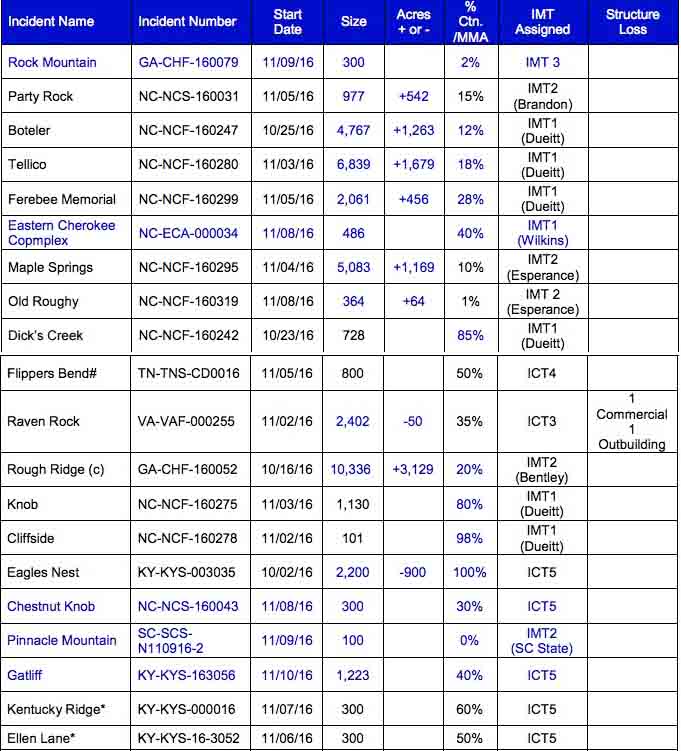
List of some of the larger wildfires in the southeast U.S. on November 11, 2016. Data from SACC. Click to enlarge.

Continue reading

Smoke from wildfires impacts Georgia

smoke wildfires south

Above: Satellite photo showing smoke from wildfires in North Carolina, South Carolina, Tennessee, and Georgia, November 10, 2016.

Many wildfires are still burning in North Carolina, South Carolina, Georgia, Tennessee, and several other states in the southeastern United States. On Thursday much of the smoke was being blown into the northern half of Georgia, potentially causing health problems for sensitive people.

map fires south
Map showing the location of wildfires in NC, SC, TN, and GA. Click to enlarge.

The primary culprit for the wildfire activity is a lack of precipitation. Many areas in the southeast have not received any significant rain in weeks. It has been more than 70 days for some locations in Kentucky, Tennessee, North Carolina, Georgia, Mississippi, Alabama, and South Carolina. This has resulted in many wildfires breaking out in the last month.

list wildfires south
List of some of the wildfires in North Carolina November 10, 2016 (many others, including some in other southern states, are not shown in this list).

The state with the most active fires is North Carolina, but the largest fire currently burning in the south is in Georgia, the 10,336-acre Rough Ridge Fire in the northern part of the state. Caused by lightning on October 16, it is being fought by 296 personnel, 9 hand crews, 2 helicopters, 7 engines, and 2 dozers.

Continue reading

Rocky Chesser receives USFWS Fire Safety Award

Rocky Chesser, receives award
Rocky Chesser (center), Maintenance Supervisor at Okefenokee National Wildlife Refuge receives the USFWS National Fire Safety Award for 2013 from John Segar, Chief, Branch of Fire Management (right), and U.S. Fish and Wildlife and Service Southeast Regional Director Cindy Dohner (left). USFWS photo.

The following information was released by John Segar, Chief, Branch of Fire Management for the U.S. Fish and Wildlife Service:

****

“I am very proud to announce that Rocky Chesser from Okefenokee NWR was awarded the Service’s first Annual Fire Safety Award. Rocky is being recognized for his consistent leadership, professionalism, longstanding safety record, and significant contributions to the Okefenokee Wildlife Refuge Fire Management Program. Specifically:

  • During the Honey Prairie Fire, Rocky was engaged for the entire year, from the first day to the last in roles from Resource Advisor to Incident Commander. During this marathon incident Rocky provided calm, consistent leadership and was able to maintain fire safety from early initial attack to large scale management roles as the fire progressed.
  • Rocky’s proactive approach prior to the fire working with the GOAL partners and the Georgia Forestry Commission (GFC) were key to assuring the refuge was prepared for supporting such a large scale fire event.
  • Rocky was instrumental in coordinating large scale rehab projects such as hazardous tree removal project of approximately 50 miles of canoe and boating trails in the wilderness. He worked with contractors in promoting a safety culture and assured that all safety standards were maintained.
  • Rocky is one of the region’s most knowledgeable heavy equipment instructors and hosts annual training. He is the “go to expert” on assuring that equipment meets all safety standards and is ready for safe fire operations. When the refuge fire program underwent a major transition and the district FMO position was moved off site, Rocky stepped up more than ever to keep the fire program running strong and safe. His leadership, positive attitude, and commitment to safety helped the program adapt well through this transition.
  • Rocky also coordinates annual Fire Refresher Training between state, private, and federal firefighters and equipment operators in the Okefenokee area.”

****

You may remember the Honey Prairie Fire. Started by a lightning strike, it burned 309,200 acres between April 30, 2011 and April 16, 2012 in southern Georgia and northern Florida. In one six-day period in May, 2011 it grew by 81,000 acres.

Honey Prairie Fire April 29
Honey Prairie Fire May 1, 2011, one day after it started. USF&WS photo.
Firefighters conducting firing operations
Firefighters conducting firing operations on the Honey Prairie Fire. USFWS photo.

Red Flag Warnings, March 21, 2013

Red Flag Warnings, 3-21-2013

Red Flag Warnings, 3-21-2013

Some portions of New Mexico, Texas, Alabama, and Georgia are under Red Flag Warnings for enhanced wildfire danger today. The National Weather Service site that usually serves up a dandy map showing the warnings is not working properly this morning, so we’re making do with the substitute above. If you need to interpret the colors other than red, which is for Red Flag Warnings, you can go to this NWS site where you’ll see a legend showing, for example, six different shades of brown, with three of them being almost identical light brown. Ridiculous.

***

The map above was current as of 9:35 a.m. MT on Thursday. Red Flag Warnings can change throughout the day as the National Weather Service offices around the country update and revise their forecasts. For the most current data, visit this NWS site, however today the graphics are not working correctly..