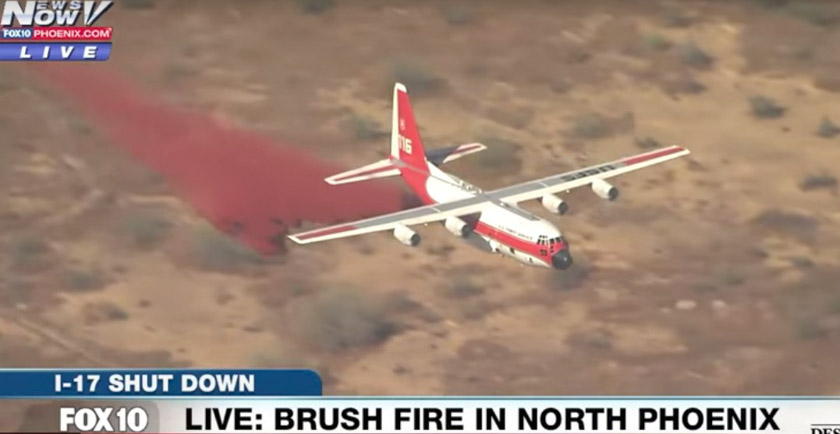
Above: Tanker 116, an HC-130H, on final approach at Fresno, July 22, 2017. Photo by L.S. Braun.
(Originally published at 2 p.m. PDT July 267, 2018)
Now that the U.S. Forest Service has decided that they do not want the seven HC-130H aircraft that were in the process of being transferred from the Coast Guard to the Forest Service, the door has opened for Plan B for those aircraft.
This story began in 2013 when Congress passed the National Defense Authorization Act directing that the Coast Guard transfer the planes and that the Air Force would arrange to take care the backlog of maintenance and the work needed to turn them into air tankers, appropriating up to $130 million to complete the work. At least two of the planes were close to completion with the exception of installing a retardant delivery system. Tankers 116 and 118 have been seen occasionally working on fires using a borrowed Modular Airborne FireFighting System in lieu of a permanent tank.
CAL FIRE has been considering the long range plans for their fixed wing fleet for a while. The 1,200-gallon S2T’s are not getting any younger and in recent years the agency has been supplementing those 23 air tankers with large and very large air tankers on a call when needed and exclusive use basis. At various times CAL FIRE has used BAe-146’s, DC-10’s, the 747 Supertanker and other tankers, all holding from 3,000 to 19,200 gallons. CAL FIRE was an innovator, being the first to contract for the Very Large DC-10 and 747 air tankers.
CAL FIRE Chief Ken Pimlott announced in an email July 26 that the agency is hoping to obtain the seven HC-130H’s:
…Senator Feinstein and her staff have worked tirelessly to seek amendments to the National Defense Authorization Act that authorize the transfer of the seven C-130H air frames to the State of California. This amended language will be voted on by Congress in the next week.
If approved, there are a number of steps which must take place before California, and ultimately CAL FIRE, can take possession of these aircraft. Additionally, they must be developed into firefighting air tankers, which will require funding through future budget processes. The number of aircraft to be built and the ultimate base locations have yet to be determined, and may take several years to implement. However, the acquisition of these aircraft are an important step forward in bolstering our capacity to address the State’s wildfire risk.
The U.S. House and the Senate are considering different versions of the National Defense Authorization Act referred to by Chief Pimlott. The conference committee charged with modifying and merging the versions agreed to require the Air Force to complete the conversions of the seven aircraft and give them to the state of California.
Here is what they came up with, in Congress-speak:
The House bill contained a provision (sec. 1075) that would amend section 1098 of the National Defense Authorization Act for Fiscal Year 2014 (Public Law 113-66) to relieve the Air Force from the mandate to modify United States Coast Guard (USCG) HC-130H aircraft with firefighting capabilities for use by the United States Forest Service (USFS). The Senate amendment contained no similar provision. The Senate recedes with an amendment that would maintain the mandate for the Air Force to modify the USCG HC-130H aircraft, but designate the state of California as the ultimate recipient of the aircraft, vice the USFS.
The amended bill still has to be voted on and approved by the Senate and the House and then signed by the President, which could happen as soon as next week.