Tanker 118, during training flights at Ramona, CA February, 2022. Photo by Ryan Grothe.
The California Department of Forestry and Fire Protection brought air tanker 118, a C-130, to the airport at Ramona, California last week. Ryan Grothe who shot these photos said, “They conducted training flights in the area, including some touch and goes on the runway and pattern work.”
The seven Coast Guard C-130s will not be officially transferred to CAL FIRE until all of the maintenance and conversion to air tankers is complete, or close to it. That is expected to happen in 2023. No retardant delivery systems have been installed in any of the aircraft. Some of them may still need depot level maintenance.
Tanker 118, during training flights at Ramona, CA February, 2022. Photo by Ryan Grothe.
Mr. Grothe said one of the C-130s is expected to be based at Ramona.
The relatively short runway restricts which types of aircraft can use the facilities at Ramona. When the U.S. Navy built the airport in 1945 as an emergency landing field it was only 4,000 feet long and remained that length well after it was conveyed to the County of San Diego in 1956.
CAL FIRE established an Air Attack Base there in 1957 and the U.S. Forest Service followed three years later.
Tanker 118, during training flights at Ramona, CA February, 2022. Photo by Ryan Grothe.
In 2002 the runway was lengthened to 5,001 feet but it is difficult for most large air tankers and impossible for very large air tankers to work at the base.
In August of 2019 one of Coulson’s C-130s under contract to CAL FIRE was spotted at Ramona.
Tanker 118, during training flights at Ramona, CA February, 2022. Photo by Ryan Grothe. Tanker 118, parked during training flights at Ramona, CA February, 2022. Photo by Ryan Grothe. Two S-2Ts were also there, Tankers 71 and 88.
Tanker 119 at McClellan, shortly after getting new paint. Photo by Mike McKeig November 20, 2020.
Mike McKeig sent us an excellent photo of CAL FIRE’s Tanker 119 taken after the aircraft received a new paint job.
This is at least the third of seven HC-130H aircraft the agency is getting from the Coast Guard that have been painted in CAL FIRE livery. The plan is for all seven to receive internal gravity-powered retardant tanks so they can be used as air tankers. In May we had photos of Tankers 116 and 118.
The rudder on T-118 was also one of the last components to be painted, like T-119 at the top of the article.
A new contract awarded to DynCorp specifies that in addition to maintaining and supplying pilots for CAL FIRE’s fleet of S-2T air tankers, they will do the same for the HC-130H tankers.
Here is a “before” photo of T-119:
T-119, an HC-130H, was seen at McClellan May 5, 2020. Photo by John Vogel.
Below are Tankers 118 and 116:
CAL FIRE air tanker 118 at Sacramento McClellan Airport. Photographed by John Vogel March 4, 2020. CAL FIRE air tanker 116 at Sacramento McClellan Airport. Photographed by John Vogel March 4, 2020.
Warning: Trying to access array offset on value of type bool in /home/customer/www/wildfiretoday.com/public_html/wp-content/themes/jupiterx/lib/api/image/functions.php on line 61
Deprecated: ltrim(): Passing null to parameter #1 ($string) of type string is deprecated in /home/customer/www/wildfiretoday.com/public_html/wp-content/themes/jupiterx/lib/api/utilities/functions.php on line 206
Deprecated: preg_replace(): Passing null to parameter #3 ($subject) of type array|string is deprecated in /home/customer/www/wildfiretoday.com/public_html/wp-content/themes/jupiterx/lib/api/image/class-image-editor.php on line 177
Warning: Undefined array key "extension" in /home/customer/www/wildfiretoday.com/public_html/wp-content/themes/jupiterx/lib/api/image/class-image-editor.php on line 179
Deprecated: preg_match(): Passing null to parameter #2 ($subject) of type string is deprecated in /home/customer/www/wildfiretoday.com/public_html/wp-includes/functions.php on line 3089
Deprecated: is_file(): Passing null to parameter #1 ($filename) of type string is deprecated in /home/customer/www/wildfiretoday.com/public_html/wp-includes/class-wp-image-editor-gd.php on line 95
Deprecated: preg_match(): Passing null to parameter #2 ($subject) of type string is deprecated in /home/customer/www/wildfiretoday.com/public_html/wp-includes/class-wp-image-editor-gd.php on line 95
Above: Tanker 118 at McClellan Air Field, May 3, 2017. Photo by John Vogel.
This is the first photo we have seen showing U.S. Forest Service Air Tanker 118 with its latest paint job. The USFS plan is to have two of the HC-130H’s at McClellan Air Field at Sacramento (the other is T-116) while the additional five are going through heavy maintenance and retardant tank installation. One is to be actively used as an air tanker while the second is for training, or filling in while the other is down for routine maintenance. As far as I know they are sharing just one of the slip-in MAFFS II retardant delivery units that convert a C-130 into an air tanker. It only takes a few hours to install one of the systems.
The photo below shows T-118 in 2015. Both versions show the crude looking “118” on the tail that detracts from the otherwise very acceptable new paint design. That scheme, approved in 2014, also used the crude font for the number. In addition to flying with the Coast Guard, aircraft #1721 also served with the Air Force and the Navy.
Tanker 118, an HC-130H, at McClellan Airport. Photo by Jon Wright, July 25, 2015.
The Air Force, responsible for converting the Coast Guard HC-130H’s into air tankers, has been dithering for years about installing the permanent internal gravity-powered retardant delivery systems in the seven aircraft that are being transferred to the USFS. Most of the ships also need program depot maintenance including new wing boxes. That process began in 2013 when Congress passed the National Defense Authorization Act directing that the Air Force arrange to take care of all of the maintenance and conversion work needed on the planes. Unfortunately, Congress did not give the Air Force a required completion date.
It is interesting that private companies like Aero-Flite, 10 Tanker, Neptune, and Coulson can turn an aircraft into an air tanker in less than a year, but the work on these HC-130H’s is not expected to be complete until the end of this decade, about seven years after it started. And not a single one is finished, four years after it began.
These aircraft that the Coast Guard was happy to unload, are not getting any younger while the Air Force vacillates. Adding another seven years while they are going through the conversions means that Tankers 116 and 118 will be 36 and 32 years old, respectively, in 2020.
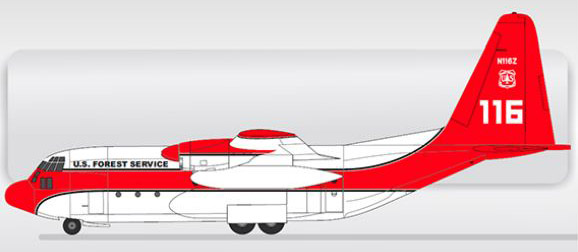
This is the US Forest Service approved paint design that will be used on the seven HC-130H air tankers acquired from the Coast Guard. The aircraft will be maintained and operated according to Coast Guard guidelines, rather than Federal Aviation Administration procedures.
After the Governor of Montana wrote a strongly worded letter to the Secretary of Agriculture complaining about what he called “nonsensical restrictions” that prohibit the use of the state’s five UH-1H helicopters on U.S. Forest Service protected lands, we started looking into the root of the problem. The former military helicopters are actually owned by the USFS, and are leased to the state under the provisions of the Federal Excess Personal Property (FEPP) program which require that the helicopters be maintained in full compliance with Federal Aviation Administration (FAA) regulations. But the Montana Department of Natural Resources and Conservation (DNRC) apparently does not hold FAA Airworthiness Certificates for the helicopters.
However, the USFS does not maintain all of their government owned aircraft in strict compliance with FAA regulations.
When we asked the USFS why the agency does not allow the non-certificated Montana aircraft to be used on USFS lands, Public Affairs Specialist Jennifer Jones, told us:
The Forest Service and the State of Montana Department have different standards and regulations to which each must adhere. Federal agencies, including the Forest Service, follow federal operational aviation safety standards that prescribe minimum specifications for the types of aircraft. These performance specifications provide an industry recognized margin of safety.
The USFS and the rules governing the loan of FEEP aircraft require the Montana helicopters to be maintained and modified according to FAA standards. Since these requirements are not met, the helicopters can’t be used on USFS fires.
Even though the USFS requires compliance with FAA procedures for their contracted air tankers and helicopters — and the state of Montana’s aircraft — the following USFS aircraft are not FAA certified, nor will they be:
Tanker 118, the HC-130H acquired from the Coast Guard that has been dropping retardant on fires this summer using a Modular Airborne FireFighting System (MAFFS). Neither the aircraft or the MAFFS have ever been certificated by the FAA.
The other six HC-130H aircraft that are being transferred from the Coast Guard to the USFS.
Four C-23A Sherpas used for smokejumping and hauling cargo.
Two AH-1 Cobra helicopters.
The eight MAFFS units used in military C-130s for fighting wildfires, and the modifications made to the C-130s so that they can use the MAFFS.
After the seven HC-130H aircraft are finished with their heavy maintenance and air tanker retrofitting, they will be owned by the USFS and maintained and operated by contractors. But they will not be brought under the FAA umbrella, according to Mrs. Jones:
The U.S. Forest Service’s firefighting mission is a Public Use mission in government owned aircraft. The Forest Service maintains airworthiness on Tanker 118 in accordance with Coast Guard maintenance standards, and the Coast Guard maintains engineering authority.
The Air National Guard and Air Force Reserve C-130s used to drop retardant with the MAFFS are maintained, modified, and operated according to military procedures.
Aircraft shall conform to an approved type design, be maintained and operated in accordance with Type Certificate (TC) requirements and applicable Supplemental Type Certificates (STCs). The aircraft shall be maintained in accordance with an FAA approved inspection program and must include an FAA approved Supplemental Structural Inspection Document (SSID), Structural Inspection Document (SID), or Instruction for Continued Airworthiness (ICA) for the airframe structure, as applicable with an ICA and Airworthiness Limitations Section (ALS) approved by the manufacturer (or equivalent) and the FAA for the airtanker role.
The USFS is not the only federal agency operating former military aircraft that bypasses the FAA. Others include the Coast Guard, NASA, and NOAA.
We asked a person in the commercial air tanker industry (who did not want their name disclosed) about the USFS not following FAA procedures:
The FAA governs the largest fleet of commercial aircraft in the world and are looked upon by foreign agencies as the golden standard. They can certify an A380 to pack 700 people but cannot certify a restricted category airtanker? The USFS is hiring a ton of ex-military people who all stick together with their other Air Force buddies and think the military is the be-all-end-all.
I think it would be fair to argue that the FAA knows much more about airtankers than the Air Force or the Coast Guard. The USCG maintenance program is not setup for an airtanker mission profile, nor is the USAF. I talked to the FAA guy who was on all the calls with the USFS about this program and he was in disbelief when they finally made the decision not to have any FAA involvement.
Tanker 44 on the Lowell Fire, July 25, 2015. Photo by Matthew Rhodes.
Matthew Rhodes sent us these excellent photos of air tankers dropping on the Lowell Fire. He said he took them July 25 near Gold Run in Placer County. Thanks Matthew!
The Lowell Fire has burned 1,700 acres 46 air miles northeast of Sacramento, California, west of Interstate 80.
Tanker 60 on the Lowell Fire, July 25, 2015. Photo by Matthew Rhodes. Tanker 60 on the Lowell Fire, July 25, 2015. Photo by Matthew Rhodes. Tanker 118 on the Lowell Fire, July 25, 2015. Photo by Matthew Rhodes. Tanker 118 on the Lowell Fire, July 25, 2015. Photo by Matthew Rhodes.