Kamov Ka-32A on standby at Loulé heliport in Portugal. Photo by Bill Gabbert August 29, 2012.
The government of Portugal will give their six Kamov Ka-32A helicopters to Ukraine to be used in Russia’s war, said Helena Carreiras, Portugal’s Minister of National Defence.
In 2006 the government spent €348 million to buy six Kamov Ka-32A helicopters which could transport personnel and drop water, but over the last 10 years have had difficulty keeping them airworthy. In January none of the six were operational. The Helicopter Investor reported that in April the Portuguese government expelled a team of Russian mechanics working on three of the Kamovs, and shut down the hangar in Ponte de Sor where the maintenance crew was working.
The sanctions imposed on Russia have made it impossible for Portugal to maintain the helicopters. At this time none of them hold airworthiness certificates, and one is inoperable due to a crash.
Carreiras said: “At the request of Ukraine and in conjunction with the Ministry of Internal Affairs, we will make available to Ukraine our fleet of Kamov helicopters which, due to the current scenario, the sanctions imposed on Russia, we are no longer able to operate.”
The condition of the helicopters is already known by the Ukrainians, and they will be “transferred as they are … as soon as possible”, said Carreiras.
The Interior Ministry of Turkey reported that two people were killed and five were injured when a firefighting helicopter crashed as it was en route to the Turkish port of Marmaris.
Personnel on the helicopter included two Russians and five Turkish citizens but the ministry did not give the nationalities of the deceased.
An official at the General Directorate of Forestry told journalists the helicopter had flown in from the northern province of Kastamonu to join others at Marmaris, a resort town on the Aegean Sea.
No cause was given for the crash which occurred in a field in the Çardak district, Denizli province.
The helicopter may have intended to assist with a large wind-driven fire in the Yalancıboğaz area of Marmaris. On Wednesday aircraft working on the blaze included 15 helicopters and 8 fixed wing aircraft assisting 500 firefighters on the ground. The fire is near a naval base which prompted the response of military personnel and equipment to assist in suppression.
Aviation Safety Network reports the helicopter was a Kamov Ka-32 operated by Avialift. It had departed from Kastamonu en route to Marmaris.
We send out our sincere condolences to the family, friends, and co-workers of the deceased and injured.
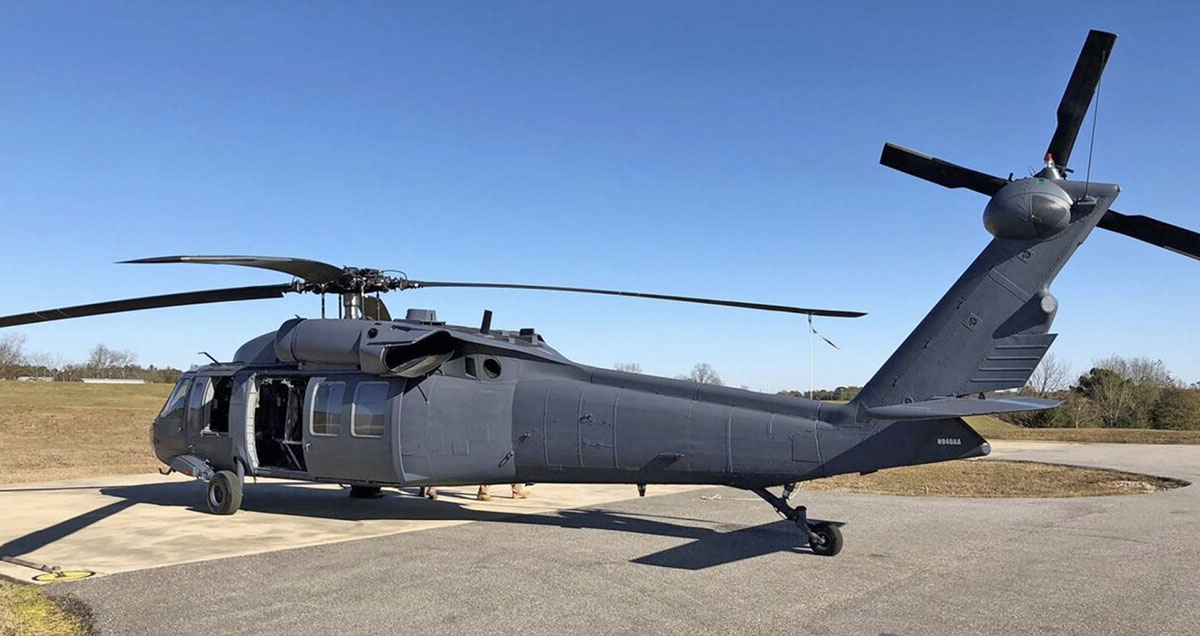
Blackhawk helicopter. Photo by Arista Aviation Services.
The Portuguese Air Force has signed an agreement to purchase six Blackhawk helicopters outfitted for fighting wildfires. The aircraft will be supplied by Arista Aviation Services, a US-based firm which specialises in modernising surplus US Army UH-60 Black Hawk helicopters.
Delivery of the first two is scheduled for the first quarter of 2023.
The contract includes the supply of material and tools, plus technical maintenance support until 2026 and training for six pilots and 21 mechanics. The UH-60 Black Hawk will allow transport of 12 firefighters and their equipment and has the capacity to carry up to 780 gallons of water.
The Expresso publication reported that the terms of the contract allow for the helicopters to be up to 35 years old. While age of the body of the ships may be measured in decades, it is possible that the helicopters have been modernized with recent technology.
In recent years a number of agencies in the United States have purchased new S-70i Blackhawks, which are given the “Firehawk” name after adding a 1,000-gallon (3,785-liter) water tank system, a raised landing gear (to accommodate the tank), and associated integrated avionics — a process that typically takes six months.
But some agencies go the UH-60 route, taking a former military helicopter and performing a similar conversion to a firefighting machine. Ventura County Fire Department in California is an example.
When I was in Portugal in 2012 working on a fire consulting project, the aerial firefighting capabilities of the country were very, very limited. There was no significant air tanker fleet or a system for providing aerial platforms for intelligence, surveillance, and reconnaissance. A problem that confronted firefighters on a large fire was not knowing exactly where the fire was or how far it had spread, which made ordering evacuations a challenge.
Kamov Ka-32A on standby at Loulé heliport in Portugal. Photo by Bill Gabbert August 29, 2012.
In 2006 the government spent €348 million to buy six Kamov Ka-32A helicopters which could transport personnel and drop water, but over the last 10 years have had difficulty keeping them airworthy. In January none of the six were operational. The Helicopter Investor reported that in April the Portuguese government expelled a team of Russian mechanics working on three of the Kamovs, and shut down the hangar in Ponte de Sor where the maintenance crew was working.
Embraer C-390 equipped with a MAFFS II. Embraer photo.
Portugal was Embraer’s first export customer for the C-390 fixed wing aircraft when it ordered five in 2019 for $930 million. Recently Embraer has successfully completed the flight test certification campaign for the Modular Airborne Fire Fighting System (MAFFS II), which provides the C-390 with the ability to drop up to 3,000 gallons water or retardant on wildfires.
Here is a collection of tweets about aerial firefighting. Most of them were brought to our attention by @jetcitystar.
Numerosos medios terrestre y aéreos intenta apagar el incendió de “El Berrueco en Sotillo de la Adrada.
Hoy a las 13:00
En concreto este en la zona llamada “Las Apreturas” pic.twitter.com/uDfdpzZj2j
Tanker 75 is France’s newest Q-400, the first of six they recently purchased. They already had two that were acquired in 2005.
✈️🚒 Il combattra demain les #FeuxDeForêts, protègera des vies et préservera nos espaces naturels : le nouveau Dash bombardier d’eau de la sécurité civile est officiellement livré, à Nîmes, sous les applaudissements de nos soldats du feu.
Je partage leur émotion et leur fierté. pic.twitter.com/51VPkUfz2T
As the U.S. enters firefighting season, Kaman is increasing K-MAX fleet support by storing spare parts on the West Coast, closer to our operators. We’re reducing transportation time when every minute counts and downtime can lead to catastrophic results. #kmax#firefightingpic.twitter.com/B2crvR3Ew5
— Kaman Aerosystems (@KAMNAerosystems) July 8, 2019
Un equipo humano de unos 500 profesionales de distintas administraciones trabajan conjuntamente en la extinción de los #IFCenicientos e #IFCadalso.
Están divididos en dos sectores de trabajo: zona Este de Cadalso y zona Oeste de Cenicientos. Cada uno con sus propios subsectores. pic.twitter.com/rK6rC7y0Is
Photographer Heath Moffatt grabbed some photos of a Kamov Ka-32A11BC being loaded onto a Volga-Dnepr Ilyushin IL-76TD in Victoria, B.C. The IL-76 used internal cranes to lift and load the helicopter which was then flown to Chile. On Christmas Eve Billings Flying Service unloaded one of their CH-47D Chinooks off a ship in Chile. Both helicopters will be working on firefighting contracts.
Kamov KA-32 at Loulé heliport in Portugal, similar to the one that crashed in B.C. Sunday. Photo by Bill Gabbert, August 29, 2012.
A Russian-built Kamov KA-32 helicopter made a crash landing in British Columbia Sunday, August 4. Jen Norie of VIH Aviation Group confirmed that one of their helicopters was conducting water dropping operations on a wildfire near Bella Colla, British Columbia using an external bucket when the aircraft developed an engine problem. The ship made a hard landing on uneven terrain collapsing at least one landing gear, which caused the aircraft to tip over about 30 degrees. The twin overhead counter-rotating main rotors struck the ground, which of course destroyed them.
Thankfully the two pilots walked away with no injuries, so in that sense it was a “good landing”. There were no passengers on board.
Ms. Norie said the company has been operating KA-32s since the mid-1990s, accumulating over 46,000 flight hours without a major incident, until Sunday.
The registration number on the Kamov was RA-31591.