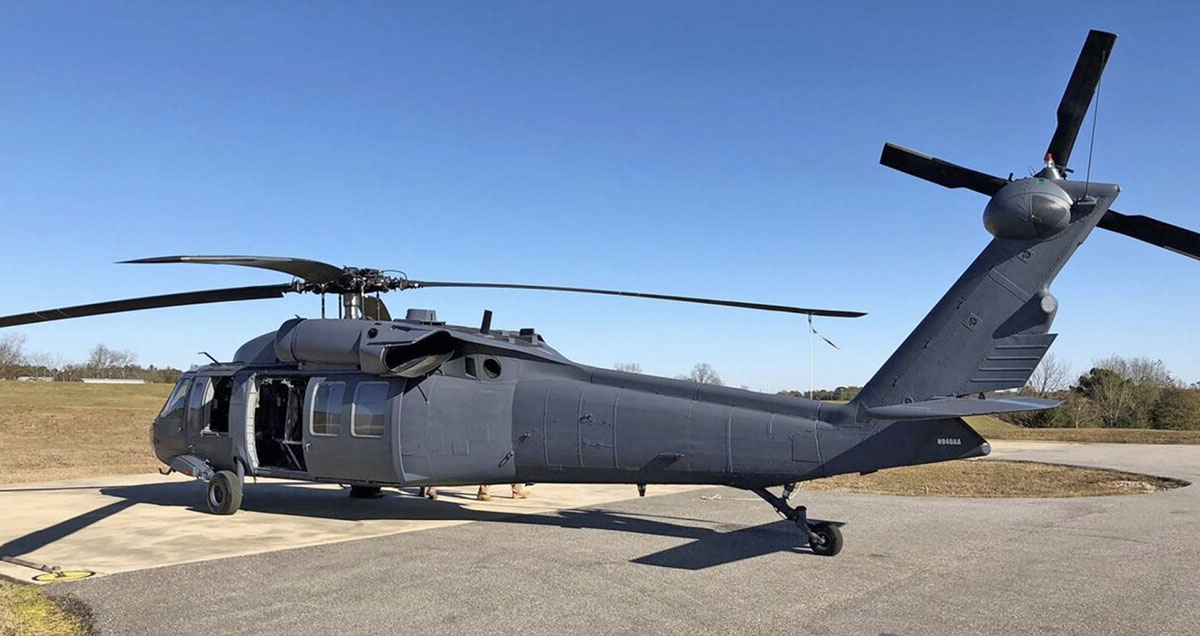
Portugal to purchase six firefighting-capable Blackhawk helicopters

Blackhawk helicopter
Blackhawk helicopter. Photo by Arista Aviation Services.

The Portuguese Air Force has signed an agreement to purchase six Blackhawk helicopters outfitted for fighting wildfires. The aircraft will be supplied by Arista Aviation Services, a US-based firm which specialises in modernising surplus US Army UH-60 Black Hawk helicopters.

Delivery of the first two is scheduled for the first quarter of 2023.

The contract includes the supply of material and tools, plus technical maintenance support until 2026 and training for six pilots and 21 mechanics. The UH-60 Black Hawk will allow transport of 12 firefighters and their equipment and has the capacity to carry up to 780 gallons of water.

The Expresso publication reported that the terms of the contract allow for the helicopters to be up to 35 years old. While age of the body of the ships may be measured in decades, it is possible that the helicopters have been modernized with recent technology.

In recent years a number of agencies in the United States have purchased new S-70i Blackhawks, which are given the “Firehawk” name after adding a 1,000-gallon (3,785-liter) water tank system, a raised landing gear (to accommodate the tank), and associated integrated avionics — a process that typically takes six months.

But some agencies go the UH-60 route, taking a former military helicopter and performing a similar conversion to a firefighting machine. Ventura County Fire Department in California is an example.

When I was in Portugal in 2012 working on a fire consulting project, the aerial firefighting capabilities of the country were very, very limited. There was no significant air tanker fleet or a system for providing aerial platforms for intelligence, surveillance, and reconnaissance. A problem that confronted firefighters on a large fire was not knowing exactly where the fire was or how far it had spread, which made ordering evacuations a challenge.

Ka-32 helicopter Portugal
Kamov Ka-32A on standby at Loulé heliport in Portugal. Photo by Bill Gabbert August 29, 2012.

In 2006 the government spent €348 million to buy six Kamov Ka-32A helicopters which could transport personnel and drop water, but over the last 10 years have had difficulty keeping them airworthy. In January none of the six were operational. The Helicopter Investor reported that in April the Portuguese government expelled a team of Russian mechanics working on three of the Kamovs, and shut down the hangar in Ponte de Sor where the maintenance crew was working.

Embraer C-390 equipped with MAFFS II
Embraer C-390 equipped with a MAFFS II. Embraer photo.

Portugal was Embraer’s first export customer for the C-390 fixed wing aircraft when it ordered five in 2019 for $930 million. Recently Embraer has successfully completed the flight test certification campaign for the Modular Airborne Fire Fighting System (MAFFS II), which provides the C-390 with the ability to drop up to 3,000 gallons water or retardant on wildfires.

Blackhawk helicopter flies for the first time without a pilot on board

UH-60 Blackhawk first autonomous flight
UH-60 Blackhawk in first autonomous flight. February 5, 2022. DARPA photo.

For at least two years Erickson Inc. has been working with Sikorsky and Lockheed Martin to develop a new pilot optional nighttime firefighting solution for helicopters, integrating Sikorsky’s MATRIX Technology into a wildfire suppression system. It would enable the S-64 Air-Crane, which was originally manufactured by Sikorsky, to fight wildland fires during the day or night. Fire Aviation first wrote about this project in February, 2020.

Sikorsky is not limiting this pilot optional capability to the Air-Crane, of course. On February 5 they completed the first of what they occasionally call “uninhabited flight” with a UH-60A Blackhawk. On the runway in Fort Campbell, Kentucky, one of Sikorsky’s pilots in a Blackhawk helicopter flipped the optionally piloted cockpit switch from two to zero, exited the aircraft, and walked across the runway.

Moments later the aircraft, identifiable by DARPA’s logo and tail number N600PV, completed a pre-flight check list, started its engines, spun up its rotors, and took off with no crew onboard. All of it happened fully autonomously.

Equipped with ALIAS (Aircrew Labor In-Cockpit Automation System), the Blackhawk began executing a 30-minute mission. To demonstrate its ability to adapt to a variety of mission environments, the uninhabited BLACK HAWK navigated at typical speed and altitude through a simulated cityscape, avoiding computer-generated buildings while route re-planning in real time.

The BLACK HAWK helicopter then autonomously executed a series of pedal turns, then maneuvered and completed a perfect landing. Once it shut itself down, the two pilots approached and reentered the aircraft. The OPV (optionally-piloted vehicle) switch was reversed from zero to two, and then the pilots taxied back down the runway.

This flight marks the first time that a Blackhawk has flown autonomously. It illustrates how ALIAS-enabled aircraft can help soldiers successfully execute complex missions with selectable levels of autonomy – and, said Lockheed, with increased safety and reliability.

We wrote last March that the helicopter which may be Erickson’s most well known Air-Crane, the one named Elvis, was being gutted down to the studs, so to speak. The company planed to rebuild N179AC as an S-64F+ that could operate without a pilot in the cockpit or autonomously.

"Elvis", an Erickson Air-Crane
“Elvis”, an Erickson Air-Crane. Credit: Erickson

Thanks and a tip of the hat go out to Tom, Rick, and Gerald.

Coulson-Unical Blackhawk spotted at McClellan

Coulson Unical Blackhawk
A Coulson-Unical Blackhawk, UH-60A, was photographed at Sacramento McClellan Airport August 14, 2019 by Mike McKeig.

As we reported in March, Coulson Aviation is partnering with Unical Air, a new unit of the Unical Group of Companies, to create a heavy lift helicopter joint venture company that will build and operate Boeing CH-47 and Sikorsky UH-60 Blackhawk aircraft for aerial firefighting and other markets.

At the HAI Heli-Expo in Atlanta, March 5, 2019, Britt Coulson explained that they intended to install internal tanks in both models of helicopters. In the last few weeks the new partnership has been working to get their first aircraft of the joint venture carded, the company said in a Facebook post August 12, when they posted the photo below:

Coulson Unical Blackhawk
Coulson photo posted August 12, 2019.

The camo paint job reminds me of Air Spray’s T-170. We’ll have to see if this makes it less visible to other aircraft when flying low and slow over a fire.

Air tanker 170 BAe-146
Air tanker 170 at MCC March 12, 2018. Photo by Bill Gabbert.

The livery on the Coulson-Unical helicopter is very different from their Blackhawk that was on display in Atlanta.

Coulson-Unical CU-47 CU-60
Coulson-Unical CU-47 and CU-60 in Atlanta March 5, 2019. Photo by Bill Gabbert.
Coulson-Unical CU-60 helicopter UH-60
The engineering design for the water/retardant delivery system on the Coulson-Unical CU-60. Coulson image.

In the video below, Mr. Coulson describes the new Chinook and Blackhawk program they are undertaking with Unical. It was filmed at the HAI Heli-Expo in Atlanta, March 5, 2019.