Air tanker pilot killed in Spain

From Waypoint Airmed & Rescue, dated May 26, 2014:

A pilot was killed when the AT802 plane she was flying crashed into a hillside during a firefighting mission in Almeria, Spain, at around 14:20 hrs on 25 May. The 40-year-old woman, named in reports as Sonia Morales Martínez, was part of an INFOCA team tackling a wildfire in the Sierra de Los Filabres in the Serón area. INFOCA released a statement of condolence to the pilot’s family, noting that she had extensive experience in aerial firefighting including over 5,000 hours’ flight time on this model of plane. She also served as a flight instructor.

Witnesses reported seeing unusual movements in the plane’s tail before it fell to the ground and burst into flames. It is believed that the pilot was killed on impact.

A Spanish language article about the accident can be found at ABCandalucia.

Our sincere condolences go out to the friends, co-workers,and family of Ms. Martinez.

Wyoming firefighter dies while taking Pack Test

(UPDATE: May 19, 2104)

Below is a news release issued today:

****

For Immediate Release

Wyoming State Forestry Division Employee Line of Duty Death

May 19, 2014

Contact: Bill Crapser, Wyoming State Forester 307-214-7843

(Newcastle, Wyo.) — The Wyoming State Forestry Division employee that died in the line of duty on May 17, 2014, in Newcastle, Wyoming has been identified as Honor Conservation Crew Supervisor Ted Drake.

Mr. Drake was participating with other employees in the annual firefighter work capacity test (pack test when he suffered a heart attack and attempts to revive him on scene were not successful.

Mr. Drake was 63 years old and had worked for the Wyoming State Forestry Division as a Crew Supervisor since June 2006.

“The Wyoming State Forestry Division is deeply saddened by this tragic event,” Bill Crapser, Wyoming State Forester said. “Our hearts go out to his family, friends and co-workers. The support from the fire service in Wyoming and the wildland fire service nationally is greatly appreciated.”

According to the Billings Gazette Mr. Crapser said Mr. Drake was the first worker to have died in service to the department since it came into existence in 1952.

A memorial service for Mr. Drake will be held Tuesday at Newcastle Assembly of God church.

****

(Originally published May 18, 2014)

The Billings Gazette is reporting that a firefighter with the Wyoming State Forestry Division died Saturday, May 17 while taking the Pack Test.

The man, whose name has not yet been released, suffered an apparent heart attack during the test, and attempts to revive him were unsuccessful. The test requires that a person walk three miles in less than 45 minutes while carrying a 45-pound pack.

Wyoming State Forester Bill Crapser said in a press release, “The Wyoming State Forestry Division is deeply saddened by this tragic event. Our hearts go out to his family, friends and co-workers.”

Our sincere condolences go out to the firefighter’s friends, family, and co-workers.


Thanks and a hat tip go out to Chris.

Firefighter dies fighting his own fire

The Lac La Biche Post reports that a 70-year old volunteer firefighter in Rich Lake, Alberta died May 12 while fighting a vegetation fire at his residence.

…According to a press release from Lac La Biche County, the man reported a grass fire at his residence before attempting to extinguish it. A County peace officer arrived at the scene to find the man, who had recently suffered cardiac arrest.

“We are very saddened by this tragic event,” Acting Mayor Robert Richard said in the release, which described the man as a long-serving, respected local volunteer firefighter and did not reveal his name before family members were notified. “Our thoughts and prayers are with the family during this difficult time.”

The person has not been identified yet, but our sincere condolences go out to the family.

Firefighter fatality map

NIOSH has created an interactive mapping system that enables a web site visitor to configure and view a map showing the locations of firefighter fatalities. The U.S. Fire Administration data, for the years 1994 through 2013, can be manipulated with numerous variables, including wildland fire and the year.

Unfortunately, the way the data is displayed is not consistent. Some multiple-fatality incidents are represented by a purple arrow with the number of fatalities. A quick look found, for example, that the 14 fatalities on the 1994 South Canyon Fire are represented by an icon that usually indicates a single fatality, and it does not include a number. In addition, it is not placed in the correct location in west-central Colorado.

Maybe it is a work in progress.

Below are a couple of examples of maps that can be produced. The first shows wildland fire fatalities in 2013 and the next is from 1994 through 2013.

NIOSH Fire Fighter Fatality Map, 2013 NIOSH Fire Fighter Fatality Map, 1994- 2013In spite of the bugs, which hopefully will get worked out, NIOSH should be congratulated for putting together this tool which could be very useful.


Arizona firefighter dies while taking pack test

On Saturday, March 8, 61-year old  volunteer firefighter Bobby Mollere of the Hellsgate Fire Department in Star Valley, Arizona collapsed and died while taking the pack test version of the Work Capacity Test, which requires a person to carry a 45-pound pack for three miles in less than 45 minutes. The cause of death was listed as “stress/overexertion” and heart attack.

Below is the official notice from the U.S. Fire Administration:

While performing a Wildland Pack Test, Lieutenant Mollere collapsed on the Payson High School track. Fellow firefighters on scene initiated a medical assessment and found Mollere in cardiac arrest. The EMTs and Paramedics began advanced life support immediately on scene. Lieutenant Mollere was transported to the Payson Regional Medical Center where resuscitative efforts continued until he passed away. Incident Location: Payson High School track, AZ (U.S. National Grid: 12S VC 6952 8857)

Our sincere condolences go out to Mr. Mollere’s family, friends, and fellow firefighters.

Previously we have written about other fatalities and serious injuries that occurred while taking the Pack Test. Federal land management agencies and some other organizations require that their on-the-ground firefighters pass the test once a year in order to be qualified to fight wildland fires.

Laguna Hot Shots taking Pack Test
File photo of the Laguna Hot Shots, based at Descanso, California, taking the Pack Test while wearing weighted vests. Photo by Laguna Hotshots.

Wildfire briefing, March 3, 3014

Wildland firefighter dies in Tennessee

A wildland firefighter with the Tennessee Division of Forestry became ill and died while preparing to respond to a vegetation fire in Tennessee. Jerry Campbell, 61, collapsed while getting ready to deploy to a wildfire in the Cherokee National Forest Friday night. He was transported to the Newport Medical/Tennova Healthcare Center where he was pronounced dead at 1:45 a.m. Saturday morning.

Our sincere condolences go out to Mr. Campbell’s family and coworkers.

Wildlife or wildfire?

Sanibel boat fire
Boat fire south of Sanibel Island

Occasionally people who are not that familiar with wildland fire write or say “wildLIFE” when they mean “wildFIRE”. An article in Florida’s Cape Coral Daily Breeze reported that a boat from the “Fish & Wildfire Commission” responded to a boat fire three miles south of Sanibel Island in the Gulf of Mexico on March 3. But in a subsequent paragraph they referred to a craft from “Fish and Wildlife”.

John N. Maclean teaches course in Iowa

John N. Maclean will be teaching a week-long course in northwest Iowa in May about the history of wildland fire, from the Big Burn of 1910 to the Yarnell Hill Fire of 2013. The Iowa Lakeside Laboratory, a biological field station administered through the University of Iowa, will be offering the new course with a working title of “Causes and Consequences of Fatal Wildfires” offered by Mr. Maclean, author of “Fire on the Mountain” and three other books on wildfire. Scholarships for room and board are available. More information.

Tractor plow fatalities

Tractor plow
Tractor plow at the 2002 Blackjack Bay Fire, Okeefenokee NWR, Florida and Georgia. Photo by Bill Gabbert

We did some research on the history of line of duty deaths involving the operators of tractor plows while working on fires.

Tractor plow fatalities

Most, but not all, of the incidents are listed in the NWCG publication “Historical Wildland Firefighter Fatalities 1910 – 1996”.

1998 Arkansas tractor plow fatality
The site of the 1998 tractor plow fatality in Arkansas. NIOSH photo.
Tractor plow at 2002 Blackjack Bay Fire, Okeefenokee
The underside of a tractor plow at the 2002 Blackjack Bay Fire, Okeefenokee NWR, Florida and Georgia. Photo by Bill Gabbert

Line of duty death in Mississippi

A Mississippi firefighter died while fighting a wildfire in Amite County in southern Mississippi (map) on Saturday, February 1. According to the Enterprise-Journal, Dwight Hilton, 57, of the East Fork community ” ‘had some type of medical issue. He went into cardiac arrest,’, said East Central Volunteer Fire Department Chief Cam Sharp, who also is the county coroner. An ambulance took Hilton to Southwest Mississippi Regional Medical Center, where he was pronounced dead at 2:24 p.m. ‘He died in the line of duty,’ Sharp said.”

The incident occurred while firefighters were suppressing a vegetation fire that ultimately burned less than 10 acres.

Mr. Hilton was a long time member of the East Central Rural Volunteer Fire Department, which was assisting the Liberty Rural VFD.

Arson is suspected, according to Murry Toney, the Amite County arson investigator. The fire started in three different places, Mr. Toney said.

Jones Family Funeral Service of McComb will be handling the final arrangements.

Our sincere condolences go out to the family and fellow firefighters.

Measuring the severity of a fire season

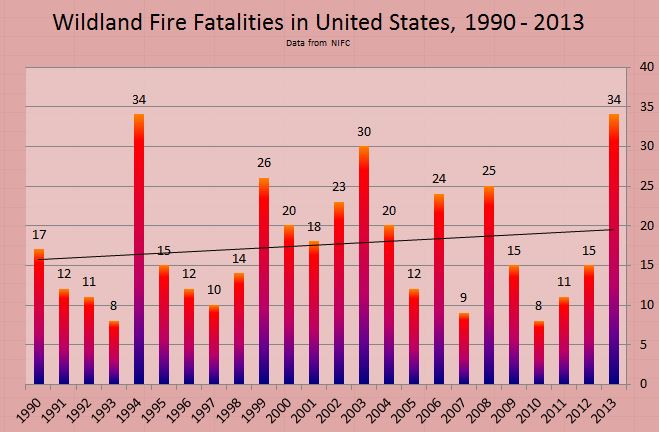
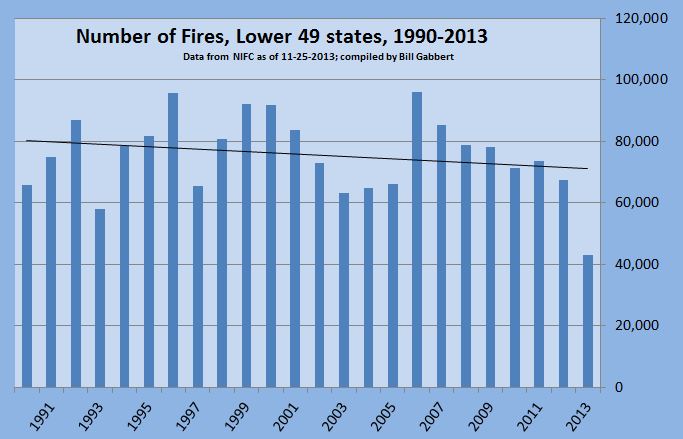
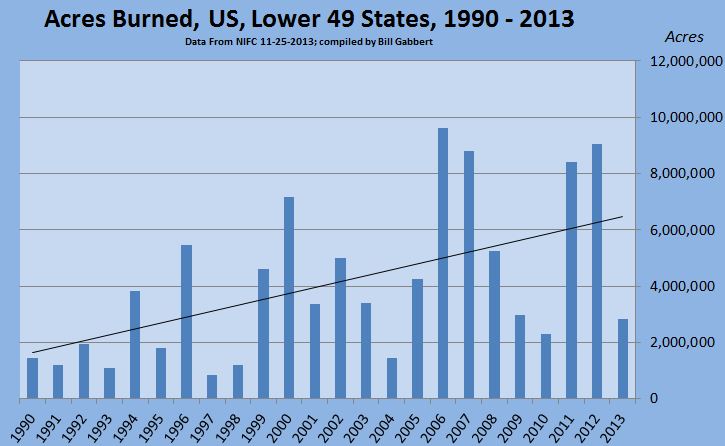
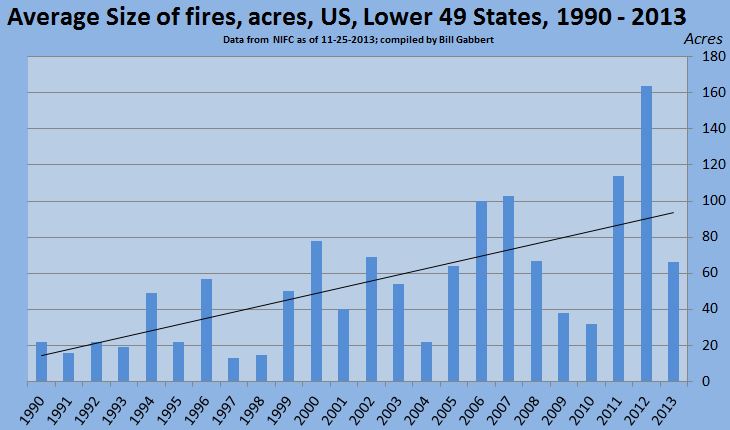
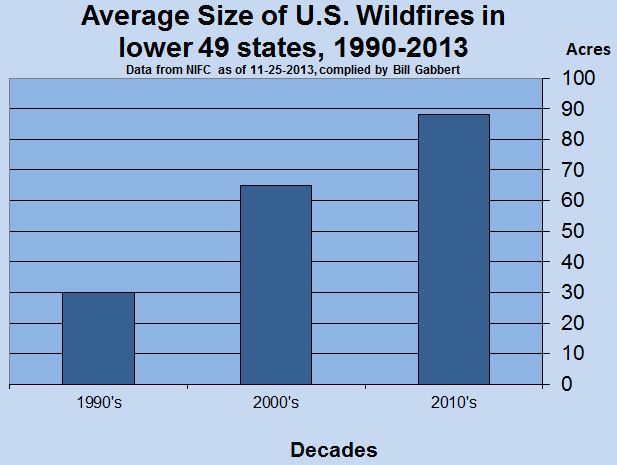
By some measures the 2013 wildfire season in the United States was less severe than usual. In the lower 49 states this year to date there has been a decline in the number of fires, the number of acres burned, and the average size of fires. Sounds pretty good so far, right? But there was a sharp rise in the number of firefighters that were killed on fires — 34 so far this year.

Wildland Fire Fatalities 1990 through 2013

Not only did the number of fatalities more than double over last year, according to the data from the National Interagency Fire Center, but the linear trend shows an increase since 1990. The wildland fire fatality statistics from the Federal Emergency Management Agency and the U.S. Fire Administration show even higher numbers for most years.

Of course more than half of the fatalities this year occurred on one fire, the Yarnell Hill Fire which killed 19 members of the Granite Mountain Hotshots. But if that terrible tragedy had not happened, there would still have been 15 fatalities, the same number from the previous year. Between 1990 and 2013 to date the average number of wildland fire deaths is 18 each year.

We can do better. We have to do better.

More wildfire statistics:

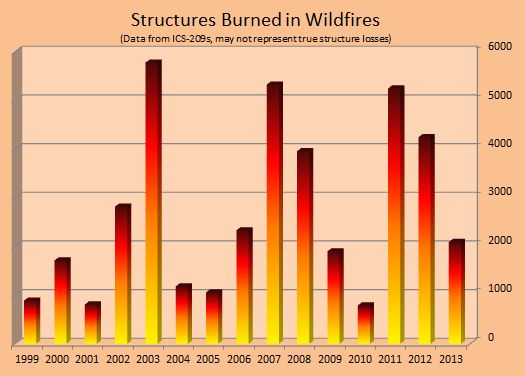
Structures lost in wildfires, 2009 to 11-25-2013

Below are some statistics on wildland fire occurrence in the United States from 1990 through today. The numbers are for the lower 49 states, which excludes Alaska, a state that in 2013 to date has had 609 fires that blackened 1,319,234 acres, about half the number of acres that burned in the other 49 states. Fire management in Alaska is very different from the rest of the country. Some fires there are aggressively suppressed, but many fires are not staffed at all, some are fought with small numbers of firefighters, and others only get attention in areas where a remote cabin is threatened. Including Alaska numbers with the rest of the country would skew the trend analysis.

Number of wildfires, lower 49 states, 1990 - 2013

Acres burned lower 49 states, 1990 - 2013

Average size of wildfires, annually, lower 49 states, 1990-2013

Average size of fires by decade, lower 49 states, 1990 - 2013

Learning Review released for smokejumper fatality

A report called a “Learning Review” has been released for the Luke Sheehy fatality, the smokejumper who was killed by a falling limb while suppressing a wildfire on the Modoc National Forest in northeast California on June 10. In addition to the primary report an additional document with supporting information, including some mind-numbing charts, was released.

The objective as stated in the document was to “understand the rationale for the actions/decisions involved in the incident and then, if possible, to learn from them”.

Frequently at Wildfire Today we will write a summary and then our analysis of serious accident reports, but this particular document is very different from the traditional report. It adopts the new paradigm of leaving out conclusions and recommendations, a process that began to be etched into stone in August when the Serious Accident Investigation Guide was revised. This Learning Review claims that “conclusions can sometimes close the door on learning”. I would say on the other hand that they can more frequently open the door to an enhanced safety environment for firefighters. People can sometimes be hit by meteorites, but not often.

And like virtually every research paper, most of the recommendations are for additional studies, ensuring continued employment for academics and researchers.

Call me old school, but this document appears to be more useful for human behavior researchers than firefighters. How did we get to the point where language such as this is used repeatedly in a U.S. Forest Service funded official report about a wildland fire?

  • “Typical mission flow”
  • “Synthesis, analysis and sensemaking”
  • “Margin of maneuver”
  • “Sensemaking team”
  • “Single Loop vs. Double Loop Learning”
  • “Hoberman Sphere”
  • “Pressures and filters”
  • “Mind maps”
  • “Auditory signal”
  • “Signal detection”

The Learning Review does suggest that two additional products be prepared, one for “the field” and another for “the organization”. Maybe the field document, if produced, will be more useful for firefighters. And presumably the organization version will have conclusions and recommendations that will remain secret if the guidelines revised in August are followed.

I am not sure why the U.S. Forest Service paid the 22 people, plus multiple focus groups, to produce this study if they did not receive for their investment products usable by the field or the organization.

But I am old school when it comes to opportunities for learning lessons.