Ryan Grothe captured for us several terrific photos of a San Diego County wildland drill between April 30 and May 2 in Chula Vista. Several fire and law enforcement agencies participated and training included shelter deployments, structure protection, wildland hose lays, and radio communications.
A San Diego Fire-Rescue helicopter made numerous water drops, along with a few simulated hoist rescues.
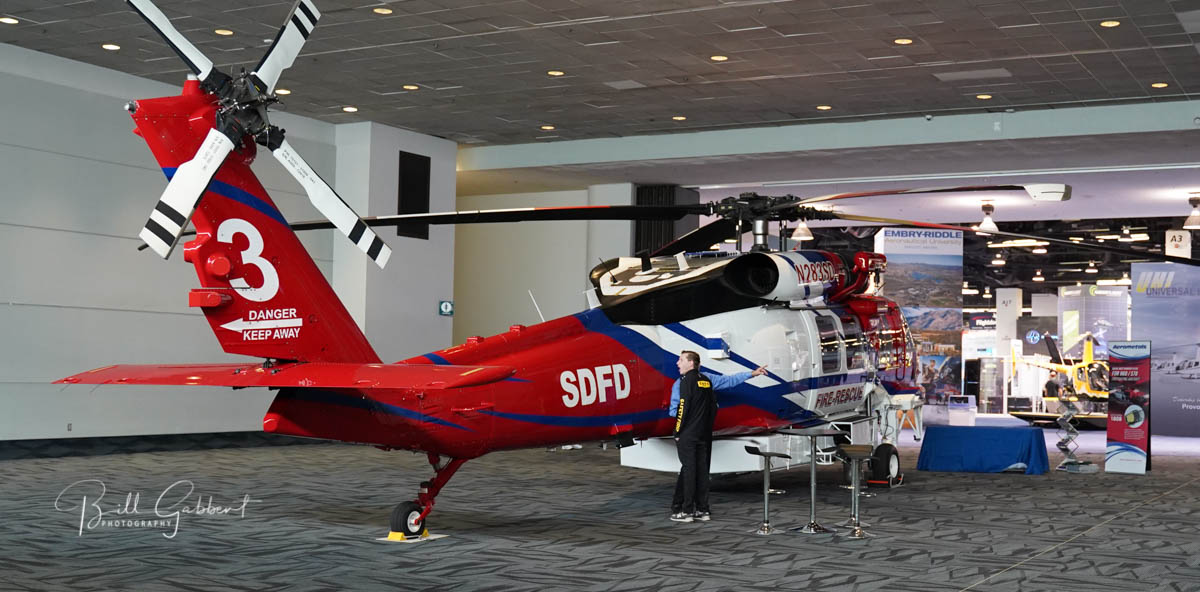
This event is held annually;. San Diego Fire Rescue operates a Sikorsky 70i Firehawk and they have recently purchased a Bell 412 EPX, expected to be delivered sometime toward the end of this year. Once it arrives, the new Bell will go to Hangar One at Palomar Airport for installation of avionics.
The San Diego County Sheriff’s Department and the San Bernardino County Sheriff’s Department this week acquired Bell 412EPX helicopters, adding to their airborne resources for emergency response. Three SUBARU Bell 412EPX helicopters were delivered, two to San Bernardino County and one to San Diego.
The Bell 412EPX has an internal weight of 12,200 lbs., external weight of 13,000 lbs., and the ability to carry 5,000 lbs. with its cargo hook.
In San Diego, the Sheriff’s aviation unit, Aerial Support to Regional Enforcement Agencies (ASTREA), completes nearly 6,000 public safety missions each year with its all-Bell fleet of emergency response helicopters, including four Bell 407GXis, three Bell 205s, and its newest addition of a SUBARU Bell 412EPX. ASTREA plans to use its new ship in conjunction with Cal Fire responding to wildfires in the region.
“We are working hard to have crews trained and ready for the upcoming fire season,” said Deputy Gary Kneeshaw, a pilot with San Diego County. “We have found the SUBARU Bell 412 EPX to be a very capable aircraft that is delivering on its promises.”
San Bernardino County is the largest county in the United States — over 20,000 square miles — and its Sheriff’s Department will use its two Bell 412EPX helicopters for law enforcement and emergency response including wildfires and search-and-rescue ops. Over 50 years ago, the Sheriff’s Aviation Unit began operations with two Bell 47Gs; the fleet now includes 17 aircraft.
“Our Air Rescue program is a critical component to providing safety to the residents of San Bernardino County,” said Lieutenant Brian Chambers with the Sheriff’s Department.
Fire photographer Ryan Grothe attended a San Diego County Sheriff’s Department press conference last week as officials showed off their new firefighting helicopter. Sheriff Kelly Martinez introduced the new fire helicopter and a patrol helicopter, a $21 million investment for the two, at the Aerial Support to Law Enforcement Agencies base in El Cajon.
Bell 412EPX photo by Ryan Grothe
The 2023 Bell 412EPX is equipped with a 375-gallon tank that can drop water or foam. The helicopter can seat 14 people. The crew will include a deputy pilot, a CAL FIRE captain, and a paramedic. There can be seven firefighters seated in the back for fires.
San Diego County’s new Bell 412EPX helicopter is equipped with a 375-gallon tank for water or foam fighting fires. Photo by Ryan Grothe
This is the newest helicopter for the San Diego County Sheriff’s Department. With a cruise speed of 230 km/h (142 mph) and a range of 672 km (417 miles), the Bell 412EPX has the capability for long-range duty at impressive speed.
Cost of the helicopter was $15.7 million, using the department’s budget and funds from Proposition 172 (PDF) — the Local Public Safety Protection and Improvement Act of 1993. Tony Mecham, County Fire and CAL FIRE San Diego Unit Chief, said the acquisition will improve response to both wildfires and remote area rescues.
The new patrol helicopter is the Bell 407GXi, which is dedicated to law enforcement operations 24 hours a day. It includes a flight deck with precision navigation to track and respond to incidents and is equipped with a bucket to help with water drops on a fire.
This begins the phasing out of the current fleet of three Bell 205s which were built in the 1960s. The county plans to order two more 412EPX helicopters in the future.
All deputy pilots will complete ground and flight training as well as safety and familiarization training with the new helicopter before the 412 begins flying next year.
San Diego County’s new Bell412. Photo by Ryan Grothe.
Helicopter Terrain Avoidance Warning System (H-TAWS) capability
Power Situation Indicator (single indicator for quick pilot monitoring)
Automatic Dependent Surveillance-Broadcast (NextGen, Standard ADS-B out, Optional ADS-B in)
LED cockpit lighting and panels
The 412 is a twin-engine helicopter that enables a pilot to land safely with a backup engine in the event of an engine failure. This is a key safety feature in fighting fires at night, which is planned for future operations. There is a contract in place with the City of San Diego for nighttime firefighting.
July 2022 in San Diego on the Margerum Fire — City of San Diego’s Copter 2, a Bell 412, making water drops. The fire threatened homes on Margerum Avenue near Navajo Road but was held to just 2 acres. Ryan Grothe photo
The Aerial Support to Regional Enforcement Agencies (ASTREA) base has provided support to the Sheriff’s Department and partner agencies across the county since 1971. ASTREA averages nearly 6,000 missions annually supporting patrol and fire and rescue calls throughout the region.
Josh Stotler sent us a collection of images he shot on recent incidents in southern California; San Diego County was dealing with a string of brushfires that kept aircraft and crews busy for a while. Of course there’s not a “season” with a defined start and end in southern California, but it looks like the helicopters and crews with San Diego Gas & Electric (SDG&E) and San Diego County are off to a good start for the summer.
SDG&E Helitanker 729 banks to get a better view of the drop zone while coordinating with ground crews at the Wildcat Fire on the Barona Indian Reservation south of Ramona, California.
San Diego Sheriff’s Helicopter 10 makes a low water drop at the Blackwood incident on the tribal land of the Campo Reservation in Pine Valley, California.
San Diego Sheriff’s Copter 10 surveys the drop zone of the Wildcat Fire in unincorporated San Diego.
San Diego Helitack crew, based out of Gillespie Field in El Cajon, packs up after fighting the Wildcat Fire on the Barona Reservation in eastern San Diego County.
San Diego Helitack firefighter Dakota Armstrong acts as spotter as Deputy/Pilot Tony Webber prepares to lift off from the LZ after the Wildcat Fire in eastern San Diego County.
SDG&E Helitanker 729 makes a drop on target as handcrews cut brush below, trying to halt flames of the Wildcat Fire in eastern San Diego County.
THANKS JOSH for the excellent images … and thanks to the pilots, crews, and other personnel for your quick slapdowns on these brushfires. Stay safe out there.
Josh Stotler is an East County native and freelance photojournalist with over 20 years of fire service experience.
A wildfire that started this afternoon in northwest Mexico just south of the California border burned into the U.S, followed by a response from Cal Fire crews.
CBS8 News reported that Cal Fire San Diego launched several aircraft to initial attack a brushfire when it burned across the border at Dulzura; Cal Fire got reports just before 1 p.m. of a 20-acre fire near Border Road and Marron Valley Road. Firefighters reported gusty winds in the area.
Cal Fire San Diego said the Border 14 Fire was burning in the Copper Canyon area with about 2 acres burning on the U.S. side of the border.
June 12, 2023 (San Diego’s East County) — As the longer, warmer days of summer approach, San Diego braces for an all too familiar phenomenon: wildfire.
According to Cal Fire, eastern San Diego County experiences an average of 192 wildland vegetation fires per year, burning 5,843 acres — and that number is increasing with each new season. Thankfully, 95 percent of these incidents are contained at 10 acres or smaller, a target that local and state fire agencies strive to uphold. The wildland/urban interface grows larger every year, as San Diegans build further and further into the eastern parts of the county.
When it comes to wildfire, it is important to be alert, informed and prepared. This article will help answer some important questions as well as introduce you to some of the agencies and resources that make San Diego one of the most prepared places on earth when it comes to wildfire.
It’s late afternoon. It’s hot and dry and there is a slight wind blowing. A hint of smoke wafts through a neighborhood just off Interstate 8 in East County. It’s not long before a plume of smoke is hundreds of feet high and can be seen for miles. Calls to 911 pour in as residents realize something is terribly wrong. An ember from a poorly extinguished campfire has blown into a grove of pine trees; the ground is thick with dead needles and a fire is born. Bark beetles have destroyed the water-starved trees, turning them into the perfect vehicles to spread a growing fire; tall brush is abundant from the unseasonal rains that spring brought — the perfect recipe for disaster. Alarms ring at a local fire station, and dispatch alerts firefighters of a “vegetation initial attack.”
Often, the initial attack units will be able to handle a small, slow-moving fire with minimal fuel, but that’s not the case here. Initial responders call in a large fire in steep foothills covered in heavy fuel with a fast rate of spread. Alarms go off all over the county as engines, brush units, hand crews, attack aircraft, bulldozers, and law enforcement personnel are dispatched to the incident. All of these assets are carefully coordinated and assigned to aggressively attack the fire and establish a containment perimeter.
Through a partnership with CAL FIRE that started in 2005, the San Diego Sheriff’s Department’s ASTREA (Aerial Support to Regional Enforcement Agencies) unit provides San Diego County with among its most valuable resources: three Bell 205 fire/rescue helicopters. Staffed with a Sheriff’s pilot and full CAL FIRE Helitack crew, these units pair law enforcement with fire personnel aboard a mixed-crew helicopter. This arrangement has proven very successful in immediately putting crews on the ground and water on a fire.
San Diego County Fire includes the San Diego County Fire Protection District and CAL FIRE San Diego working under a cooperative agreement; 35 stations scattered throughout the county ensure extended around-the clock-protection of 1.5 million acres of unincorporated San Diego County. Around 500 first responders on staff uphold the mission to “coordinate, regionalize, and improve fire protection and emergency response services provided to the unincorporated areas of San Diego County.”
San Diego Gas & Electric Co.
In addition to providing San Diego with gas and power, SDG&E has expanded its role to include firefighting and incident command capabilities. SDG&E has added some very high-tech units to its fleet: an S-60 Blackhawk helicopter, which can reach 140 mph and carry 850 gallons of water, an Erickson Aircrane that can deliver 2,650 gallons, and three Incident Support Vehicles. Within minutes, SDG&E can have firefighting aircraft in the area with the capability to relay information to first responders and fire managers.
Whether you are in El Cajon or Alpine, Ramona or the Cleveland National Forest, there are firefighters and other first responders ready and willing 24 hours a day to respond to a wildfire call. What are some things you can do to prepare for fire season? CAL FIRE Capt. Mike Cornette offers some advice.
“Ready, Set, Go is what we would like our residents to know,” he says. “We need to be ready by creating defensible space and hardening the home against embers. Getting set includes making a wildfire action plan, assembling an emergency supply kit, and signing up at AlertSanDiego. Go and go early when wildfire strikes. The earlier you are able to leave the better — it ensures you get out safely and frees up roadways for emergency responders.”
Through a partnership with CAL FIRE, the Resource Conservation District of San Diego County, and local Fire Safe Councils, no-cost chipping and defensible space assistance can be provided to local residents. Check out the details at ReadyForWildfire.org or firesafesdcounty.org
Creating a defensible space around your property and home is vital to improving the survivability of your home in a wildfire situation. There are other factors that most of us don’t think about when it comes to preventing wildfires, too. Capt. Cornette says, “You may be doing the right things the wrong way.” He explains, “You should try to use your mower no later than 10 a.m. — and never when it’s windy. Metal blades can cause a spark that can create a fire. Always maintain your equipment and never fuel your equipment in grass or brush. Keep a fire extinguisher or hose nearby. Do not drive in tall grass or drag trailer chains — and keep your cell phone with you at all times. In case of emergency, call 911 immediately.”
Something new this year is the authorization for emergency vehicles in California to use the “Hi-Lo” siren tone to alert citizens that they are in immediate danger and need to evacuate. The European type two-tone siren is easily identifiable, is different from the normal response siren, and sends a clear message: “When you hear the Hi-Lo, it’s time to go.” Take some time today to check your evacuation plan, update your emergency kit, and ensure your home is within county guidelines for fire safety. A little planning and common sense can mean the difference between being prepared for wildfire season and finding yourself in real trouble. If you have questions regarding wildfire preparedness, contact your local fire agency.
Josh Stotler is an East County native and freelance photojournalist with over 20 years of fire service experience. Many thanks to him for this feature, first published by East County Magazine.
San Diego Fire Rescue Helicopter 2, a 412EP (N282SD), drops on a wildfire in San Diego, July 22, 2022. Photo by Ryan Grothe.
Friday morning firefighters from San Diego Fire Rescue made quick work of knocking down a fire in the city’s San Carlos neighborhood. Working with the department’s Helicopter 2, a Bell 412EP, they stopped the spread at about two acres.
San Diego Police officers briefly informed residents on southbound Navajo Road, between Park Ridge Boulevard and Margerum Avenue, to evacuate, but that was lifted after about half an hour.
Thanks go out to Ryan Grothe for these photos.
San Diego Fire Rescue Helicopter 2, a 412EP (N282SD), drops on a wildfire in San Diego, July 22, 2022. Photo by Ryan Grothe.
San Diego Fire Rescue Helicopter 2, a 412EP (N282SD), drops on a wildfire in San Diego, July 22, 2022. Photo by Ryan Grothe.
San Diego Channel 8 shot aerial video of the fire. You can see the helicopter dropping water at the beginning and again at 3:20.
San Diego County Sheriff helicopter 12 drops on a wildfire in Oceanside, CA June 29, 2022. Photo by Ryan Grothe.
Ryan Grothe got some additional photos of San Diego County Sheriff Office helicopters yesterday as they dropped on a small wildfire in Oceanside, California that started near train tracks.
The Sheriff’s Office has two Bell 205A-1 ships used for firefighting and other missions — H-10, N449BZ manufactured in 1973; and H-12, N107BZ manufactured in 1968.
San Diego County Sheriff helicopter 12 drops on a wildfire in Oceanside, CA June 29, 2022. Photo by Ryan Grothe.
San Diego County Sheriff helicopter 10 drops on a wildfire in Oceanside, CA June 29, 2022. Photo by Ryan Grothe.
In addition to the San Diego County Sheriff’s helicopters, San Diego Fire Rescue has a new Sikorsky S-70i. After being retrofitted by United Rotorcraft it was delivered at Montgomery Field (map) November 23, 2019. It is now known as a Firehawk after being reconfigured with an aerial firefighting mission package including extended landing gear, a 1,000 gallon firefighting tank, and a retractable snorkel system. The FAA registration number is N283SD.
San Diego Fire Rescue has two other helicopters that assist firefighters, a Bell 212 (N800DM) and a Bell 412EP (N807JS) manufactured in 1980 and 2008, respectively.
San Diego Fire Rescue Helicopter 3 helping to locate a swimmer off Mission Beach, June 15, 2022. Ryan Grothe.
On Tuesday three swimmers off Mission Beach near San Diego were in distress, having trouble staying afloat. Lifeguards rescued two, but the third was not found. On Wednesday the search transitioned to a recovery. Units involved included Helicopter 3 from San Diego Fire Rescue, three lifeguard rescue vessels, and scuba divers for a total of 18 personnel.
Ryan Grothe took the opportunity to get additional photos of San Diego Fire Rescue’s Firehawk helicopter. Thanks Ryan!
San Diego Fire Rescue Helicopter 3 helping to locate a swimmer off Mission Beach, June 15, 2022. Ryan Grothe.


 SDG&E Helitanker 729 banks to get a better view of the drop zone while coordinating with ground crews at the Wildcat Fire on the Barona Indian Reservation south of Ramona, California.
 San Diego Sheriff’s Helicopter 10 makes a low water drop at the Blackwood incident on the tribal land of the Campo Reservation in Pine Valley, California.
 San Diego Sheriff’s Copter 10 surveys the drop zone of the Wildcat Fire in unincorporated San Diego.
 San Diego Helitack crew, based out of Gillespie Field in El Cajon, packs up after fighting the Wildcat Fire on the Barona Reservation in eastern San Diego County.
 San Diego Helitack firefighter Dakota Armstrong acts as spotter as Deputy/Pilot Tony Webber prepares to lift off from the LZ after the Wildcat Fire in eastern San Diego County.
 SDG&E Helitanker 729 makes a drop on target as handcrews cut brush below, trying to halt flames of the Wildcat Fire in eastern San Diego County.