
The UH-1H crashed August 19, 2020
Continue readingA look at the Ventura County helicopters
 The first time that Ventura County Copter 2 was used on a wildfire, June 10, 2020. Photo by John Carman.
Ventura County, between Los Angeles and Santa Barbara, has an air unit which is a cooperative enterprise of the Fire District and the Sheriff’s Office. The unit has four Bell UH-1 helicopters and one Bell Long Ranger. In addition, they purchased three military HH-60L Blackhawk helicopters in order to convert them into FIREHAWKS to be used for fighting wildland fires, personnel transport, search and rescue, law enforcement, and medical evacuation.
 Ventura County Copter 5. Ventura County is converting military HH-60L Blackhawks into FIREHAWKS. VCSO photo, Capt. Romano Bassi January, 2019
 Ventura County Copter 8. Photo by Ventura County Air Unit
 Ventura County Copter 8. Photo by Ventura County Air Unit
 Ventura County Copters 6, 8, 9, and 2. Photo by Ventura County Air Unit
 Ventura County Copter 3. Photo by Ventura County Air Unit
Summarizing the aerial firefighter line of duty deaths during a recent 49-day period
May they rest in peace
Continue readingPilot killed in crash of firefighting helicopter near Coalinga, California
August 19, 2020 | 5:12 p.m. PDT
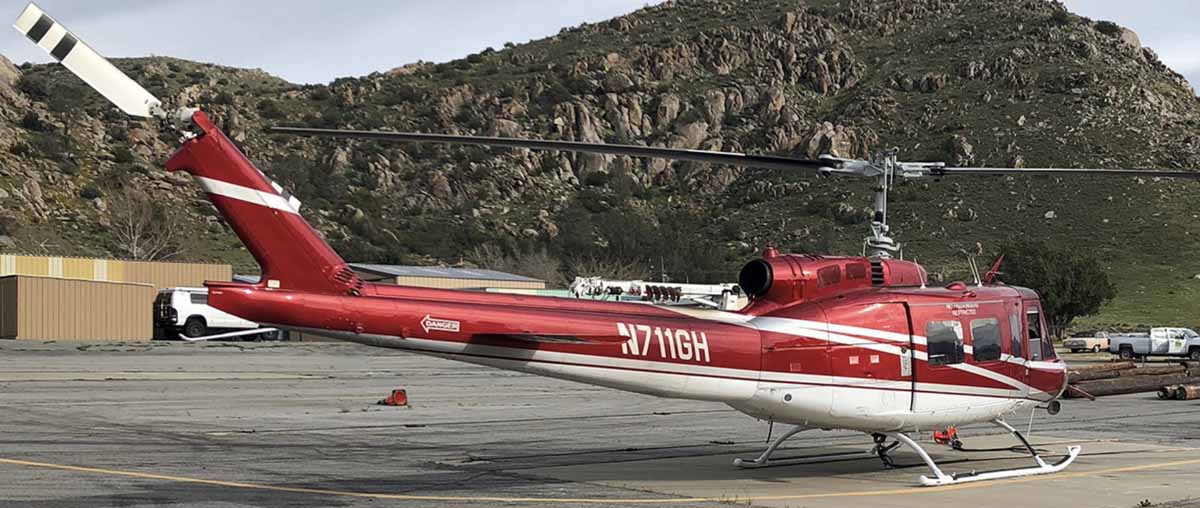 N711GH, Guardian Helicopters photo.
A pilot was killed August 19 in the crash of a helicopter while working on the Hills Fire, approximately 9 miles south of the City of Coalinga. Air and ground resources responded immediately to the crash site which was in rugged terrain. The pilot was the only person aboard and the name has not been disclosed. Local TV station ABC30 said the helicopter was on a water dropping mission. (UPDATE: the pilot was identified as Mike Fournier, 52, of Rancho Cucamonga, California.)
CAL FIRE released the information about the crash, saying the National Transportation Safety Board is leading the investigation and CAL FIRE is assisting.
Zoe Keliher, a spokesperson for the NTSB, said the helicopter will be recovered August 20 and moved to a location for further examination. She confirmed that the registration number of the aircraft is N711GH.
Personnel with the FAA said the aircraft crashed around 10 a.m. Wednesday and the accident started a new fire.
FAA records show that it is a Bell UH-1H manufactured in 2009 and owned by Guardian Helicopters, Inc. of Van Nuys, California.
The Hills Fire started Saturday and has burned about 1,500 acres. ABC30 said the fire started by the crash will likely burn into the Hills Fire.
We send out our sincere condolences to the family, friends, and co-workers of the pilot.
Thanks and a tip of the hat go out to Pamela, Jim, and Douglas.
Orange County plans to upgrade helicopter fleet
And, background on how the helicopter crews for Orange County Sheriff’s Department and Fire Authority have divided the responsibilities for rescues
Continue readingAustralian Navy recovers helicopter from reservoir
The UH-1H helicopter ditched while working on a bushfire
Continue readingHelicopter ditches in lake while fighting bushfire in Australia
The pilot swam to shore and was taken to a hospital
Continue readingWashington DNR prepares helicopter fleet for wildfire season

Above: One of Washington DNR’s UH-1H helicopters. Washington DNR photo.
The Washington Department of Natural Resources is getting their fleet of eight helicopters ready for the coming wildfire season. The agency began acquiring their military surplus UH-1H (B-205) ships in 1989.
The DNR started their helicopter program in the 1960’s with two Bell-47’s used for recon and carrying a 50-gallon water bucket which was designed by one of their pilots, Harold Clark. By the mid-1970’s the Kaman Husky, which could carry up to 450 gallons, replaced the Bell-47’s. Those six Kaman’s were phased out in the late 1970’s due to a shortage of spare rotor blades and the availability of the more reliable and faster Huey UH-1B, which were replaced by the UH-1H about 10 years later.
 A Washington DNR Kaman Husky from the 1970’s. It had interlocking rotors, not unlike the present day Kaman K-MAX. DNR photo.
The agency now has a program manager, one helicopter coordinator, 11 U.S. Forest Service certified helicopter pilots, 6 aviation maintenance technicians (AMT) who maintain, and configure the aircraft, and one chief pilot who leads the team. Usually 7 helicopters are deployed, with one held in reserve as a spare.
All of the pilots have current Class II Medical Certificates and FAA Commercial Rotor Wing Certificates. Many maintain an FAA Certified Instrument Instructor rating and Airline Transport pilot certification.
In addition to the pilots and mechanics, the staffing includes one transportation supervisor, 7 helicopter managers, 7 squad leaders, 14 firefighters, and 8 support drivers. All helitack modules have an incident commander. Generally they stage at Omak, Deer Park, Dallesport, Pomeroy, Wenatchee, Colville and Olympia.
 Maintenance on Washington DNR’s UH-1H helicopters. DNR photo.
Below is an excerpt from an article at Spokesman.com:
The department pays for fuel, operations and maintenance, which works out to about $1,600 an hour when they fly.
Dropping water on forest fires can be rugged work. But while these “Hueys” are old – the most senior helicopter in the DNR fleet came off the factory line in 1963 and did two tours in Vietnam, where it was shot down twice – they’re extremely reliable and spare parts are plentiful.
 Washington DNR photo
Montana still disappointed that the USFS will not approve their helicopters
The disagreement between the U.S. Forest Service and the state of Montana over helicopters operated by the Montana Department of Natural Resources and Conservation continues.
 Helicopter operated by the Montana DNRC. Photo credit: Montana DNRC.
The DNRC operates five UH-1H (Huey) helicopters that are on loan from the U.S. Forest Service under the Federal Excess Personal Property (FEPP) program. After the state made several significant modifications to the aircraft they no longer conform to the specifications the USFS requires to be approved, or “carded”, so that they can be used on federal wildfires. With the modifications, Montana now calls them “MT-205” helicopters. The change most often mentioned is the 324-gallon water bucket they use when the maximum allowed for that model under USFS regulations is 300 gallons.
In the latest development in the disagreement, MTN News reported that on Wednesday Montana’s Environmental Quality Council voted to send letters to U.S. Interior Secretary Ryan Zinke and Agriculture Secretary Sonny Purdue, asking that an exception be made that would allow the modified MT-205’s to be used on federal lands.
In an excerpt from an article by Jonathon Ambarian of MTN News, DNRC Director John Tubbs explains why they do not wish to use the USFS approved water bucket.
Tubbs said the MT-205 helicopters would have to be outfitted with a bucket smaller than 300 gallons in order to meet the federal standard. He said DNRC isn’t willing to make that change, because they want to maintain as much firefighting capacity as possible.
After we wrote about this controversy in 2015, representatives from three privately owned helicopter companies sent us a letter laying out a number of reasons why the MT-205’s should not be granted an exception to the federal standards. In addition to the issue of government competing with private enterprise, they said:
The Forest Service has not approved their aircraft for use, and has not for several years, because engineering and data for certain modifications performed on their aircraft is suspect or missing. Furthermore, critical required engineering data that has been provided to the DNRC is not adhered to.
And their letter continued:
[The helicopters acquired through the FEPP] are to be maintained in accordance with the original military standards or a combination of military or commercial (FAA) standards, whichever are more stringent. The DNRC has done neither.
Three Hueys dipping water
This video was posted on Facebook yesterday by Gastón Tomcat who wrote:
Hi from Dominican Republic, this was today in Santo Domingo. Independence Day.