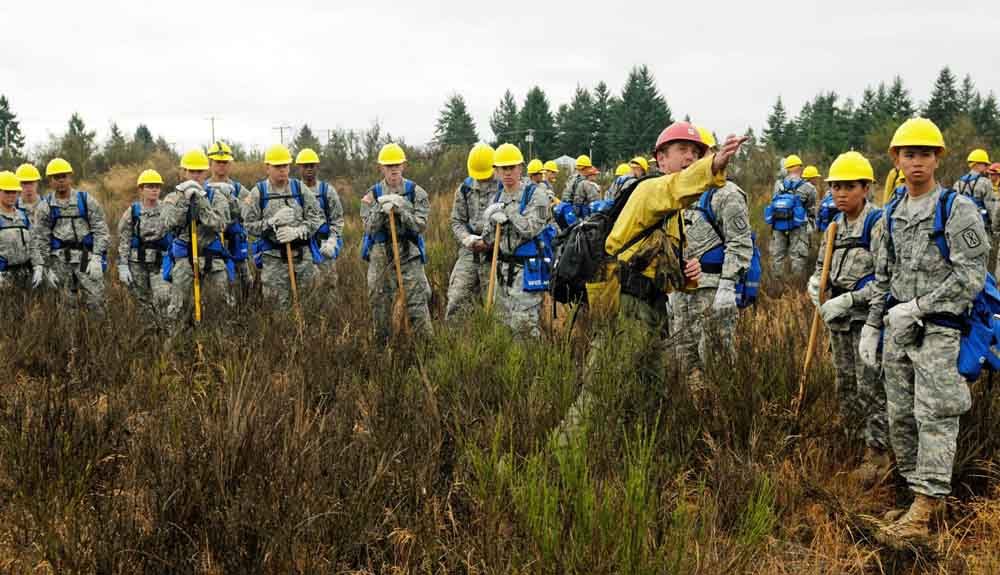
Jay Karle, center right, a wildland firefighter assigned to assist Soldiers of 5th Battalion, 3rd Field Artillery Regiment, 17th Field Artillery Brigade, points out boundaries to be used during wildland firefighting training near Joint Base Lewis-McChord, Aug. 20, 2015. The “First Round” Soldiers have been activated to help suppress fires in the Pacific Northwest due to civilian resources running low. (U.S. Army photo by Sgt. 1st Class Andrew Porch, 28th Public Affairs Detachment.)
Approximately 200 U.S. Army Soldiers assigned to the 5th Battalion, 3rd Field Artillery Regiment, 17th Field Artillery Brigade, 7th Infantry Division, at Joint Base Lewis-McChord near Tacoma, Washington have been activated to assist in the suppression of wildfires during a period when over 32,000 regular wildland firefighters are deployed but still more help is needed.
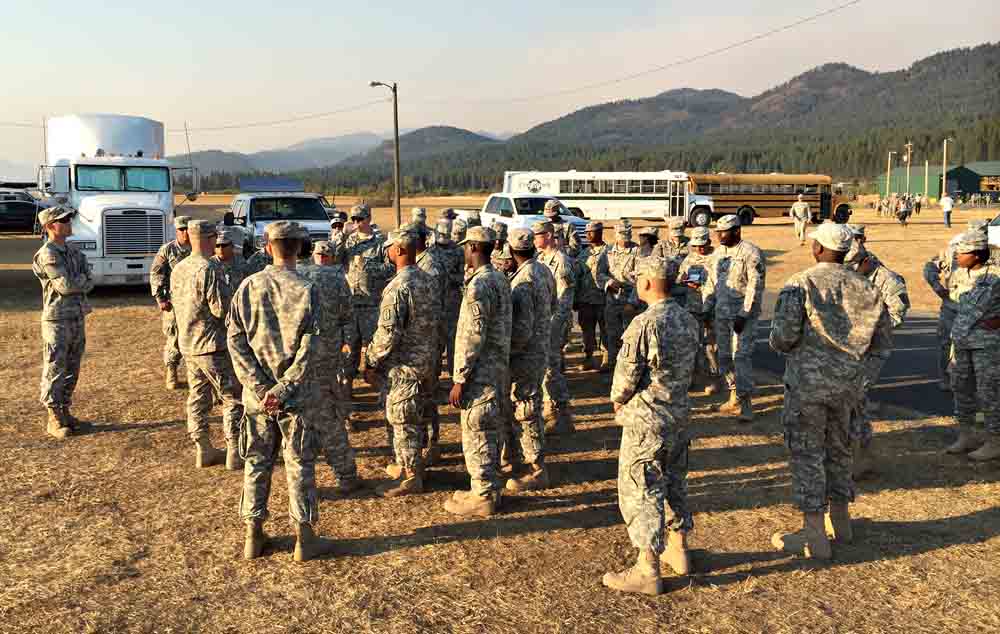
The Soldiers were trained at their base by wildland fire agency personnel, including the Bureau of Land Management Vegas Valley Crew comprised entirely of military veterans. They arrived at the Tower Fire in western Washington near the Idaho border late in the afternoon on August 22, where Tom Story captured some images.
Members of the Army’s Task Force First Round are briefed on the layout of the Incident Command Post after arriving at the Tower Fire, near Newport, Washington August 22, 2015. Photo by Tom Story. After a briefing on the layout of the Tower Fire Incident Command Post, The Army’s Task Force First Round joined the other firefighters in the dinner line. The Saturday evening meal was pasta with sausage meat sauce, veggies, salad and garlic bread. Photo by Tom Story.
Illustrating the severity of the wildfires and the shortage of firefighters in the northwest, for the first time ever the state of Washington is asking for volunteers to help suppress the 12 uncontained large fires currently burning in the state. Five of those fires are “complexes” that are comprised of many fires, sometimes more than 10.
At first the Department of Natural Resources was asking for anyone who could operate heavy equipment, such as a dozer or grader, who would then be given specific wildfire training. But now the DNR is only accepting volunteer applications from:
…from those with wildland firefighting qualifications, including an Incident Qualification Card (commonly called a Red Card), a “Blue Card,” or a letter of certification from a local or rural firefighting agency stating that you have met appropriate physical fitness, experience and training standards for serving on wildfire incidents.
Please complete our online intake form by listing your qualifications and contact information to volunteer with our temporary community resource coordination centers in Colville, Omak and Castle Rock.
The DNR has set up centers at three locations to talk to potential volunteers:
Omak: Jay Guthrie
Omak City Hall
2 Ash St. N
Phone 509-826-2546
Colville: Julie Sacket
Washington State Department of Transportation
Second Floor
440 N Hwy 395
Phone 509-675-7847
Castle Rock: Kellie Williams
601 Bond Rd.
Castle Rock, WA 98611
Phone 360-575-5024
This video created by Kenji Kato using Google Earth, is a “fly-through” showing heat data collected by a satellite for the Chelan Complex of Fires, the Okanogan Complex of Fires, and other fires in north-central Washington state. The fly-through starts above the U.S., then flies in on the Pacific Northwest, then Central Washington, before closing in on the fire areas. The icons represent heat detected by a satellite as late as 3:30 a.m. PDT on August 20, 2015.
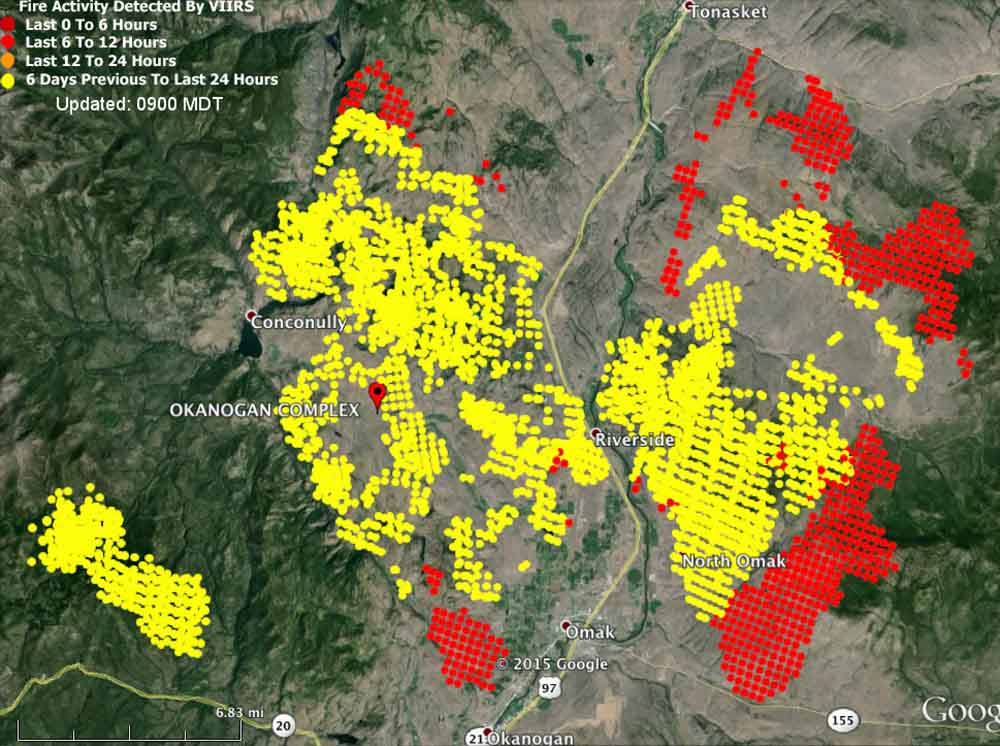
The icon color is based on fire activity with red representing heat detected in the last 0-12 hours (at the time data was updated). Orange represents activity in the previous 12 to 24 hours, and yellow is data 1 to 6 days before.
The three U.S. Forest Service firefighters that were overrun by fire and killed on the Twisp River Fire in Washington August 19 have been identified as Tom Zbyszewki, 20, Andrew Zajac, 26 and Richard Wheeler, 31.
Their vehicle crashed while fighting a fire west of Twisp, Washington. Fox News reported “Authorities gave few details, shedding no light, for example, on the crash, other than to say that it was not the accident itself that killed the victims, but the fire.”
On Thursday, after a team of investigators assessed the accident site, the bodies of the three firefighters were removed in separate ambulances and transported from the scene in a procession of fire engines and other emergency vehicles.
Four other firefighters were injured, one very seriously. King5 had additional information about the serious injury:
Daniel Lyon, 25, of Puyallup [Washington], was airlifted to Harborview Wednesday in critical condition. Doctors say he suffered third degree burns to over 50 to 75 percent of his body.
Doctors said he was in the resuscitation phase, receiving a lot of fluids, and doctors were trying to stabilize his condition. If his condition improves, doctors hope to move him to the operation phase, where they will remove some of the burns from his body.
Lyon had only been a firefighter for a few months with the U.S. Forest Service before heading to Central Washington to battle the Okanogan Complex Fire.
Q13 reported that the other three injured firefighters were treated at a hospital and released.
The investigation into the accident is being conducted by a team led by John Phipps who currently serves as Station Director of the U.S. Forest Service Rocky Mountain Research Station in Fort Collins, Colorado.
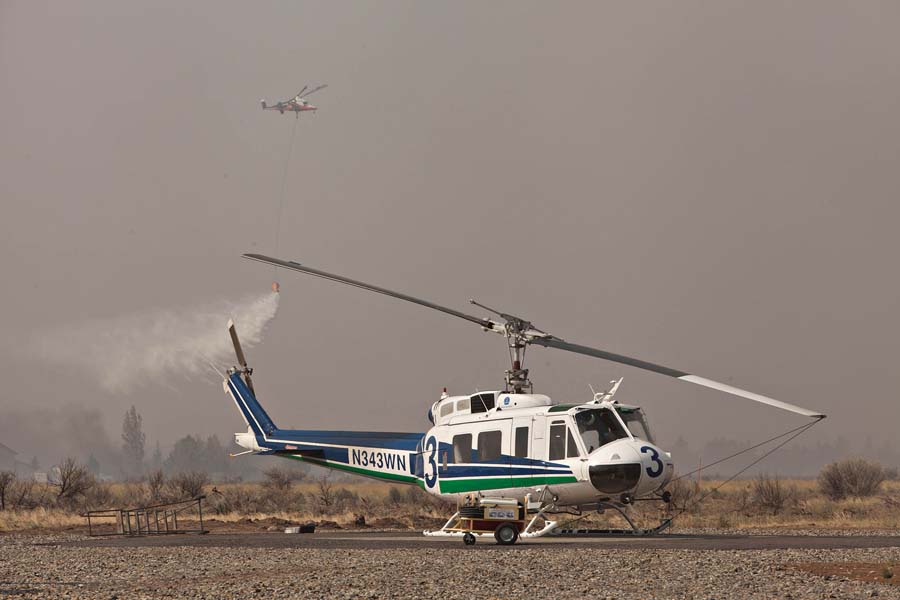
The arrival of the predicted dry cold front on August 21st, 2015 brought strong winds to the Okanogan Complex of fires and drove part of the blaze into an area near the Okanogan airport where a K-Max helicopter performed bucket work in an area near one of the Washington DNR UH-1 Hueys. Two of the DNR ships joined the K-Max and a civilian Blackhawk in the engagement. Photo by Tom Story.
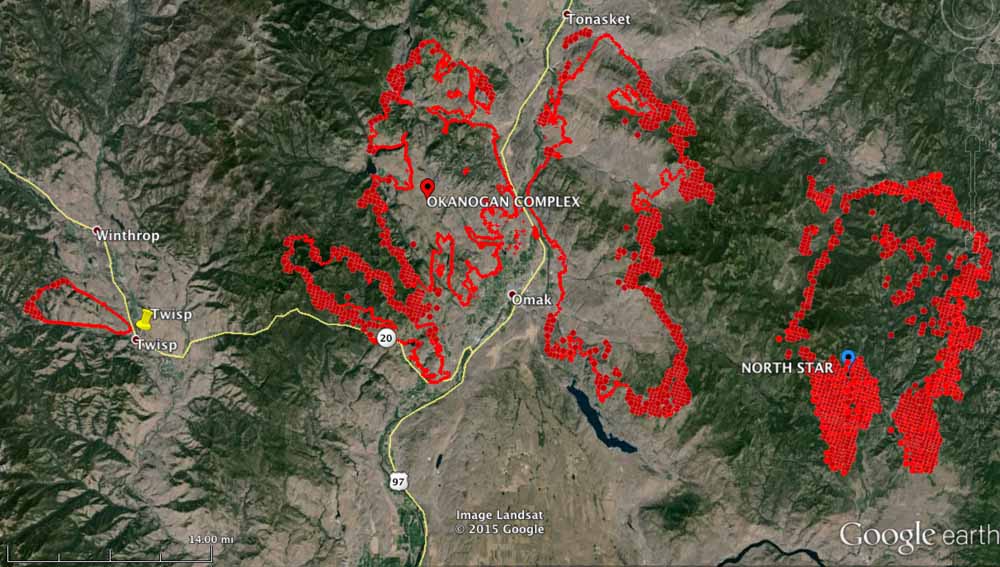
The Okanogan Complex of fires was very active again on Friday as a cold front with strong winds passed through the area. According Incident Commander Todd Pechota (via Joe O’Sullivan) more than 227,000 acres have burned since the fires started on August 15. Additional evacuation orders were issued as the portion of the fire west of Okanogan spread south and approached and in at least one area crossed Highway 20, which is closed.
Map of the Okanogan Complex of Fires. The fire perimeters shown were mapped at 9 p.m. on August 21. The red dots represent heat detected by a satellite during the 12 hours before 2:22 a.m. on Aug 22, 2015. (click to enlarge) A Washington DNR UH-1 Huey at the Okanogan airport takes off to engage the Okanogan Complex of Fires with some bucket work. Photo by Tom Story.
On Friday, President Obama signed an emergency declaration, ordering federal aid to assist in battling Washington state’s wildfires. The declaration allows FEMA to coordinate disaster relief efforts in Asotin, Chelan, Douglas, Ferry, Klickitat, Okanogan, Pend Orielle, Skamania, Spokane, Stevens, and Yakima counties. It also brings aid to the Colville, Spokane, Kalispel, and Yakima tribes.
For the first time, volunteers are being asked to fight the fires. More than 3,000 people have called and emailed in response to the state’s request for volunteer help with wildfires.
Dino sent us this link to four webcams in the Methow Valley between Twisp and Winthrop, Washington. He said they refresh once an hour. When I checked them Saturday afternoon they were shrouded in smoke.
****
(UPDATE at 9:47 a.m. PT, August 21, 2015)
Map showing heat detected on the Okanogan Fire by a satellite at 3 a.m. PT August 21, 2015.
The Okanogan Complex of Fires consumed another 40,000 acres of vegetation on Thursday and now covers 124,083 acres, crossing the 100,000-acre threshold to obtain megafire status.
****
(Originally published at 2:58 p.m. PT, August 20, 2015)
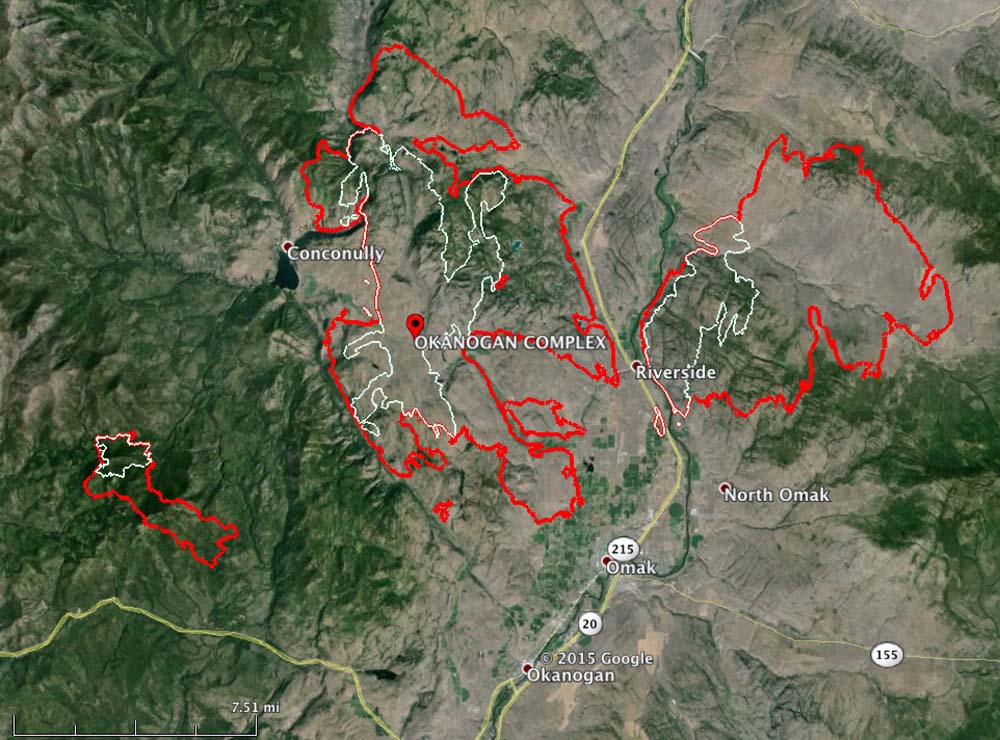
The red line was the fire perimeter of the Okanogan Complex at 11 p.m. PT August 19, 2015. The white line is from about 24 hours before. (click to enlarge)
The Okanagan Complex, comprised of 11 fires, some of which grew together, quadrupled in size on Wednesday. It added 60,282 acres and as of 11 p.m. Wednesday night it was 83,441 acres and still growing rapidly (see map above). The Twisp River Fire, on which three firefighters were killed Wednesday, was added to the Complex this morning. A Type 1 incident management team will inbrief on Thursday.
The fire is near Omak, Riverside, and Okanagan in north-central Washington.
The area is under a Red Flag Warning through Friday (see map below) for continued warm temperatures, low humidities and strong north winds on Friday that could reach 50 mph — possibly downing power lines that could start new fires.
This morning at 11 a.m. PT Washington Governor Jay Inslee and U.S. Forest Service Chief Tom Tidwell conducted a news conference at the fire station in Chelan, Washington. They discussed the general fire situation in the Northwest, and mentioned the three USFS firefighters who were killed near Twisp, Washington the day before, on August 19.
The fire that killed three firefighters on Wednesday is still very active and is heading toward the town of Twisp, Washington. The above tweet was sent by KHQ reporter Gabe Cohen at 10 Wednesday night. It sounds like firefighters in the town are going to have their hands full. The entire town and the nearby community of Winthrop are under evacuation orders affecting 3,000 people.
And the weather will not be their friend. Red Flag Warnings are posted for the area through Friday night for strong winds. The chart below (click on it to see a larger version) predicts that Wednesday night the wind at Twisp will be from the northwest at 15 to 17 mph with gusts to 24 mph, pushing the fire closer to the town. It will decrease to 6 to 15 during the day on Thursday and then crank up again Thursday night with gusts up to 22 mph. Friday a cold front will move through but the relative humidity will remain fairly low and the winds will be even stronger, gusting to 28 mph.
(Originally published at 6:12 p.m. PT, August 19, 2015; updated at 8:12 a.m. PT, August 20, 2015)
Three U.S. Forest Service firefighters were killed Wednesday, August 19, while they were fighting the Twisp River fire west of Twisp, Washington. The agency confirmed that they were “engaged in initial attack operations and were involved in a vehicle accident when it is believed that the fire overtook the vehicle.”
According to Okanogan County Sheriff Frank Rogers, the three Forest Service deaths occurred in a fire on Washington Department of Natural Resources land.
Four additional firefighters were injured: one USFS, two DNR, and one DNR contractor.
Evacuations of the 3,000 residents of two nearby towns were ordered, Twisp and Winthrop.
The names have not been released, pending notification of next of kin.
“We are devastated by the tragic loss of three of our Forest Service firefighters,” said Mike Williams, Forest Supervisor on the Okanogan-Wenatchee National Forest. “We are working with County and State partners to notify the families of those lost. Our hearts and prayers go out to the families and fellow crewmembers of these brave firefighters.”
The Forest Service said a national incident management team has been ordered.
Q13 Fox reported that the county “sheriff said the wind suddenly shifted and the firefighters became trapped as the fire was turned back on them”.
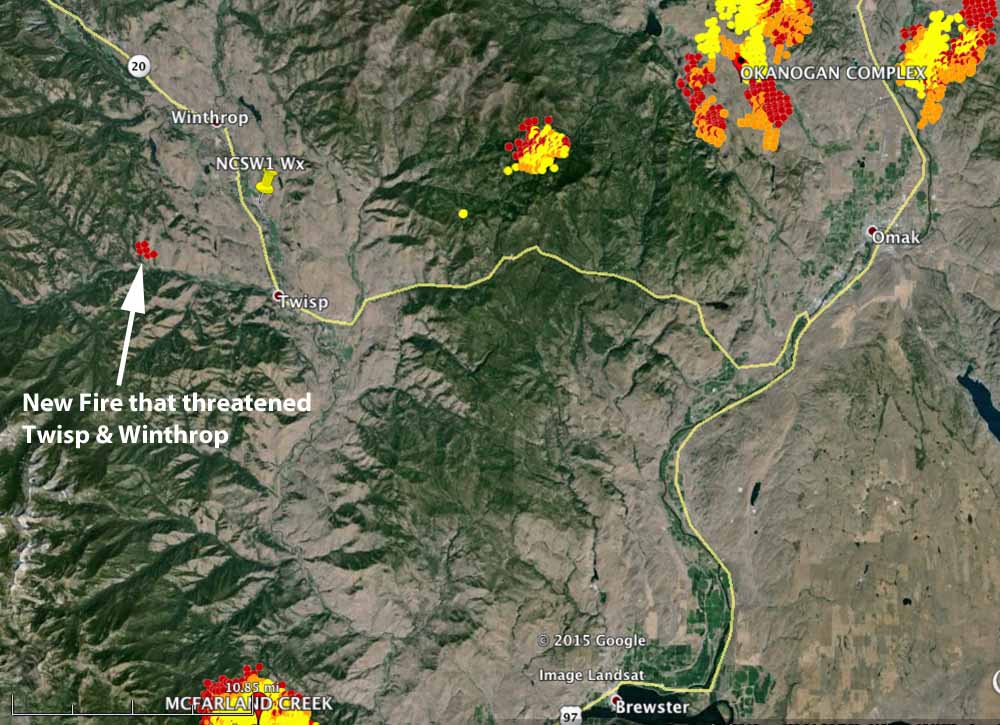
The rapidly spreading new fire that caused the evacuations is represented by the six red dots in the map below, 6 miles northwest of Twisp. Heat from the fire was detected by a satellite at 1:05 p.m. PT, August 19. Click on the map to see a larger version.
Fires near Twisp, Washington. The dots represent heat detected by a satellite, with the red ones being the most recent, recorded at 1:05 p.m. PT on August 19, 2015. (click to enlarge)
The first articles to report the fatalities were time-stamped shortly before 6 p.m. PT, August 19. The reports say shifting winds may have contributed to the entrapment of the firefighters. The weather station between Twisp and Winthrop, NCSW1, between 8 a.m. and 5 p.m. on Wednesday recorded winds from all directions, starting from the north at 8 a.m., the wind direction changed going clockwise until they were from the north-northwest at 5 p.m. The wind speeds were light, at 1 to 6 mph until 5 p.m. when they increased to 10 with gusts to 20 mph. The relative humidity was in the mid-teens and the high temperature was 95 degrees.
Our sincere condolences go out to the families of the injured and deceased firefighters.
Five new lightning-caused fires started Friday that surrounding Chelan, Washington, threatened homes in the city, then some of them joined forces and crossed the Columbia River. Our main article about the Chelan area fires is HERE (which is updated daily), but you may want to hear a portion of the back story of how wildfire organizations came up with a plan to deal with the quickly developing emergency during a time when the competition, nationally, for firefighters has become overwhelming.
In this video Rob Allen, the Deputy Incident Commander for the Wolverine Fire which is 30 air miles up Lake Chelan from the City by the same name, describes how his fire sent firefighting resources from their winding-down incident to assist with the initial attack of the five new fires near the city.
In the last one-third of the interview, Mr. Allen explains the nationwide shortage of firefighters and how the competition for resources is affecting firefighting in the Washington area and the rest of the West. As we reported earlier on Saturday, even though 554 20-person hand crews are currently working on wildfires in the western United States, there are outstanding orders for 160 more crews that are unable to be filled. Other important nationally-managed resources are already fully committed to ongoing fires and are completely unavailable for new fires, including transportable shower units and caterers that can set up in a remote area and begin feeding hundreds of hungry firefighters a few hours after they arrive in a dusty field near a fire.
The Regional Office in U.S. Forest Service Region 6, comprised of Washington and Oregon, distributed an update on the wildfire situation to USFS retirees. Below are some excerpts from the message, dated August 13.
****
“…As predicted, initial attack (IA) was heavy across the region yesterday and into today. Many new and extended attack fires grew steadily, and in some cases, quite dramatically. Wednesday saw 32 new fires in Oregon for 9,738 acres while Washington had 58 new fires for 1,426 acres. The most concerning of these is the Stickpin on the Colville National Forest . There is continued concern for the National Complex, the Cornet/Windy Ridge, and Cougar Creek. Four Type I teams are assigned in the region at the Wolverine Fire on the Okanogan-Wenatchee, the National Complex on the Rogue River-Siskiyou, Umpqua and Crater Lake National Park, the Stouts Creek also on the Umpqua, and finally at Cornet/Windy Ridge out on the Wallowa-Whitman. IA resources are stretched thin and many Type III teams are managing challenging fire situations while Type I and II teams get in place. For more information on specific incidents, please visit the INCIweb: inciweb.nwcg.gov
The regional situation is all juxtaposition with the fact that nationally, there are 73 (and counting) uncontained large fires. More than 19,000 U.S. Forest Service and other federal, state, and local wildland firefighters; more than 100 helicopters; and 25 large airtankers are working to suppress wildland fires. Over the last week however, of the more than 1,200 new fires reported on National Forest System and other federal, state, and private land nationwide, about 50 – just 4% – became large fires. This is a testament to those tremendous IA efforts. An interesting point here in the Pacific Northwest though is that many of the large fires are burning into fire scars, some as recent as 2013. We are finding that old fire scars are not slowing the progress of fire spread this year. I think this represents another example of how fire behavior is not as it once was and the unpredictably we now face…”