The National Park Service announced today that John Buehler will be the new branch chief for the agency’s Aviation Program, succeeding Margaret “Meg” Gallagher, who is retiring in January 2019 after spending about nine months in the position.
Mr. Buehler has served in a variety of jobs in his professional career:
U.S. Army (beginning in 1994), tank platoon leader, headquarters company executive officer, a graduate of the Aviation Officer Advanced Course
General Electric, Six Sigma program
General Accountability Office, auditor
Nuclear Regulatory Commission, special agent
Bureau of Land Management, internal affairs special agent (his present job).
Mr. Buehler is a graduate of the United States Military Academy at West Point, with a degree in civil engineering, math, and law. He received a Master of Business Administration from Vanderbilt University’s Owen School of Management where he completed a dual concentration in finance and operations.
Mr. Buehler is a private pilot and continues to serve in the Army Reserves. He was activated as the Department of Defense Liaison to the National Interagency Fire Center in 2014, 2015, and 2017.
John Buehler has been named as the new branch chief for the National Park Service Aviation Program, succeeding Margaret “Meg” Gallagher, who is retiring in January 2019 after spending about nine months in the position.
Mr. Buehler has served in a variety of jobs in his professional career:
U.S. Army (beginning in 1994), tank platoon leader, headquarters company executive officer, a graduate of the Aviation Officer Advanced Course
General Electric, Six Sigma program
General Accountability Office, auditor
Nuclear Regulatory Commission, special agent
Bureau of Land Management, internal affairs special agent (his present job).
Mr. Buehler is a graduate of the United States Military Academy at West Point, with a degree in civil engineering, math, and law. He received a Master of Business Administration from Vanderbilt University’s Owen School of Management where he completed a dual concentration in finance and operations.
Mr. Buehler is a private pilot and continues to serve in the Army Reserves. He was activated as the Department of Defense Liaison to the National Interagency Fire Center in 2014, 2015, and 2017.
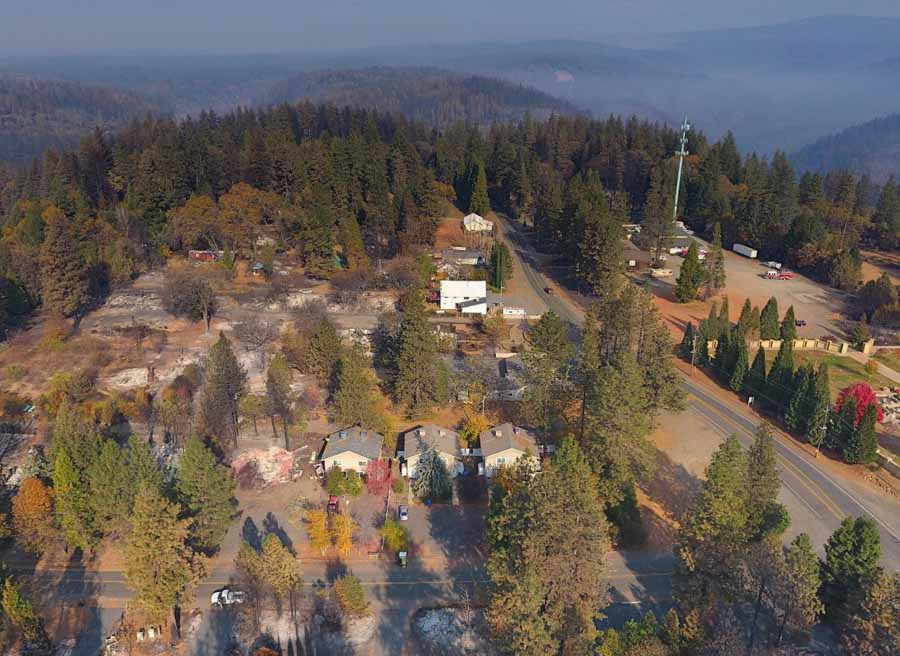
Photo taken on the Camp Fire by a drone in Magalia, California near Indian Drive.
With tens of thousands of homes being destroyed in the last year in California wildfires it should be a very high priority for home builders and local governments to swiftly adopt the practices that can greatly reduce the vulnerability of structures. It is not a given that if a large rapidly-spreading wildfire approaches a house it will ignite and burn to the ground.
Media reports sometimes marvel at how an occasional structure will be spared, and may describe it as miraculous or random. Instead, it is based on science. Some structures are designed, built, and maintained to be less vulnerable than others. The other half of the equation is what is within the home ignition zone — what will become fuel within 100 feet. If there is continuous vegetation or other flammable material in that zone that can carry the fire, especially close to the structure, it stands less chance of survival.
But for now let’s think about the structure itself. There are several useful reference guides for architects, home builders, and zoning boards containing information that can lead to designs and building codes that can help keep a fire from turning into a disaster.
• International Code Council’s International Wildland Urban Interface Code (IWUIC),
• National Fire Protection Association’s Standard for Reducing Structure Ignition Hazards from Wildland Fire (Standard 1144), and
• California Building Code Chapter 7A—Materials and Construction Methods for Exterior Wildfire Exposure.
Headwaters Economics compared the costs of new construction of a typical home vs. one with wildfire resistant standards for a three-bedroom, 2,500-square-foot, single-story, single-family home representative of wildland-urban interface building styles in southwest Montana. Below are excerpts from the article:
We examined costs in four vulnerable components of the home: the roof (including gutters, vents, and eaves), exterior walls (including windows and doors), decks, and near-home landscaping. Overall, the wildfire-resistant construction cost 2% less than the typical construction, with the greatest cost savings resulting from using wildfire-resistant fiber cement siding on exterior walls, in lieu of typical cedar plank siding. While cedar plank siding is typical in the wildland-urban interface of western Montana, fiber cement siding is already a common choice in many regions because of its relative affordability, durability and low maintenance needs. Wildfire-resistant changes to the roof resulted in the largest cost increase, with a 27% increase in gutters, vents, and soffits. The following sections describe the wildfire-resistant mitigations for each component.
Screenshot from video by Tarrawingee Rural Fire Brigade.
Quick work by firefighters in Victoria, Australia drew praise from the daughter of a landowner whose property was burning near Tarrawingee northeast of Melbourne.
The Country Fire Authority reported that firefighters from Eldorado, Everton, Springhurst, Tarrawingee, Wangaratta, and Wangaratt North responded to the fire on the Tarrawingee-Eldorado Road at around midday on Saturday December 1. The fire was brought under control by 12:25 P.M.
Posting on Facebook, Brooke Sheppard Ross said: “For one hour these selfless people assisted by DSE and Forestry members battled the dry grass and intermittent wind that fanned the flames into our bush land paddocks.”
From The Guardian on November 28:
While parts of the drought-stricken eastern [Australian] states have enjoyed some recent rain and there have been huge downpours along the NSW coast during this week’s storms, experts are warning it won’t be long before the hot summer temperatures dry out ground vegetation.
“Above-normal fire potential remains across large parts of southern Australia,” the Bushfire and Natural Hazards Cooperative Research Centre said in its seasonal bushfire outlook, also released on Thursday.
As part of its summer outlook, the Bureau of Meteorology has forecast a drier-than-average summer for large parts of Queensland, Western Australia and the Northern Territory.
“Having said that, locally heavy rainfall events similar to what we have seen in NSW in the last two days are always a possibility during summer, no matter what the outlook is showing,” Watkins said.
NSW has recorded its eighth driest and fourth hottest April-November on record, with Queensland and Victoria having experienced similar conditions.
Aerial view of the Pentagon Building located in Washington, District of Columbia (DC), showing crews responding to the destruction caused when a highjacked commercial jetliner crashed into the southwest corner of the building during the 9/11 terrorists attacks. Photo September 14, 2001 by TSGT Cedric H. Rudisill, USAF.
When a hijacked 757 airliner crashed into the Pentagon in Washington, D.C. on September 11, 2001 shortly after two others were flown into the World Trade Center in New York City, no one knew what would happen next. The National Park Service has many parks, facilities and employees in the Washington D.C. area. The agency is responsible for managing and protecting those areas as well as others across the country, such as the Statue of Liberty, St. Louis Gateway Arch, Liberty Bell, Washington Monument, and the other 385 units (at the time) within the NPS system.
In an effort to document the events of 9/11, determine how the National Park Service responded that day and the months that followed, and learn lessons, agency historians and ethnographers conducted more than a hundred oral history interviews with Service employees in parks, regional offices, and the Washington headquarters. Janet McDonnell, a Historian for the NPS, started with those interviews and wrote the 132-page report, “The National Park Service: Responding to the September 11 Terrorist Attacks.” It is very well written and comprehensive, broken down by geographic area, Washington and New York City. It also covers the use of multiple incident management teams that helped to mitigate the wide-ranging effects across the country.
One of the sections concentrates on the role of the Park Police Aviation Unit, which is a division of the NPS. Fire Aviation has a story about how their personnel and two helicopters assisted in the D.C. area after the attack.
Another section describes how the other NPS employees in Washington responded to the events. That is below, but first a few details that will add some background.
The document refers often to Rick Gale — on 15 different pages, according to the index. Before 9/11 Mr. Gale had been the Chief Ranger of the NPS, based in Washington and responsible for law enforcement within the agency. After that and at the time of the attack he was the Director of Fire and Aviation working out of Boise. He had been a Type 1 Incident Commander, an Area Commander, and the Incident Commander of the NPS Type 1 All Risk Incident Management Team. He was very well known and respected in the wildland fire and incident management community. When I was the Planning Section Chief on his All Risk Team we were activated and detailed to Washington to develop Continuity of Operations (COO) Plans for the NPS facilities at the Main Department of the Interior building and three other Park Service facilities in and near Washington. The plans that we completed in March of 1998 are referenced many times in the report.
The purpose of the COO Plans, as we wrote then, were to establish procedures “to ensure that essential functions and activities of (___the facility___) are able to continue or be reactivated as quickly as possible during the full range of human-caused, natural, technological, or national security emergencies that have some reasonable likelihood of occurring at this facility.”
On 9/11 Mr. Gale happened to be temporally in the city at the Main Interior building in Associate Director Dick Ring’s third floor office when they learned about the planes that crashed into the World Trade Center in New York City. Mr. Gale and Mr. Ring knew each other well, and had spent weeks working together in hurricane-ravaged Everglades National Park in 1992 when our Incident Management Team was assisting with response and recovery from Hurricane Andrew. At that time Mr. Ring was the Superintendent at Everglades.
The report points out that after the attacks Mr. Ring convinced Director of the Park Service Fran Mainella that it was in her best interests to keep Mr. Gale within shouting distance at all times so she could take advantage of his wisdom and experience in emergency incident management.
Below is the section of the report that describes the initial response by the NPS in Washington, mostly centered around the Main Interior building.
Introduction
At 8:45 a.m. (EST) American Airlines Flight 11 carrying ninety-two people from Boston to Los Angeles crashed into the North Tower of the World Trade Center. Twenty minutes later, United Airlines Flight 175 with sixty-five passengers and crew also heading toward California ripped through the South Tower. At 9:40 a.m. (EST) American Airlines Flight 77, a Boeing 757 commercial airliner carrying sixty-four people and 30,000 pounds of fuel for its long flight from Dulles to Los Angeles, smashed into the west façade of the Pentagon with such force that it penetrated four of the building’s five interior rings. The Federal Aviation Administration promptly banned takeoffs nationwide and ordered all flights that were in the air to land at the nearest airport. Then came the alarming news that United Airlines Flight 93 with forty passengers and crew en route to San Francisco had crashed in Shanksville, Pennsylvania. Not long after, reports circulated that this plane had been headed toward Washington, D.C., and heroic passengers had intervened to thwart this plan.
[…]
Main Interior Building, Tuesday, September 11, 2001
Rick Gale, chief of the National Park Service’s fire aviation emergency response and head of its incident management program, was sitting in Associate Director Richard (Dick) Ring’s third floor office in the Department of the Interior’s Washington, D.C. headquarters, when a call came in advising Ring to turn on the television. It would prove fortuitous that Gale who normally worked at the National Interagency Fire Center in Boise, Idaho, happened to be in Washington that day. Ring turned on the television just in time to see the second plane strike the World Trade Center in New York City. Gale headed back to his temporary office in the ranger activities division. Not long after, Ring received word that the Pentagon had been struck. He stepped outside onto his small balcony and glancing south saw an ominous cloud of smoke rising in the distance. Continue reading
File photo. A U.S. Park Police helicopter patrols downtown Washington, DC. Credit: USPP
The two helicopters of the U.S. Park Police, a division within the National Park Service, played a vital role after the terrorist attacks on September 11, 2001.
Established in 1973, the missions of the USPP Aviation Unit include aviation support for law enforcement, medevac, search and rescue, high-risk prisoner transport, and Presidential and dignitary security. The unit has provided accident-free, professional aviation services for over 28 years.
Their base at the “Eagle’s Nest” in Anacostia Park is two to three air miles from the Capitol building, the White House, and the Pentagon.
When a hijacked 757 airliner crashed into the Pentagon in Washington, D.C. on 9/11 shortly after two others were flown into the World Trade Center in New York City, the two USPP Bell 412 helicopters, Eagle I and Eagle II, responded to the Pentagon immediately. The crews transported injured personnel to hospitals, served as a command and control platform, used their Forward Looking Infrared equipment to provide firefighters with intelligence about the scope and spread of the fire through the five rings of the structure, and took over air traffic control for the Washington, D.C. airspace after the controllers at Washington National Airport had to evacuate due to thick smoke.
In an effort to document the events of 9/11 and how the National Park Service responded that day and the months that followed, Park Service historians and ethnographers conducted more than a hundred oral history interviews with Service employees in parks, regional offices, and the Washington headquarters. Janet McDonnell, a Historian for the NPS, started with those interviews and adding her own research wrote the 132-page report, “The National Park Service: Responding to the September 11 Terrorist Attacks.” It is very well written and comprehensive, broken down by geographic area, Washington and New York City. It also covers the use of multiple incident management teams that helped to mitigate the wide-ranging effects across the country.
One of the sections concentrates on the Aviation Unit of the USPP. It is below:
Lieutenant Wallace and Sergeant Beck [of the USPP Motorcycle Unit] were not the only Park Police officers to respond at the Pentagon in those first devastating minutes. Officers in the aviation section also played an important role at the scene. At the aviation hangar in southeast Washington along the Anacostia River, some of the crew were taking advantage of the warm weather and bright sunshine by washing the floor out in the aviation hangar with the door open. Meanwhile, in an open field next to the hangar, one of the helicopter pilots, Sgt. Kenneth Burchell, was conducting riot training for the Defense department’s uniformed health services unit in preparation for the upcoming World Bank/International Monetary Fund protest demonstrations.
One crew member saw the news account of the first plane hitting the World Trade Center and called in the others. Sergeant Burchell, his fellow pilot Sgt. Ron Galey, and a few others went inside to watch the television coverage. After seeing the second plane strike and noting the clear blue sky, they quickly concluded that the crash was not an accident. Burchell and Galey headed back out to the hangar. They heard a loud thud and looked up to see a column of smoke rising from the vicinity of the Pentagon. Burchell immediately ran back inside, yelling for his crew.
Minutes later, the “aircraft crash phone” rang, setting off a distinctive horn alarm. The crash phone was a direct communications line from the control tower at Ronald Reagan Washington National Airport to the hangar so that the aviation unit can respond quickly to incidents at the airport. Sergeant Galey took the call. On the other end of the line, the air traffic controller indicated that a 757 commercial airplane had crashed in the vicinity of the Pentagon. Meanwhile, a call had also come in on the police radio indicating that the Pentagon had been attacked.
Sergeant Keith Bohn retired in November, 2018. From the NPS: “Congratulations to Sergeant Keith Bohn, who retires from the USPP after 35 years. His work in Patrol, SWAT, and Aviation was invaluable to the Force. A hero pilot of the Eagle on 9/11, but may be known best for his straightforwardness.” NPS photo.
The helicopter crews scrambled to gather their equipment, get to the helicopters, and launch. The duty crew that day, which included Sergeant Galey, rescue technician Sgt. John Marsh, and Officer John Dillon, ran out to Eagle I, a Bell 412 helicopter, and took off within two or three minutes. Sergeant Burchell grabbed Sgt. Keith Bohn and two Defense department medics with Uniformed Services University and Health Sciences who were there for the training. They began installing a mass casualty kit on Eagle II, another Bell 412 helicopter, which allowed them to carry four patients instead of two. The installation took a few minutes. Then Eagle II took off with pilots Burchell and Bohn, the two medics, aviation unit commander Lt. Philip Cholak, and assistant commander Sgt. Bernie Stasulli.
Shortly after launching, Eagle II received its first report that there was an unauthorized aircraft inbound. Eagle I directed Eagle II to land at the Pentagon to conduct medical evacuations. Eagle II quickly landed on a paved roadway 150 to 200 yards from the area of impact. Some of the crew grabbed their emergency medical equipment and ran toward the Pentagon building. At this point, with the reports of an unauthorized inbound plane, Sergeant Burchell realized they needed not only to evacuate the casualties but also to be ready to get as many people as possible away from the site before there was another attack.
Two casualties are loaded on Eagle II.
Sergeant Bohn kept the helicopter engine running and Sergeant Stasulli stood outside to secure the landing zone. Stasulli was particularly concerned that people moving away from the building, particularly those who seemed somewhat dazed, would inadvertently step too close to the aircraft’s tail rotor blades and be seriously injured. Meanwhile, Lieutenant Cholak, Sergeant Burchell, and the two medics moved closer to assess the situation. They initially anticipated ferrying hundreds of patients to hospitals all day long so they wanted to set up an orderly process for this first. They checked in with the triage officer who indicated that there were only eleven casualties in need of medical evacuation. Cholak and one of the medics went to the triage area to assist. Burchell headed back to get Sergeant Bohn to move the aircraft closer, which he did.
A screenshot from the ABC10 video below, shot by an officer’s body cam.
In the video below produced by ABC10, law enforcement officers and firefighters tell their stories about encouraging residents to evacuate during the first hours of the Tubbs Fire that burned into Santa Rosa, California October 9, 2017. One firefighter explains how he kept working after learning that his house was one of the hundreds that were destroyed. Body cam footage gives us an up close viewpoint of what the first responders were going through. The North Bay fires destroyed about 8,900 structures (including homes and outbuildings).
A man who stole items from inside a Redding Fire Department truck during the Carr Fire at Redding, California received much more than the 1-year sentence plus probation recommenced by the Probation Department. Judge Cara Beatty gave Brian Daniel Martinson five years in county jail, according to the Shasta County District Attorney’s Facebook page.
Mr. Martinson had pleaded guilty to grand theft and committing the crime during a natural disaster.
Martinson was accused of stealing items belonging to Redding firefighter Erick Mattson that were inside a fire department utility truck while it was parked in front of Mattson’s home.
Mattson was at his Palo Cedro home resting in between fighting the Carr Fire when Martinson broke into the truck.
In August, Martinson was arrested in Chico after being caught shoplifting from a Sportsman’s Warehouse. Officers there found Martinson with a backpack belonging to the firefighter and items from the fire department.
The stolen property included more than $5,000 worth of things that included a laptop and a hard drive containing family photos. Chico police said at the time the hard drive wasn’t located.
Butte County investigators questioned Martinson and he admitted to burglarizing the fire truck, the DA’s office said.
The Carr Fire started July 23, 2018, killed eight people and burned over 229,000 acres and 1,604 structures.
In a different but similar incident, the two men who were arrested on the first day of the Camp Fire for stealing a vehicle and other items from a fire station at Jarbo Gap November 8 have pleaded not guilty to the crimes. Robert DePalma and William Erlbacher, both of Concow, California are scheduled to appear in court December 6 for a preliminary hearing. They remain in custody with bail set at $250,000 each. More information about this incident is at the Chico Enterprise-Record.
The Camp Fire burned more than 153,000 acres at Paradise California, killed approximately 85 people (as of November 25, 2018), and destroyed over 14,000 homes.