
Investigators have removed parts of a transmission tower to examine more closely
Continue readingEverybody has a plan until…
 While I was watching the Clemson vs. Mississippi State University basketball game today on ESPN2 I didn’t expect to hear words of wisdom or a pithy quote. One of the announcers was Chris Spatola, a former basketball player for Army West Point who is also a veteran. After only 8 minutes into the game MSU had thrown in “tons of three-pointers.” As they talked about how Clemson had hoped to limit MSU’s three-pointers, Mr. Spatola said,
Everybody has a plan until they get punched in the mouth.
The other announcer, Jon Sciambi, recognized the quote as being from Mike Tyson who had been asked by a reporter whether he was worried about Evander Holyfield and the fight plan he had bragged about.
After Mr. Spatola did an impression of Mr. Tyson, Mr. Sciambi said, “I am going to enjoy working with Chris Spatola.”
As a Planning Section Chief on Incident Management Teams, of course I appreciate the necessity of planning. And I think Mr. Tyson’s quote while it at first seems crude and simplistic, actually is worth thinking about and can have multiple messages. The most obvious is that yes, you have a plan, but you encounter difficulties and quickly realize that you’re going to need a Plan B. If you prepared for an alternate strategy, you might succeed after all. If not, well, thanks for playing and here is your Participation Trophy.
Another interpretation is that after encountering unexpected problems, you don’t throw in the towel, but you have the guts and perseverance to keep fighting and working through the complications, eventually achieving the goal and overcoming the odds stacked against you.
Helmuth Von Moltkex said:
No plan survives contact with the enemy.
Bob Robins told me about a good plan on a wildfire that was poorly briefed and executed. He was in one group of firefighters that was attempting to stop the spread of a fire by burning out along a road, working toward another group that started at the other end. The objective was to burn the vegetation between the road and the fire, removing the fuel. The fire would then be stopped in that area. When the two groups met, they were horrified to find that they had ignited opposite sides of the road, and they suddenly had a lot more fire to deal with.
General Norman Schwarzkopf directed the planning and strategy to kick the Iraqis out of Kuwait after they invaded the country in 1990. His plan was based on overwhelming force using strong infantry attacks supported by artillery and armor after bombing the crap out of them from the air for weeks. It worked. The ground fighting in Desert Storm was over within about 100 hours. Not long after, most of the U.S. troops returned home. I have latched on to his strategy when writing about using the concept of overwhelming force for the initial attack of new wildfires. It can often be successful, and then everybody goes home and prepares for the next one, not getting bogged down and tying up resources and taxpayer dollars in a months-long campaign.
Here are some other planning-related quotes. Do you have a favorite, or an example of a plan that worked? Or didn’t?
“In preparing for battle I have always found that plans are useless, but planning is indispensable.”
―
“Give me six hours to chop down a tree and I will spend the first four sharpening the axe.”
―
“By failing to prepare, you are preparing to fail.”
―
“A goal without a plan is just a wish.”
―
If you don’t know the past, you can’t understand the present and plan properly for the future.”
― Davita’s Harp
“I wasn’t planning to lead, I was standing in the back and then everyone turned around.”
―
“No matter what the work you are doing, be always ready to drop it. And plan it, so as to be able to leave it.”
― Leo Tolstoy, The Journal of Leo Tolstoy
“If you don’t know where you are going, you’ll end up someplace else.”
― Yogi Berra
*On December 8 Mississippi State beat Clemson, 82-71. They sank 19 three-point shots (63 percent), led by Lamar Peters who accounted for 9 of them.
Forest Service intends to restore areas in Wyoming with logging, prescribed fire, and building roads
The project would take place in the Medicine Bow National Forest in southern Wyoming
Continue readingForest Service now offers one-year contracts for air tankers
This may be a result of inadequate funding for firefighting by the Administration and Congress
Continue readingForest Service moving to one-year contracts for air tankers
This appears to be a result of inadequate funding for firefighting by the Administration and Congress
Continue readingTBT: Time to Think
For Throwback Thursday, we’re revisiting an article we wrote August 9, 2008, titled “Time to Think”.
When I walked into Bill Supernaugh’s office one day in 1995 I found him looking out the window with his feet up on his desk. I was the Fire Management Officer and had an appointment with the Assistant Superintendent of Indiana Dunes National Lakeshore to brief him about the prescribed fire we were going to ignite in the park in a few days. I got along well with him and felt comfortable smiling and saying, “Oh sorry, I didn’t know you were busy–I’ll come back later” and half turned to walk away.
He pointed to a chair and told me to sit down. In the banter that we usually engaged in before getting around to business he explained that he was “thinking”, something that he felt was important for a manager in his position, supervising the Operations of a large workforce and a big chunk of public land. Taking time to think gave him the opportunity to mull over the issues of the day and strategize about the direction the park would take. He said a person in his position was more of a thinker than a doer.
I wanted to slink down into my chair and disappear, because what he said made perfect sense and I was giving him a hard time. I was there to brief him about a project I was going to DO, and he was going to take my information and THINK about it, then approve it, ask for more information, or give me advice about how to do it differently, or not at all.
At 5:00 a.m. on August 26, 1992 Hurricane Andrew made landfall, knocking the crap out of south Florida and four national parks including Everglades, Big Cypress, and Biscayne Bay. Early the next morning I was in a rental car south of Miami driving through Homestead trying to navigate on back roads while driving over downed power lines and other debris. The first power line was scary as hell, but then we realized there was no electricity anywhere. Navigation was difficult because all of the road and street signs and many of the usual landmarks were gone. Even someone with us that was familiar with the area was disoriented.
We were a Type 1 All-Hazard Incident Management Team with a mission to rescue park employees and restore the infrastructure. It was a huge job and after a few days as Planning Section Chief I felt a little overwhelmed, with lots to do and not enough time in the day to get it all done. In confessing my situation to our Incident Commander, Rick Gale, he said “Order the personnel you need to get the job done. You are paid to think, not do.”

After that, I made time, like Bill Supernaugh, to think. Occasionally I even put my feet up on a desk.
Until he retired from the day to day operations of Microsoft, Chairman Bill Gates scheduled a twice-yearly “Think Week” ritual, where he would take a helicopter or float plane to his secret lakeside cabin and… think….by himself….barring all outside visitors. He would rarely leave the cabin during the week except for an occasional walk on the beach, having a caretaker slip him two simple meals a day at the cabin. He subsisted on the two meals, Diet Coke, and Orange Crush.
Think Week was legendary in Microsoft. Gates would pore over about 100 papers written by company executives, researchers, managers, and developers, who hoped to obtain approval for their new project, or a new direction for the organization. Comments that Gates wrote on the papers could give the green light to a new technology that millions of people would use, or send Microsoft into new markets. He had to be careful what he wrote, after finding that a casual “Hey, cool, looks good” could result in 20 people being assigned to a project.
Barack Obama appears to understand how important it is to set aside time to think. Here is part of an accidentally-captured conversation between Obama and British Conservative Party Leader, David Cameron. Cameron asks Obama if he will be taking any time off for a vacation this summer:
Mr. Cameron: Do you have a break at all?
Mr. Obama: I have not. I am going to take a week in August. But I agree with you that somebody, somebody who had worked in the White House who — not Clinton himself, but somebody who had been close to the process — said that should we be successful, that actually the most important thing you need to do is to have big chunks of time during the day when all you’re doing is thinking. And the biggest mistake that a lot of these folks make is just feeling as if you have to be …Mr. Cameron: These guys just chalk your diary up.
Mr. Obama: Right. … In 15 minute increments and …
Mr. Cameron: We call it the dentist waiting room. You have to scrap that because you’ve got to have time.
Yes. You have to have time to think. Those of us in the emergency management business too often see time to think as a luxury we don’t have. True, at times, when split second decisions can have life-long, or even life-dependent outcomes. But when initial attack becomes extended attack morphing into a long duration incident, thinking is not a luxury. It is a necessity.
***
“All successful people men and women are big dreamers. They imagine what their future could be, ideal in every respect, and then they work every day toward their distant vision, that goal or purpose.”
― Brian Tracy, Personal Success
On 60 Minutes Chief Pimlott describes the rapid rate of spread of the Camp Fire
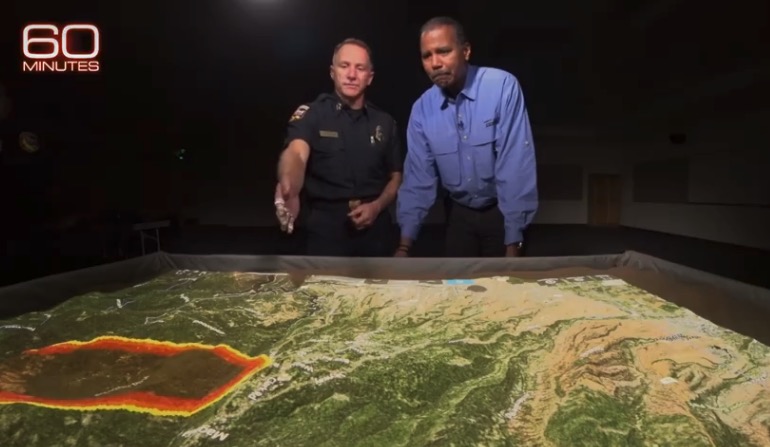
This is a 1 minute clip from a piece on Sunday’s edition of 60 Minutes in which Ken Pimlott, Chief of CAL FIRE, describes how the Camp Fire was growing during its first burning period at “one football field per second”. I assume he means it was consuming 1.3 acres per second which is the size of an American football field, rather than the rate of spread of the flaming front. The video shows one of those cool sand tables onto which a computer projects a spreading wildfire. They are excellent for training exercises and modeling fire behavior.
This clip was taken from a very good 10 to 15 minute piece on Sunday’s 60 Minutes about the Camp Fire, and is worth checking out. You can see the entire 42-minute show on the CBS website including the section on the fire, but you’ll have to watch the commercials.
Firefighters are very busy in Queensland, Victoria, and New South Wales
The Australians have arranged for more aerial firefighting equipment than usual in Queensland, Victoria, and New South Wales
Continue readingList of unaccounted for in Camp Fire reduced to 11
Businessman gives $1,000 to each student at Paradise High School
Continue readingWildfire potential, December through March

On December 1 the Predictive Services section at the National Interagency Fire Center issued their Wildland Fire Potential Outlook for December through March. The data represents the cumulative forecasts of the ten Geographic Area Predictive Services Units and the National Predictive Services Unit.
If their analysis is correct, the only area with above normal wildfire activity during the period will be Hawaii. Southern California has dropped out of the very active prediction category.
Below:
- An excerpt from the NIFC narrative report for the next several months;
- More of NIFC’s monthly graphical outlooks;
- NOAA’s three-month temperature and precipitation forecasts; and,
- Drought Monitor.
“Much Climatologically speaking, fire activity during the winter months, December through February, is at a minimum. Areas most susceptible to activity are generally restricted to the southeastern states where periodic increases in fire activity are possible during dry periods until spring greenup begins. However, current data and expected trends in precipitation suggest that large fire potential will be Below Normal in this region. The abundance of moisture should keep fuels in most areas from becoming critically dry. Drought forecasts project that the region should remain mostly free of drought. In March, short duration wind events can trigger grassfire activity across the southern Great Plains while the fuels are receptive prior to greenup. This is considered normal and some activity is expected entering spring.
“The ongoing weak El Niño event will lead to an overall below average snowpack west of the Continental Divide this winter except possibly across the southern Rockies where above average precipitation is expected. Snowpack deficits along the Divide will likely be buffered by northeasterly flow events as fronts drop south into the country from central and northern Canada.
“Sea surface temperatures (SSTs) surrounding the Hawaiian Islands range from half a degree to 2 degrees Celsius above average. Average temperatures throughout the region are expected to continue to be slightly above average through March. Rainfall was above normal in October but dropped off sharply in November. The official outlook for Hawai’i follows historic correlations, calling for below average rainfall from December through the spring months. Fuel loading has been above average since last spring, and fire activity was above average during the drier portions of the summer. Therefore, as dry weather continues Significant Fire Potential will increase to Above Normal in December and remain there through March and likely beyond.”
