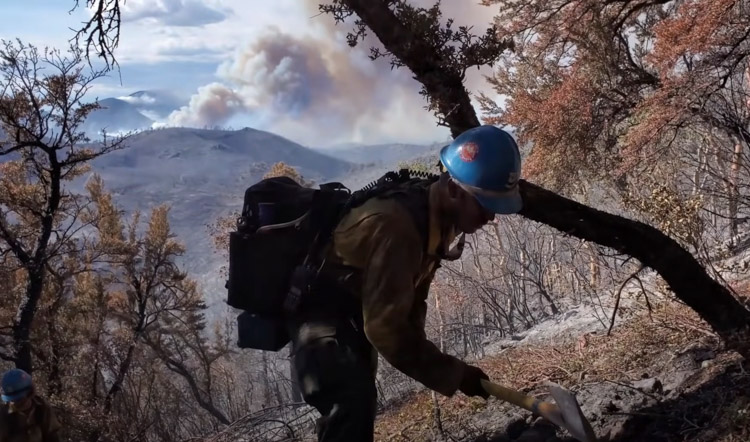
A video response to Representative Tom McClintock’s description of wildland firefighters as “unskilled labor”

 fire firefighters wildland wildfire
Still image from the Jack Jones “Unskilled Labor” documentary

When U.S. Rep. Tom McClintock of California called wildland firefighters “unskilled labor”earlier this month it provoked strong responses from the highly trained, professional, tactical athletes who put their bodies on the fireline to protect our citizens and forests.

One of those reacting was Jack Jones who was motivated by the criticism to put together the video he shot last year while serving as a highly skilled firefighter on the Idaho-based Sawtooth Hotshots. The resulting 26-minute documentary is titled, “Unskilled Labor” A Season with the Hotshots.

 fire firefighters wildland wildfire
Still image from the Jack Jones “Unskilled Labor” documentary

The video is the best I have seen that captures what it is like to work with 20 other highly skilled professional firefighters over the course of a fire season — digging fireline, mopping up, firing out, and hiking impossibly steep terrain while carrying heavy loads. Mr. Jones narrates as we see excellent photography of scenes that most people can’t even imagine. It brought me back to the five seasons I spent on Southern California hotshot crews.

Mr. Jones addresses thoroughly the ridiculous comment by Representative McClintock about “unskilled labor”.

The viewer may be left with the conclusion that if the trained and experienced firefighters on Hotshot crews were not skilled, instead of returning home after a fire assignment they could be in a cemetery.

Smoke forecast, 11 pm MDT July 31, 2021

Smoke forecast
Smoke forecast for 11 p.m. MDT July 31, 2021.

For the last couple of days wildfires in Southern British Columbia have been producing large quantities of smoke which has been drifting into Alberta, North-central US, the American Midwest, and points further east. The forecast for Saturday night indicates this trend is continuing.

Clouds have made it difficult for satellites to photograph smoke coming from the Bootleg Fire in Oregon and the Dixie Fire in California.

Satellite photo smoke wildfires British Columbia Montana
Satellite photo showing smoke from fires in BC and Montana at 7:40 p.m. MDT July 30, 2021.

A Senate infrastructure bill will address many wildland fire issues

The Capitol, Washington, DC
The Capitol, Washington, DC. Photo by Bill Gabbert

A $1 trillion bipartisan infrastructure bill with funding for some wildland fire issues passed an important procedural vote in the Senate Friday that opened up the legislative package to the next phase, potential changes and amendments. In the evenly divided body at least 60 votes are needed for amendments and final passage. It received 66 today which allows it to move forward in the process. The Senate version of the bill is S.2377 – Energy Infrastructure Act.

About 0.3 percent, or approximately $3,369,000,000 in this $1 trillion “small” infrastructure bill is directed at wildland fire. Another infrastructure bill that may spend more than $3 trillion will be considered later.

The $1 trillion version appropriates funds toward a couple of dozen wildland fire issues, most of which are important, but especially a few that have been near and dear to the hearts of Federal firefighters Forestry Technicians for years, especially the creation of a Wildland Firefighter occupational series. This would mean if the bill passes they will no longer be pigeonholed as they are now in a Forestry Technician job description. A bump in salary is also included.

After it made it onto the Senate floor this week things started happening quickly. While amendments can be brought forward, there is hope that the final version could receive a vote in a matter of days, perhaps as early as Sunday August 1. If not then, probably soon thereafter. However, with politicians and legislation anything is possible — or sometimes impossible. After it passes the Senate, then it moves to the House where the outcome is less certain. The politicians and staffers are motivated to do SOMETHING, because they are anxious to leave on their August recess.

The bill authorizes $600 million for management of personnel — those who fight fires.

  • The bill directs OPM to develop a distinct “wildland firefighter” occupational series.
  • The DOI and FS shall convert no fewer than 1,000 seasonal wildland firefighters to wildland firefighters that are full-time, permanent, year-round Federal employees who will reduce hazardous fuels on Federal land for at least 800 hours each year.
  • The base salaries of Federal wildland firefighters will be increased by the lesser of an amount that is commensurate with an increase of $20,000 per year or an amount equal to 50 percent of the base salary.
  • Develop mitigation strategies for wildland firefighters to minimize exposure due to line-of-duty environmental hazards.
  • Establish programs for permanent, temporary, seasonal, and year-round wildland firefighters to recognize and address mental health needs, including care for post-traumatic stress disorder.

Other provisions of the the bill, authorized for fiscal years 2022 through 2026. (M = million)

  • $20M, Satellite fire detection
  • $10M, Radio interoperability
  • $30M, Reverse 911 systems
  • $50M, Slip-on firefighting modules for pickup trucks
  • $100M, Pre-fire planning, and training personnel for wildland firefighting and vegetation treatments
  • $20M, Data management for fuels projects and large fires
  • $20M, Joint Fire Science Program (research)
  • $100M, Planning & implementing projects under the Collaborative Forest Landscape Restoration Program
  • $500M, Mechanical thinning, timber harvesting, pre-commercial thinning
  • $500M, Wildfire defense grants for at risk communities
  • $500M, Prescribed fires
  • $500M, Constructing fuelbreaks
  • $200M, Remove fuels, produce biochar and other innovative wood products
  • $200M, Post-fire restoration
  • $8M, Firewood banks
  • $10M, Wildfire detection and real-time monitoring equipment

One issue this legislation does not address is the inadequate funding of aerial firefighting, the use of air tankers and helicopters to assist firefighters on the ground by dropping water or retardant to slow the spread of wildfires, which is necessary for Homeland Security. The Federal agencies entered the year with 18 large air tankers and 28 large Type 1 helicopters, when they should have 40 large air tankers and 50 large helicopters on exclusive use 10-year contracts instead of the existing 1-year contracts.

Billions in losses, thousands could die if wildfire response unchanged: report

Cub Creek 2 Fire
Cascade Type 2 IA crew on Cub Creek 2 Fire in Northern Washington, July 25, 2021. InciWeb.

A team of scientists from British Columbia, the United States, and Spain say Western Canada must address the threats posed by highly destructive wildfires or face deadly consequences.

The scientists, including Mathieu Bourbonnais, assistant professor of earth and environmental sciences at the University of British Columbia Okanagan, predict devastating wildfires such as those currently burning in B.C. and elsewhere in the country will be commonplace by 2050.

The group has released a paper predicting billions of dollars in suppression and indirect fire costs as well as hundreds or thousands of premature deaths due to exposure to wildfire smoke if climate change and fire causes are not resolved.

The warning comes as statistics from the B.C. government show 1,251 wildfires have charred more than 4,500 square kilometres of bush since the start of the fire season on April 1.

Three dozen of those blazes are considered extremely threatening or highly visible and include the 395 square kilometre fire southwest of 100 Mile House that remains out of control and prompted an evacuation alert for another 161 properties on Wednesday.

Environment Canada has issued heat warnings or special weather statements for inland sections of the north and central coasts and much of southern B.C., as the BC Wildfire Service warns the combination of high temperatures and low relative humidity will make wildfires even more intense.

Bourbonnais, who spent years working as a wildland firefighter, says in a statement that a new long-term plan is needed because it’s simplistic and insufficient to blame the wildfire crisis on the forest sector or wildland fire management agencies.

“Wildfires affect so many facets of our society and environment including health, the economy, biodiversity, ecosystem function and more,” he says in the release.

“Wildland fire management must engage additional proponents, including Indigenous Peoples, industry and communities, to help people learn to live with the realities of landscapes and ecological systems that include wildfires but, over time, work to reduce their more catastrophic effects.”

The economic and social costs of wildfire response are unsustainable, the scientists argue.

—

First published by The Canadian Press