
A 30-year-old woman has been arrested for starting the blaze
Continue readingPay raise of $2,500 requested for Florida wildland firefighters
7:46 p.m. EDT Sept 24, 2021
 Florida Forest Service photo.
Last week, Florida Agriculture Commissioner Nikki Fried submitted a budget request for fiscal year 2022-2023 that includes a $2,500 pay increase for 932 firefighter and firefighter support positions within the Florida Forest Service.
A vacancy announcement for Forest Ranger, position #42002179 closing today whose duties include forest fire prevention, detection, suppression and pre-suppression shows a starting salary of $29,080 annually, which works out to $13.98 an hour (based on 2,080 work hours per year). This raise would increase it to $15.18 an hour.
 Nikki Fried, Florida Commissioner of Agriculture and Consumer Services.
These numbers are similar to the pay for a federal wildland firefighter starting at a GS-3 in most of the United States. Their salary is being temporarily bumped up to around $15 an hour, but there is an effort to rebuild the pay system on the federal side, possibly with a more substantial permanent increase.
Applicants for the Florida job must swear that they have been a non-user of tobacco or tobacco products for at least one year immediately preceding application. They must live within 30 miles of the headquarters, in this case Chipley Florida, throughout employment in the position. Within 6 months of appointment they are required to obtain a Class A Commercial Driver License (CDL).
Over the last three years, Florida Forest Service personnel responded to an annual average of 4,672 fires that burned 147,169 acres, according to a press release from the Florida Department of Agriculture and Consumer Services.
60 minutes to cover the very large firefighting helicopters in SoCal
A group of 4 helicopters known as the Quick Reaction Force
Continue readingIn case of fire break glass
The group of four helicopters known as the Quick Reaction Force will be covered on 60 Minutes
Continue readingFirefighters conduct firing operations to protect Sequoia National Park Headquarters
On the KNP Complex of fires in Southern California
Continue readingLegislation introduced in Australia and the U.S. to benefit wildland firefighters
Presumptive illnesses recognized for forest firefighters in Victoria, and in the U.S. a housing allowance and mental health program
Continue readingTom Sadowski, El Cariso Hotshots, 1969-1972
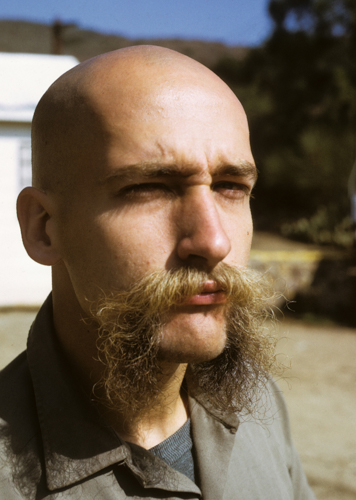 Tom Sadowski. Photo by Bill Gabbert, circa 1972.
A former El Cariso Hotshot passed away unexpectedly on June 16. Tom Sadowski was on the crew from 1969 through 1972.
Tom was unique — if you spent much time with him you would remember him. He was one of the smartest people I ever met. I learned from him. As young and dumb as I was, I had much room in my little brain for knowledge about wildland firefighting and how the world works. For a year we were roommates in the hotshot barracks up the hill from the hotshot camp in the Orange County facilities. At night there was not much to do so we talked or read. He taught me a great deal about photography and with his guidance I purchased my first 35mm camera of my own, a Minolta, after using a very old Argus that was my mom’s.
One year Tom drove with his girlfriend from his home in New England 2,500 miles to our base near Elsinore, California in a very old, army surplus jeep. He was pulled over more than once for driving too slow.
He admired well-built machinery that was made to last with heavy duty materials. We were on a fire in Wyoming and Tom had climbed on top of a large old water tender to check it out. I was taking a picture of him with my old beat-up Argus. When I pressed the shutter, I could hear and feel the guts of the camera come apart. I shook it and it rattled, which is never a good sign. I blamed Tom then for breaking my camera. I still do. I took a picture of him and he literally broke the damn camera.
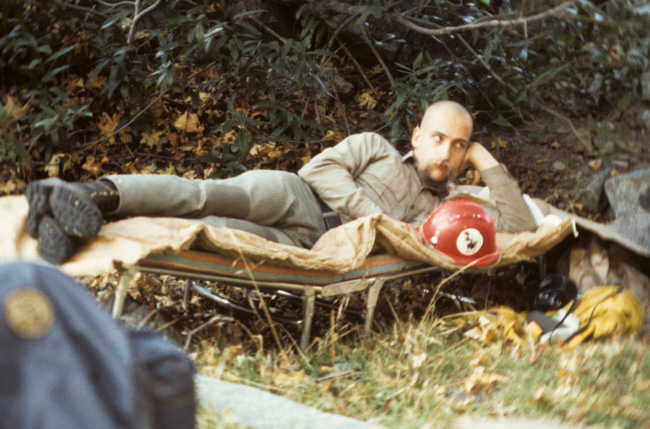 Tom Sadowski resting on a cot and a paper sleeping bag. Photo by Bill Gabbert, around 1971.
When Tom was on the crew there was no standard training curriculum in the USFS for new firefighters. At the direction of crew Superintendent Ron Campbell our crew developed a four-day basic training package which became known as the “Basic 32-hour Package”.
Tom taught us how to build a slide program of illustrations, graphics, photos, narration, and visual aids that was automatically advanced by silent cues on a taped narration.
There were no personal computers then, and we made all of our graphics using hand-drawn images, artist supplies, press-on letters, and a 35mm camera, mostly Tom’s, but I also contributed some images.
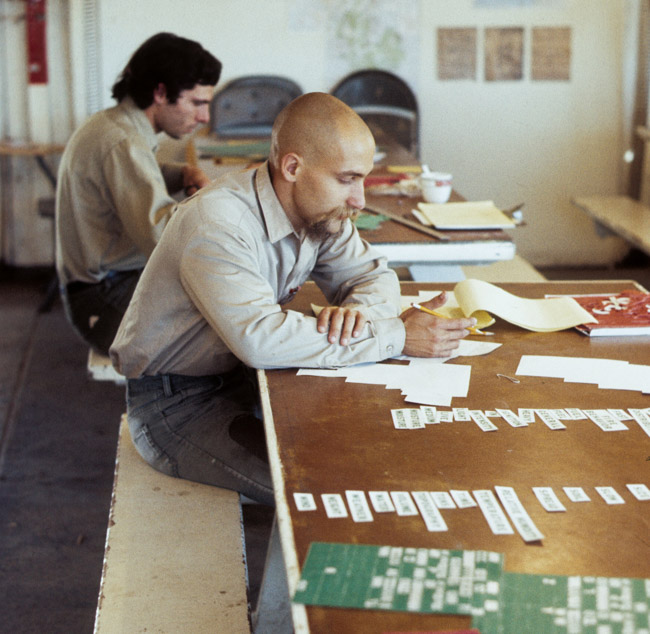 Rick Bondar (L) and Tom Sadowski in 1972 working on what became the Basic 32-hour Fire Training for new employees.
When the training package was finished in 1972 or 1973, it required a Wollensak cassette recorder and a 35mm slide projector, but eventually was converted to VHS tapes and was used with the workbooks in many locations around the country for training new firefighters.
In 1972 Tom and I sent some of our fire photos and a proposal to National Geographic hoping they would pay us handsomely. We received a very nice declination letter from someone there named, and I have not forgotten this, “Smokey”. He explained that they liked our photos, but that they had done a wildland fire story 3-4 years before and it was too soon to do another one.
After fighting fires in Southern California Tom worked for the BLM in Alaska and worked his way up to the position of Assistant Fire Management Officer. In the 1980s I visited him at his home on a hill that had a very nice view of Anchorage. I knew he was an excellent photographer, but was surprised to see that he had a full-blown studio with fancy lighting and various backgrounds on spools that could be pulled down behind his subject.
 In 2008 Tom recreated the El Cariso Hotshots logo for the commemoration of their 50th year. I’m not sure that he ever received proper credit for that project.
In his later years Tom lived in Maine and for a while he and his wife ran a women’s clothing store and later a restaurant and bar.
He and I stayed in touch by email exchanging messages every one to three years.
He wrote a regular humor column, “Just Saying”, that ran in at least one newspaper, The Free Press in Maine, where an archive of his columns is still available. If you only read one, check out a tribute to him written by Ethan Andrews, “Remembering Tom Sadowski”, which includes Tom’s own thoughts about how to write his “autobituary”. (UPDATE Dec. 26, 2021: The previous three links no longer work, but the WayBackMachine has retained some of the archives.)
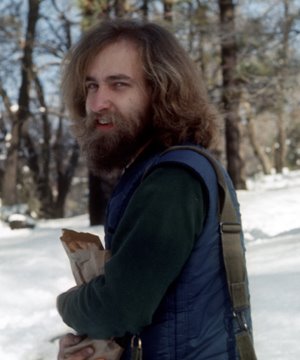 Tom Sadowski in 1975. Photo by Bill Gabbert.
We have published some of Tom’s writings on Wildfire Today. In 2013 he contributed a large section of our tribute to former El Cariso Superintendent Ron Campbell. In 2015 he wrote about the passing of Fred Rungee, “Alaska resident, forest fire control veteran and humanitarian.”
Who has said, “we can’t fight fires on the cheap”?
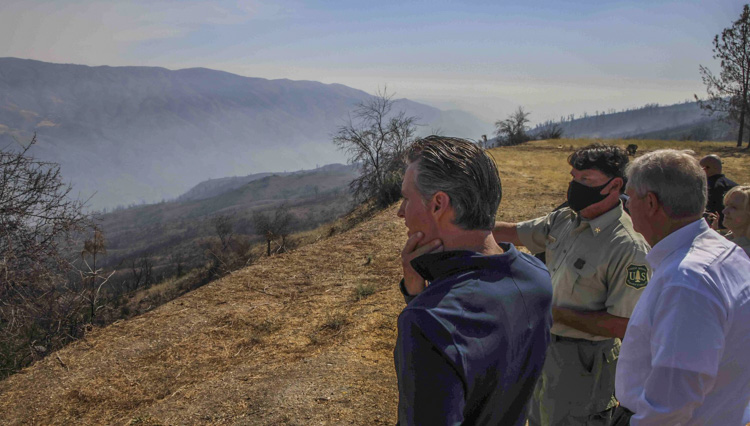
When Secretary of Agriculture Tom Vilsack said August 4 we can’t manage forests and suppress fires “on the cheap” it was not the first time that concept has been stated. Here is part of what the Secretary said when he was meeting with California Governor Gavin Newsom to discuss state and federal collaboration on wildfire response and fuels management across the West:
We are prepared to do a better job [of forest management] if we have the resources to be able to do this… Candidly, I think it’s fair to say over the generations and decades, we have tried to do this job on the cheap. We have tried to get by, a little here, a little there, with a little forest management here, a little fire suppression over here, but the reality is this has caught up to us.
We have to significantly beef up our capacity. We have to have more boots on the ground… And we have to make sure our firefighters are better compensated. Governor, that will happen.
We need to do a better job, and more, forest management to reduce the risk of catastrophic fire.
Looking back at the Wildfire Today archives, here is where we’ve seen that phrase before — excerpts from the articles:
William Scott, September 8, 2012:
Stop narrowly thinking of fires as a land management issue, and begin treating them as a national security issue. Finally it’s time. We have to develop and field a robust large air tanker fleet of firefighting aircraft. The Forest Service has made a good start, but it still suffers from a culture and attitude of what firefighters call ‘cheapism’, the idea that we can fight wildland fire on the cheap. And that’s no longer acceptable.
Senator Harry Reid, July 19, 2013, from the Las Vegas Review-Journal:
As firefighters head home from Southern Nevada, U.S. Sen. Harry Reid on Wednesday blamed “climate change” for the intense blaze that consumed nearly 28,000 acres and drove hundreds of residents from their homes around Mount Charleston this month.
Reid said the government should be spending “a lot more” on fire prevention, echoing elected officials who say the Forest Service should move more aggressively to remove brush and undergrowth that turn small fires into huge ones.
“The West is burning,” the Nevada Democrat told reporters in a meeting. “I could be wrong, but I don’t think we’ve ever had a fire in the Spring Mountains, Charleston range like we just had.
“Why are we having them? Because we have climate change. Things are different. The forests are drier, the winters are shorter, and we have these terrible fires all over the West.”
“This is terribly concerning,” Reid said. Dealing with fire “is something we can’t do on the cheap.”
“We have climate change. It’s here. You can’t deny it,” Reid went on. “Why do you think we are having all these fires?”
Bill Gabbert, February 25, 2018:
The federal government is reducing the numbers of large air tankers and helicopters on exclusive use contracts. Air tankers are being cut from 20 to 13, and Type 1 helicopters over the last year have been reduced from 34 to 28. Cutting back on these firefighting resources is not going to enhance our ability to suppress new fires before they become large, dangerous, and expensive.
You can’t fight fires on the cheap.
.
Sometimes “cheap” is too expensive.— Wildfire Today ? (@wildfiretoday) February 24, 2018
Bill Gabbert, March 16, 2018:
OpEd: I am tired of complaints about the cost of fighting wildfires
(This was first published on Fire Aviation)
The large air tankers on exclusive use contracts have been cut this year from 20 to 13. In 2002 there were 44. This is a 73 percent reduction in the last 16 years.
No scooping air tankers are on exclusive use contracts this year.
The large Type 1 helicopters were cut last year from 34 to 28 and that reduction remains in effect this year.
Some say we need to reduce the cost of fighting wildfires. At first glance the above cuts may seem to accomplish that. But failing to engage in a quick, aggressive initial attack on small fires by using overwhelming force from both the air and the ground, can allow a 10-acre fire to become a megafire, ultimately costing many millions of dollars. CAL FIRE gets this. The federal government does not.
Meanwhile the United States spends trillions of dollars on adventures on the other side of the world while the defense of our homeland against the increasing number of acres burned in wildfires is being virtually ignored by the Administration and Congress. A former military pilot told me this week that just one sortie by a military plane on the other side of the world can cost millions of dollars when the cost of the weapons used is included. The military industrial complex has hundreds of dedicated, aggressive, well-funded lobbyists giving millions to our elected officials. Any pressure on politicians to better defend our country from wildfires on our own soil is very small by comparison.
I am tired of people wringing their hands about the cost of wildfires.
You can’t fight fire on the cheap — firefighting and warfighting are both expensive. What we’re spending in the United States on the defense of our homeland is a very small fraction of what it costs to blow up stuff in countries that many Americans can’t find on a map.
Government officials and politicians who complain about the cost need to stop talking and fix the problem. The primary issue that leads to the whining is that in busy years we rob Peter to pay Paul — taking money from unrelated accounts to pay for emergency fire suppression. This can create chaos in those other functions such as fire prevention and reducing fuels that make fires difficult to control. Congress needs to create the “fire funding fix” that has been talked about for many years — a completely separate account for fires. Adequately funding fire suppression and rebuilding the aerial firefighting fleet should be high priorities for the Administration and Congress.
Welcome to Yosemite, the new Pyrocene Park
 Prescribed fire in Yosemite National Park. Merced River and moon. NPS photo by Isaiah Hirschfield.
By Steve Pyne
The Pleistocene epoch that began 2.6 million years ago sent ice in waves through Yosemite.
Glaciers gouged out great valleys along the Merced and Tuolumne rivers, ice sheets rounded granite domes, cirques sculpted the High Sierra. John Muir traced virtually every landscape feature of Yosemite to its legacy of ice.
Now the residual ice is melting, the streams and waterfalls are drying and the living landscape is burning. In 1990, the A-Rock fire closed the park for the only time in its history, so far. The 2013 Rim fire burned around the Hetch Hetchy reservoir; the 2018 Ferguson fire burned along the park’s Wawona Road. Where the fires didn’t spread, their smoke did.
Add in the industrial combustion of fossil fuels, with its climatic impacts, and virtually every management issue of Yosemite today traces back to fire.
~
Humans have always used fire: It’s our ecological signature.
The end of the last glaciation allowed us, a fire-wielding species, to interact with an increasingly fire-receptive planet. Our pact with fire was mutual. Fire allowed us to flourish; in return, we have taken fire everywhere, even to Antarctica.
The pact had to operate within boundaries set by living landscapes. After all, fire was a creation of life, which furnished its oxygen and fuel and established ecological barriers. Then we discovered an immense reservoir of combustibles buried in geologic time. It was as though we had found a new world –- a fossilized, “lithic” landscape –we could work the way we did living landscapes. The only constraints were those people chose to impose on themselves.
Add up all the burning that people now do in living, and it would seem we are refashioning the Earth with the fire-informed equivalent of an Ice Age, complete with a change in climate, rising sea levels, a mass extinction, major shifts in biogeography and smoke palls. Little on Earth is unaffected.
Fire is driving off the last vestiges of the Pleistocene, from its ice to its mammoths. We have been creating a Pyrocene for millennia, but binge-burning fossil fuels put the process on afterburners.
Fifty years ago Yosemite recognized that its fire scene was out of whack. The problem then was not too much of the wrong kind of fire but too little of the right kind. The park sought to restore pre-settlement fire regimes. Among targeted sites was Illilouette Creek, an elevated basin southeast of Glacier Point.
The park recognized that suppressing fire had stockpiled fuels from the foothills to the crestline, caused Yosemite Valley and the Mariposa Grove to overflow with invasive conifers that blocked views, and prevented the fabled sequoias from regenerating. The park introduced prescribed fire and learned to loose-herd wildfires. The Illilouette basin shuffled toward something like its former fire regime.
No place has the fire program it wants, but Yosemite seems better positioned than the national forests and private lands around it to cope. The issue is no longer to restore natural fire but to find the right mix of fires suppressed and prescribed, and of wildfires managed, to ward off the megafires that are plaguing everyplace else.
Yosemite deals with fires that can threaten small and not-so-small villages. Its specialty is working with wildland fire.
By Aug. 20 of this year the park had coped with 54 fires, 43 from lightning and 11 from people. Some were put out. Some were confined within natural barriers. And a few burning in Illilouette Basin were tweaked as nature’s invisible hand massaged them into five decades of layered burning. The legacy of past fires had altered the conditions for the fires that followed, softening the shock of tougher, meaner burns.
Yosemite has long been celebrated for distilling into near-crystalline state the magnificence of the Western landscape. As it moves from ice to fire, it is showing that it may also serve as a proxy for some of what the Earth needs to do to survive our deepening fire age. There is no way we can’t not manage fire.
 Stephen Pyne
Steve Pyne is a contributor to Writers on the Range where this article was first published. It is a nonprofit dedicated to spurring lively conversation about the West. He is the author of The Pyrocene. How We Created an Age of Fire, and What Happens Next.
PBS interviews wildland firefighters about benefits, travel, health care, and pay
Laura Paskus, a reporter and producer for PBS of New Mexico, interviewed three wildland firefighters for an episode of Our Land: New Mexico’s Environmental Past, Present, and Future. They covered some of the pressing issues faced by wildland firefighters, including health care, benefits, extensive travel, and pay.
Seen in the video are Marcus Cornwell, federal wildland firefighter; Kelly Martin, president of Grassroots Wildland Firefighters; and Jonathon Golden, former wildland firefighter.