Around 200,000 people in Canada live in diesel-dependent communities, most of whom are Indigenous and face major challenges. A new report claims that a transition to a more environmentally friendly fuel source could also reduce their wildfire risk.
The recent paper, published in the Communications Earth & Environment journal, identified dual benefits if Canada’s First Nations transitioned away from diesel fuels to “fire-smart” fuels.
Around 70% of the Indigenous communities within the country are off Canada’s electricity grid and are dependent on diesel-powered generators as their main sources of both power and heat, causing energy insecurity problems and worsening climate change.
“Diesel-dependent remote communities pay approximately 2–6 times more for energy…than the average Canadian, even with subsidies,” the report said. “Since 2017, the Government of Canada, has supported over one hundred clean energy projects, including bioenergy via its Clean Energy for Rural and Remote Communities program and many fire-prone communities have expressed the need to integrate local biomass management with wildland fire management plans.”
“They found that 30 of the 33 communities could meet their annual energy needs by harvesting less than 1% of their local biomass.”
The researchers identified 33 diesel-dependent communities at high wildfire risk due to the accumulation of flammable forest fuels. They found that 30 of the 33 communities could meet their annual energy needs by harvesting less than 1% of their local biomass. If communities made such a transition from diesel to wood-based bioenergy, the researchers said their energy insecurity issues and wildfire risk would be greatly reduced.
Canadian Forest Service Landscape Restoration Researcher Nicolas Mansuy told WildfireToday that there are numerous barriers for diesel-dependent communities that want to transition to new energy sources, including:
Infrastructure and logistics constraints
Technical capacity and skilled labor
Long-term funding and operational support
Policy and regulatory barriers
Community readiness and energy planning gaps
Lack of reliable and localized data
The nation’s Clean Energy for Rural and Remote Communities program, however, can help expand the transition, according to Mansuy. The program already supports bioenergy projects and encourages communities to use local feedstocks from local forest management, salvage logging, and fuel treatments.
The study claims to be the first Canada-wide assessment of potential biomass extraction for bioenergy and wildfire risk mitigation.
“Although we conducted the analysis on a limited number of off-grid communities, our findings clearly demonstrate that remote off-grid communities, which are predominantly Indigenous, face the dual threats of wildfire and energy insecurity,” the researchers said. “Given the growing wildfire risk and the need for energy security in Indigenous communities, Indigenous leadership, and collaboration with wildland fire agencies, are essential for developing integrated fuel management strategies and identifying synergies with the bioenergy sector.”
The County of Los Angeles Department of Medical Examiner on Tuesday announced that the death toll from the Palisades and Eaton Fires has risen, more than six months after the fires burned.
Officials were called to the scene near the 10 block of La Venezia Court in Altadena on Monday to investigate possible human remains found there, the department said in a press release. There, the department’s Special Operations Response Team determined the remains were human and linked to the January wildfires.
“The death toll related to the wildfires is now 31 – 19 in the Eaton Fire and 12 in the Palisades,” the department said. “The latest Medical Examiner case number is 2025-11669 and is Unidentified Doe #431.”
Officials said case information will be added once the remains are identified and legal next of kin have been notified.
Most of the deaths connected to the Palisades and Eaton Fires were confirmed in January, with the exception of this death and a death confirmed on April 2. Then, officials found the body of 54-year-old Kevin Devine at a residence in the 900 block of Boston Street in Altadena. The cause of death was listed as inhalation of products from combustion and thermal injuries.
Heatwave temperatures, drought and decades of poor forest management are producing an extreme wildfire season across Europe into July.
More than 230,000 hectares have been burnt by wildfires across Europe so far this year, according to the EU’s European Forest Fire Information System (EFFIS). As of 15 July, the cumulative total of scorched land stands at 230,049 hectares – 119 per cent above the long-term average of 106,587 hectares for this time of the year. A total of 1203 fires larger than 30 hectares have been detected, compared to 783 this time last year, which was closer to an average year for wildfire.
Early July saw multiple fires involving evacuations of thousands of residents in areas including Turkiye where three lives were lost, Catalonia with two deaths, Crete, Scotland and around Marseille in France. Ireland issued a rare Condition Red Forest Fire Warning, its highest level of Fire Danger.
From mid-July, the focus has been on northern Europe and Scandinavia, and southern European regions around the Mediterranean.
Two wildfires burning in Scotland merged, creating the nation’s largest recorded wildfire event, according to the Scottish Wildfire Forum.
The fires, one burning near Carrbridge and the other near Dava moor, occurred between June 28 and July 1. The fires burned a total of 24,087 acres (9,752 hectares) and had a perimeter length of 157 miles (253 kilometers). The burned land included 21,529 acres (8,716 hectares) of moorland and peatland and 2,559 acres (1,036 hectares) of forest.
“The fires threatened homes and damaged moors, forests, peatland and farming infrastructure such as fences,” the forum said in a press release. “Smoke was an issue over a wide area. Many roads in the area had to be closed and residents were advised to close windows and doors on public health grounds. The Local Resilience Partnership, where multi-agency responses to such incidents are managed, held daily meetings.”
Scottish Land & Estates, a rural business association, said numerous businesses and estates helped government officials respond to the fire, including over 100 employees and £3.1 million in firefighting equipment. The association also sent a questionnaire out to all estates affected by the fire, seeking information on the fire’s spread and local impacts.
A report from the association found that more than 110 ATVs, fogging units, tractors, diggers, water bowsers and other assets were deployed by local businesses and estates. Several “near-miss” incidents also occurred, according to the report.
“The Scottish Wildfire Forum is deeply grateful to all those who were involved in bringing these difficult fires under control,” the forum said. “The SFRS crews alongside the expertise and dedication of keepers, foresters and farmers who work in our rural landscapes, fought for several days to ensure the fires were extinguished. People travelled great distances to bring their resources to bear. Locals volunteered and donated huge quantities of food and drinks. Our thanks go to all.”
In his editorial in International Journal of Wildland Fire, Co-Editor-in-Chief Martin Girardin shares some of the challenges facing the journal, celebrates the achievements and offers thoughts on where he believes both the field of wildland fire science and this publication are heading. And there is global call for new Associate Editors in new fields of wildfire science.
It has now been a year since I stepped into the role of co-Editor-in-Chief of the International Journal of Wildland Fire (IJWF). As summer sets in and the day-to-day demands of my government position ease, I find myself with a moment to reflect on this transformative experience.
Journal context and legacy
The IJWF stands as a cornerstone of wildland fire research – a not-for-profit society scientific journal covering all aspects of wildland fire science and management. Published under the stewardship of the International Association of Wildland Fire (IAWF), a non-profit organisation dedicated to facilitating communication and providing leadership for the wildland fire community worldwide, the journal has served as the premier venue for fire science discourse for over three decades.
Since its founding in 1992, IJWF has continuously grown and evolved under the distinguished guidance of three exceptional Editors-in-Chief. Mike Flannigan, my former PhD co-advisor, served throughout 2002–2008, establishing the journals reputation for rigorous peer review and broad scientific scope. He was succeeded by Stefan Doerr and Sue Conard, who served as co-Editors-in-Chief and worked together to strengthen the journals international reach and interdisciplinary approach, providing remarkable stability and growth to the publication. Most recently, Sue continued in the role from 2009 until her well-deserved retirement in the summer of 2024, at which point I was nominated to succeed her as co-Editor-in-Chief.
My connection to IJWF extends well beyond this past year. Having served as an Associate Editor since 2006, I was already deeply familiar with the journals culture, standards and the dedicated community of researchers, practitioners and stakeholders who contribute to its success. This long-standing involvement provided invaluable preparation for the transition to the Editor-in-Chief role, though nothing could have fully prepared me for the breadth and complexity of the challenges ahead.
A year in numbers: growing impact and reach
Taking over an Editor-in-Chief role inevitably comes with its challenges, and the past 12 months have been both demanding and deeply rewarding. Over this period, IJWF has received 216 submissions from 33 countries, a testament to both the international scope of our readership and the increasingly global nature of wildland fire science. We published 119 articles last year, each representing months of dedicated work by our authors and the rigorous review process maintained by our Associate Editors, editorial board members and peer reviewers.
The numbers alone tell a compelling story of growth and engagement. Over the last six months, we have observed a notable acceleration in manuscript submissions, reflecting the mounting global attention on fire-prone ecosystems in the context of climate change. The expansion in research activity we observe at IJWF mirrors broader trends in the field. Contemporary submissions span traditional fire ecology and behaviour studies, cutting-edge modeling innovations, community resilience and social impact assessments, fire management strategies and emerging interdisciplinary research that bridges natural and social sciences.
Climate change has thrust wildland fire into the global spotlight, transforming it from a specialised area of study into a critical component of environmental science, public policy and societal resilience planning. As wildfire activity intensifies across many regions worldwide – from the Mediterranean basin to the boreal forests of Canada, from the chaparral of California to the eucalyptus forests of Australia – research efforts have expanded dramatically. The breadth of topics reflects not only the maturation of fire science as a discipline but also the urgent need for comprehensive, evidence-based solutions to increasingly complex fire management challenges. This transformation brings both opportunities and responsibilities for our journal and the broader fire science community.
Navigating editorial challenges in a rapidly evolving field
While this growth is encouraging, it has also presented us with a complex set of challenges that require thoughtful adaptation and strategic planning.
Our editorial team is composed of experienced Associate Editors, many of whom are senior researchers and generalists with deep disciplinary knowledge across the breadth of fire science. This foundation has served us exceptionally well over the years, providing the expertise needed to evaluate diverse submissions and maintain our standards of scientific rigour. However, the pace of technical innovation in our field is accelerating at an unprecedented rate.
New modeling frameworks, artificial intelligence (AI)-driven data synthesis, advanced remote sensing techniques and sophisticated computational approaches are emerging faster than most researchers – let alone editors – can fully absorb and evaluate. Machine learning applications in fire prediction, high-resolution satellite-based fire detection systems and complex coupled climate-fire models represent just a few examples of the increasing technical sophistication of submissions. Ensuring robust peer review for such specialised topics while maintaining our commitment to accessibility and broad relevance poses a significant challenge.
In parallel, emerging research priorities increasingly reflect the complexity of fire-climate-vegetation interactions. The field is evolving beyond traditional fire weather indices to encompass compound events, long-term system thresholds and diverse knowledge systems. This includes critical advances in understanding fire-drought synergies, paleo-informed reconstructions of reference conditions and climate attribution of extremes – as well as a growing recognition of Indigenous fire stewardship and traditional ecological knowledge.
While there is strong confidence that fire weather will intensify with ongoing climate change, the direction and magnitude of vegetation responses – especially under various management interventions – remain far more uncertain. Understanding the impacts of silvicultural strategies such as fuel treatments, species selection and the assisted migration of genetically differentiated, drought-adapted populations is central to forecasting future fire regimes. These vegetation dynamics will ultimately shape the spatial and temporal patterns of biomass burning across near- and long-term horizons. These developments are not only expanding the scope of wildland fire science, but also challenging us to integrate across disciplines in ways that support more holistic and actionable understanding.
Renewing and diversifying editorial leadership
Compounding this challenge, several of our long-serving Associate Editors have recently concluded their terms, taking with them decades of experience and institutional knowledge. While we celebrate their many contributions to the journal and the field, this transition presents an opportunity and an imperative for renewal to further enrich our editorial board – aligning its composition with the evolving frontiers of fire science and the diversity of our global readership.
To that end, as a community journal, we’re always looking to expand the experience, breadth of scope and diversity of our editorial board. We want our editorial board to reflect the diversity of our audience, providing unique perspectives and coverage in niche topics. We encourage applications from researchers with broad methodological expertise, including early-career scientists who bring fresh perspectives, quantitative modelers with cutting-edge technical skills and interdisciplinary researchers working at the intersections of ecology, climate science, data science and social research.
This strategic renewal will support our continued ability to engage with the rapidly expanding scope of wildland fire science, while ensuring that we maintain the rigorous standards and broad accessibility that define IJWF.
One of our ongoing editorial challenges involves maintaining an appropriate balance between encouraging methodological innovation and ensuring practical applicability. While we actively welcome innovation – particularly in fire modeling, process-based ecological approaches and machine learning applications – we require that all manuscripts remain grounded in scientific rigour and demonstrate clear implications for fire management, policy development or a fundamental understanding of fire processes.
As the field matures, the need for synthesis and methodological review papers is also becoming more pronounced. These articles can consolidate knowledge across disciplines, highlight research gaps and provide much-needed guidance for future work. This balance is crucial because the real-world impact of our published research remains a core tenet of IJWF. Our readers include not only academic researchers but also fire managers, policymakers and practitioners who depend on our publications to inform critical decisions affecting communities and ecosystems worldwide.
A shared responsibility
As wildland fire science continues to evolve, I remain optimistic about the direction of both wildland fire science and IJWF. This not-for-profit society journal thrives because of its community. I am deeply grateful to our Associate Editors, editorial board members and reviewers for their expertise and generosity. Their dedication ensures that IJWF continues to publish thoroughly peer-reviewed research that advances both scientific understanding and practical fire management.
Martin P. Girardin
Co-Editor-in-Chief, IJWF
Research Scientist
Canadian Forest Service, Natural Resources Canada
Girardin Martin P. (2025) One year in: reflections from the IJWF Co-Editor-in-Chief. International Journal of Wildland Fire 34, WF25151. https://doi.org/10.1071/WF25151
Arizona Governor Katie Hobbs has called for an independent investigation into the federal response management of a wildfire that caused numerous residents and workers to evacuate and destroyed a historic lodge.
“(The fire) was driven by strong northwest wind gusts, uncommon to the area, and jumped multiple containment features,” according to Inciweb. “The fire is being managed with a full suppression strategy. Fire behavior is very active, driven by hot temperatures, low relative humidity, and continued strong wind gusts.”
The National Park Service reported that aerial bucket drops were conducted to slow fire movement near the Grand Canyon Lodge and Transept Canyon. However, the use of aerial retardant was not feasible due to a chlorine gas leak at the water treatment facility, which required the evacuation of firefighting personnel from critical zones nearby.
New photos from the Dragon Bravo Fire on the North Rim are available on Grand Canyon National Park’s Flickr page. The photos were taken Friday, July 18, 2025, and include aerial reconnaissance photos along with on-the-ground images showing damage in the North Rim Lodge area.
Multiple structures in the North Rim were damaged, including the complete destruction of the only lodging at the location, the nearly century-old Grand Canyon Lodge. Preliminary National Park Service assessments indicate that between 50 to 80 structures have been lost, including NPS administrative buildings and visitor facilities. No injuries or loss of life have been reported, and all staff and residents were successfully evacuated prior to the fire’s escalation. Workers of the lodge said they’re devastated by the loss.
“We are deeply grateful to all who have chosen Grand Canyon Lodge as their basecamp of exploration and adventure,” workers said in a press release. “Each guest helped make Grand Canyon Lodge more than just a destination, but a place filled with life-long memories. It is with heavy hearts that we share this devastating news. We know that Grand Canyon Lodge has meant as much to so many of you as it has to us.”
Hobbs said the loss of the historic structure and the surfacing of the wildfire response details called for a full and thorough independent investigation into the management of the fire.
“Arizonans deserve answers for how this fire was allowed to decimate the Grand Canyon National Park,” Hobbs said in a statement. “As wildfires become more frequent and more intense, Arizona deserves nothing less than an aggressive and proactive emergency response from federal partners to ensure Arizonan’s lives, homes, businesses and natural resources are preserved.”
The North Rim of the park will remain closed for the rest of the 2025 season, which runs to October, and inner canyon trails and campgrounds are closed until further notice, the National Park Service said. The South Rim of the park remains open.
Wildfires have been a natural part of Arctic ecosystems – including tundra and boreal forests – for thousands of years. As in other regions, wildfire helps to shape and maintain these ecosystems, impacting plant traits, ecosystem diversity, and composition. However, climate change is making Arctic fires more frequent, intense, and widespread. The Arctic is warming two to four times faster than the rest of the planet, leading to longer fire seasons, more extreme fire weather, and increased lightning strikes that ignite fires.
This article is from a special issue of Wildfire magazine from the International Association of Wildland Fire and the Arctic Council. In this issue scientists, policy experts, community and Indigenous leaders provide clear insights on what is occurring with wildland fire in the Arctic and how best to respond, locally, nationally and internationally.
In addition to combusting vegetation, wildfires in the Arctic also burn the organic soil layers, which play an important role in insulating and protecting the permanently frozen ground, called permafrost, that underlies the tundra and much of the boreal forest. When vegetation and soils are removed by fire, this can trigger or accelerate permafrost thaw.
Most permafrost has been frozen for hundreds to thousands of years. Over time, organic carbon derived from plants has slowly accumulated in permafrost soils because the frozen conditions slow decomposition, leading to the accumulation of an immense amount of carbon – on the order of 1,600 billion tons, or roughly three times the amount of carbon contained aboveground in all the world’s forests. With climate warming, permafrost is thawing, and microbes are decomposing this ancient carbon and releasing it into the atmosphere as greenhouse gasses, carbon dioxide and methane. The release of greenhouse gasses from permafrost thaw, referred to as the permafrost carbon feedback, could be a major accelerant of global climate change in the coming decades and centuries.
Wildfires amplify the permafrost carbon feedback. At the time of burning, Arctic wildfires release large amounts of carbon in the form of carbon dioxide, methane, and other gases and aerosols due to the combustion of organic soils. In fact, the levels of carbon emitted per unit area from Arctic wildfires are among the highest on Earth, rivaled only by tropical peatland and deforestation fires. For the most part, this carbon can ultimately be removed from the atmosphere by vegetation regrowth and stored by ecosystems over a period of decades to centuries. However, by burning the upper soil layers that otherwise keep permafrost cool, Arctic fires also initiate and exacerbate permafrost thaw. In some cases, this is barely noticeable from the surface but can still generate greenhouse gas emissions. In other cases, permafrost with high ice content can thaw abruptly, leading to dramatic features such as thermokarst lakes and permafrost thaw slumps, generating even higher levels of carbon emissions.
HOW ARE ARCTIC FIRES CHANGING?
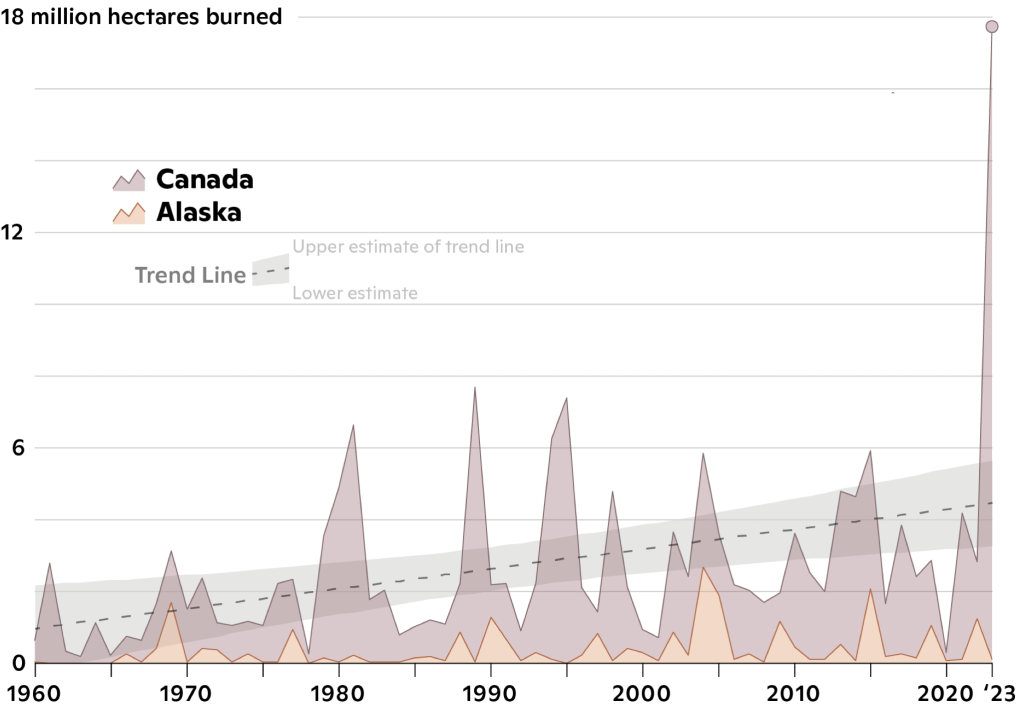
Long-term trends in area burned across Canada and Alaska, developed with data from the Canadian Wildland Fire Information System and the Alaska Interagency Coordination Center.
Image by Greg Fiske, Woodwell Climate Research Center.
Many studies have documented the links between Arctic fires and climate change. The best long-term observational data come from Alaska and Canadian government databases, which detail fires and their area burned since the mid-20th century. From the databases, we know the average yearly burned area across Alaska and Canada during the past two decades is roughly twice that of pre-climate change levels. By far, the most severe fire season was 2023. Canadian wildfires in 2023 burned more than twice the area of any other year on record and emitted between 480 and 760 million tons of carbon. For perspective, that’s three to five times higher than annual emissions from all other sectors in Canada combined, and higher than every country’s annual emissions except China, the United States, and India. It should be noted that regrowing forests from these fires are unlikely to re-sequester much carbon by the mid-21st century – when the world otherwise needs to be approaching net-zero emissions to limit the most damaging impacts from climate change –and that these estimates do not include postfire permafrost emissions.
Novel fire years are not limited to Canada. Russia, for instance, experienced unprecedented wildfire activity in eastern Siberia and north of the Arctic circle in 2019, 2020, 2021 and 2024, which has been linked to warming temperatures, early snow melt, and polar jet dynamics associated with climate change. If current climate warming trends continue, Arctic fires will likely become even more frequent and intense. Studies project a 75 per cent increase in Arctic burned area for every degree Celsius of global warming.
The carbon released by these fires, combined with emissions from permafrost thaw, could rival those of major global economies. Yet these emissions are not currently accounted for in global climate models nor are they fully accounted for in the “accounting framework” used to assess progress toward the Paris Agreement goal of limiting warming to well below two degrees Celsius above pre-industrial levels.
Carbon and climate are not the only causes for concern over increasing Arctic wildfires. These fires emit smoke that degrades air quality and threatens human health for communities near and far. Wildfires impact habitat and subsistence activities for Indigenous communities, can shut down aviation and overland travel, damage infrastructure, and lead to mass evacuations.
Ground slumping in yedoma permafrost after a wildfire, in the interior of Alaska. Yedoma permafrost generally contains large amounts of ground ice, making it vulnerable to abrupt thaw after fires. Yet fires can accelerate permafrost thaw and carbon emissions in many different types of permafrost. Photo by Torre Jorgenson.
WHAT TO DO?
The situation is urgent, and solutions exist. Governments can prioritize wildfire preparedness and community protection plans, fuels treatments and fire breaks around fire-prone communities, and improve real-time forecasting and information sharing, especially with rural and Indigenous communities. Supporting cultural burning practices, where Indigenous communities conduct controlled burns to manage landscapes, can also reduce the risk of severe wildfires. Finally, the combination of improved satellite detection and emerging technology such as autonomous firefighting aircraft presents opportunities for early action suppression of the most damaging wildfires.
However, the most critical solution lies in reducing global greenhouse gas emissions. Cutting global emissions will slow Arctic warming, reducing the conditions that fuel these fires and making other wildfire prevention efforts more effective. Arctic fires are a growing global concern with wide reaching implications for the climate and communities worldwide. By investing in local adaptation, embracing Indigenous knowledge, and tackling the root cause – climate change –we can work toward a more resilient future.
Brendan Rogers is an associate scientist at the Woodwell Climate Research Center in Massachusetts. Rogers uses a combination of field measurements, satellite remote sensing, and modeling techniques to diagnose the impact of increasing Arctic fires on carbon and climate. Rogers uses science to inform natural resource management and policies for improved climate mitigation, adaptation, and ecosystem protection.
Susan Natali is a senior scientist at the Woodwell Climate Research Center whose research on permafrost thaw is motivated by an acute awareness of the risks it poses. Natali has worked extensively across the Arctic, in Alaska, Siberia, and elsewhere, combining field research of permafrost and carbon cycling with remote sensing and modeling to assess current and future climate impacts across the Arctic. Natali works with Indigenous communities, scientists, resource managers, and policymakers at all levels to craft just and effective strategies for limiting harm from Arctic warming.
The Canadian government is not doing enough to support Indigenous people suffering from 2025’s wildfires, according to the Nisichawayasihk Cree Nation.
The Nation, located in Canada’s Manitoba province, recently sent out a press release accusing Indigenous Services Canada, the First Nations and Inuit Health Branch, and the Canadian Red Cross of refusing to answer their calls for help amid the province’s disastrous wildfires. The Manitoba Government on Thursday declared a State of Emergency in response to the “unprecedented” wildfire activity.
The Nation also condemned the organizations’ “delay, denial, and deflection” amid the disastrous wildfires, along with leaving the Nation’s “most vulnerable” residents behind.
“We are being told there are no hotel rooms, they say they are calling other provinces, they say their hands are tied, but where was this excuse-making when thousands of Ukrainian refugees were welcomed to Canada and provided with housing, food, health care and dignity?” Chief Angela Levasseur said. “Why are our people – Indigenous peoples – being left to suffer and choke on thick black smoke while federal ISC and FNIHB officials and the Canadian Red Cross sit at their desks and say ‘not it’?”
The Nation demanded that the agencies immediately evacuate all priority individuals from the nation to safe and private accommodations, deploy emergency medical staff to support evacuations, and for the agencies to respect the nation’s autonomy.
The Canadian Red Cross, in an emailed statement to WildfireToday, said it provides support upon request and at the direction of the Government of Manitoba. Once the organization is requested by a community, it works closely with Indigenous leadership to support individuals, families, and communities impacted by the wildfires.
“This has been a very busy start to the wildfire season in Manitoba and the Canadian Red Cross has been working around the clock to provide support to people impacted by fires,” the statement said. “This is a fast-moving and evolving response, and the Red Cross is working closely with community leadership, the Government of Manitoba, and/or Indigenous Services Canada to provide support to people impacted, as requested and directed by the community.”
Republican representatives from Minnesota and Wisconsin recently sent a formal letter to Canada, demanding that the nation “deal with” its wildfires and the smoke produced by them.
The letter, signed by multiple Republican lawmakers from Wisconsin and Minnesota, was addressed to Canadian Ambassador to the United States Kristen Hillman. Lawmakers accused Canada of having poor forest management and said their constituents are suffering because of it.
“While we know a key driver of this issue has been a lack of active forest management, we’ve also seen things like arson as another way multiple large wildfires have ignited in Canada,” the letter said.
Typically, at this time of year, smoke from Canadian wildfires spreads south into neighboring northern U.S. states such as Minnesota and Wisconsin and beyond.
“Our constituents have been limited in their ability to go outside and safely breathe due to the dangerous air quality the wildfire smoke has created,” the letter said. “In our neck of the woods, summer months are the best time of the year to spend time outdoors recreating, enjoying time with family, and creating new memories, but this wildfire smoke makes it difficult to do all those things.”
The letter doesn’t provide any evidence to back up its poor management claim. Canada has long been seen as a global leader in the sustainable management of its 907 million acres of boreal forest, nearly half the entire area of the United States and around 9% of the world’s total forest cover.
The letter also makes no reference to climate change as a significant driver of increasingly frequent fire weather days and increasingly dry boreal forests throughout Canada, a primary driver of the nation’s worsening wildfires.
“Warmer-than-average temperatures, decreased levels of snowpack, low soil moisture and elevated drought conditions are indicators that climate change is impacting the frequency, size and range of wildland fires in Canada. For example, the number of over-wintering fires is increasing,” Natural Resources Canada‘s website states.
President Donald Trump and his administration have worked to erase all mention of climate change from government websites and correspondence. Outside of the U.S., some mentions of climate change have also had to be scrubbed in order to appease the nation’s current leaders into joining international agreements, like the recently established Kananaskis Wildfire Charter. Ilya Goheen with the University of Toronto’s G7 Research Group told The Canadian Press that G7 leaders may have avoided including mentions of climate change in the charter to placate Trump.
Thirty-two thousand years ago this spring, in the eastern interior of Alaska, during an ice age so severe that the Laurentide Ice Sheet covered most of the continent of North America a mile thick, a Gwich’in man, dressed in neatly tailored, tanned, caribou skin pants and a shirt, walked around the forested edge of a lake, dragging a stick through the tall grass. At the end of the stick flickered a flame that leapt to the grass. The snow in the shadows of the trees blocked the fire’s path, so the flames could travel only into the dead grass that had accumulated, thinning some of the dead willows out in its maw.
This article is from a special issue of Wildfire magazine from the International Association of Wildland Fire and the Arctic Council. In this issue scientists, policy experts, community and Indigenous leaders provide clear insights on what is occurring with wildland fire in the Arctic and how best to respond, locally, nationally and internationally.
The man continued to walk with his torch, through the portage to another lake, and then another, and another. All the while the flames did the work, clearing away the thick grass, making it easier to walk, getting rid of the early coverage for mosquitoes and biting insects where the people would camp through break-up and the summer season in their caribou skin tents.
The plants that grew back, he knew, would be a bit different than what had burned: all nature of flowers and thicker, greener, more lush plants. The areas near the berry patches would grow more berries; the bees and the birds would take the place of the gnats and the mosquitoes; and instead of a thick mat of grass that could sustain a fire that could race away, the land was neatly trimmed, down to its very root top – a black mat.
A cultural burn in Fort Yukon, Alaska in May 2024. The wildland fire community, along with governments, policy makers, and citizens, need to take a critical look at the role of culture file in the landscapes of northern Alaska, Canada, Russia and across the circumpolar Arctic. Photo by Edward Alexander
The fire was doing its work. Not perfectly, as there were areas away from camp where the fire had dwindled due to the ground being too wet, or from the wind blowing in a certain direction. The man saw his kids following him, trying to start their little sticks on fire, and one throwing snowballs at the flames.
Migrating birds would soon arrive and would find good food to greet them; the burn would help make browse so nutritious that the birds would all be fat. The people would have good eggs to eat, birds to hunt, and the muskrat would be plentiful. Maybe the moose would have two calves, or three, instead of one. There wouldn’t be a fire to come racing down through the grass, not this summer; it could still come through the timber, the man thought, but the mosaic of lakes and meadows and sloughs that had been burned should be enough to break up any threats the family might face that summer. The man enjoyed the walk, and the way back would be an easier path, one that could help his whole family, his whole tribe.
Today, we call this man’s activity a cultural burn, and, sadly, all too often, the wisdom in that man’s actions has been forgotten, outlawed or not implemented in our landscape that sorely needs the presence of Dinjii Zhuh K’yaa, our traditional Gwich’in ways of life.
The man didn’t have to cut a fireline with a Pulaski or a chainsaw; he didn’t have to work in a bulldozer cutting a dozer line; and he didn’t have to have air support to keep the fire out of the trees. The snow did the work. The season did the work of keeping the fire cool and controllable, and the fire did its work of clearing the land and creating a green fire break for the summer. The man didn’t have to apply amendments to the soil to make the plants more nutritious, and he didn’t have to apply pesticides to keep biting insects at bay – the ash did all that for him. The man didn’t have to do anything except take a walk while his kids tired themselves out behind him inventing games along the edge of the burn.
The wildland fire community, along with governments, policy makers and citizens, need to take a critical look at the role of cultural fire in the landscapes of northern Alaska, Canada, Russia, and across the circumpolar Arctic. The Pyrocene has met the cryosphere, and the results over the last 20 years have been conclusive: NASA’s MODIS data documents some 174 million hectares of burned area in the circumpolar Arctic Boreal Zone, an area greater than Iceland, Norway, Sweden, Finland, Denmark, and Greenland. While most of these acres have burned in Russia, Canada, and the United States (Alaska), the message written in flame and ash is clear: our environment is changing, and we need to change too.
To protect the Arctic and its people, we need mildfire, not wildfire. We need a healthy environment, not a stagnant monoculture of dead grass. We need solutions that make economic sense. There aren’t enough wildland firefighters in the world to fight fires in the north. How do we tie in a fireline for fires that are larger than U.S. states, or that burn in duff that thickly covers and insulates the soil but readily dries? We must consider the economics of the responses to these fires, and whether mitigation activities are successful at the scale that is needed. To maintain the land and its people, there needs to be a cultural revitalization of Indigenous Knowledge and Indigenous mitigation techniques, not wildland fire suppression born of arbitrary rules, written for the south, and incapable of doing what Indigenous practices have proven they can: stop a fire crisis before it happens, and replace it with a sustainable, fire resilient landscape.
In the modern context, everyone in the wildland fire community has heard of, worked extensively in, or planned for wildland-urban interface (WUI) events. In the sparsely populated north, we do have traumatic WUI incidents, such as the evacuation of the capital city of Yellowknife in the Northwest Territories in 2023. People fled on the only escape route out, sometimes with fire on both sides of the only highway; the fire advanced 70 kilometers in one day and was a mere 15 kilometers from burning the largest city in the Canadian north to the ground. Usually, in the north, fires are in sparsely populated rural areas larger than any national park and they’re left to burn. These fires fill the air with smoke that threatens the health of people in the north, and, at times, it pours into cities far from the Arctic Boreal Zone – in one instance making the Statue of Liberty’s torch seem snuffed out in the orange haze that descended on New York; it looked apocalyptic, and the truth is it probably was, in ways we don’t yet understand.
We need new tools in the Arctic to help us better understand wildland fire in the circumpolar context, and what’s occurring with cultural landscapes. Ideally, a Wildland Cultural Interface, and / or an Arctic Wildland Cultural Interface could be developed, so we don’t respond to fires in the Arctic by saving the cabin – the traditional structural protection value at risk – but miss the reason the cabin is there: for the activity of trapping, and the trapline was allowed to burn over. A trapping cabin can be built in a few days. A trapline, however, is another story; imagine cutting 60 miles of fireline by yourself, and having your income taken out of the equation. We need to reframe cultural resources and values at risk into a matrix of action; we need to understand the cultural structures that need protection – which are different in the Arctic context than elsewhere – and they need to be fully accounted for.
We need to see, and protect, cultural resources on the land; we must understand that cultural landscapes have a lot of intrinsic and naturally developed value. A stand of spruce trees in the north may take hundreds of years to develop to the point that lichen grows thickly on the branches, which feeds caribou on which northern people depend.
Lichen in stands like these help these populations of caribou be resilient in winter rain events that are becoming more common and block these animals from reaching ground browse covered in ice. Shouldn’t we use a Wildland Cultural Interface to understand and protect myriad critical values like these?
Development of a Wildland Cultural Interface or Arctic Wildland Cultural Interface, coproduced by Indigenous leaders, elders, fire leaders and fire keepers with fire managers, can help us see the true picture of values at risk in the Arctic, and what we need to do to protect.
The Arctic is changing four times as quickly as southern areas; in fact, wildland fires in the Arctic Boreal Zone have become so massive the region has become a major climate change driver. We need to frame our understanding of the gravity of this correctly. We need to understand that a global climate stability is a value at risk by massive wildland fires in the largest forest on planet Earth: the Arctic Boreal Zone. Another value at risk is the collective health of communities that are choking on toxic smoke for months at a time. We need to understand the fact that the largest carbon storage device anywhere on Earth happens to be the living, biological system of the Arctic Boreal Zone, which has sequestered more carbon in its forest soils than humans have ever released from all sources since industrialization, and this system is now aflame. We need to collectively understand that a value at risk is the immense store of carbon in permafrost, which contains more than twice the amount of carbon that humanity has contributed to the atmosphere and is now rapidly collapsing in a thawed state after fire has removed the insulating layers.
There is a special kind of ancient permafrost in the north called yedoma, which, due to the new severity of wildland fires in the north, is thawing abruptly from losing its deep layers of protective vegetation, duff, and top soil, releasing not only carbon dioxide but also methane and nitrous oxide, which are far more potent greenhouse gases. Yedoma thaw is an imminent global threat to climate stability, and global carbon budgets, and it too is a value at risk, but today is virtually unaccounted for in how wildland fires are managed anywhere in the Arctic except in Gwich’in homelands. We need new tools for the Arctic.
Pyrocumulonimbus cloud / smoke from the MacDonald fire south of Fairbanks, Alaska, which ignited on June 8, 2024. The fire burned the Tanana Flats Military Training Area and grew to more than 172,000 acres before merging with the Clear Creek fire. The fire was caused by lightning and was propelled by strong winds and dry conditions.
We need a Wildland Climate Interface that can help managers, communities, leaders, firefighters, and policy makers understand how to respond to these issues. An interface can be built to increase our understanding about what we need to do to protect our world, which, when the largest terrestrial carbon storage system is burning and thawing, is a value at risk. Gwich’in have long felt that the answer lies with our ancestors, with that man and his children who passed along cultural burning techniques that are now more important than ever to remember.
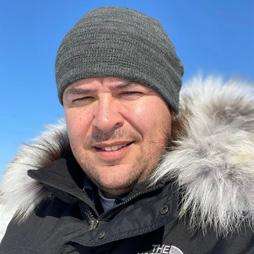
Edward Alexander represents Gwich’in internationally as the co-chair of Gwich’in Council International and has been appointed by the Chiefs of Alaska for multiple terms in this role. He serves as the Head of Delegation to the Senior Arctic Officials, and to the Conservation of Arctic Flora and Fauna (CAFF) and Emergency Prevention, Preparedness, and Response (EPPR) Working Groups of the Arctic Council. He works for Woodwell Climate Research Center as the senior Arctic lead. Additionally, he served as the co-lead of the Arctic Council’s Chairship Initiative on Wildland Fire. Alexander also served as the 2nd Chief of the Gwichyaa Zhee Gwich’in for seven years.
For over three months, firefighters have fought more than 4,000 wildfires threatening northern Syria, over 300 igniting since the start of July, according to Minister Raed al-Saleh. The fires are encroaching on the nation’s “most important” forested area.
The al-Fronloq Protected Area is a nature preserve that spans 11,000 acres (4500 hectares). The forest is a biodiversity haven, housing the Pine Brutia keystone species and acting as the home canal for many species of wild birds near the Asia/Europe border.
Al-Saleh, in a recent statement, said the fires are burning throughout the Lattakia Governorate in the nation’s northwestern region, nearing the preserve. He also said firefighters are focusing their efforts on preventing the flames from reaching the “largest and most important forest” in Syria. The fires have also forced some villages near the Turkish border to evacuate.
Credit: Syria Minister Raed al-Saleh.
“Extinguishing operations required a total of 3,744 hours of work, of which 1,400 hours were in Lattakia Governorate alone, reflecting the intensity and complexity of the fires in that governorate, characterized by its complex mountainous terrain and vast forest areas,” the minister’s statement on Monday said. “Firefighting teams from the Syrian Civil Defense and forest firefighting units continue to battle forest fires in Latakia Governorate for the fifth consecutive day.”
Crews from Turkey, Jordan, and Lebanon are assisting Syria’s fire brigades in fighting the fires, the minister said. The United Nations has also sent humanitarian crews to assess the damage from the “devastating” fires and address the most immediate needs as well as long-term support.
“At this difficult time, our hearts and thoughts are with the people of Lattakia,” UN Resident and Humanitarian Coordinator for Syria, Adam Abdelmoula, said in a recent statement. “We are steadfast in our commitment to support local authorities and provide timely, principled assistance to all affected communities, ensuring that urgent needs are addressed swiftly and effectively.”