Marc Mullenix passed away last night. Last year he was a Type 1 Incident Commander trainee on Kim Martin’s Incident Management Team in the Rocky Mountain Geographic Area. Some of his past jobs included Wildland Fire Division Chief for the Boulder Fire Department, Fire Management Officer for Mesa Verde National Park, and Fairmont Fire Protection District, all in Colorado.
We will post more information after funeral services have been planned.
Strong winds in Texas, at times over 50 mph, have contributed to the spread of many fires. The state has put half the counties, 152 of them, under a burn ban. They have Chinook and Blackhawk helicopters on standby.
Central Texas Austin area Denton County (northeast Texas) Williamson County (central Texas) Statewide
Here is a flashlight that produces enough heat to start a fire, at least in paper and plastic. I wonder if it would be practical for burning out or backfiring in light fuels if you ran out of fusees or drip torch fuel? It costs about $300 and the battery only lasts 15 minutes, so maybe I just answered my own question. The website for the flashlight, WickedLasers, has received so many hits it is down, but it may be up later.
Professor Ronald Wakimoto, Deanne Shulman, and Alissa Roeder. Photo courtesy of the Royal Government of Bhutan
Some familiar names in wildland fire in the United States assisted the Kingdom of Bhutan January 25-27 by providing advice about the use of the Incident Command System in dealing with wildland fires, landslides, and floods. Professor Ronald Wakimoto from the University of Montana, Deanne Shulman, the first female smokejumper in the U.S., and Alissa Roeder, the Superintendent of the Pike Hot Shots, (all left to right in the photo) were part of the delegation that helped put on the workshop.
In case you are not familiar with the Kingdom of Bhutan (I had to look it up), it is a landlocked country sandwiched between India and China and is one of the most isolated and least developed nations in the world.
You may have heard of Glenn Beck. He appears on CNN Headline News and also has a nationally-syndicated radio show. I rarely agree with anything he says, but I just found out that on his October 22 radio show, while the Witch Creek, Harris, and other fires were burning in southern California, he said:
“I think there is a handful of people who hate America. Unfortunately for them, a lot of them are losing their homes in a forest fire today.”
Both fires started in eastern San Diego county and were pushed by strong Santa Ana winds into the outskirts of San Diego. In the Harris and Witch Creek fires, a total of 1,246 homes burned, 7 people were killed, and a CalFire engine crew was entrapped and seriously burned.
Beck contradicted himself several times, but his rationale is that since California is predominantly a Democratic state, and since he believes that Democrats “hate America”, that the homes of people who hate America were burning. Of course Beck is an idiot, but to say this while over 1,000 homes are burning and 500,000 residents are being evacuated is the height of irresponsibility, insensitivity, and stupidity.
There is an excellent article by Richard Manning about some of the issues we are currently facing in wildland fire. Manning interviewed two well-known figures in the Northern Rockies area, George Weldon, Deputy Director for Fire and Aviation for the USFS in the Northern Rockies Region, and Orville Daniels, retired Forest Supervisor of the Lolo National Forest.
These two men show remarkable insight and candor in describing fire management strategy… what works and what doesn’t. Weldon is quoted as saying:
“[The Ahorn] was a fire we went after very aggressively,” Weldon says. “We put in a couple loads of smoke jumpers, a hotshot crew, aviation assets. We spent a lot of money on that fire. We exposed a lot of folks. We crashed a helicopter. We had a shelter deployment on that fire. Despite all that, we influenced that fire very minimally, and we spent $18 million trying.”
Weldon goes on to say:
“I think it is disrespectful to tell people we are going to protect their structures when we don’t have the capability,” he says. “What’s different is that the environment we are living in and working in is going to demand that we look at it differently. I don’t think we have a choice.”
A big thanks to Dick Mangan for the tip on this article.
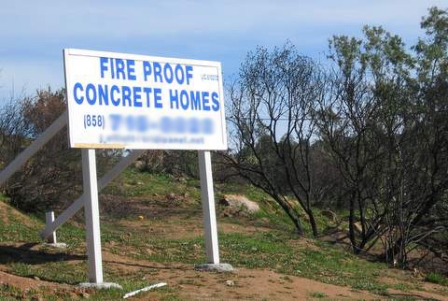
A sign installed in Harbison Canyon within the footprint of the 2003 Cedar Fire east of San Diego. The fire burned 273,246 acres and 2,232 homes. Photo by Bill Gabbert, 2004.
The second Blue Ribbon Commission Task Force in California since the fires of 2003 presented its report yesterday about how to deal with large wildland fires in the state. The recommendations include more engines, more aircraft, more firefighters, fire safe construction, and better systems for real time communications and intelligence. Many of these were in the report following the 2003 fires but were not implemented because of the state’s fiscal problems. Click here to download the 106-page report (788 KB).
Here is how the LA Times began their story on the report:
Three months after massive brush fires burned hundreds of homes across Southern California, a blue-ribbon task force on Friday made dozens of recommendations aimed at improving the response to large-scale blazes.
But many of the proposed measures are similar to those made after the devastating wildfires of 2003 — and many of those were never implemented because there was no money available.
And because the state is in a fiscal crisis, it remains unclear whether the new recommendations will fare any better. Several reports over the last decade have said California needs to increase the number of firefighting aircraft as well as boost the number of firefighters.
UPDATE: January 18, 2018. The links above no longer work, but found a copy of a 2004 Blue Ribbon Report about the 2003 fires. It is a huge 21 MB file.
From a press release issued yesterday by the U.S. Fire Administration:
“Emmitsburg, MD- Today, the U.S. Fire Administration in cooperation with the National Wildfire Coordinating Group, announced a new aid to help local and rural firefighters identify training equivalencies and needs for effectively fighting wildfires that threaten residential areas. The Skills Crosswalk identifies critical wildland firefighting skills that structural firefighters need to be safe and effective when making an initial attack on a wildland fire in their jurisdiction, or when working with state and federal wildland firefighter agencies.
“Our nation’s firefighters already have the necessary skills for fighting fires in all structures in a community,” said U.S. Fire Administrator Greg Cade. “Structural training does not however always address the critical wildland fire suppression techniques which differ from structural firefighting techniques. The new Skills Crosswalk highlights the differences in order for structural firefighters to be able to address wildland fire suppression challenges.”
According to the U.S. Census Bureau 2006 report, in every area of the nation rural development is expanding into wildland areas. Since the 1980’s, the rural population has more than doubled, with 140 million people now living in rural areas. As a result, rural and volunteer firefighters increasingly manage fire in the Wildland/Urban Interface.
The new Skills Crosswalk provides a performance-based methodology and a learning resource guide for qualified structural firefighters to develop wildland firefighting knowledge and skills in a focused and time-efficient format. This methodology will assist structural firefighters with wildland skills in working more safely and effectively on initial and extended attack operations and enhance cooperative firefighting efforts with neighboring jurisdictions and federal wildland firefighters.
For more information, visit the Wildfire section of the U.S. Fire Administration’s Web site.”
A big thank you to Greg Greenhoe for the tip on this.
Kurt Kamm, “after studying fire science and spending three years with L.A. County Fire Department and CalFire crews”, has written a book about wildland firefighters. “One Foot in the Black” is available on the Wildland Firefighter Foundation (WFF) web site. The proceeds from the book go to the WFF. I have not read the book, but the WFF is a wonderful organization that assists wildland firefighters and their families when they have experienced a serious line of duty injury or death. If you have read the book, leave a comment.
Here is an excerpt from a review of the book.
“After the gig ends, Greg drives south to Malibu, daring to survive the notorious four week training camp required to join a fire-suppression unit with the LA County Fire Department. Life in the academy is brutal, but it is here that Greg begins to discover the family he never had: fellow trainee Luis Zambrano, who dreams of a better life for his wife and newly born child; Hector Wells, a rootless Native American with years of service as a firefighter; and Capt. Tom Bratton, a gruff yet kindhearted superior who takes a liking to Greg, offering home-cooked meals and sage advice. An unpredictable wildfire in the middle of the dry season, raging over the hills north of Los Angeles, gives Greg plenty of firsthand experience but tests his resolve and dedication to the profession.”
It’s not often that you see any news or articles about fire weather forecasters. We have come to depend on them and we probably take them for granted, so it is refreshing to see them receive a little publicity. Here is an excerpt from a ScrippsNews article about Richard Thompson, from Oxnard, California.
“But a lot of it also involves forecasting that relies as much on hunches and knowledge of local weather patterns as on science.
“The conditions can be pretty primitive out there,” said Thompson, who works out of the National Weather Service office in Oxnard, “but it can also be very rewarding work.”
Unlike the forecasts he produces behind a desk in Oxnard, Thompson’s field work generates almost instant feedback from firefighters. “If your forecasts are accurate or bad, they’ll let you know about them right away,” he said.
Gary Montgomery, a rangeland management specialist in Los Padres National Forest, uses forecasts by incident meteorologists to decide where to send firefighters and equipment during wildfires.”