The where, when and how of fuel treatment decisions

With a big landscape, a limited budget and a diverse set of community objectives, how do we decide where, when and how fuel treatments are best undertaken to reduce wildfire risks?

Decision makers have a set of options – conduct a prescribed burn, mechanically reduce the fuel, introduce grazing, or use a herbicide. When deciding between these possible fuel treatment plans, each option, or combination of options, must be considered so that community objectives for risk reduction can be achieved with the resources available.

This decision point is the focus of a PhD study by Douglas Radford, from Adelaide University, in his article “Optimising fuel treatment plans to reduce burn probability: the importance of navigating context, priorities and trade-offs” in the International Journal of Wildland Fire.

Joint winner of the Best Student Paper 2025 in the International Journal of Wildland Fire. Read the full paper.

Read about the other Joint winner here

Radford explains that his work applies multi-objective optimisation to support decision-making for bushfire risk reduction – that is, where and how should we use prescribed burning to reduce risk? The optimisation approach was able to find solutions that improved the effectiveness of fuel treatment plans significantly (80 – 280% improvement).

“An important message here is that what makes a “good” decision will depend highly on how we collectively understand and define what our objectives are, and on how we navigate any trade-offs between those objectives,” Radford said.

“While optimisation and other “tech-based” approaches can help us to explore good decisions, the process of working alongside our communities to define what “good” looks like is values-based and cannot be out-sourced.”

Radford applied his case study to the Adelaide Hills of South Australia. By using a state of the art computational “metamodel” the study was able to run thousands of possible fuel treatments across a large area.

“My PhD project aimed to improve decision-support for land and fire management agencies. Further research will make this work more reflective of the multi-dimensional nature of fire its roles and the values of our communities.”

Radford is confident his algorithms are flexible and can be adapted to a wide range of objectives and constraints and therefore, can be used beyond South Australia.

“These approaches can be tailored to unique communities – human and environmental – in all sorts of contexts.

“We have started applying these tools in New South Wales and following a chance meeting at the IAWF Fire Behaviour and Fuels conference in Hobart this year, we’ve started exploring their applications in Canada too. I’m excited to see where we can go next!”

Radford’s study “Optimising fuel treatment plans to reduce burn probability: the importance of navigating context, priorities and trade-offs” was judged joint winner of the Best Student Paper 2025 in the International Journal of Wildland Fire.

Douglas Radford, Best Student Paper 2025 Joint Winner, International Journal of Wildland Fire

Read about the other Joint Winner here

Studying combined fuel treatments gives us a better picture of effectiveness

While many studies have established that fuel treatments are an effective wildfire mitigation tool, the gap in our understanding has been how a range of different treatments work together over many years across large areas to produce a desired outcome.

Research led by Boise State University PhD student Kendra Fallon, now a National Fire Ecologist for the US Wildland Fire Service in Boise, Idaho, looked at the combination of fuel treatments in Californian forests and found that 61 percent of treatment footprints that were intersected by wildfire were effective at modifying the fire behaviour, even under extreme weather conditions.

Joint winner of the Best Student Paper 2025 in the International Journal of Wildland Fire. Read the full paper.

Earlier studies on the effectiveness of fuel treatments have relied heavily on individual case studies that looked primarily at the single most recent fuel treatment in an area recently burnt by wildfire.

The researchers’ fused the Forest Service Activity Tracking System (FACTS) data, which documents all land management activities (treatments), with the data in the interagency Fuel Treatment Effectiveness Monitoring system (FTEM) which flags the overlap of the most recent fuel treatment activity with a wildfire that intersects it. While FACTS includes all management activities, it also includes naturally caused wildfires that have been identified as ‘meeting objectives’. This approach summarizes all fuel treatments (combinations and individual treatments) across over 20 million acres (8 million hectares) of National Forest System lands in California, which has a long-standing record of fuel mitigation efforts.

By combining these two data sets over 1621 cases of fuel treatments between 1950 and 2022, they found 61 percent modified wildfire behaviour; although they note this may be an underestimation given that some of the more subtle signs of wildfire behaviour change are missed by novice observers and not captured in the data

The fuel treatment in these forests was mostly prescribed fire but also included some mechanized fuel removal or rearrangement using hand tools or large machinery, and in some cases, grazing or chemical spraying. Importantly, many areas had undergone more than one type of treatment.

“This bridges the scientific gap on how the sequence or combinations of multiple hazardous fuel treatments, rather than just the last treatment before wildfire, contribute to the treatment efficacy across large geographies.”

Fallon is optimistic that this methodology looking at fuel treatment success is transferable to other geographical areas that lack the extensive set of case studies available in California.

“While we focused our methodology on case studies from California, given the abundance of fuel treatment effectiveness studies in the state, the approach is applicable to other geographies,” she said.

“Motivated by the needs of wildland fire practitioners, this research developed a novel methodology for evaluating fuel treatment effectiveness. As a full-time wildland fire practitioner and non-traditional student, I sought to produce research that bridged the gap between current operational challenges and applied fire science.”

Kendra Fallon, Best Student Paper 2025 Joint Winner, International Journal of Wildland Fire

Fallon’s study “A novel methodology to assess fuel treatment effectiveness: application to California’s forests” was judged joint winner of the Best Student Paper 2025 in the International Journal of Wildland Fire.

Spring fire potential across Australia awaits the full impact of El Nino

Seasonal Bushfire Outlook for Spring (Sept-Nov) 2026

Australia is facing a watch and wait scenario for its summer bushfire season as the latest Bushfire Seasonal Outlook predicts a mild but warm spring before the main El Nino impacts are expected to appear later in the year.

El Nino is now firmly established and the Bureau of Meteorology is watching it continue to strengthen with a peak not expected until late Spring or early Summer. Meanwhile, Australian fire agencies are watching the severe northern hemisphere wildfire season and thinking about what it means for the southern hemisphere summer and the provision of mitigation and firefighting resources, both people and aircraft, some of which are currently in the US, Canada and Europe.

The Australian Seasonal Bushfire Outlook for Spring was released today at the AFAC26 by Intershutz conference in Melbourne. The Australasian Fire and Emergency Service Authorities Council (AFAC), the Bureau of Meteorology and the nation’s Fire Commissioners and Chiefs prepare the quarterly outlook to prepare resources and community messages tailored for each state.

The Spring outlook is important for the populous eastern and southern states as it leads into the main summer bushfire season. The next outlook, to be released late November, will have a clearer picture of what Australia will face this El Nino summer.

The Bureau is predicting below average rainfall and higher than average temperatures across most of eastern and southern Australia up to November. This will dry out many of the areas that have received good rainfall this year.

While the El Nino is important, it is not the only climate driver being watched. The Bureau’s Michael Logan, General Manager of National Production Service, said El Nino was one part of the picture.

“An El Nino event is underway, it is strengthening and it is going to be a very strong one. But that is not the only driver that influences the Australian climate.,” Logan said at the outlook launch.

“The Indian Ocean Dipole (IOD) is currently neutral but models are suggesting a positive IOD is underway, which also influences Australian rainfall. We also have very warm sea surface temperatures around much of our coastline. All of these will come into play as we go through Spring in terms of fire risk, and also potentially into summer as well.”

Michael Logan, Bureau of Meteorology, at the Australian Seasonal Bushfire Outlook launch, Spring 2026

Fire authorities are predicting a heightened risk of fire across northern and southeastern New South Wales, south-east Queensland, northeastern Tasmania, parts of Western Australia (WA), South Australia and Victoria, and most visibly, large parts of the Northern Territory.

The current fire season in the Top End is expected to extend an extra month, into November, with a late wet season keeping the fire risk high. Central areas of the Northern Territory also face an elevated fire potential due to high fuel loads.

The strong 2025-2026 wet season produced a flourishing mass of greenery and an associated influx of animal and bird life that is now drawing in the tourists. But this will evolve into a dry mass of fuels as the NT moves into a hotter, drier period over the next few months.

Australian Seasonal Bushfire Outlook launch, Spring 2026

Double fatality in Greek helicopter collision

The collision of two firefighting helicopters working on a wildfire west of Athens, Greece, has had tragic results with the death of two crew members, a Danish pilot and a Greek fire service liaison officer.

Australian operator McDermott Aviation has confirmed that two of its helicopters were involved in the mid-air collision near Psatha, Greece, on 2 August 2026 (local time).

The company’s founder and president John McDermott released a statement: “We are deeply saddened to confirm that the two crew members aboard one of the helicopters have lost their lives. The two crew members from the second helicopter are in the care of medical professionals.

Our thoughts and deepest condolences are with the families, friends and colleagues of those affected by this tragic incident. Both crews were undertaking the critical work of supporting firefighting operations to help protect communities.

McDermott Aviation is working closely with the relevant authorities and will continue to assist as they undertake their investigation into the incident.”

McDermotts is a long-time operator in Greece, having deployed many of its Bell 214ST and other helicopters over the last seven years, as well as deploying regularly to the US, Canada, other parts of Europe and across Australia.

Unverified video posted online and reported in some media appeared to show two helicopters cross paths at low altitude as they moved to drop water.

Greek Prime Minister Kyriakos Mitsotakis expressed “sorrow for the tragic accident” and extended condolences to the families of the firefighters killed in the crash.

“The loss of the Greek coordinator and the Danish pilot at the time they were attempting the major fire in Porto Germano fills us all with grief,” Mitsotakis said in a statement.

Earlier this week, two firefighters died fighting a fire on Crete, while a third was killed on the Peloponnese.

The McDermott fleet is not the only Australia presence – or indeed, non-European presence – in the air in Europe. South Australia’s Aerotech Aviation has four Air Tractor AT-802 aircraft in France with six crew.

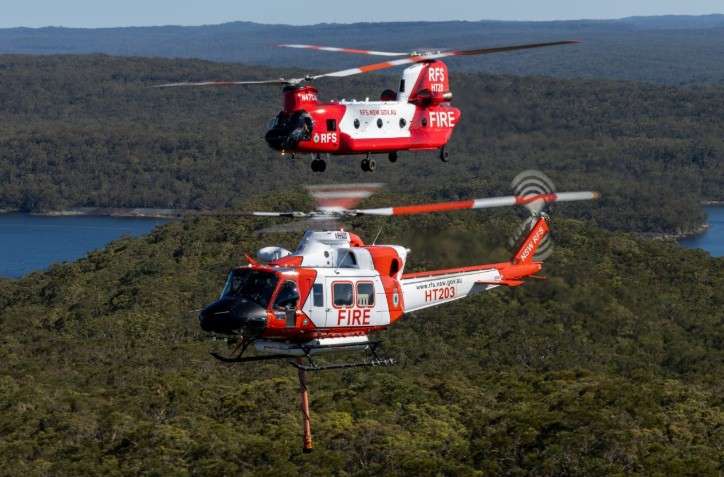
Meanwhile, a New South Wales Rural Fire Service CH-47D Chinook helicopter and a Bell 412 support aircraft deployed this weekend to fight fires in France. This will mark the Service’s first-ever European deployment and is in addition to its crews and its 737 Large Air Tanker already deployed to North America.

A New South Wales Rural Fire Service CH-47D Chinook helicopter and a Bell 412 support aircraft deployed to fight fires in France, August 2026. Photo: NSWRFS

In France, the two aircraft will be accompanied by 24 aerial and ground crew.

The Chinook, equipped with an 11,300-litre belly tank will work with the Bell 412, and is also capable of conducting waterbombing missions at night. Should it be tasked to do so in France, it will be the first time night-time waterbombing has been undertaken in the country.

“This is the first time we have deployed to Europe,” said Ben Millington, Deputy Commissioner at the NSWRFS.

“We have firefighters and incident management teams currently operating and supporting agencies in Canada and the United States with this pending deployment to France that will see our crew across three countries.”

Australia sets air tanker SOPs after 737 crash findings

The sharing of large firefighting aircraft across Australian states has been simplified with the introduction of national standard operating procedures. The new standards will replace individual state arrangements across a range of procedures including minimum drop heights, airspeed, flight paths, communications and training.

The change addresses safety issues found after a 2023 Boeing 737 accident in Western Australia.

The Australian Transport Safety Bureau (ATSB) announced the new procedures this week following the publication of the standards by the National Aerial Firefighting Centre at the end June 2026.

On 6 February 2023, a Coulson Aviation Boeing 737 large air tanker hit a ridgeline on rising terrain after completing a retardant drop in the Fitzgerald River National Park in the state’s south-west.

The two pilots on board survived the accident without injuries and were quickly rescued by a nearby helicopter crew. The aircraft, however, was destroyed in the collision and subsequent fire.

Boeing 737 airtanker crash, Western Australia, February 2023. Photo: Australian Transport Safety Bureau.

The ATSB’s final report into the accident identified several safety factors which contributed to, or increased risk in, the accident.

Among these, the investigation highlighted how Australian states and territories had developed their own separate standard operating procedures for large air tankers engaged in firefighting operations.

The ATSB benchmarked the WA, New South Wales and National Aerial Firefighting Centre standards against the United States Forest Service and United States National Wildfire Coordinating Group standards and found inconsistencies between the Australian agencies’ standards but not among the United States agencies’ standards. It said that this was likely a result of each Australian state participating in the LAT program independently producing their own standards.

“The investigation found differing standards between jurisdictions could result in safety requirements being omitted or misunderstood by the various tasking agencies, such as a minimum drop height,” ATSB Chief Commissioner Angus Mitchell said.

“This resulted in inconsistencies in the development and application of large air tanker standard operating procedures (SOPs).”

These SOPs have now been collaboratively developed, endorsed and adopted by all Australian fire agencies, through the National Aerial Firefighting Centre.

“Large air tankers, which can quickly move around the country in response to operational need, play an increasingly critical role in the management and suppression of bushfires in Australia.

“As such, the implementation of national air tanker standard operating procedures represents a significant milestone in the ongoing maturity of the aerial firefighting safety system in Australia.

Synchronised fires test new Europe wildfire response

The coordination of Europe’s firefighting forces under new-look civil protection measures are getting an early season test as Central Europe faces a forecast of more heat and little prospect of rain.

With extreme fire weather affecting several countries simultaneously, scientists are looking more closely at “fire-weather synchronicity” as multiple countries call on aircraft and personnel at once. Says one scientist: “The fires are separate. The weather connecting them is not.”

The EU has deployed assistance to both France and Spain under the EU civil protection mechanism as ongoing wildfires have triggered one of the biggest evacuation operations in Europe, displacing more than 300,000 people so far in both countries with that number growing by the day.

Three firefighters have died in the wildfires with many more injured. The total number of deaths remains unclear as many are also heat-related and many people are still unaccounted for as large numbers of people – both residents and tourists – are on the move.

Other parts of Europe also impacted, including the United Kingdom, with fires in the Cairngorms in Scotland and in the south-east of England.

Prince William wrote in a post on X: “Our thoughts are with everyone affected by the devastating wildfires across France, Spain and the UK. We are deeply grateful to the firefighters, emergency services and volunteers working tirelessly in extraordinarily difficult conditions. These events are a stark reminder of the challenges posed by an increasingly extreme climate and the importance of protecting both people and nature.”

Spain and France are hardest hit in July 2026 wildfires, but the UK and Italy are also battling many fires. Source: Copernicus EFFIS

The EU has long coordinated shared resources, but following the extreme fire year of 2025 it ramped up its preparedness to a higher level for 2026. So far this month:

France has received:
7 firefighting planes and 4 helicopters from Czechia, Croatia, Germany, Portugal, Slovakia, Sweden and Türkiye. Most of these aircraft are part of the rescEU firefighting fleet.

Spain has received:
6 firefighting planes from Greece, Italy and Türkiye, as well as 134 emergency personnel and 41 vehicles from Portugal.

The EU’s Copernicus satellite service is providing emergency maps to support operations on the ground, while the Emergency Response Coordination Centre remains in constant contact with national authorities.

The 2026 fires were not so unexpected – many had predicted another severe season straight after the historically bad 2025 – several European firefighting teams were pre-positioned in France and Spain as support for local teams, enabling a rapid response when the fires broke out.

The UN Commissioner for Preparedness and Crisis Management, Hadja Lahbib, said the case for a pan-European firefighting force was clear:

‘Right now, hundreds of thousands of people have been forced to flee their homes, while firefighters battle walls of flame in dramatic conditions to save lives and communities. No country should ever have to face a disaster of this scale alone. That is exactly why Europe built a common response capacity: aircraft in the sky, firefighters on the ground, and more support standing ready the moment it is needed. To the people of France and Spain: Europe will stand with you until the fires are out.‘

Fire weather synchronicity and other observations

The current fires have generated much discussion, with the notion of “fire-weather synchronicity” helping us better understand why all the fires seem to be happening at once and what this means for sharing resources.

Several research papers have been published including Synchronized wildfires will strain global fire resources: report

Francesca Di Giuseppe, from theEuropean Centre for Medium-range Weather Forecasts (ECMWF), Reading, United Kingdom, co-authored “Large increase in extreme fire weather synchronicity over Europe”.

In a post, Di Giuseppe says that synchronicity turns separate regional fires into a shared European emergency. Extreme fire-weather synchronicity has already increased across Europe and is projected to rise further as the climate warms.

“Climate change does not provide the ignition, but it is shifting the background conditions towards hotter, drier and longer fire seasons – and increasing the likelihood that dangerous conditions develop across large areas at the same time. The fires are separate. The weather connecting them is not.”

Many observers are noting the extreme nature of some of the fire activity, with a rare – for Central Europe – and possibly the first occurrence of a pyrocumulonimbus event in Bordeaux, France.

For a good summary of the fires see the BBC.

For a good photo spread see CNN.

European Civil Protection 2026 Photo: Portuguese National Authority for Emergency and Civil Protection (ANEPC), 2026

Wildfire support on the way from Aust/NZ

A contingent of 74 personnel from across Australia and New Zealand are being deployed to the United States to support ongoing wildfire operations. They are expected to be assigned to fires in the north-western states.

The deployment includes incident management specialists, field supervisors, heavy plant and aviation specialists. They will be deployed for five weeks and will play a vital role in supporting firefighting operations, drawing on their specialised skills and experience managing large bush fires in Australia.

The troops will follow the earlier deployment of the New South Wales Rural Fire Service’s large air tanker, the Marie Bahir, which has already dropped more than 500,000 litres of retardant on fires, most recently supporting operations on the Summit Fire near Piñon Hills, California.

Australian Large Air Tanker Marie Bashir supporting the United States in wildfire operations, Summit Fire, California, July 2026. Photo: ABC Eyewitness News

With elevated fire conditions continuing across the US, a formal request for assistance was sent to Australia and New Zealand: a process refined and repeated over many recent seasons. The Australasian Fire and Emergency Service Authorities Council/National Resource Sharing Centre coordinates the deployment on behalf of the individual fire and land agencies. The main request is for Incident Management Personnel, Task Force Leaders and Air Base Managers to assist with the ongoing firefighting operations. They are sourced from several states – including New South Wales, Victoria and Western Australia.

Nationally across the US, firefighters are working on 70 large fires across the country, including five new large incidents since yesterday. The National Interagency Fire Center reports 21,171 firefighters and support personnel engaged in nationwide fire activity, including 478 crews, 1,161 engines, and 128 helicopters.

So far this year, 41,377 fires have burned more than 3.9 million acres across the United States. Red flag warnings are in place in several places, especially southern and central Oregon, and extreme heat warnings are in effect throughout the southern United States. The Northwest continues to pose special concern, with more heavy thunderstorm activity predicted today.

Wildfire activity today over North America, 23-24 July 2026. Source: NASA LANCE FIRMS US/Canada

Cross state procession honors helicopter crash pilot

The pilot who died in a helicopter crash while involved in fighting a wildfire in Colorado was honored in a highway memorial procession that crossed much of the state this week.

The pilot, 56-year-old Nicholas Dale from Sooke, British Columbia, was the only person on board and was killed in the crash.

Dale was a federal contracted fire aviation pilot flying for Helicopters Express LLC, a Georgia-based company with a fleet of helicopters used for firefighting and heavy-lifting operations. The helicopter was a Kaman K-1200.


The Federal Aviation Administration released an early, short statement that provided little detail on the circumstances of the incident:

“A Kaman Aerospace K-1200 crashed into Silver Jack Reservoir in Gunnison, Colorado, around 5:10 p.m. local time on Sunday, July 12, during firefighting operations. Only the pilot was on board. The FAA and National Transportation Safety Board (NTSB) will investigate. The NTSB will lead the investigation.”

A CPR News report quotes a Federal Aviation Administration comment that the incident occurred under “unknown circumstances” and that the helicopter became “inverted” in the reservoir.

Helicopter Express shared the loss of their colleague on social media with this post:

“Yesterday, while conducting firefighting operations on the Gold Mountain Fire, our pilot, Nicholas Dale, was involved in an accident at the dip site while flying one of our Kaman K-1200 K-MAX N40HX. Tragically, Nick did not survive.

This is a heartbreaking loss for everyone at Helicopter Express and throughout the aerial firefighting community. Nick’s dedication, professionalism, and commitment to protecting others will never be forgotten.”

Governor Jared Polis said state flags will fly at half-staff on Dale’s memorial date to honor his bravery and sacrifice.

“We are heartbroken by the loss of Nicholas Dale, a heroic firefighting aviation pilot who gave his life while protecting Coloradans from the Gold Mountain Fire. Our state is deeply grateful for the brave firefighters, pilots, and first responders who put themselves in harm’s way to keep our communities safe.”

Dale is the fourth firefighter killed battling Colorado wildfires in the past month.

The Gold Mountain Fire, which began on June 27, 2026, has burned over 38,000 acres and is now around 24 percent contained. The fire has prompted evacuations in several counties and has 909 personnel actively fighting the blaze today. The fire is burning mainly in high elevations in continuous mixed conifer stands. The steep and rugged terrain has limited the use of direct extinguishment.

Meanwhile, with a National Preparedness Level now at 5, the National Interagency Fire Center reports 72 large fires across the US, with 20,939 firefighters and support engaged in fire fighting activities, including 1127 engines and 125 helicopters.

So far this year, 40,989 fires have burned more than 3.9 million acres across the United States.

K-Max file photo.

Wildfire death toll rises in Spain, as Europe swelters

Current situation of active wildfires and burnt areas across Europe 10 July 2026 from European Forest Fires Information System.

Twelve people have died with many others injured or unaccounted for in wildfires in Almeria, southern Spain, as extreme heat continues across much of Europe.

Details of the tragedy are still emerging, with the wildfire still active and authorities piecing together reports from areas worst affected.

Witnesses reported that the fire may have started after a powerline fell, igniting dry vegetation before spreading rapidly through surrounding woodland but authorities have not yet officially confirmed the cause. Road closures and evacuations are in place.

Fire fighters are also battling major fires in France, Portugal, Greece and elsewhere.

The Andalusia region of the Almeria fire has baked in 40C (104F) degree heat in recent days in the third heatwave of the early northern European summer. May and June both produced extensive heatwaves across the continent, leaving much of the area without any significant rain.

Earlier, the European Commission began to mobilise assistance through its EU Civil Protection Mechanism, where member states can call for support.

France activated it on 5 July. The European Commission mobilised 4 rescEU airplanes from Sweden and Cyprus.. Portugal activated the mechanism on 3 July. 118 firefighters and 45 vehicles from Spain arrived on site a few hours after the activation and 3 rescEU firefighting aircrafts from Italy and Spain were deployed.

For the 2026 European season, the Commission has deployed a record number of firefighters to combat wildfires. 777 firefighters from 14 European countries are already, or soon will be, strategically pre-positioned in high-risk areas across Cyprus, Greece, Italy, France, Spain, and Portugal. In parallel, 22 firefighting airplanes and 5 helicopters from the EU fleet are ready to support countries at need.

The immediate outlook for much of Europe appears to offer little relief. This is the fire danger forecast for this week, up to 15 July, just issued from the European Forest Fires Information System:

Very extreme conditions dominate a large area of western and central Europe, with the heaviest concentration across France, Spain and northern Portugal, the Alpine arc extending into northern Italy, the south of the UK and southeast Ireland. 

Extreme conditions extend into southern Portugal and southern and central Spain, parts of the British Isles, and the western Balkans. 

Very high danger covers the remaining parts of the UK and central Ireland, southern Scandinavia, and parts of Türkiye. 

High to moderate danger is foreacst for scattered areas across central-eastern Europe and further into Türkiye. Eastern Europe, northern Scandinavia, and Russia remain at low fire danger.

Fire Danger Forecast 8-15 July 2026
Weather forecast for week 13 to 19 July 2026, from European Forest Fires Information System.
Weather forecast for week 13 to 19 July 2026, from European Forest Fires Information System. The strongest warm anomaly remains visible over western and central Europe and is most intense across France and the areas bordering the Alps, extending into the British Isles and Spain. Southern Scandinavia and parts of northern Africa face moderate positive anomalies. A cold anomaly sits over Portugal and eastern Europe, with additional cold patches over the Middle East.

Despite the current wildfire intensity, this season has not started as badly as 2025 for Europe, albeit the worst year on record for wildfire. So far, 155,569 hectares have been burnt, compared to 228.098 hectares at the same time last year.

1057 large fires have been detected – less than the 1182 of last year but well above the long term average of 476 fires.

RELATED COVERAGE: Europe preps for a wild wildfire summer

RELATED COVERAGE: Europe burns – a view to the summer of 2026

Bringing wildfire scenario planning to life

Capital Shield Foresight training scenario.

As fire and other emergencies become more complex, chaotic and concurrent, incident managers may find that traditional pre-season tabletop exercises struggle to cope with these new demands.

An emerging Australian company has seized the power of AI to develop a scenario package that moves faster, adapts to sudden changes, reacts to multiple pressures, and responds to decisions in real time, for better or for worse. Capital Shield’s Foresight platform is pitched as the next level full-dress rehearsal for wildfire and other emergency agencies.

The story starts back in 2020, when a group of undergraduates at the National Security College at the Australian National University established the Australian Crisis Simulation Summit. They brought together around 100 students from across Australia with Australian Government support to focus on realistic national security scenarios using a range of software platforms built for such exercises.

Tim Hobbs, CEO of Capital Shield, says the problem was that none of the platforms did what was actually needed. “They couldn’t generate a genuinely realistic exercise environment. We could build a compelling scenario on paper, but the tools couldn’t bring it to life.”

And so, Hobbs and his co-founder, Connor Kneebone, built a new software platform, using AI to lift the standard to include more complex, more dynamic scenarios, that can twist and turn in real time.

“It’s a browser-based environment built around doctrine that recreates the pressure of a real incident, with live spatial mapping, radio traffic, media calls, social media sentiment and stakeholder pressure all arriving at once, against a compressed operational clock,” he said.

“An agency can build a scenario in its own geography, with its own fuel loads, fire weather and community assets, then run its IMT through it. Because the environment is adaptive, the fire responds to the team’s decisions.”

Capital Shield has established relationships in the Defence and national security space with several Australian Government agencies using the platform, which links to the Australasian Inter-service Incident Management System (AIIMS), or as needed, to a state emergency plan, or to an organisation’s own crisis management plan or competency standards.

Capital Shield was an exhibitor at the IAWF Fire Behaviour and Fuels conference in Hobart in April this year and attracted strong interest demonstrating Foresight.

Foresight is also aimed at international use with take-up by agencies in Germany and Japan, and early approaches being made in the US and Canada.

The exercise can be delivered by one facilitator in person or remotely, with participants in different places able to share the same simulation for fire, flood, storm or other events.

Hobbs says the platform offers a better option to static and scripted exercises in current use worldwide. “They are often PowerPoint-based, with a facilitator reading injects off a list and giving a subjective debrief at the end. Everyone agrees it’s a great way to learn, and it is. But the pressure isn’t real, the realism isn’t there, and performance isn’t measured.

“We’ve taken exercises to the next level. In Foresight you’re making the decisions you’d be expected to make on the day of a real incident, in a live, reactive environment, but a safe one. The fire responds to your suppression strategy, the media and the community push back through the same channels you’d really use, and the clock doesn’t wait.

“Then at the end it recalls all of it and gives you a structured after-action review: here’s how you went, here’s where the gaps were, measured against the doctrine your organisation actually operates under. So, it’s not just a better way to rehearse, it’s the first time most teams can demonstrate their readiness rather than assert it.”

For more on Foresight go to:

https://www.capitalshield.com.au