UPDATE: Zach Garland, the state firefighter injured Thursday on a Kentucky wildfire, is now in stable condition at the burn center in Huntington, West Virginia. On April 25 the Pike County 2 Crew was working a wildfire when the fire shifted; Zach was trapped and burned and critically injured. He was building fireline when fire cut off his escape route. Crew members immediately called for EMS; Zach was flown to the burn center at Huntington, where he is in good spirits. Though he is medically stable, he faces a very long road to recovery; Zach suffered second- and third-degree burns to his face, arms, hands, and knees.
Zach Garland in the burn center at Huntington, West Virginia
His friend and co-worker Trey Beam has started a GoFundMe page to help with medical expenses. “Zach was protecting our Kentucky land,” writes Trey, “as well as wild horses, homes, and civilians. Zach is a dad to two young children, the youngest of whom was born on the day after Zach was injured. We are requesting contributions of any size, to assist with out-of-pocket expenses for medical bills, travel, lodging, and Zach’s lost wages. Zach and his family face a very long road ahead.”
Zach’s unexpected expenses. If you have another $20 in your pocket, he
and his wife need it more than you do — and May the 4th be with you.
Kentucky firefighters Teena Dunn and Zach Garland.
PUBLISHED 27. APRIL 2024 — On Thursday about a mile south of Stopover in Pike County, Kentucky, the Blankenship Hollow Fire early in the afternoon injured a firefighter in a burnover incident. A structure fire in Blankenship Hollow escaped into the woodland and was reported to the Hazard Branch forestry office; volunteer fire departments at the incident requested a forestry crew to assist. The Forest Ranger IC type 5 and a Pike County crew were dispatched just before 2 p.m. and arrived at 3 p.m.
Kentucky fires Zach Garland running firing on a burnout operation.
Initial size-up from the IC was 10 acres burning in timber with an uphill run and high spread potential.
The IC reported that several additional structures near the fire would be their initial focus.
About 45 minutes later with structure protection completed, the IC and the crew hiked up the mountain to engage the head of the fire directly. They said they had active behavior with short-range spotting and decided to wait for a break before engaging.
Blower line on the Blankenship Hollow Fire near the site of shelter deployment. The area is hardwood leaf litter — as was 90 percent of the burn area. The area around the deployment zone was 60-100 ft hardwood with 3-12 ft beech, maple, and mountain laurel understory.
At 5:15 the IC reported a break in fire behavior and they re-engaged with direct handline construction. Firefighters began building line down both flanks and at 5:55 IC reported that a firefighter had become trapped by a spot fire, cutting him off. He said he was deploying a shelter; 3 minutes later the IC reached the crew member and began a medical assessment. Kentucky State Police out of Pikeville was contacted by dispatch; they sent EMS units and requested a life-flight medical helicopter be held on standby.
The IC and the fire crew were able to assist the injured firefighter, who walked mainly under his own power off the mountain to the waiting ambulance, where EMTs decided to request helicopter transport to the burn unit at Cabell Huntington Hospital in Huntington, West Virginia. There were no reports of other injuries.
The burned firefighter is in stable condition at the burn center this evening and is in good spirits. He endured burns on the hands, knees, and face; there will be a 72-hour followup report.
A statewide burn ban is in effect through the end of this month.
The British Columbia Aviation Museum announced last month that it had acquired Martin JRM Hawaii Mars, and yesterday the Pima Air and Space Museum (PimaAir.org) announced it has acquired the Philippine Mars.
Coulson Aviation said the Philippine Mars — one of just seven flying boats built by Martin JRM Mars — will be transported to the PASM east of Tucson later this year, according to a feature story by Vintage Aviation News.
“This has been an exciting month for both Martin Mars waterbombers,” said Coulson CEO Wayne Coulson. “As a fitting tribute to their years of service and years of hard work by many people in B.C. and the U.S., we are pleased to see both Mars aircraft landing to rest at world-class institutions in 2024.” The Mars aircraft were built between 1942 and 1947, and the giant aircraft flew cargo between Hawaii and the Pacific Islands in support of the U.S. Navy. After World War II the aircraft and crews flew in the Korean War, making medical air transport flights between Hawaii and California, and then doing hauling cargo between Hawaii and California before they were decommissioned back in 1956.
The first was christened The Old Lady; after that the production planes were called Hawaii Mars, Philippine Mars, Marianas Mars, Marshall Mars, Hawaii Mars II (named after the original Hawaii Mars was destroyed), and lastly, Caroline Mars. Hawaii and Philippine are the only Martin JRM Mars aircraft remaining today.
In 1958 the remaining four were sold to a consortium of timber companies in British Columbia and converted into waterbombers that could carry 7200 U.S. gallons. In 2007 Coulson purchased the Hawaii Mars and the Philippine Mars, launching its fixed-wing air operations for aerial wildland firefighting.
“We are pleased to have the Philippine Mars join our museum where we will preserve this World War II-era aircraft for decades to come,” said Scott Marchand, CEO of the museum at Pima. The Philippine Marsis expected in Arizona later this year. The museum — at PimaAir.org — features some 400 historic aircraft, an amazing collection ranging from a Wright Flyer to a 787 Dreamliner.
Pima map
Sited on 80 acres at the eastern edge of Tucson, the museum opened to the public in May of 1976 and has for 40+ years grown and expanded. Today the facility includes six indoor exhibit hangars (three dedicated to WWII), along with extensive outdoor grounds and interpretive displays and other features to welcome visitors and charm aviation enthusiasts. Admission’s under $20 with discounts for kids, seniors, and locals. The museum’s about 5 miles from the Tucson International Airport, and it’s open 7 days a week, closed only on Thanksgiving and Christmas. You can’t visit this place just once.
In a forested area west of Bend, Oregon yesterday, Sarah Jakober watched helicopters circling overhead. Soon she’d board one with other rappellers so they could practice jumping out of a perfectly good helicopter.
Actually, they don’t jump — from planes — like smokejumpers. Rappellers, affectionately known by some as sliders, climb out of a helicopter door, balance on the skids with their gear, then slide down their own ropes to a wildland fire below.
Grande Ronde Rappellers with a cargo drop last year
Jakober is in Bend for two days as part of annual recertification required by the USFS for rappel crews. Michael Kohn of the Bend Bulletin reported on this in a feature published by the Oregon Capital Insider (along with some DANDY photos by Andy Tullis).
Rappel crews typically fly into remote locations not easily reachable in the early stages of a fire by firefighters in ground vehicles.
Jakober is with the Grande Ronde Rappel Crew based out of La Grande. She told Kohn the job’s easier now than when she was a rookie seven years ago. “It was pretty scary,” she said. “I was hyper-focused on what I needed to do.”
The Malheur Rappel Crew (MRC), based in John Day, Oregon, is a Type 1 25+person crew specializing in initial attack and helicopter ops. The Malheur base is one of 11 in the USFS nationally. Rappelling as an initial attack fire response began in the Pacific Northwest and the region hosts five of the national bases, with rappellers coordinated at the regional and national level.
Malheur Rappellers
The Malheur airbase responds to smoke reports on the Malheur National Forest and the Strawberry Mountain Wilderness and includes four wilderness areas in its response zone. Big timber and very few roadways have required rappellers for initial attack; for 40 years there’s been a helicopter based out of John Day.
1997 Malheur Rappel Crew, John Day Airbase
The Malheur crew adheres to stringent fitness standards; without fail, the questions they always get include: “What are the minimums? What do I have to do to be considered for entry into the program?” Malheur rappellers are held to the USFS minimum physical standards, like every other program in the agency, including the pack test, which is carrying a 45 lb. pack over 3 miles in under 45 minutes. Beyond that, the rappel program includes the mile-and-a-half run, pull-ups, push-ups, plank tests, and the rappeller pack-out.
Minimum requirements:
1.5-mile run in 11:00 min or less (AVG: 9:40min) 2:00 min plank (AVG: 2:40min) 25 push-ups in 1 min (AVG: 36.5) 7 pull-ups (AVG: 10.4) 3-mile flat <90 min pack-out 85 lbs. (AVG: 55:45min)
These physical standards will be met by all members of the program on day one of the season — veteran rappellers, permanent staff, and rookies alike.
Grande Ronde ships at the La Grande base.
Rappel crews typically have a wide range of skills and strengths; Malheur crewmembers provide a list of quals from ICT5 to DIVS to FEMO.
This variety of skills and experience is typical at a rappel base.
The Grande Ronde Rappellers include these staffed positions:
1 Base Manager (GS-11 PFT)
2 Foremen (GS-9 PFT)
4 Assistant Foremen (GS-7/8 PFT)
6 Squad Leaders (GS-6/7 PSE 18/8)
14 Senior Firefighters (GS-5 PSE 13/13)
16 Seasonal Firefighters (GS-4 or 5 Temp 1039)
About 80 wildland firefighters were certified this week on the Deschutes National Forest. The full story by Michael Kohn on this week’s recertification is [HERE] and is worth the read!
First responders showed up within minutes of the first reports to dispatch, on the huge wildfire last summer that nearly destroyed Lahaina, the historic Hawaiian town on the island of Maui. The first emergency calls came in to dispatch at 2:55 p.m. on August 8, according to the new report by the State Attorney General. Firefighters spotted smoke at 2:57 p.m., arrived at the fire at 3:00 p.m., and were joined by law enforcement who said the first building caught fire at 3:05 p.m.
The new report indicated that the federal Bureau of Alcohol, Tobacco, Firearms and Explosives has a separate investigation underway into the origin and the cause of the fire.
Maui fire progression map
According to the REUTERS report, first responders battled a storm of embers sailing downslope ahead of unusually high winds. The fires destroyed most of Lahaina, the former capital of the Hawaiian kingdom, killing over 100 people.
The Associated Press compiled numerous 911 calls that dispatchers on the island received the next day, and the dispatchers’ answers were the same each time; police and fire responders couldn’t help find missing people because they were still trying to get people to safety, still working hotspots and responding to fires.
The New York Times reported that fatalities from the Maui fires surpassed that of even the 2018 Camp Fire in Paradise, California, and made the Maui fires the deadliest since the Cloquet inferno in Minnesota killed hundreds back in 1918.
The island’s officials were pleading with tourists from the U.S. mainland and elsewhere to cancel vacation plans and spare locals and emergency responders the drain on scarce resources, and later encouraged tourists to come back to the island that depends heavily on visitors and tourism dollars. Hotels and other lodging options on Maui scrambled to shelter evacuees and the suddenly homeless; that struggle on the island is far from over.The state attorney general’s office has more maps online.
Jaiden Stansberry, a senior in the forestry program at the University of Montana in Missoula, is one of just 60 Truman Scholars this year — chosen from 709 candidates. Stansberry is in the Davidson Honors College and is also completing a Fire Science and Management minor. Stansberry’s application focused on wildland fire.
She is studying fire science and management at UM and works summers as a wildland firefighter in Yosemite National Park, where she spent much of her childhood. Because of her father’s work there, Stansberry grew up at Yosemite — she calls herself a park brat and says her experience as a firefighter gave her an edge in the scholarship competition. The application process requires a policy proposal, and her focus was recruitment and retention of leaders in fire management — by drawing more seasonal workers into the NPS apprenticeship program.
University of Montana Forestry School
Grad students in the Truman program are selected for their leadership potential, commitment to a career in government or the nonprofit sector, and demonstrated academic excellence.
Growing up in the National Park Service encouraged a dedication to natural resources for Jaiden. She is currently studying forestry with a minor in fire sciences and management and has worked as a wildland firefighter for the National Park Service for the past two years. Her experience inspired her to focus on prescribed fire implementation and challenges. She intends to pursue an MS in natural resources stewardship with a concentration in forest sciences to expand her knowledge of the influence of policy in forest management. Jaiden is particularly interested in designing prescribed fire programs for the National Park Service to support natural disturbances on a landscape while mitigating fuel to protect property and life. She hopes to encourage collaborative efforts between National Parks and local tribes to perform burning in areas with cultural significance. In her free time, Jaiden can be found flyfishing the Blackfoot River and traveling to different National Parks.
The Truman Scholars receive $30,000 for graduate studies, leadership training, career counseling, and internship opportunities in federal agencies. Stansberry said her experience at the University of Montana has been just what she’d hoped college would be. “It’s been a phenomenal time here, and I’m really glad this is the school I ended up going to,” she said.
She’ll work this summer as a firefighter at Glacier National Park, then head to Washington DC for her internship after her first year of grad school focused on wildland fire policy. We certainly congratulate Jaiden and wish her the best; you can the full story feature by Abigail Lauten-Scrivner of the UM News Service [HERE], and there’s more about the Harry S. Truman Scholarship Foundation [HERE]. Brief bios of the 2024 Truman Scholars are posted [HERE] and it’s a mighty impressive read.
~ Thanks and a tip of the hardhat to Steve for this.
ALASKA FIRE SERVICE CREWS ARE HOSTING A REUNION
CELEBRATING 40 YEARS OF TYPE 1 STATUS!
May 10-11, 2024
We are celebrating the 40 years of Type 1 status, but we recognize that the Alaska crews existed long before then — and that the program was built up over time. It’s an important part of our shared history!
We’d love to see anyone who was on the crews before, during, and after we were around, and anybody associated with AFS in any capacity since the beginning of time.
Wildfires present an increasing challenge to humans and to the ecosystems and atmosphere we depend on. Our response to larger and more destructive wildfires and ability to prepare for a changing climate is increasingly challenged. Understanding fire behavior and human response is ever more important.
The 7th International Fire Behaviour and Fuels Conference offers a forum at which fire management experience and lessons are documented, current work showcased, and emerging research is shared.
This conference on three continents showcases new fire management policies and frameworks to address fire risks and build resilience. The conference will unite policy makers, scientists, fire managers, and Indigenous land stewards for a shared purpose and a better future living with fire.
Held concurrently in Tralee, Ireland and Canberra, Australia and Boise, Idaho.
BOISE HIGHLIGHTS:
Monday: Workshops, Field Tours, Keynote Session by Dr. Lori Moore-Merrell, Opening reception with sponsors and exhibitors.
Tuesday: Sessions, exhibitors, and Poster session/reception.
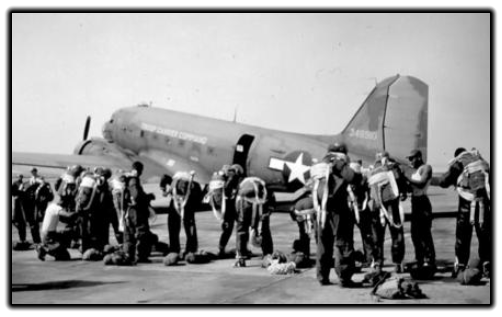
A rendezvous and a celebratory jump from a Douglas C-47 Skytrain by retired paratroopers and smokejumpers is underway this weekend at the airport in Pendleton, Oregon.
The feature below was written by retired Lt. Col. Bradley Biggs, who was the first officer in America’s first all-black paratrooper unit called the Triple Nickles, the 555th Battalion of the 82d Airborne. In 1943 the troop was created and trained to go to war, but instead was sent to the West Coast to fight forest fires started by Japanese balloon bombs. They were some of the early parachuters to fight fires, and were formed a few years after the first fire jumps by two U.S. Forest Service employees in 1940. Later they became the first army unit to be integrated into the regular army during World War II. This article is used with permission from TripleNickle.com.
Smokejumpers in the 555 preparing for a mission in 1945. Jump masters inspect their fellow jumpers. (From THE TRIPLE NICKLES)
Let us travel back to the origins of this unit, its conversion from a highly trained and combat ready parachute unit to the extremely dangerous role of “smoke jumping” and their performance in one of the best kept secret operations in World War II.
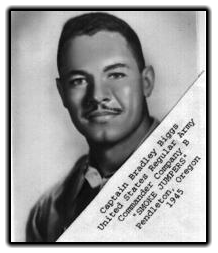
Captain Bradley Biggs
(From THE TRIPLE NICKLES)
Through December 1944 and January 1945, the Triple Nickles had continued to jump, maneuver, and grow to a strength of over four hundred battle-ready officers and men. During that same period a far more deadly action was taking place on the battlefields of Belgium – the Battle of the Bulge – the massive German counter-attack in the Ardennes that began on 16 December 1944. It lasted more than a month and before the Germans were turned around, the American army had suffered some 77,000 casualties. Many of them had been paratroopers – men from General Jim Gavin’s 82nd Airborne Division and General Maxwell Taylor’s 101st who had made the heroic stand at Bastogne. The cry was out for replacements, not only in paratroopers ranks but throughout the European Theater of Operation (ETO) combat command.
At last we thought we were going to tangle with Hitler, whose embarrassment at the 1936 Olympics of a Black American named Jesse Owens was fresh in our minds. We eagerly anticipated pitting the Nazis against another group of black champions – men like Walter Morris, “Tiger Ted” Lowry, Jab Allen, Edwin Wills, Jim Bridges, Roger Walden, the list goes on.” Biggs recalls in his book THE TRIPLE NICKLES. He goes on to say that:
“We soon found that we would not go as a battalion but rather as a “reinforced company”. The reason was simple, we had not trained or maneuvered as a battalion. The original orders authorizing the 555th said we would not begin such training until we had reached a strength of twenty-nine officers and six hundred enlisted men. This could have been achieved if commanders army-wide had released volunteers and approved scores of requests for parachute duty.”
Eventually, the Triple Nickles would grow to more than 1,300 for duty, 600 in jump training at Fort Benning and 1,900 on the morning report rosters. But for now the smaller number had some advantages. It had enabled them to concentrate on intensive individual and small-unit training. Riflemen, machine gunners and mortar men had sharpened their aim to perfection. Training in judo and other forms of hand-to-hand combat were intensified. They had time and opportunity to become superb combat men. No goof-offs were allowed.
Moreover, men could be sent to schools for special training as riggers, jumpmasters, pathfinders, demolition experts, and communications men. Jump demonstrations and small unit maneuvers had helped them to perfect the tactics and logistics essential to many paratrooper combat missions, especially those requiring no more than a company-size force, such as an attack on an enemy communications center, bridge, enemy headquarters or road junction.
So when the order came to “skeletonize” to one reinforced company of eight officers and 160 men, the battalion had a pool of the best from which to choose the super-best. It began with a downward shift of command, a move for which everyone was fully prepared. The battalion executive officer, for example Captain Richard W. Williams became the company commander. Williams, the eleventh officer to join the Triple Nickles, had come to the organization as a first lieutenant from the 92nd Infantry Division. A well-built, muscular man, he was known as a tough, aggressive officer, filled with imaginative ideas and a sense of adventure.
The battalion S3 (Plans and Training), lst Lt. Edwin Wills, the real “brains” of the training program, became the company executive officer. The commanders of A, B, and C rifle companies became platoon leaders, with each given his choice of an assistant platoon leader. Each former company commander chose his executive officer. First sergeants became platoon sergeants and platoon sergeants became squad leaders.
This special company was ready to take on anybody. But suddenly midway through the rigorous combat training, their destiny changed. By, April 1945, the German armies were collapsing. Americans were on the Elbe River – and would stay there. From the east the Russians were moving on Berlin, and the fall of the German capital was only weeks away. It seemed unlikely that any more paratroopers would be needed.
In late April 1945, the battalion received new orders – a “permanent change of station” to Pendleton Air Base, Pendleton, Oregon for duty with the U.S. Ninth Service Command on a ‘highly classified” mission in the U.S. Northwest. No one had any idea of what the mission would be.
On 5 May 1945, the battalion left Camp Mackall for Oregon. The move was made in about six days. Ninety-eight percent of it by rail the rest by battalion motor vehicle or private auto – including Graphite. Sergeant Lowry and two other NCO’s brought the faithful old Ford cross-country. (Graphite was a two-door 1937 Ford, owned by Lt. Julius F. Lane and Lt. Bradley Biggs). It was the battalion’s service vehicle.
Japanese balloon bombs
Apparently no one had noticed a brief Associated Press item that had appeared in the New York Times of 10 September 1944. With a Portland, Oregon dateline headed “Fire Fighters Use Parachutes”, the story reported that: “Crews have been dropped by parachute to fight forest fire in many areas of the Northwest. A blistering summer sun indirectly caused fire in six areas in Idaho in the last 48 hours. An eight man unit crew was dropped to fight a blaze in the Lost Horse Pass Country of Idaho. Other parachutists were dropped into the back woods of Chelan National Forest to battle 300 acre Fire”.
On 6 May, while the battalion was still en route west, a woman named Elsie Mitchell and five children were on a Fishing trip near Bly, Oregon. One of them found a strange object on the ground and the others went to investigate. Suddenly the object exploded, killing all six. First news reports said it was a blast of “unannounced cause”.
Actually, the object had been a Japanese bomb that had traveled across the Pacific on a hydrogen-filled balloon. Though it remained a tightly-guarded secret for a time, the Mitchell’s had been the victims of the first intercontinental air attack on this country. Since early November, 1944 the Japanese had been launching these “balloon bombs” – layered silk-like bags with clusters of incendiary bombs and explosives attached to them.
The secrecy continued even after one balloon caused a near calamity at the Hanford Engineering Works in Washington state, then turning out uranium slugs for the atomic bomb that would destroy Nagasaki. One of the balloons descending in the Hanford area became tangled in electrical transmission lines causing a temporary short circuit in the power for the nuclear reactor cooling pumps. Backup safety devices restored power almost immediately, but if the cooling system had been off a few minutes longer a reactor might have collapsed or exploded and this country could have had a Chernobyl for which it was totally unprepared. The havoc would have been unimaginable.
By January, 1945, however, both Time and Newsweek magazines had told of two wood-choppers near Kalispell, Montana who had found a balloon with Japanese markings on it. By the time the battalion arrived in Oregon the veil of secrecy was partially lifted. The War and Navy Departments had issued statements to the local populace describing the bombs and -warning people not to tamper with anything resembling them.
The balloons, we learned, were made of silk paper and were thirty-five feet in diameter. Filled with hydrogen, they would rise to a height of 25,000 to 35,000 feet. Then they would pick up prevailing air currents (latter called the “jet stream”) from west to east across the Pacific.
Each time a balloon descended below 25,000 feet from loss of gas and cooling, a pressure switch automatically dropped a sandbag. This caused the balloon to rise again toward the 35,000 foot level. The balloons traveled up to 123 miles an hour, and took from 80 to 120 hours to reach the U.S., depending on weather. If the Japanese have it figured right the last sandbag has been dropped only after the balloon has reached this country. At that time a second automatic switch takes over.
When the balloon dropped to 27,000 feet a bomb was released. The balloon rose up and then down again and another bomb is released and so on. When the last incendiary or bomb was dropped, a fuse ignited automatically and set off a demolition charge which destroyed the balloon. Fortunately, all of the demolition charges didn’t work and some balloons we recovered intact. As part of this joint operation the U.S. Air Corps was increasing its air patrols flown by P-51 aircraft to try to sight the balloons and shoot them down before they reached the coast. Watchers along the coast also gave sighting warnings for air patrol action.
Not mentioned publicly at the time was the possibility that Japan might equip the balloons with the capability to carry out some form of chemical-biological warfare. Their experiments with prisoners of war in the notorious unit 731 were not known until much later – but they began in 1937 and point to existence of a Japanese program to develop for use deadly biological agents. Such agents quite possibly could have been delivered in quantity to the United States mainland by balloons.
Also not mentioned was the 555th Parachute Infantry Battalion. By now they knew that they had acquired a new, temporary nickname, the “Smoke Jumpers”, and that it would be part of the highly secret project known more officially as “Operation Firefly”.
It was clear that the white people of Umatilla County were not used to seeing many black faces in their midst. Clearly there would be few of the joys of the service clubs and homes of Atlanta or Fayetteville. A few of the troopers and a handful of officers would finally be able to find passable living quarters in town where their families could join them. But these were few indeed.
When we arrived however, we had more pressing things than social life on our minds. We were assigned quarters in the center of the post garrison area, close to the airfield and operations shed. Once settled, Captain Porter, our commanding officer, and Lieutenant Wills, his S3, set out to get more details in our mission and operations plan.
The mission was soon clear enough. Working in teams out of Pendleton and Chico, California, we would be on emergency call to rush to forest fires in any of several western states and join with the forest service men in suppressing the blaze. At the same time, we would be prepared to move into areas where there were suspected Japanese bombs, cordon off the area, locate the bombs, and dispose of them.
But this, we found, would call for an entirely new training program. We knew how to jump from air-planes. But the heavily-forested areas of the northwest presented drop zones that were more difficult and more dangerous than any we had faced before. We knew, how to handle parachute lines. But here we would be using a new type of chute – one with special “shroud lines” for circling maneuvers. We knew how to read military maps, but the forestry service maps were something new. We were used to explosives, but we had little, if any, experience in the disarming of bombs – particularly any of Japanese origin.
Fire fighting was an entirely new experience
All of this and our past “jumper” experience, was a prelude to the great experience of integration. Our mind sets, individually and collective outlooks gave a new and different meaning to our lives.
Our new station, Pendleton Air Base, lay in Umatilla County, in north-eastern Oregon. It was located on a plateau overlooking the town of Pendleton. The base at one time had accommodated B-29 bomber air corps training units. Now, with the war winding down, it had been skeletonized into “caretaker” status. The area was barren. We were the only unit except for control tower personnel and a small engineer maintenance contingent. A consolidated mess would feed the 555th officers and men together. It was, however, still commanded by a full colonel, a man who would quickly make it clear that he disliked having an all-black unit at his station. He was careful that we did not mix with his officers, that our area was inspected with undue meticulousness, and that the atmosphere of his office was “cool” to us. We didn’t give a damn about all of that because we enjoyed eating with our men and our areas were always clean and well-policed. But we disliked the fact that we had to serve again under a prejudiced post commander. We had just left one at Mackall. And before that at Benning. Such was the 555th’s lot.
Early morning 6 August 1945. Capt. Richard W. (Black Daddy) Williams, battalion executive officer, and 1st Lt. Clifford (Jabo) Allen, commanding officer, headquarters company, and jump master for this “smoke jump” mission, peer through the open door of the Troop Carrier Command C-47 at the spot where they will drop 2nd Lt. Harry Sutton and his firefighting team. Lt. Sutton, on the left, smiling and bareheaded, achieved immortal fame as the rifle company commander whose unit held the ridge overlooking the Hungnam-Hamburg sea evacuation in the Korean War. He was killed by a sniper a few days before the evacuation ended. Posthumously awarded the Silver Star for gallantry in action, Sutton joined the ranks of Korean War Heroes. (From THE TRIPLE NICKLES)
The colonel’s views were shared by the white civilian population in the area. In Pendleton, then a town of about twelve thousand and famous as the home of the Pendleton Rodeo, the black soldiers, who were helping Oregon save its forests, and possibly some of its people, found it difficult to buy a drink or a meal. Only two bars and one restaurant would serve them anything.
Oregon had a long history of tensions over minority groups. First, in the nineteenth century, the Chinese had suffered not only discrimination but outright violence. In the early twentieth century the Japanese had been the targets. And in the 1920’s, during a resurgence of the Ku Klux Klan, Oregon and Indiana were the two northern state where the “invisible empire” seemed to find its most avid supporters. No doubt the Klan in Oregon had been motivated by anti-Catholic, anti-“foreign” nativism than by a fear of blacks who were a small target indeed. The 1930 census showed the black population of Oregon to have been 0.2 percent. It had hardly changed by 1940.
Fire fighting, of course, was an entirely new experience. And it was in this field that a new training began on 22 May. Wills set up one of his brilliant training schedules. It was a three week program which included demolition training, tree climbing and techniques for descent, if we landed in a tree, handling fire-fighting equipment, jumping into pocket-sized drop zones studded with rocks and tree stumps, first aide training for injuries—particularly broken bones.
Troopers learned to do the opposite of many things they learned and used in normal–jumps like deliberately landing in trees instead of avoiding them. Troopers would jump with full gear, including fifty feet of nylon rope for use in lowering themselves when they landed in a tree. Their steel helmets were replaced with football helmets with wire mesh face protectors. Covering their jumpsuits and/or standard army fatigues, they wore the air corps fleece-lined flying jacket and trousers. Gloves were standard equipment but not worn when jumping; bare hands manipulate shroud lines better.
Naturally their physical training program was intensified because missions often found troopers miles from civilization and in heavily wooded and mountainous terrain. It paid off handsomely in that few injuries occurred and only one death. On most of their missions troopers would work with forest rangers. The forest rangers could walk up the hills like a cat on a snake walk. They taught the tough paratroopers how to climb, use an axe and what vegetation to eat. At the time, troopers underwent an orientation program with forest service maps.
On 8 June, specially selected men began work with bomb disposal units of the Ninth Army Service Command, learning the business of handling unexploded bombs.
Then came a new parachute. The parachute training was under a civilian, Frank Derry, who had designed the special chute for jumping in heavily forested areas. A special feature of the “Derry chute” was its maneuverability. By pulling the white shroud line the parachutist could turn himself into a 360 degree circling movement. This, in turn, gave him a wider choice of landing areas – a vital factor when trying to avoid tangles with the highest trees in the thickly-timbered areas.
The parachute training included three jumps, two in clearings and one in the heavy forest. The C-47 pilots who carried the 555th were a friendly, gung-ho lot, many of them were veterans recently back from flying “the hump” in Southeast Asia. Their spirit and were a welcome relief from that which we encountered among most other whites in the area. Whenever a trooper was injured, the pilots often beat us to the hospital to see how the injured smoke jumper was doing. One group of smoke jumpers will never forget the pilot who brought them all home in one trip, when a rule-book flier might have made at least two trips.
By mid-July, the entire battalion had qualified as “Smoke Jumpers”– the Army’s first and only airborne firefighters. Soon their operations would range over at least seven western states, and in a few instances, southern Canada. And there would be two home bases – one in Pendleton, Oregon and one in Northern California at the Chico Air Base.
The main group would be based at Pendleton, with the mission of fighting fires and handling bombs in Oregon, Washington, Montana, and Idaho. Another group of six officers and ninety-four men would be based at Chico, to provide coverage for California.
First Fire Call
The first fire call came in mid-July 1945 to suppress a blaze in Klamath National Forest in northern California. Between 14 and 18 July, the Chico contingent supplied fifty-six men. It was a successful mission with no injuries.
The first call for the Pendleton contingent come just a few days later on 20 July—to drop fifty-three men and two officers to fight a fire in the Meadow Lake National Forest in Idaho. The group took off at dawn in three planes, arrived over the drop zone (DZ) at 0830 hrs. Flying in trail formation, each plane made a low level (200 feet) pass over the fire area, looking for an acceptable DZ.
“After checking the wind by watching the smoke from the fire”, Captain Biggs recalls, “the pilot and I made the decision on a one thousand foot drop—this was two hundred feet below the standard drop altitude. Swinging around to take advantage of the wind, the pilot gave me the green light and held the plane in a slow jump-attitude until I chose to jump. Once out, I did not manipulate or “slip” my chute—I just floated down like a wind dummy.”
Meanwhile, the aircraft flew a 360-degree turn with the pilot and jumpmaster keeping their eyes on Capt. Biggs descent trajectory to see if he had made a timely exit; that is jumped at the correct landmark in order to land on the DZ without steering the chute. When he landed in the center of the DX, the pilot and the jumpmaster had their points of reference to follow. While they were trained to handle themselves if they landed in trees, most of the members chose clearings from force of habit and past experience.
During the initial pass of each C-47, an A5 container was dropped. The A5 contained axes, food, water, medical supplies and radio gear. This equipment was sufficient to sustain the group until they linked up with the forestry department personnel.
From 14 July to 6 October, the Chico and Pendleton units participated in thirty-six fire missions with individual jumps totalling twelve hundred. There were also casualties. In six months, more than thirty men suffered injuries from cuts and bruises to broken limbs and crushed chests. One typical report listed under “injuries”: “1 EM (enlisted man) broken leg above knee, 1 EM knee out of place, 1 EM crushed chest.”
On one jump in early August, one of the men suffered a spinal fracture. He remained on the scene throughout the fire fighting operation. Then, realizing his men were tired and short of food and water, he refused to burden them with the job of carrying him to the nearest airstrip. Somehow he managed to stand up and without help, walked straight-backed for eighteen miles to the strip where his units would be picked up by C-47 for the return trip to Pendleton. He spent weeks in the Walla Walla Hospital. Pure Guts!
Tragically, one man lost his life. The ill-fated trooper had landed in the top of a tall tree. In attempting to climb out his harness and lower himself with a rope that each man carried, he apparently slipped or lost his grip and crashed into a rock bed 150 feet below. It took three days for patrols to find his body.
Capt. Biggs recalls, “that all was not work. On 4 July we staged demonstration jumps for the local populace. We saw the famous Pendleton Rodeo. Killer Kane and I learned to fly from two grand guys, Pat Stubbs and Farley Stewart. We went to movies and took time to hunt and fish. I spent my spare bucks flying and seeing the west. We had storytelling sessions nightly at the BOQ. And we found the black WAC Company at Walla Walla Air Base happy to visit us (and our accommodations). Meanwhile, Graphite was serving as battalion taxi, cargo vehicle, and most loaned-out vehicle for anyone needing a ride to town.
For the first time in the annals of military history of any nation, a military organization of paratroopers was selected to become “Airborne Firefighters”. The Triple Nickles became not only the first military fire fighting unit in the world, but pioneered methods of combating forest fires that are still in use today.
The conduct of The Triple Nickles during the heretofore highly secret and untold story contributed immeasurably to the well-being of most Japanese Americans in internment camps. If it were known that the Japanese balloons, the first unmanned intercontinental ballistic missiles, had been successful in reaching our shores, the Japanese military machine would have strengthened its efforts in that area. If the secrecy of the 555th’s operation had been broken, there is no telling what additional maltreatment would have befallen the incarcerated Japanese in western camps.
In October 1945, the battalion was assigned to the 27th Headquarters and Headquarters Special Troops, First Army, Fort Bragg, North Carolina. In December, it was attached to the13th Airborne Division at Fort Bragg, where it proceeded to discharge “high point” personnel.
In February 1946, after two months of no supervision and watching friends leave for home, the 555th was relieved from attachment to the 13th Airborne Division and attached to the 82nd Airborne Division for administration, training, and supply. It retained its own authority to discipline and manage its own personnel matters. Further attachment was made to the 504th Airborne Infantry Regiment, then commanded by a colonel whose name will go down in history as the originator of “search and destroy missions” in Vietnam. General William C. Westmoreland.
As an integral part of the 82nd Airborne, the finest American division of World War II and commanded then by Major General James M. Gavin, a man who unlike so many white commanders, was color-blind, 555th went on to become the first in many key areas of military innovations. Pioneering in integrating the Army was not the least among them, an action that changed forever the character of the Army and the nation. Today it is an acceptable fact that this pioneering by the 555th created the modern Army of today. And further, this achievement spread into all sectors of society. For original Smoke Jumpers it is gratifying to know than many of the techniques and equipment tested and developed during “Operation Firefly” are still in use in both civilian and military fire fighting missions.
Traditional wisdom conveys to us that past events and history carry the portents and guidance for the future. Dismissing that antiquated notion, these black soldiers relied on human perceptions of the known conduct of black military men in the familiar hostile white environment both military and civilian. There was no necessity to try to philosophize, theorize and intellectualize their role and contribution. Theirs was a new phenomenon to all walks of American society and the meaning of the experience of pioneering in becoming the first military “Smoke Jumpers” in the world. They shunted the windows of the past and dominated this scene by values of character, drive, pride and unity.
Captain Bradley Biggs was the only black officer to pioneer in both armor and parachute units. He made over 362 parachute jumps. After retiring from the Army he made a second career in academia in which he held many positions, the last was Associate Vice President for Business & Finance of university-wide operations at Florida International University in Miami. He passed away in 2004. His obituary was published in the Harvard Courant.