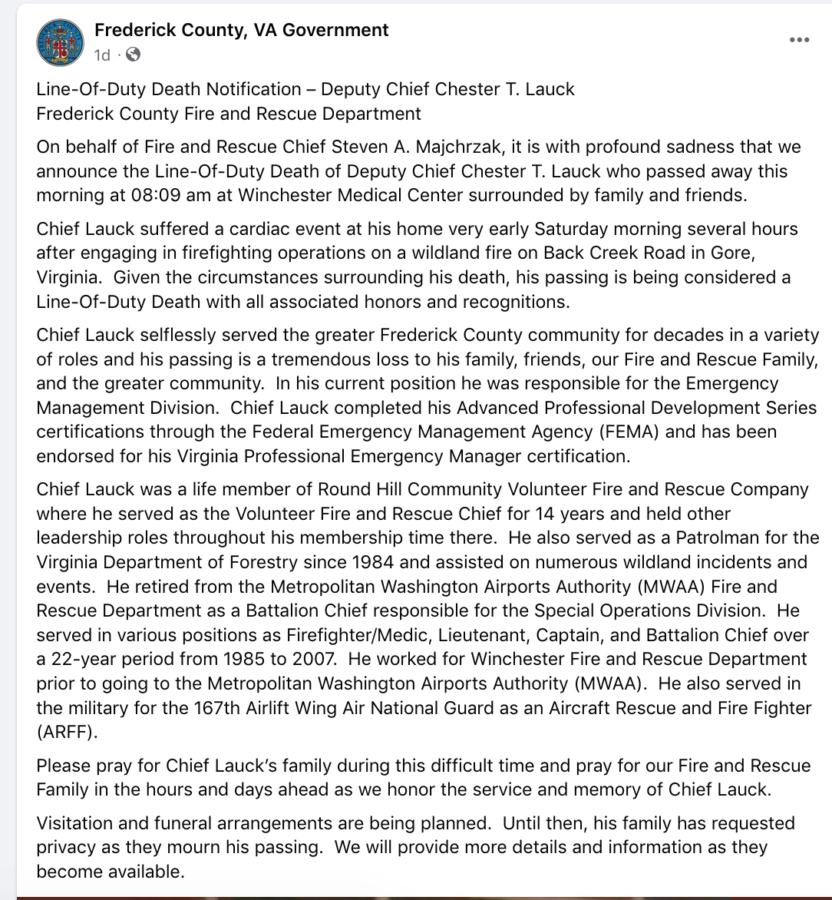
A Virginia firefighter, Deputy Chief Chester T. Lauck with Frederick County Fire and Rescue, suffered a heart attack hours after responding to a wildfire and died the following morning.
The notice from the Frederick County Government Facebook page on Sunday announced “On behalf of Fire and Rescue Chief Steven A. Majchrzak, it is with profound sadness that we announce the Line-Of-Duty Death of Deputy Chief Chester T. Lauck, who passed away this morning at 8:09 a.m. at Winchester Medical Center surrounded by family and friends.”
In his most recent position, Lauck was responsible for the Emergency Management Division. Prior to that he had worked for the Winchester (Virginia) Fire and Rescue Department and had retired He retired from the Metropolitan Washington Airports Authority (MWAA) Fire and Rescue Department as a Battalion Chief of the Special Operations Division. He’d also worked as an Aircraft Rescue and Fire Fighter (ARFF) for the Air National Guard and began service in 1984 as a patrolman for the Virginia Department of Forestry, where he worked on wildland incidents and events.
Ali Velshi, a business correspondent and analyst for MSNBC, focused on wildfires for his Earth Day commentary. He introduces his concerns by noting that “More than half of the most destructive wildfires in US history have occurred since 2018,” with annual acres burned doubling in the past 30 years and forecast to double again in the next 30. The intro to his report continues … “Meanwhile, wildfire fighting tactics for detection and suppression haven’t changed in decades – and as the fires get bigger, faster, and deadlier, firefighters can’t keep up. New technologies are needed – soon – to save ecosystems, property, and lives.”
His report expands on the recent years of record fires and the impact this has had on communities and the firefighters who work to meet this daunting challenge. His key point … after 53 years of protesting and calling for action and significant changes, we’re now amid the “behemoth challenges” of climate change. On this Earth Day, Velshi suggests for us all to face and address the wildfire crisis with new technology and approaches.
Screenshot from a broadcast by Ali Velshi on MSNBC. Click the image to watch the video.
That technology and business approaches are a component of Velshi’s call may reflect his reporting focus. And it’s worth noting that Velshi sits on the board of the XPRIZE, and his Earth Day report echoes the XPRIZE’s recent challenge focused on wildfire.
Details on Velshi’s broadcast were also tweeted on Earth Day.
On this 53rd annual #EarthDay, we’re focusing in on #wildfires. Their growing intensity is far outpacing our ability to combat them, and it’s only going to get worse. New methods are needed asap in order to save ecosystems, property, and lives.
On April 22, 2023, Earth Day 2023, the largest fire of national note is burning in North Carolina.
For April 21, the most recent update of the national portal for the Geographic Area Coordination Centers – because it’s not quite busy enough for weekend staffing – there are three GACCs at Preparedness Level 2 – Eastern, Southern, and Southwest – while the rest of the country is at PL 1. And a scan of national-level fire hazards doesn’t show any Red Flag Warnings or Watches for the day.
For the prior week, national initial attack activity in the National Situation Report was considered light at 1,075 fires, with 50 large fires reported and 50 contained. Fire names ranged from a label only an agency can love (AR-BUP-000924 in the Buffalo National River) to a menagerie of animals – Swine, Third Goat, Antelope Flats, Wolf Creek, Otter Creek, Kingfisher Hollow – to the uniquely local – Natural Bridge (named for the actual Natural Bridge in Kentucky), Muzzle Loader Club (perhaps the local shooting range in Oklahoma?), Jimmys Water Hole in New Jersey and Shinhollow in New York, and Tinaja in southern Arizona (translated from the Spanish as “large earthenware jar”).
The Fire Weather Outlook for Earth Day was minimal except for southwest Arizona. The Day 2 Fire Weather Outlook for today noted that “Elevated conditions are likely near the international border in the Lower Colorado River Basin, as 15 mph sustained southwesterly surface winds overlap with 15 percent humidity for a few hours around afternoon peak heating. Elevated highlights were added since fuels should be marginally receptive to fire spread.” Looking ahead, the only fire hazard of note in the fire weather outlook is for the New Mexico-Texas-Mexico area on Tuesday-Wednesday, April 25-26.
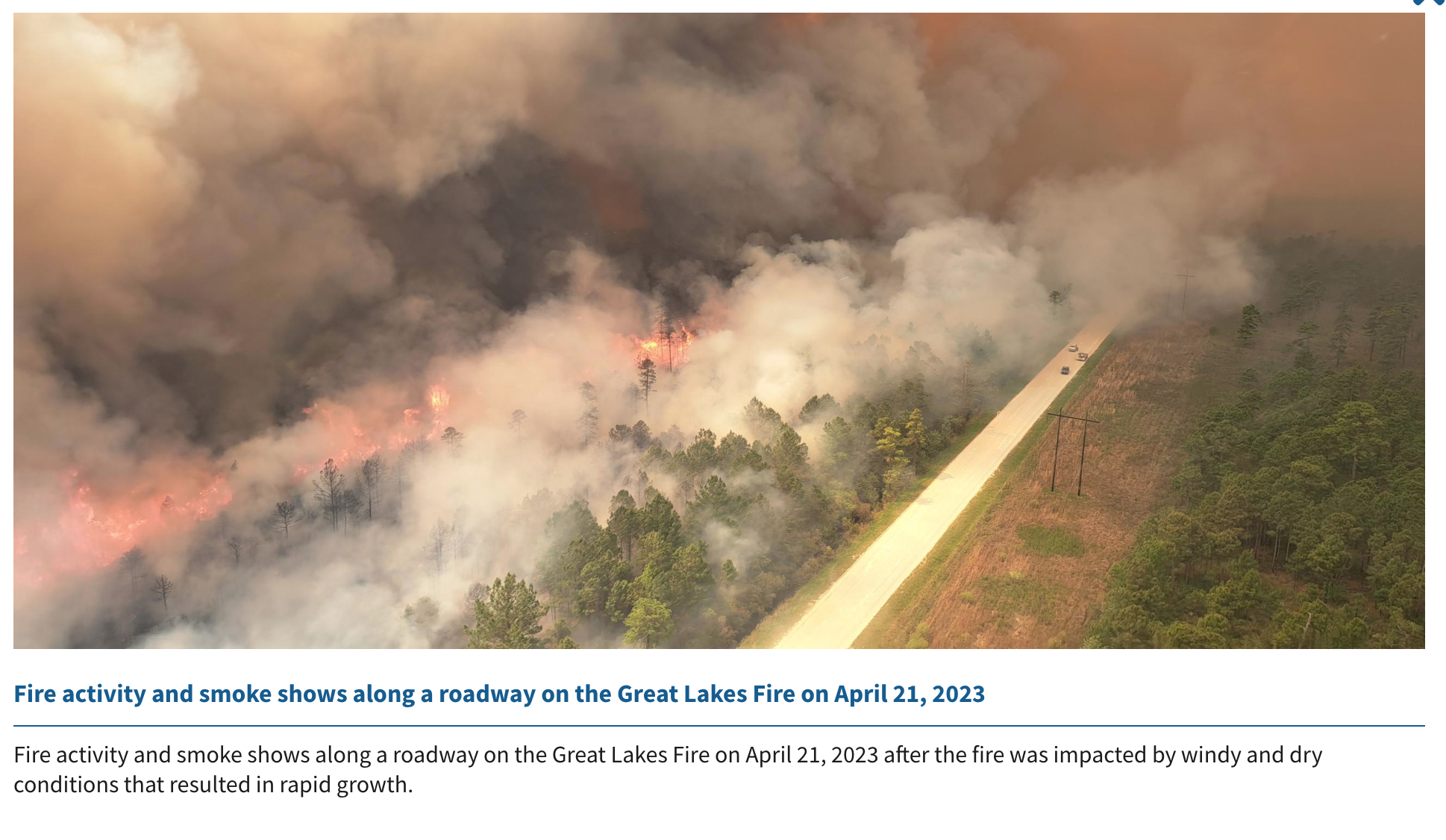
All this being duly noted, one can be certain that residents near the Great Lakes Fire will agree that this fire (also called the Great Lake Fire) likely holds claim to being Earth Day’s fire of note in the U.S. Named for a singular Great Lake, with other lakes around it, in the Croatan National Forest), the fire quadrupled in size in 24 hours, from 7000 to an estimated 30,000+ acres, with a national Southern Area fire management team being assigned.
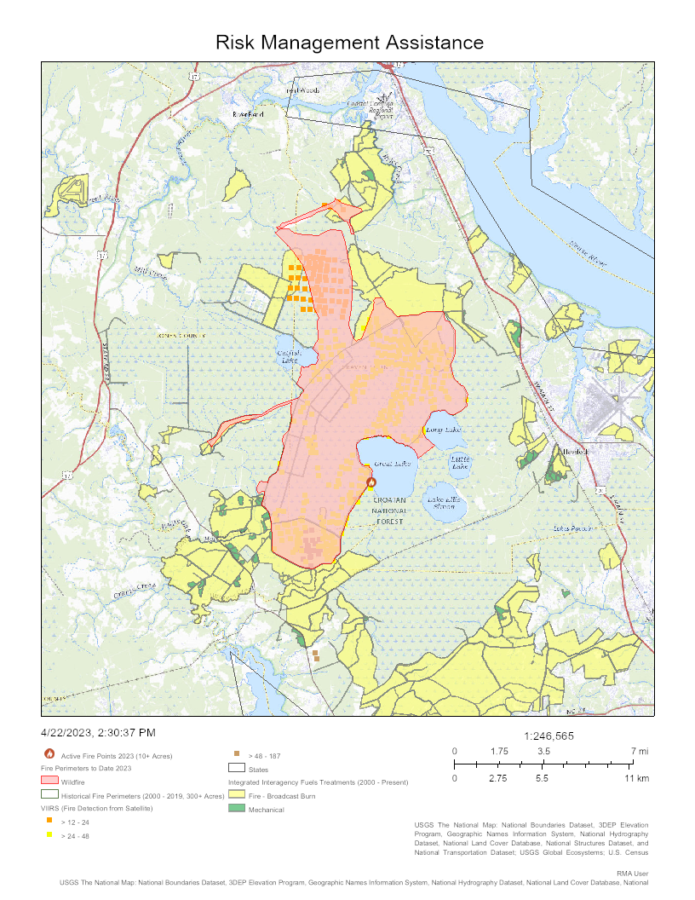
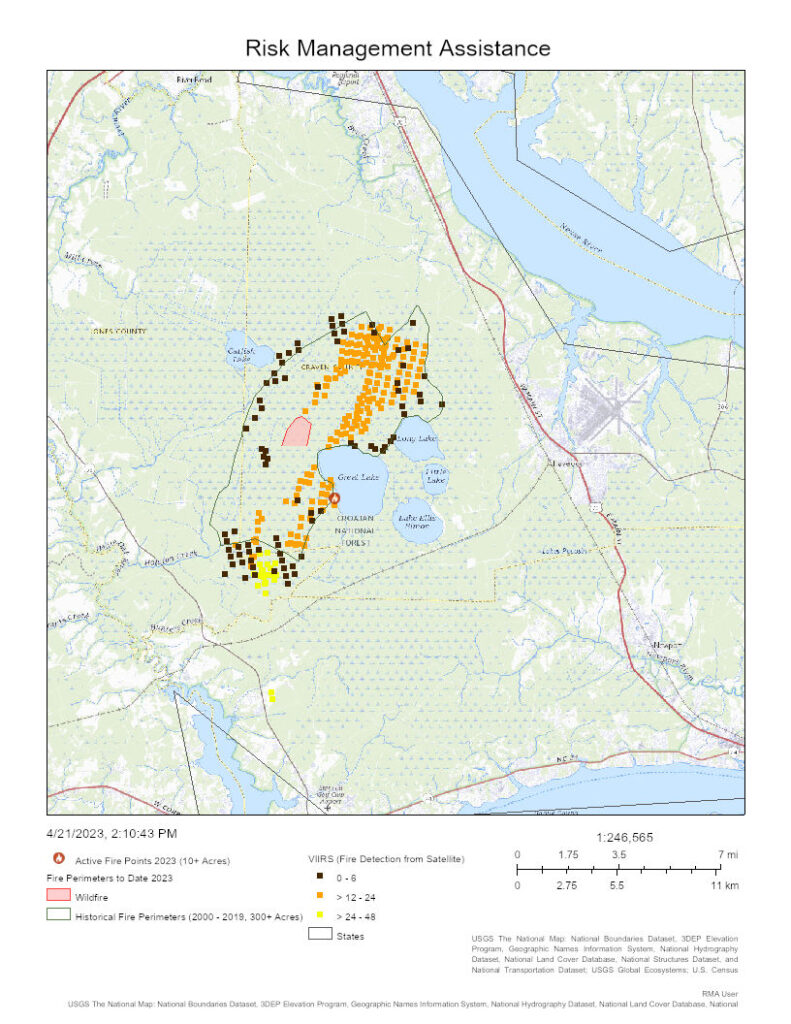
As noted yesterday in our partner site, FireAviation.com, the VIIRS satellite data offered space-based mapping of yesterday’s growth that was confirmed in the map available today from the Risk Management Assistance Dashboard … compared to yesterday’s rapid spread, the majority of recent heat signatures are to the north, where the fire is burning into and between past fuel treatments. The fire has definitely outgrown the 21,000 acre footprint of 2012’s Dad Fire.
Additional mapping is being shared by Joseph Elfelt …
#GreatLakeFire Croatan National Forest North Carolina. Symbols on the map are heat detection by MODIS and VIIRS satellites. Not real time, locations approximate. To learn more click “Map tips” upper left corner. #NCwx
— Joseph Elfelt post.news/mappingsupport (@MappingSupport) April 21, 2023
And current info arrives from a variety of Twitter posts with the handle of #GreatLakeFire (no plural) …
Great Lakes Fire estimated at 35,000 acres, 10% containment. Southerly winds expected to continue through Sat. evening. Communities north of Croatan National Forest can expect smoke impacts to continue. More: https://t.co/K7lWSwbMkopic.twitter.com/8Gvg5Kq0XJ
#SATELLITE SPOTLIGHT: @NOAA‘s GOES16🛰️ is tracking the smoke from a #wildfire in Croatan National Forest in North Carolina today. Officials estimate the blaze has already burned more than 35,000 acres since Wednesday. #NCwxpic.twitter.com/JpVFkKwjJA
— NOAA Satellites – Public Affairs (@NOAASatellitePA) April 21, 2023
A recent tweet equated the fire’s size to the acreage of DisneyWorld, which, in case you were curious, was forecast to have average crowds for Earth Day according to the Magic Guides Crowd Calendar.
There is no current estimate for how many firefighters are working the Great Lake(s) Fire, though it’s certainly increasing. Yesterday’s census for the Southern Area had some 1200 resources assigned in the overall GACC area.
Managing fires is a traditionally on-the-ground profession that adapted quickly to the value of aerial resources. On the Great Lakes Fire in North Carolina, listed at 7000 acres yesterday, a range of sky-based tools help convey the current status, even from a continent away.
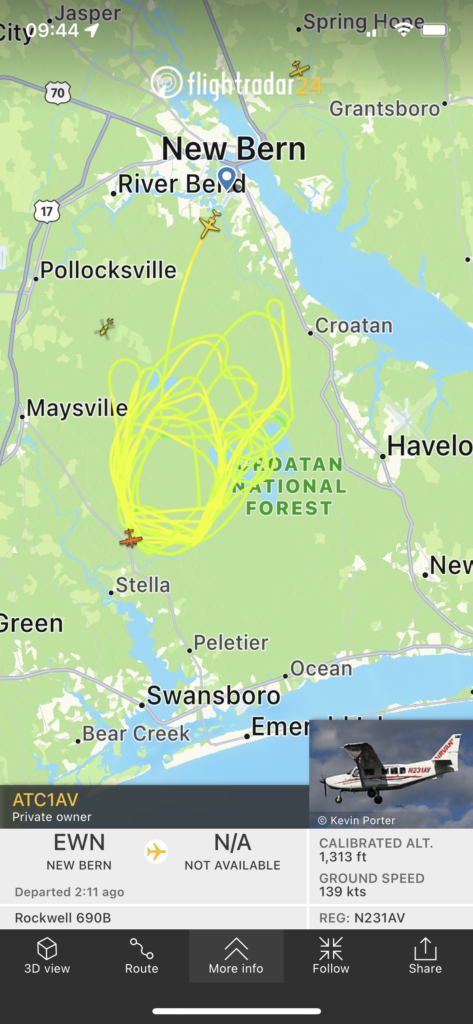
For one, there’s avionics tracking — such as that provided by FlightRadar24. A screen shot just past noon conveys a circle significantly larger than the fire footprint reported the night before.
A screen shot of FlightRadar24, with air traffic above the Great Lake Fire, at 1244 EDT, April 21, 2023.
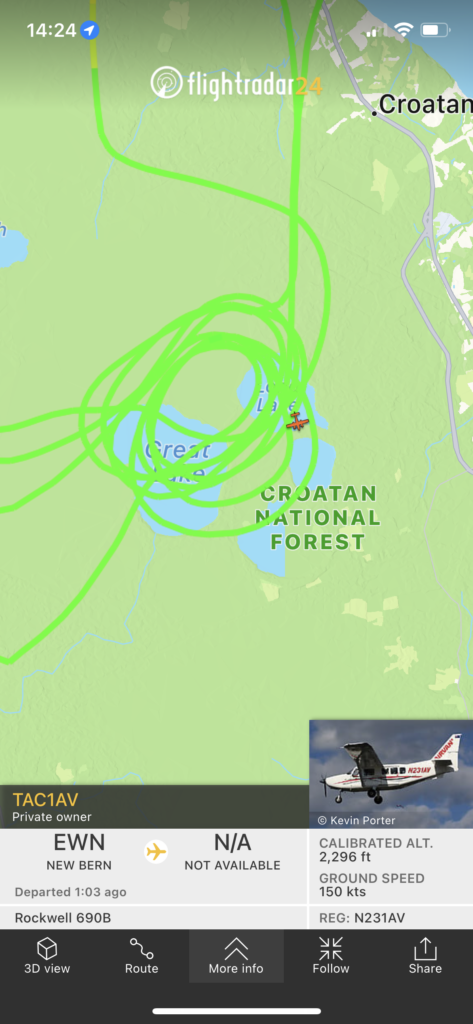
Some seven hours later in the shift, at 1724 EDT, the aerial observation ship is circling tighter and to the north.
A screen shot of FlightRadar24, with air traffic above the Great Lakes Fire, at 1244 EDT, April 21, 2023.
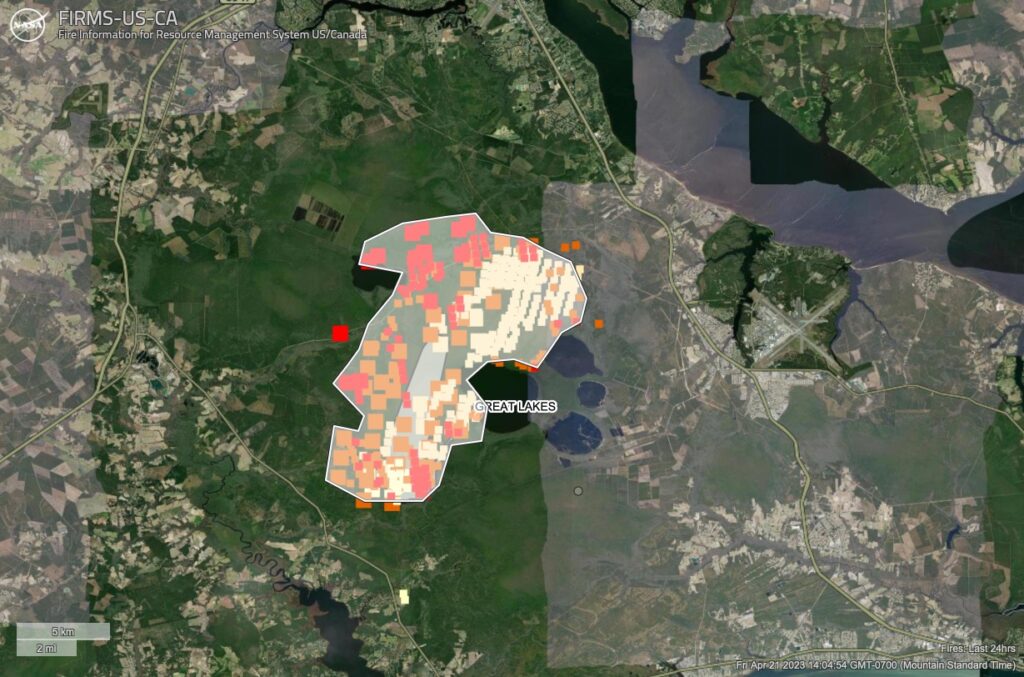
Switching to VIIRS satellites, the heat signature shows growth (and likely burnouts) in the past six hours (the brighter red, with the lighter yellow being 24 hours old). Using the Area tool built into NASA Lance FIRMS site, a rough (and likely large) estimate puts the fire at 30,000 acres.
VIIRS heat detection and estimated perimeter of 30,000 acres (which may be exaggerated by heat from the smoke column).
Switch to the toolset shared via the Risk Management Assistance Dashboard and one can overlay fire histories (the black solid line) … and lo and behold, the current estimated perimeter seems to align with the Dad Fire, a 21,000-acre fire in 2012, as well as prior fuel treatments to the north and south.
One additional tool is the mapping, forecasting, interpretation, and messaging of smoke and its impacts … as shared here via a Twitter post from the N.C. Air Quality Forecast Center.
URGENT (4:42PM FRIDAY 4/21/2023): UNHEALTHY TO HAZARDOUS AIR QUALITY LIKELY OVER EASTERN NORTH CAROLINA THROUGH TOMORROW OWING TO SMOKE FROM GREAT LAKES FIRE. #ncwx#airquality#AQI
— NC Air Quality Forecast Center (@NCDAQ_Forecast) April 21, 2023
We echo what the Air Quality center notes in its tweet: this is a developing situation, and the maps shared here are interpretations of what is certainly more challenging, and being more accurately portrayed, on the ground and in the air above the Croatan National Forest.
04/28 UPDATE: The Great Lakes Fire remains at 32,400 acres with 30 percent containment, according to Inciweb updates. They got a little rain this morning and more is forecast over the weekend. At this morning’s firefighter briefing, meteorologist Scott Kennedy said, “I’m disappointed by the amount of rain over the fire,” referring to last night’s precipitation of approximately ¼ inch of precipitation — or less. We need a lot more rain to saturate the fire that is burning underground.” The fire is suspected to be human-caused and is still under investigation. It’s burning in pocosin swamp and mixed fuels within and around the footprint of the 2012 Dad Fire, which burned roughly 21,331 acres. Previous prescribed burning by the U. S. Forest Service helped slow fire spread this week by reducing the amount of burnable vegetation.
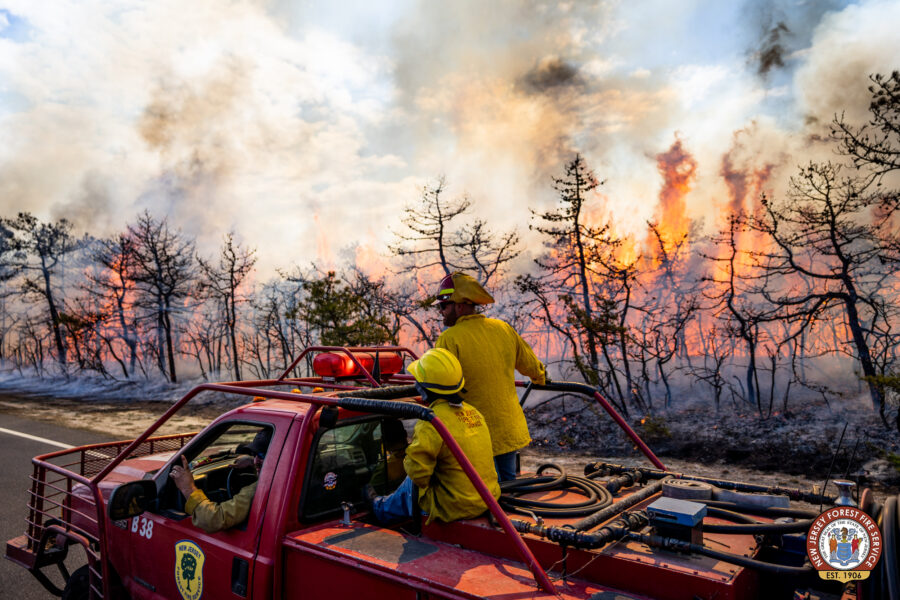
April in New Jersey was dry and windy enough for numerous Red Flag Warnings this past week, but the state Forest Fire Service still pulled off a prescribed burn and contained a wildfire.
New Jersey Forest Fire Service firefighters patrol the line on the Log Swamp Fire. Photo: NJ Forest Fire Service.
WILDFIRE UPDATE: Log Swamp Wildfire – Little Egg Harbor Twp.
At 8 am Sunday, April 16, @njdepforestfire achieved 100% containment of a 1,607-acre wildfire in Little Egg Harbor Twp. which burned portions of Bass River SF, the Stafford Forge WMA and the Warren Grove Bombing Range. pic.twitter.com/l5B4AUz8kB
— New Jersey Forest Fire Service (@njdepforestfire) April 16, 2023
Another New Jersey fire, the Kanouse Fire, burned 1000 acres in northern New Jersey, leading to evacuations — of five homes and 100+ animals from the Echo Lake Stables. Embers were reported to have started fires a half mile across Echo Lake, with the fire staffed by multiple agencies.
Though fire danger has been high to very high statewide in recent days, fire restrictions have been lifted in two of the three statewide zones as today’s calmer winds reduced fire risk.
Today’s date also marks 60 years since New Jersey’s “Black Saturday” on April 20, 1963, when 30-50 mph winds, humidity in the low 20s and temperatures in the low 80s fanned the rapid spread of 31 major fires that burned 190,000 acres, destroyed or damaged 400 structures, and evacuated 2500 residents.
This Day in History: April 20, 1963 – “Black Saturday”
The start of the largest wildfire disaster to life and property that New Jersey has experienced since the creation of the NJ Forest Fire Service in 1906 occurred 60 years ago today, on April 20, 1963. pic.twitter.com/UkZRoO3Uxp
— New Jersey Forest Fire Service (@njdepforestfire) April 20, 2023
Meanwhile, in Pennsylvania, after a week with the entire state in high fire danger, the southern and central zones are now in high fire danger and the rest of the state is classed as moderate.
This past weekend, according to Lehigh Valley Live, the 4000-acre Crystal Lake Fire east of Mountain Top led to the closure of 20 miles of the Pennsylvania Turnpike between the Poconos and Wyoming Valley interchanges.
Also during the weekend, a drone-airspace intrusion on the Peter’s Mountain Fire in Dauphin County was reported by WGAL-TV. The report reminded people that interfering with firefighting operations on public lands, per the Federal Aviation Administration, can carry a 12-month prison term, and drone pilots who interfere with wildfire suppression could also receive a fine of more than $37,000.
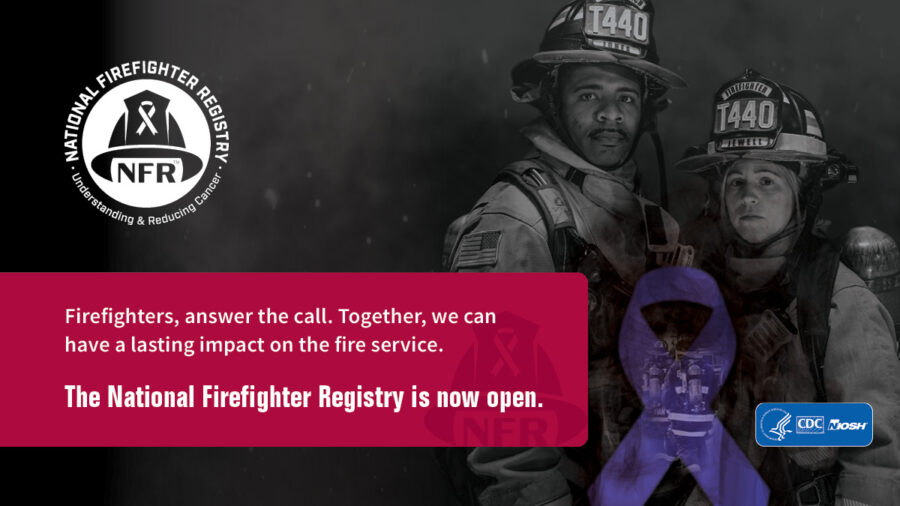
The National Firefighter Registry (NFR) officially opens its enrollment portal today after a few months in pre-launch testing and years of preparation by the National Institute for Occupational Safety and Health (NIOSH). Wildland and structural firefighters who register and share their exposure histories at NFR.cdc.gov will help support the NFR’s goal of understanding and reducing cancer in firefighters.
The registry seeks comprehensive participation and notes four objectives that firefighters will support by enrolling:
“Help protect your brothers and sisters in the fire service from developing cancer
“Help lessen the impact of cancer on firefighters’ families and friends
“Pave the way for new health and safety measures to keep the next generation of firefighters safe
“Improve understanding of cancer risk among minority, female, and volunteer firefighters, as well as groups like wildland firefighters”
To develop comprehensive and ongoing analyses of risks and illnesses, the NFR encourages participation by all firefighters, structural and wildland, and all statuses — volunteer, on-call, seasonal, full-time, retired, disabled, with or without a cancer diagnosis.
Bill Gabbert wrote many articles in Wildfire Today covering the genesis and progress toward the National Firefighter Registry (also referred to as the “cancer registry”). One article shared Kathleen Navarro’s “A Brief Look” at cancer and health risks for wildland firefighters, which notes an estimated 8-43% increased chance of lung cancer and a 16-30% increased risk of heart disease mortality among wildland firefighters. Gabbert died of cancer in January.
For agencies and organizations seeking to support enrollment, a communications portal offers a range of print and social media messages.
One suggestion when registering: gather up your experience records first. I completed the first three registration stages (the “profile” stage) in around 10 minutes and then took a break to collect some notes on seasons of service and types and amount of exposure. A registrant can step aside from the profile stage of the portal and continue later, but once you enter details of your fire experience in the “experience” stage of registration, you aren’t able to edit it.
Recording an accurate representation of work and fire experience is a core component of the registry, which seeks to create a database of fire experience, firefighter’s risk exposure and long-term health effects. This has proven a challenge for researchers examining the higher prevalence of cancer occurrence among firefighters.
This can be particularly challenging with wildland firefighters serving on seasonal assignments (and with seasonal exposure to many varieties and quantities of smoke and other potential fireline-related carcinogens). The registry includes questions that may assist in determining wildland smoke exposure, including a firefighter’s role in fire — such as hand crew, engine crew, aviation, etc.; firefighter or fire manager; and the duration and type of fires (wildfire vs. prescribed) that a firefighter responded to on average, by the specific positions held. The experience questionnaire includes most varieties of fire experience, including wildland-urban interface as compared to wildfires. The experience and personal demographic sections may take from 20-30 minutes to complete, longer if you’d had a variety of positions and fire experience in your career.
National Firefighter Registry – the Profile stages completed. Take a break and gather your exposure history before tackling the Experience Questionnaire.
The document below shares a step-by-step process. Note that the consent is in-depth, in part to ensure participants that their shared information will be kept confidential. Survey questions include general health and demographic questions, including a history of tobacco or alcohol use and workplace but non-fire exposure to potential carcinogens.
Once a firefighter is registered, an anonymized tracking system in state cancer registries will link a cancer diagnosis (if one occurs) to the last four digits of a social security number, which will then correlate the diagnosis with the NFR data that includes the firefighter’s experience and exposure. In some cases, NIOSH may connect with a registered firefighter to seek voluntary participation in additional research.
[pdf-embedder url=”https://wildfiretoday.com/wp-content/uploads/2023/04/How-to-signup-for-Firefighter-Registry.pdf” title=”How to signup for Firefighter Registry”]
The Jimmy’s Waterhole Fire in New Jersey was declared 100% contained on Thursday by the New Jersey Department of Forestry, having burned some 3900 acres, nearly half the state’s annual average in two days.
WILDFIRE UPDATE: Manchester Township – Jimmy’s Waterhole Fire
At 10 a.m. Thursday, April 13, the New Jersey Forest Fire Service has achieved 100 percent containment of a 3,859-acre wildfire in Manchester Township on federal, state and private property. pic.twitter.com/0KWhGZTaMU
— New Jersey Forest Fire Service (@njdepforestfire) April 13, 2023
This and other regional fires prompts a visit to the Eastern Area Fire Environment Outlook to explore the conditions that led to the late April fire bust. On Friday’s Morning Briefing, the Eastern Area Coordination Center had nearly 40 percent of reporting units in Very High to Extreme Fire Danger, with the largest fires in New Jersey, Missouri, Pennsylvania, Michigan and Rhode Island. In the past week, the region recorded 349 fires for 12,600 acres.
While spring is often active in the east — as forest fuels dry out between winter snow and rains and prior to green up — the last week was drier throughout the Northeast and Midwest, as well as in the Great Plains and Southwest. Look south and you can spot the focused and incredible “purple” deluge in Fort Lauderdale, Florida, and to the north there’s an unusual heart-shaped moisture pattern in Michigan.
7-Day Percent of Normal Precipitation through April 14, 2023.
Fire activity in the region has been moving northeast toward Maine with the bubble of heat, including a fire point seemingly in the Atlantic — though a closer look at the Fire Weather Dashboard (with fire points activated) places the the fire on Martha’s Vineyard.
A Fayette County, West Virginia man is in custody charged with arson and murder in connection with the fire that claimed the life of Fayette County firefighter Cody Mullens. Sheriff Mike Fridley announced that David Bass, 39, of Kimberly was charged with four counts of felony wildland arson and one count of felony murder. It’s alleged that Bass set the fire in the Tucker Hollow area of Powellton, according to Metro News in Charleston.
Firefighter Cody Mullens
Mullens, 28, of Mount Hope, was struck by a falling tree and died a short time later. A joint investigation by the West Virginia Fire Marshall’s Office, the Division of Forestry, and the Fayette County Sheriff determined that the cause of the fire, reported April 12, was arson. This is reported to be the first line of duty death in the history of the Division of Forestry.
Fridley said Mullens was brave and honorable “who was and will always be a hero.” According to WOWKTV-13 News, anyone with information can contact the Fayette County Sheriff’s Department at (304)574-3590 or Crime Stoppers of West Virginia at (304)255-STOP.
A West Virginia Department of Forestry employee, Cody J. Mullens, 28, was killed by a falling tree while fighting a wildfire on April 13 near Montgomery, West Virginia.
The firefighter’s death was announced by West Virginia governor Jim Justice, who said he and his wife were “heartbroken by the tragic news of losing one of our own. Our state foresters are some of the most dedicated workers in our state, putting their lives on the line to protect our communities from wildfires, and we owe them all, especially Cody, an enormous debt of gratitude.”
Mullens was from Mt. Hope, Fayette County. West Virginia Public Broadcasting reported that he was part of a response unit working a brush fire along Route 61 in Armstrong Creek, around 30 miles southeast of Charleston.
West Virginia has statewide burn restrictions in effect and is midway through their typical wildfire season.
Federal wildland fire funding may increase by nearly 25 percent in 2024 if President Biden’s budget priorities are adopted by Congress. The budget, released March 9, reflects firefighters’ concerns and a rising political commitment to face increasingly complex wildfire conditions.
Initiatives include a long-term fix for wildland firefighter pay equity, an 8 percent increase in the number of federal and Tribal firefighters, and expansion of prior commitments to interagency response and research, fuels management, aviation and remote sensing initiatives, and community-based prevention programs.
The summary fact sheet released by the Office of Management and Budget has a single mention of wildfires, woven into a $24 billion investment to “build communities’ resilience to floods, wildfires, storms, extreme heat, and drought brought on by climate change.”
Wildfire and wildland fire management funding in the 2024 budget appear in joint and specific releases by the lead agencies with federal wildland fire management responsibilities. The U.S. Department of Agriculture proposes a 28 percent increase and the Department of the Interior proposes a 21 percent increase over 2023 funding.
News releases from both departments note the priority for funding the proposed raises in base pay for federal and tribal firefighters. The budget summary notes that funding will pay for fuels as well as fire management. The proposal calls for “More than $4.2 billion for the U.S. Departments of Agriculture and the Interior wildland fire and hazardous fuels management” that will “implement comprehensive workforce reform, including increased firefighter pay, additional firefighting capacity, enhanced mental and physical health support, and improved housing options for firefighters.”
As detailed in a March 9 USDA release, “The budget includes increases of $180 million for USDA and $72 million for DOI to raise base pay for Federal and Tribal wildland firefighters, with additional premium pay costs covered out of funding requested for suppression operations.” The USFS Explanatory Notes page for the 2024 budget includes additional details and annual performance indicators. One indicator of note for 2022: on page 233, it’s reported that nearly 3 million acres of fuels treatments were accomplished, with 57 percent using prescribed fire despite a prescribed fire pause (followed by the release of the National Prescribed Fire Program Review) put in place after prescribed fire escapes in New Mexico. The 2024 budget increases hazardous fuels targets to 4 million acres.
The DOI release expands on the appropriations request: “The President’s 2024 Budget proposes legislation and funding to implement significant reforms to increase the Nation’s investment in the wildland fire management workforce. The cornerstone of these long-term reforms is a permanent increase in pay. The Administration proposes legislation to establish a special base rate salary table for wildland firefighters, create a new premium pay category that provides some additional compensation for all hours a wildland fire responder is mobilized on an incident, and establish a streamlined pay cap that provides waiver authority to the Secretary using specific criteria.”
The pay-raise focus has garnered support from the National Federation of Federal Employees. In a March 13 release, NFFE President Randy Erwin praises President Biden for “taking this critical step in addressing the wildfire crisis and improving the lives of federal wildland firefighters across the country.”
Erwin noted that pay reforms will “help recruit and retain skilled personnel … While there is still much work to do to ensure our wildland firefighting workforce has the resources to be sustainable in the coming years, I am proud that our members are seeing results from their advocacy.”
Approval of the budget faces the challenge of a divided Congress. A Republican-majority House may push back against the overall budget, resulting in a flat-lined continuing resolution in place of an approved 2024 budget. Additionally, implementation may be shaped by legislation that may result from reports and recommendations of the Wildland Fire Mitigation and Management Commission. The commission’s final call for recommendations from the public (including firefighters) closes on March 22.