A fire east of Québec in Newfoundland and Labrador has burned more than 24,000 acres and forced thousands to evacuate Labrador City. CNN reported that the “extremely aggressive inferno” was considered contained earlier this week, but weather changes on Friday blew the fire back to life and it spread rapidly. Premier of Newfoundland and Labrador Andrew Furey said Saturday the fire had grown to 22,000 acres and had spread 13 miles in about four hours.
In a news conference on Sunday, Furey said weather conditions are favourable for firefighting. “We have some good news today. There is no significant growth in the size of the fire that is just northwest of Lab City,” he told reporters. The fire has burned through about 14,000 hectares (about 35,000 acres) to within four kilometres of the community — the same as Saturday.
Newfoundland and Labrador fires, ESRI map
Light rain, lower temperature and humidity, and northeast winds has kept the fire away from the town and burning onto itself.
Four water bombers are fighting on the eastern front of the fire. Six to eight are fighting on the western side from Quebec.
Around 9,500 people were evacuated from Labrador City, said Jeremy Reynolds with the provincial government. “A contingent of essential personnel have remained behind to oversee the emergency response,” he said.
The remoted town of Labrador City, in the northwestern part of the province, is about 900 miles north of Canada’s capital city of Ottawa.
A province-wide outdoor fire ban prohibiting setting of fires on forest land or within 300 metres of forest land is now in effect in Newfoundland and Labrador.
Significant firefighting resources are currently dedicated to wildfire suppression near the communities of Labrador West.
Updates on the location, status, and size of active fires can be viewed online at the NL Active Wildfire Dashboard.
Labrador City fires
Residents were told to evacuate to the Town of Happy Valley-Goose Bay – a six-hour drive away.
Dauntless Air has announced a fleet expansion amid increasing demand for its single-engine water-scooping aircraft. The company’s added five more Fire Bosses to its fleet of water-scooping SEATs. In the U.S. a record number of new Fire Boss solicitations were issued during this past off-season.
“The Fire Boss is a game-changer in wildfire suppression,” said Brett L’Esperance, CEO of Dauntless Air.
As far back as 2012, the RAND Corporation recommended an increased focus on scoopers in the U.S. aerial firefighting strategy — amid numerous other airtanker studies. “It’s been a long time coming, but it’s clear that single-engine scooper initial attack is gaining ground around the world,” added L’Esperance.
As climate change and other factors exacerbate the frequency and intensity of wildfires, more states and federal agencies are considering increased focus on scoopers.
A total of 29 OAS-compliant Fire Bosses now operate across 24 exclusive-use and 10 CWN contracts, up from 15 EU and 7 CWN contracts from last year. Dauntless Air holds most of these contracts, many of which were issued by states that have never before offered a SEAT scooper contract.
Internationally, fire agencies have now ordered dozens of Fire Bosses to add to their firefighting fleets. Officials in Greece have ordered a record-setting 31 Fire Bosses in the last two years, and Turkey and Slovenia secured manufacturer contracts — for 15 and four aircraft, respectively.
David Dow’s Fire Boss photos were featured by General Aviation News; photos he captured of pilots conducting training flights at Heber Springs Municipal Airport (KHBZ) in Arkansas; they were operating out of Greers Ferry Lake just north of Little Rock.
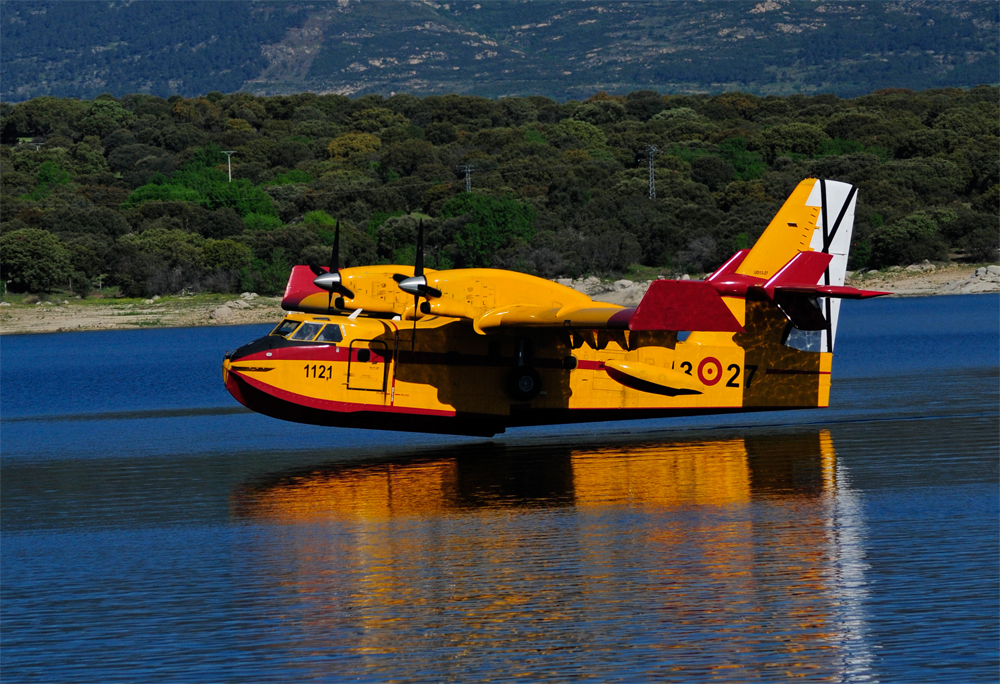
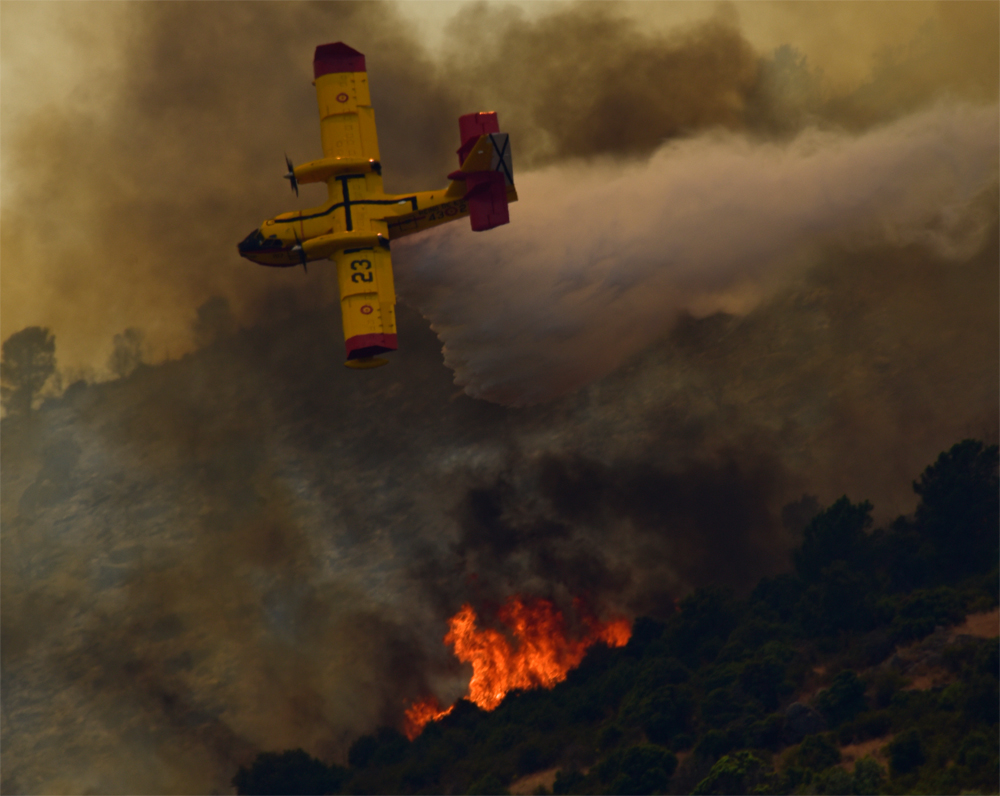
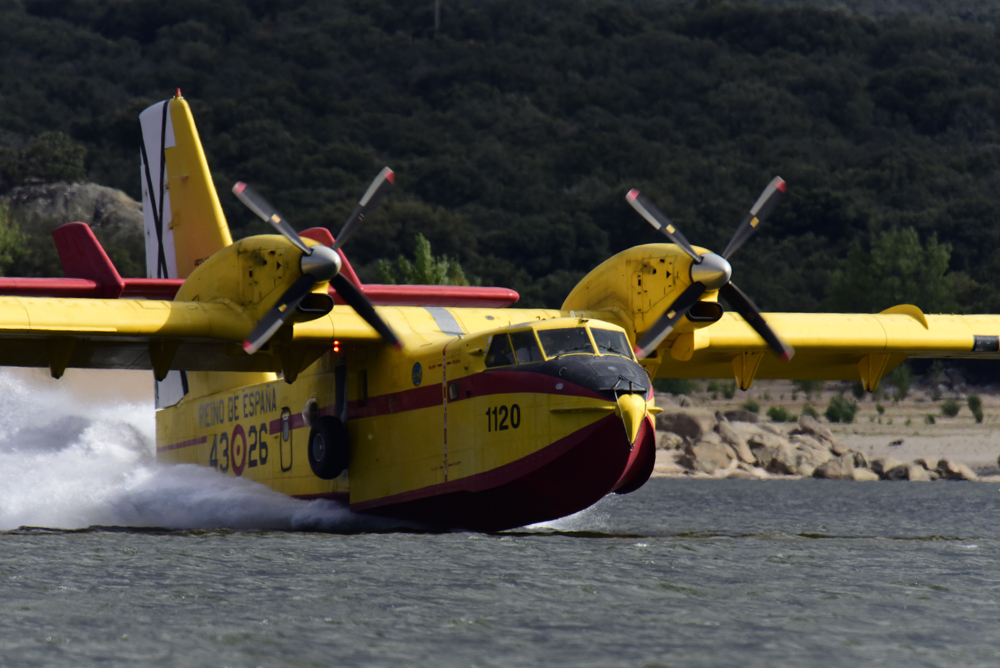
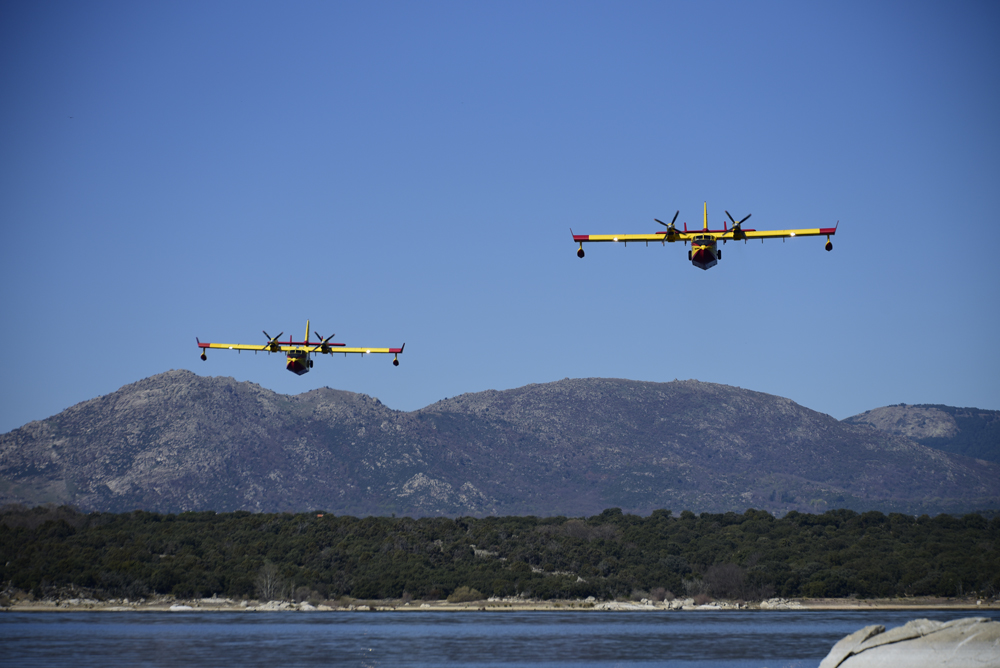
The 43rd Air Force Group in Spain is one of the main weapons in the fight against forest fires there, and the Canadian-built amphibious aircraft are one of the main reasons.
It has been over 50 years since the incorporation of the first two seaplanes, a major force in the fight from the air against forest fires in Spain and the region. The 43rd Air Force Group has accumulated a brilliant history and is one of the most successful and admired units of the Spanish Armed Forces.
Its history in Spain begins in 1969 when, after the results achieved in France, Canadair, the designer and builder of the seaplane (today Viking), deployed an aircraft in Galicia at the request of the Spanish government. The results were so impressive that the Ministry of Agriculture decided to purchase two aircraft to be operated and maintained by the Air Force. The government assigned them to the 803 Squadron of the Getafe Air Base, and personnel were trained in Canada late in 1970.
Crew training and aircraft delivery were overseen by the Canadian company and delivery flights made by the Spanish crews, who accepted the planes in February of 1971. The scoopers arrived at their base after crossing the Atlantic with stopovers in Newfoundland and the Azores. The aircraft carried out their first detachment at the Santiago de Compostela Aerodrome that same summer.
Because of the increase in forest fires and the achievements of the aircraft in the first two campaigns, in 1973 the purchase of eight more seaplanes was decided. The 404 Squadron was created, a unit dedicated exclusively to fighting forest fires and based in Torrejón de Ardoz. In 1974, the new planes arrived with some improvements – such as exploration and meteorological radar and bubble windows, which equipped the aircraft for their secondary task of search and rescue.
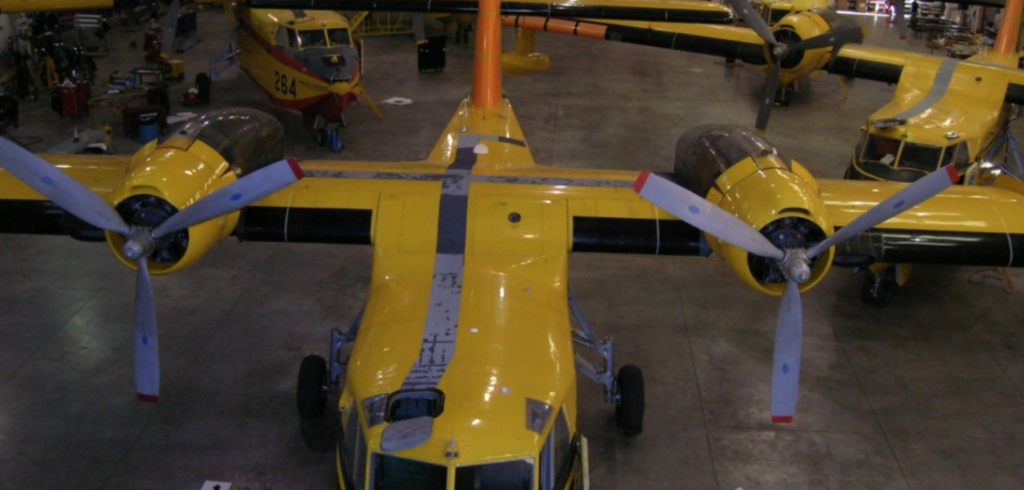
The C-215 were seaplanes with Pratt and Whitney piston engines with a power of 2,100 hp each, as well as water tanks with a capacity of 5,400 liters. Its crew consisted of a pilot, co-pilot, and maintenance specialist who also assists the crew when necessary.
In 1978 the 404 Squadron reached 10,000 flight hours and received several decorations and recognitions for its already impressive career. In 1980, the 404 became the 43rd Air Force Group, which it maintains to this day – as well as its summer deployments in Torrejón de Ardoz, Albacete, Palma de Mallorca, Santiago de Compostela, and Zaragoza.
In 1989, flight hours reached 55,000 and some aircraft were modified to the CL-215T version. This variant, developed by Canadair, was enhanced when the company was purchased by Bombardier. Among other improvements, the conversion replaces the piston engines with turboprop, resulting in greater performance and power (2,380 hp), four-blade propellers, larger capacity in the water tanks, and structural reforms such as winglets at the ends of the wings and improvements in controls and flight systems.
Not all the planes were converted, but ten seaplanes of the new version were purchased, and the unconverted primitive engines were sold or operated by civil companies, which have kept some in flight to this day.
The maintenance of the fleet has been carried out, since 1971, at the Albacete Air Master and the approvals are also conducted in Spain, a sign of the capacity of our aeronautical industry and the competence of the personnel.
In 1995, the 43 Group began operating with only the new CL-215T, reaching 100,000 flight hours in 1999 and counting thousands of hours during each season from June to September. With the passage of time and the acquisition of aircraft, the detachments have expanded: in addition to Torrejón de Ardoz, Albacete, Palma de Mallorca, Santiago de Compostela, and Zaragoza, they now also include Málaga and Badajoz, with full capacity to deploy in the Canary Islands.
In 2002, in response to the Prestige oil tanker disaster on the Galician coast, the 43rd Group collaborated with other units of the Air Force in the detection and monitoring of spills. The flights were intense and long in the harsh Atlantic winter, demonstrating the preparation and commitment of the crews and maintenance teams to help mitigate the disaster. Between December 25, 2002 and January 9, 2003, nine sorties were carried out, with some missions during that crisis lasting more than six hours with aircraft flying from sunrise to sunset.
A CL-215T carries around a 300 lb. lower payload than the CL-415 and does not have an electronic flight instrument system (EFIS) flight deck. The major visual difference is CL-215T’s two-door bomb bay; the CL-415 has a four-door bomb bay, and which aircraft is better is continuously debated by the worldwide operator base.
In 2006 the first of the four new CL-415s – an improved CL-215T – was received, and in 2012 the 43 Group reached 150,000 flight hours.
The Unidad Militar de Emergencias (UME) is a branch of the Spanish Armed Forces providing disaster relief throughout Spain, and abroad if required, and it relies on the 43 Group – with more than 150 people and 18 seaplanes (fourteen CL-215T and four CL-415, with fuselage numbers 43-31, 32, 33 and 34) that, year after year, fight forest fires not only in Spain but also other countries including Israel, Portugal, France, and Morocco. All these over the years have counted on Group 43 to fight fires in their territories.
The responsibility of the 43 Group is subject to the intensity of challenging launches, over very hot areas, landing on water surfaces that are not always clear of obstacles, along with other factors that could easily trigger disaster. Fifteen crew members over the years have lost their lives fighting wildfire. Their memory and sacrifice have a permanent tribute at the Group Headquarters, as a testimony to the enormous difficulty of the job that demands the maximum from its members.
The official motto of the 43 Group contains both the greatness and the humility with which its members fulfill their duty: Apaga … y vamanos. Literally translated, that is “Turn off and let’s go.” What it means is “Put this fire out and let’s go home” — or it’s all in a day’s work, not heroic, just part of the job.
In memoriam
08-09-1976
Alférez D. José Luis Herráez Soria
Brigada D. José Cachofeiro Ramón
Sargento 1º D. José Pérez Belmonte 12-10-1980
Comandante D. Óscar Sáez de Santamaría Alegría
Sargento 1º D. Luis Vélez Tarano 02-03-1981
Teniente D. Fernando Esteban Baturone
Teniente D. Aurelio Gil Laso
Alférez D. Eduardo Javier Moreno Jiménez
Sargento 1º D. Santiago García García 09-09-1988
Capitán D. Pedro Álvarez de Sotomayor Seoane
Capitán D. Jesús Cembranos Díaz
Teniente D. Carlos Ramírez de Esparza Figuerola-Ferreti
Sargento D. Juan Carlos Muyo Romero 25-03-2003
Sargento D. Manuel Fábrega Salas
Sargento D. Manuel Fernández Carrascosa
Miguel Hernández Fernández: “Since I can remember, I have been passionate about aviation. From building plastic kit airplanes I went on to photograph them and from there, when I had my first SLR camera in 1991, I became a spotter photographing real airplanes. At the same time I took the ultralight pilot course and, although I flew little, I enjoyed it to the fullest. With a journalistic vocation, I started with the magazine VOLAR, and the TV program ‘Caminos en el Aire,’ reporting on military and civil aviation with video. I obtained my university degree in communication and I maintain my passion for aviation and photography. And the best: when I hear a propeller or a jet engine, at home or outside, I always look at the sky.”
I just wanted to message you and share that Trans Canada Brewing up here in Manitoba took my suggestion to immortalize the venerable CL-215 by brewing an ale dedicated to fire aircraft -- it's the Scooper Pale Ale!
Not sure how far abroad availability will be, but I know for sure it will be well-received after alerts on tanker bases around here!
CHEERS, Eric
“Welcome to our newest seasonal series beer, Scooper Pale Ale,” says Trans Canada. “The CL-215, an iconic Canadian waterbomber commonly referred to as a Scooper, has been guarding the Canadian wilderness for decades. This pale ale boasts tropical and citrus notes with a refreshing bitterness to create a thirst-quenching finish.”
Flying Otter light lager
Trans Canada Brewing Co. also makes the FLYING OTTER Light Lager, complete with just about the coolest and most iconic and awesome brew logo EVER, so they can’t be all bad.
⇠ ⇠ Does the Flying Otter lager logo make you think of FirePirates, I mean fire pilots, who drove Twin Otters, I mean twatters, for smokejumpers ????? Yeah, me too !
Trans Canada has a brewery, a taproom, and a general store in Winnipeg’s southwest corner. The company is Manitoba-owned and 100 percent independent — and they’ve got some dandy vintage-style art on their website:
The more you look at that art the better you will like it.
I fully expect this SCOOPER pale ale will become just as iconic with firefighters as Moose Drool (and its family of seasonal delicious brews from Big Sky Brewing) became some years ago in the Northern Rockies fire region.
And the SCOOPER pale ale’s only “available seasonally,” so heads-up on when and where you’ll find it.
Trans Canada SCOOPER Pale Ale
— and —
BIG CHEERS and un fuerte abrazo to Our Pal Eric Malofsky for suggesting in the nicest most persuasive way to Trans Canada Brewing Co. that they oughta make us a pale ale branded with a CL-215 ! He just happens to be a 215 mechanic.
(And BTW anyone who ships me a can or six of either one wins a bonus prize.)
This is awesome, thank you so much for the article! I'm glad you like it; we've had quite the response since putting this beer out into the market. I just shipped a case to Quebec to some of the pilots out there yesterday.

One thing about our brands is there is always some sort of easter egg hidden in the label. The Scooper label has an Otter plane in the background, and our Flying Otter label is modeled after a Royal Canadian Airforce recruitment poster. Thanks again, I'm going to share this article around the office!
Cheers, Emma Houldsworth
Brand & Marketing Leader Trans Canada Brewing Co.
1-1290 Kenaston Blvd., Winnipeg MB R3P 0R7
Aero-Flite Inc. is expanding operations at Spokane International Airport, where the company is planning a 30,000-square-foot maintenance hangar to handle its growing fleet, says general manager Chris Niemann.
The Spokane Journal reported that the company has filed a pre-development conference application with the city of Spokane to review plans for the structure, valued at over $8 million. The company bases its operations in 33,000 square feet of hangar space, which includes a 6,000-square-foot attached tent; Niemann says the new hangar will be built next to the existing facility and it will improve winter maintenance capacity.
Aero-Flite ducks in a row
He says the fleet will grow from 12 to 14 aircraft. The company added one plane in 2023 and will add two more next year. The FAA issued a Supplemental Type Certificate (STC) on the Dash 8-400AT airtanker last spring; Aero-Flite has pursued the U.S. certification of the airtanker version of the Dash-8 airliner.
Also operating AVRO RJ-85 and Canadair CL-415 airtankers, Aero-Flite plans to expand their fleet; with the new STC, Aero-Flite will add two Dash 8-400ATs and the FAA approval will allow U.S.-registered Dash 8-400ATs to fly aerial firefighting missions across all states.
The Aero-Flite airtankers will operate under a long-term, multiyear contract with the State of Washington.
Expanding its hangar space will reduce employee time spent moving aircraft around during maintenance time in the off season. Aero-Flite photo
The maintenance hangar will be a pre-engineered metal building with insulated panels for siding. Spokane-based Garco Construction will be the contractor. Since Niemann joined the company in May 2021, Aero-Flite has added 40 employees, bringing the workforce to about 180 people. That includes 125 Spokane-area employees.
For four years running, Aero-Flite’s been named by the Spokane Journal of Business as one of the best places to work in the Inland Northwest.
AirMed&Rescue reported back in the spring that Aero-Flite is a business with 60 years of experience in the aerial firefighting sector. It employs over 170 aviation experts, including 51 pilots and 74 mechanics, and operates a mixed fleet of fixed-wing aircraft, including seven Avro RJ85 airtankers and four De Havilland CL-415 waterbombers; the Dash 8-400AT is one of the world’s most modern airtankers.
As wildfires burned across the Greek island of Rhodes in July, covering about 15 percent of the island, the European Union decided to invest in up to 12 new firefighting aircraft. The EU then sent 11 planes and a helicopter to Greece — nearly half EU’s firefighting fleet — reported euronews.
Janez Lenarčič, the EU Commissioner for Crisis Management, said he expects individual member states to order an additional 12 planes, and said that manufacturer De Havilland Canada, headquartered in Toronto, has agreed to re-launch production of its iconic “Canadair” aircraft if the EU places the orders.
Canadair Super Scooper
The Canadair super scoopers start at around €30 million, which is currently nearly $32 million USD. (And De Havilland Canada is hiring, by the way, if you’ve got transferable skills.)
De Havilland Aircraft has manufactured over 3,500 aircraft including what’s arguably the most advanced turboprop in the air today. The manufacturer closed down scooper production back in 2015 but now plans to design and build a new generation of Canadair scoopers, the DHC-515 — which probably will be delivered beginning in 2027. New design and production costs may very well push the price tag higher than €720 million for 24 new aircraft.
De Havilland DHC-1 Chipmunks … wikipedia photos.
De Havilland’s been around longer than Smokey Bear. The DHC-1 Chipmunk — an all-metal trainer developed for the Royal Canadian Air Force — was the first all-Canadian design to come out of De Havilland Canada.
The company followed that with the De Havilland Beaver, a rugged and versatile bush plane that can take off and land almost anywhere, helping connect communities in Canada’s most remote northern regions. The U.S. Forest Service started flying planes on floats out of Ely, Minnesota in 1929 — still before there was a Smokey Bear — and they’re still flying Beavers today. Fire personnel in the know call this the agency’s best-kept secret weapon.
De Havilland’s other notable fire aircraft include the Twin Otter and the Dash-8.
The Calgary Herald reported last month that interest in its new waterbomber is growing as the company prepares to launch its new program to build the amphibious DHC-515 in Alberta.
European countries, which signed a letter of intent last year to acquire 22 of the newly designed planes, bumped up their order by two because of more demand from France, while other jurisdictions have also made inquiries. Neil Sweeney with De Havilland said there’s significant demand globally. “It doesn’t matter if it’s in Europe or North America,” he said, “there’s a huge demand. We’ve had countries, both existing customers and new potential customers, calling us and asking about either a retrofitted aircraft or new 515s.”The DHC-515 is another in a long line of scoopers dating to the iconic Canadair CL-215, which was initially designed in the 1960s, followed by the CL-415. Scoopers fight fire across North America, and European customers include Italy, France, Greece, and Spain.Six provinces own or operate the CL-215 or CL-415 models, including Ontario, Quebec, Saskatchewan and Alberta. De Havilland in 2016 bought the manufacturing and design rights to Bombardier’s amphibious aircraft program. In March 2022 the company confirmed plans to build the new DHC-515 Firefighter, with key upgrades including state-of-the-art navigation instruments.
Hunter D’Antuono with theFlathead Beacon, by the way, captured some 5-star photos of scoopers owned by Montana’s Bridger Aerospace over the Elmo Fire on the western shore of Flathead Lake last year in August. Bridger recently purchased four more scoopers — CL-215Ts — from the Spanish government.
Things are just getting hotter in Texas, and Gov. Greg Abbott has declared a wildfire disaster with ongoing triple-digit temperatures in the forecast for the Brazos Valley — and the Texas A&M Forest Service (TAMFS) has stationed more airtankers in College Station.
Wes Moorehead, associate director and fire chief for the TAMFS, said the department uses numerous different aircraft to fight fire, but in College Station, they now have two new super scoopers.
“They are made to scoop off of open water lakes and then deposit that water onto an active fire scene,” Moorehead said. “Other aircraft, they will be loaded at the airport with retardant or water and then fly to the fire location and drop it. They’ll have to return to the airport and get reloaded.” In a report by KXXV, Moorhead said, “These in particular hold 1,400 gallons, which is a sizeable amount of water. Typically, a firetruck will hold around 500 gallons, so three times the amount of water a local fire truck can deliver.”
CBS Austin reported last week that TAMFS has brought in dozens of aircraft to work on nearly 3,000 fires across the state since the beginning of this year.
The Super Scooper is a specialized water-dropping airtnker, according to pilot Elic Kirby. “It’s just a giant, yellow beast,” he said. “It’s made to fight fire. It’s all it’s made to do, it’s all it does.” Kirby’s been flying scoopers for a couple years now, and says they’ve been flying Texas fires every day lately. His airtanker is one of about 30 aircraft brought on by TAMFS a couple weeks ago to fight fires — thousands of fires since the first of the year.
“Since January 1, we’ve actually seen 3,000 wildfires burn in the state of Texas,” said Moorehead. “These triple-digit temperatures are actually driving the moisture out of fields and driving the wildfire scene that we have in Texas right now.” He said airtankers are most helpful when aiding the crews who fight wildfires on the ground.
As Fire Aviation reported back in January, the special purpose acquisition company (SPAC) of Jack Creek Investment Corp. collaborated with the long-time aerial firefighting delivery company, Bridger Aerospace Group Holdings, LLC (BAER/BAERW), moving onto Wall Street via the Nasdaq Global Market. Shares began trading on January 25 and dropped by a third on day three, with the company’s market capitalization at a robust $760.64 million.
Bridger Aerospace, one of the country’s largest aerial firefighting companies, is purchasing Bighorn Airways’ fleet of 12 aircraft used for smokejumping and special mission transport for government agencies. The transaction, valued at $39 million, is expected to close by the end of September, financed through a combination of cash and stock.
“This expands our aerial firefighting services to new mission critical areas,” said Tim Sheehy, CEO at Bridger. “Bighorn provides year-round logistics for the Department of Defense. From providing aircraft and flight crews in support of the smokejumper program, to flying missions in the North Pole region of Alaska, Bighorn adds to what is now the largest specialty wildfire aviation fleet in the country. We are honored to welcome Bighorn to the Bridger family.”
Bighorn Airways was founded in 1947 with three planes working aerial spray operations for local ranchers. The company grew into Wyoming’s largest aviation service provider, with aircraft and helicopter charter service, aerial spraying, and full FBO services including aircraft refueling, maintenance, and avionics service.
Based in Sheridan, Bighorn has a fleet of 12 aircraft including three Dash-8 planes (De Havilland Canada DHC-8s) with a 7500 lb. payload capacity, a range of 1200 miles, and capability of low-level flights. Bighorn also operates four Casa 212-200 and five Dornier 228-200 twin turboprops capable of short takeoff and landings.
“Mountain flying is a very demanding skill set, you got to spend years learning how to fly safely in the mountains,” Sheehy, who flies Bridger’s Super Scooper, recently told KHQ-TV. “Amphibious aviation is a very specific skill set, people will spend years learning how to be high-speed boat drivers and pilots at the same time.” Sheehy said aerial firefighting combines all those skill sets together.
Bridger Aerospace, started by Sheehy in 2014 after nearly a decade as a Navy SEAL, has contracts with agencies in both the U.S. and Canada, and has two scoopers currently at Coeur d’Alene airport flying for the Forest Service.








 De Havilland Aircraft has manufactured over 3,500 aircraft including what’s arguably the most advanced turboprop in the air today. The manufacturer closed down scooper production back in 2015 but now plans to design and build a new generation of Canadair scoopers, the DHC-515 — which probably will be delivered beginning in 2027. New design and production costs may very well push the price tag higher than €720 million for 24 new aircraft.