
Two videos were released today. The first one is from the National Interagency Fire Center and summarizes the 2013 fire season to date. The second is from CAL FIRE and covers the fires in California over the last week.
Aircraft on the Rim Fire

Mike McMillan took these photos of aircraft working on the Rim Fire in California on August 29, 2013 for the U.S. Forest Service. Earlier we posted some photos of UH-60 Blackhawks and HH-60 Pave Hawks arriving at Columbia Airport to be used on the fire.


Wildfire briefing, September 1, 2013
Rim Fire becomes fourth largest in California history
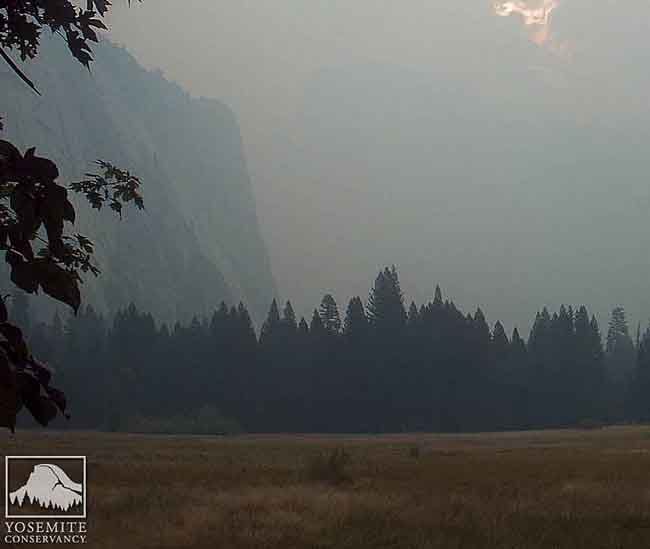
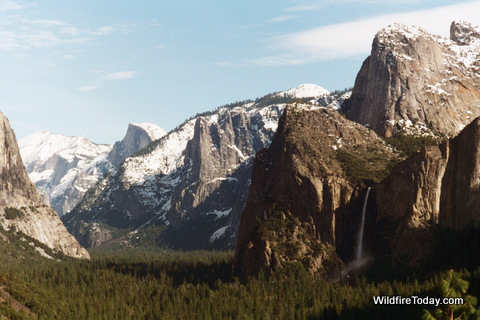
Our main article about the Rim Fire is updated daily but here are a few recent facts about the fire. On Saturday it continued to grow, adding another 3,000 acres to become at 222,77 acres the fourth largest fire in California history. Winds that shifted to come out of the west over the last two days have blown smoke into downtown Yosemite National Park, into the heavily visited Yosemite Valley. Compare these two photos of the valley; the one above was taken Sunday morning by a web cam, and the photo below we took on a day when the air was much cleaner. The fire is still eight to ten miles away from Yosemite Valley.
The 5,115 personnel assigned to the fire are fighting it by constructing direct fireline along the fire’s edge, and by indirect methods including burning out the fuel ahead of the fire. The smoke has limited the use of air tankers and helicopters for the last two days.
According to the Daily Telegraph, the fire may have been caused by activities at an illegal marijuana farm.
“We don’t know the exact cause,” Todd McNeal, fire chief in Twain Harte, a town that has been in the path of the flames, said on Friday. But he told a community meeting that it was “highly suspect that there might have been some sort of illicit grove, a marijuana-grow-type thing.”
“We know it’s human caused. There was no lightning in the area,” he said.
LA Times article about the Rim Fire
Julie Cart, who with Bettina Boxall wrote a series of Pulitzer Prize winning articles in 2008 about wildfires for the Los Angeles Times, has a new article about the Rim Fire. She mentions how firefighting policy differs between the U.S. Forest Service and the National Park Service, but greatly over-simplifies to the point of distortion the concept of “fire use” fires which are not aggressively and immediately suppressed.
Reuters: how budgets affect fires
Reuters has an article about how federal budgets may be contributing to the occurrence of larger fires by reducing the number of fuel treatment projects and prescribed fires. They have a quote from Jonathan B. Jarvis, the Director of the National Park Service:
Part of the problem, experts and many fire officials say, is that funding has been low for the controlled burns and forest-thinning work that makes it harder for a wildfire to spread.
“We’ve got to invest up front in terms of controlling and managing these fires,” said Jonathan Jarvis, director of the National Park Service from his smoke-filled post in Yosemite National Park. “Just waiting for the big fire and then throwing everything you’ve got at it makes no sense.”
In recent years, Jarvis said, the trend has been to shift money from fire prevention to firefighting.
Montana Supreme Court will decide case about firefighting strategy
The Montana Supreme Court will make a decision by November that could have an effect on how firefighters select a strategy for suppressing a fire. A Montana rancher who said firefighters’ backfires ruined his ranch won a suit against the state of Montana in 2012 which is being appealed to the Supreme Court. A jury awarded Fred and Joan Weaver $730,000 in a trial over the strategy and tactics that were used on the Ryan Gulch fire in 2000 – $150,000 was for the loss of timber, $200,000 for rehabilitation of pasture land, and the balance was for the mental suffering and anguish of seeing their ranch threatened by the fire. About 900 acres of the Weaver’s land burned during the fire.
The heart of the Weavers’ case was their contention that firefighters who usually fought fire in the flat, wet southeast United States used poor judgement in selecting and implementing an indirect strategy of backfiring, rather than constructing direct fireline on the edge of the fire. In the process, they argued, more land burned than was necessary, including 900 acres of their ranch.
We wrote an analysis of the 2012 court decision last year.
Recent articles at Fire Aviation
-
Coulson loses B.C. contract for Martin Mars
-
Photos and videos of aircraft on the Rim Fire
-
California: Castle Airport is now an air tanker base
-
Predator drone being used on Rim Fire
-
NASA test crashes a helicopter
Prescott’s Granite Mountain Hotshot crew nearly paid for itself
When the Granite Mountain Hotshots worked on federal fires the terms were established by their contract or agreement with the U.S. Forest Service. The Prescott Fire Department paid the personnel on the crew around $12 an hour according to The Daily Courier, but the department was reimbursed by the federal government at the rate of $39.50 an hour. Below is an excerpt from the article:
In fiscal year 2012, the city estimated that the crew brought in $1,375,191, and had $1,437,444 in operating expenses – for a difference of $62,253.
On June 30 of this year 19 members of the crew were killed on the Yarnell Hill Fire near Prescott, Arizona. A controversy is brewing in Prescott and the state of Arizona about the differences in compensation for the survivors of the seasonal and permanent firefighters on the crew.
It is not unusual for firefighting resources that are contracted to the federal government through local fire departments to be compensated at rates far higher than those at which federal firefighters are paid.
Thanks go out to Dick
Time lapse video of Rim Fire
This video includes time lapse views from Yosemite National Park of the Rim Fire, which has burned 201,894 acres. If you’re at work, turn down the volume on your speakers — the music at the beginning is especially loud and annoying.
The video was compiled by Yosemite National Park. They describe it like this:
The first part of this video is from the Crane Flat Helibase. The fire is currently burning in wilderness and is not immediately threatening visitors or employees. The second half of the video is from Glacier Point, showing Yosemite Valley, and how little the smoke from the fire has impacted the Valley.
Our main article about the Rim Fire at Yosemite National Park is updated daily with maps and current information.
California: Castle Airport is now an air tanker base

For a decade or two CAL FIRE and U.S. Forest Service aviation managers been talking off and on with officials at the Castle Airport (MER), 8 miles northwest of Merced, California, about using it as an air tanker base. As a former Air Force base with an 11,802-foot runway, and its location in central California near the Sierra Nevada Mountains, it could be a valuable resource for any fire aviation asset, but especially for Very Large Air Tankers like the DC-10 or 747.
Finally, prompted in part by the nearby Rim Fire, 40 miles from the airport, the U.S. Forest Service recently signed an agreement with Merced County to allow the airport to be used as an air tanker base. Tuesday of this week both DC-10 air tankers began using it to reload with retardant, making the round trip to and from the Rim Fire every 30 to 40 minutes, dropping 11,600 gallons with every trip.
According to the Modesto Bee:
Under the agreement, Merced County will charge the Forest Service through a series of fees: $225 per month for the 5,200-square-foot building lease, $450 per day for the 551,600-square-foot ramp and 50 cents per 1,000 pounds a plane weighs upon landing, according to county staff.
With a DC-10 air tanker weighing about 368,000 pounds, it will cost around $184 for each landing. The fee for landing a 6,505-pound single-engine Air Tractor AT-802 with an 820-gallon retardant capacity would be about $3.
For now, at least, the Tanker Base will be on call when needed status, staffed only if there is a specific need.
The video below has information about this new use for the Castle Airport.
Thanks go out to Johnny
Predator drone being used on Rim Fire

The California National Guard is operating a Predator unmanned aerial vehicle over the Rim Fire in Yosemite National Park. The MQ-1 Predator is streaming real-time video down to the Incident Command Post and reportedly alerted firefighters to a flare-up they otherwise would not have immediately seen.
This is not the first time that a large Predator-type drone has been used to collect real-time imagery of wildland fires. In 2008 and again in 2009 NASA made available their Ikhana Predator B UAV.
Here is an excerpt from the StarTribune with more information about the current use of the National Guard’s Predator:
…While unmanned aircraft have mapped past fires, use of the Predator will be the longest sustained mission by a drone in California to broadcast information to firefighters in real time.
The plane, the size of a small Cessna, will remain over the burn zone for up to 22 hours at a time, allowing fire commanders to monitor fire activity, determine the fire’s direction of movement, the extent of containment and confirm new fires ignited by lightning or flying embers.
The drone is being flown by the 163rd Wing of the California National Guard at March Air Reserve Base in Riverside and is operating from Victorville Airport, both in Southern California. It generally flew over unpopulated areas on its 300-mile flight to the Rim Fire. Outside the fire area it will be escorted by a manned aircraft.
Officials were careful to point out the images are being used only to aid in the effort to contain the fire.
Wildfire Today has more information about the Rim Fire at Yosemite National Park that is updated daily with maps and current information.
MAFFS air tankers assist crew in trouble
A TV station in Sacramento, California has a story about Military MAFFS C-130 air tankers making some retardant drops to assist a hand crew that was in a difficult situation on the RIM fire recently.
I am intrigued by the “common operating picture” that was mentioned by the national guard gentleman.
Our main article about the Rim Fire at Yosemite National Park is updated daily with maps and current information.
National Guard helicopters arrive at the Rim Fire

Robert Martinez was kind enough to send us some photos he took yesterday, August 27, at Columbia Airport (map) a few miles north of Sonora, California. Army UH-60 Blackhawks and Air Guard HH-60 Pave Hawks had arrived to be briefed and refueled before they were sent on to the Rim Fire near Yosemite National Park, about 10 miles southeast of the airport.


Virtual tour of the Rim Fire area
This is an excellent virtual tour video that shows the geographical relationship of the 187,000-acre Rim Fire to Yosemite National Park, Yosemite Valley, and some of the other landmarks in the area.
Our main article about the Rim Fire is updated daily with maps and current information.
Nighttime photo of the Rim Fire from space


A satellite with extraordinary light-sensing capabilities recently photographed the Rim Fire at night. The image above was captured by NASA’s Suomi NPP satellite on August 23 as the fire burned into Yosemite National Park in California. That was a very active time period for the fire, as it was growing rapidly.
It is common to see satellite data showing heat generated by wildfires, but this is the first image we have seen of visible light created by a fire at night. In this photo, the smoke from the fire is also detected.
The satellite, launched in October 2011, has a new imaging instrument with a “day-night band” that can detect natural and man-made light with unprecedented resolution and clarity — six times better spatial resolution and 250 times better resolution of lighting levels than previous instruments.
Our main article about the Rim Fire is HERE, and is updated daily with maps and current information.
For comparison with the satellite photo, below is a map of the Rim Fire at 9 p.m. August 22.
