
CAL FIRE is nearing completion on converting another OV-10 Bronco
Continue readingA quick introduction to CAL FIRE’s OV-10 Bronco
 CAL FIRE OV-10 Bronco at Redding, California, August 7, 2014.
It is #NationalAviationDay! To celebrate we want to show you a little bit more about the aircraft CAL FIRE uses to help us continue our mission of protecting the people and property of California. Watch the video to learn more about the OV-10 Bronco! pic.twitter.com/a27H0zIDqw
— CAL FIRE (@CAL_FIRE) August 19, 2019
Aircraft at McClellan, March 26

Above: Air Attack 140, an OV-10 Bronco, at MCC March 26, 2018. Photo by Sergio Maraschin.
Sergio Maraschin, always on the alert for firefighting aircraft, took these photos March 26 at Sacramento McClellan Airport.
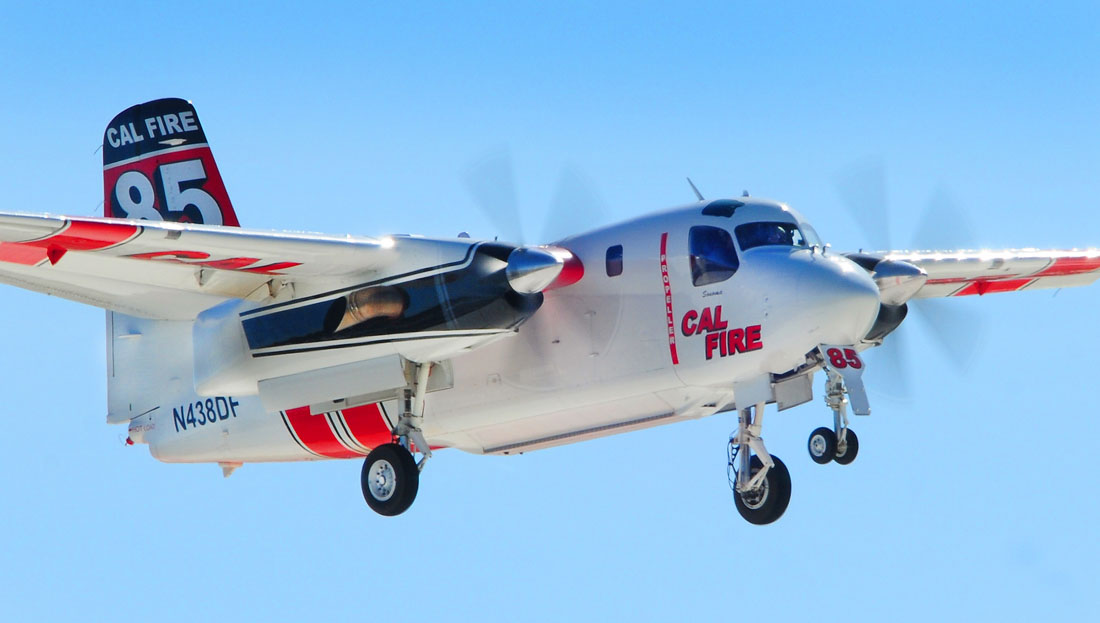 Air Tanker 85, an S-2T, at MCC, March 26, 2018. Photo by Sergio Maraschin.
 Air Tanker 23 being worked on outside the AirStrike hangar at MCC, March 26, 2018. Photo by Sergio Maraschin.
16 facts you may not know about CAL FIRE’s aerial firefighting program
The aerial firefighting program in the California Department of Forestry and Fire Protection has grown over a couple of decades into a highly respected, professionally managed organization. After spending some time at their aviation headquarters at McClellan Air Field on Thursday in Sacramento, I developed as list of 16 facts that you may not know about the program:
1. CAL FIRE has 22 S-2T fixed wing air tankers that can carry up to 1,200 gallons of retardant. They are presently converting an aircraft to replace the one destroyed in the October 7, 2014 crash that killed Geoffrey “Craig” Hunt. That process should be complete in 18 to 24 months.
 S-2T air tankers at McClellan Air Field, March 24, 2016. Photo by Bill Gabbert.
 A lineup of OV10 air attack ships at McClellan Air Field, March 24, 2016. Photo by Bill Gabbert.
 Super Huey at McClellan Air Field, March 24, 2016. Photo by Bill Gabbert.
5. The S-2T air tankers were designed to be based on aircraft carriers, and therefore have wings that fold. They still retain this feature, which makes it possible to cram more aircraft into a hangar.
 An S-2T with the wings folded. Photo by Bill Gabbert.
CAL FIRE’s aircraft lineup for 2016

The agency will have 51 firefighting aircraft working this year.
Continue readingCAL FIRE’s OV-10s grounded after prop failure

The Press Democrat is reporting that CAL FIRE grounded their 15 OV-10A Broncos Monday morning after a propeller on one of the aircraft failed while the plane was still on the ground.
Cal Fire Battalion Chief Scott McLean said mechanics had been dispatched to check on the fleet and by the afternoon five had been cleared for flying.
The OV-10s are usually used as air attack ships, serving as a platform for the Air Tactical Group Supervisor who coordinates the aviation assets working on a fire.
Some of CAL FIRE’s OV-10s are OV-10Ds that have have upgraded, more powerful engines with about 1,000 more horsepower than the OV-10A, a ramp worker at the Redding Air Attack Base told me last summer. The OV-10D has four props instead of three.
About 360 Broncos were produced between 1965 and 1986 and were retired from the U.S. military in 1995.
One of the OV-10s can be seen in the blurry webcam image at Ramona Air Attack Base.

Thanks and a tip of the hat go out to Barbara and Kirk.
An introduction to the Columbia Air Attack Base

The Motherlode website has an article about the CAL FIRE Air Attack Base at Columbia, California that is full of facts and statistics. The airport is east of San Francisco, about 40 miles northeast of Modesto (map). Here is an excerpt:
****
“Columbia, CA – The meters certainly run each time Columbia Air-Attack Base aircraft take to the skies, and this week units are in full response mode to an elevated drought-parched wildfire season, further intensified by triple-digit heat.
Ironically, just ahead of yesterday’s Big Creek Fire break out near Groveland, the Mother Lode’s first major wildfire this season, Clarke Broadcasting checked in with Columbia Air Attack Base Battalion Chief Frank Podesta about how the season is going so far. At the time, he indicated an air tanker was actively assisting the Willow Fire, southeast of Bass Lake, in Madera County, and personnel had earlier provided back up on the Lowell Fire, west of Alta, in Nevada and Placer counties.
“It’s a fire season that we had expected with the dryness and severity of the drought,” Chief Podesta remarks, a bit grimly. He adds, “Fortunately, we are getting on top of them as quickly as possible.”
Crunching Columbia Air-Attack Numbers
With so many of the base aircraft out and about, we asked how much it might cost to run those units. The chief was happy to provide some numbers to crunch. First of all, fire retardant, according to Podesta, runs $2.94/gallon for the first 100,000 gallons; $2.13 after that. As the base drops somewhere between 400,000 and 600,000 gallons per year on average, the cost for that line item runs somewhere between $933,000 and $1.4 million. By the way, he estimates, as of yesterday, the unit is “real close” to hitting that 100,000-gallon benchmark.
Built into the hourly rate for each aircraft type are their related firefighting costs, Podesta explains. Each of the two tankers, 82 and 83, cost $2,649/hour to operate and spend 180 to 200 hours in service per year. Subsequently, the average cost to operate both normally runs between $953,640 and $1,165,560 per year. At $743/hour, the Air Attack control or “spotter” plane, in use 250 to 300 hours per year, costs between $185,750 and $222,900. The unit helicopter, at $1,582/hour, which chalks up between 150 to 200 service hours per year, totals between $237,300 and $316,400.
So, annual firefighting costs, considering the above operational aircraft and fire retardant numbers, roughly ranges between $2.3 and $3.1 million per year…”
****
Thanks and a tip of the hat go out to Troy.
Aircraft at Redding, August 7, 2014
We spent some time yesterday at the Redding Air Attack Base in California and shot photos of the aircraft and will be posting them over the next few days. Here are a few to get started. Click on the photos to see slightly larger versions.
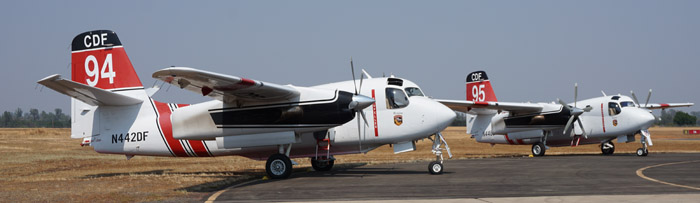


All of the photos were taken by Bill Gabbert and are protected by copyright.
Photos of aircraft at Aerial Firefighting conference

We took these photos last week, March 20, at the Aerial Firefighting conference in Sacramento. There were about 90 minutes set aside for displays of firefighting aircraft at McClellan Air Force base, as well as live demonstrations of water and water pellet drops from a helicopter, and the use of the AirTEP Airborne Tactical Extraction Platform marketed by Aerial Machine Tool. We have photos of Coulson’s C-130Q in another article.


Aircraft on the Rim Fire

Mike McMillan took these photos of aircraft working on the Rim Fire in California on August 29, 2013 for the U.S. Forest Service. Earlier we posted some photos of UH-60 Blackhawks and HH-60 Pave Hawks arriving at Columbia Airport to be used on the fire.

