
Coulson Aviation has another based in North America
Continue readingBLM evaluating Cessna Citations for air attack platform, again
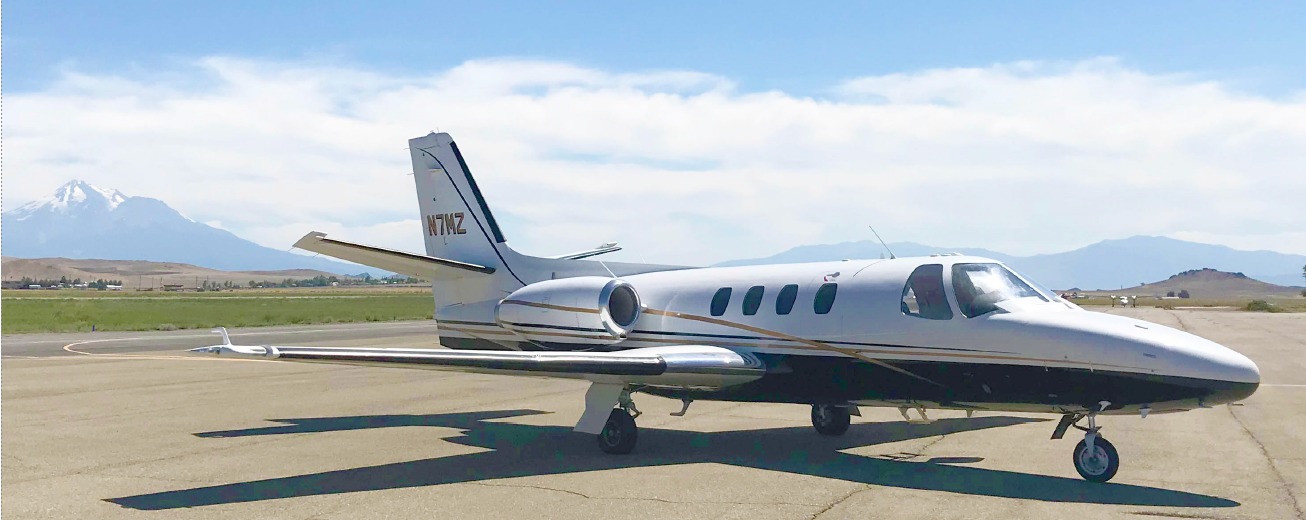 BLM contracted Cessna Citation 501, registered to Suburban Air Express, Fairbanks, AK. Air tactical group supervisor platform. BLM photo. Date uncertain; probably 2020 or 2021.
The Bureau of Land Management is evaluating the use of Cessna Citations as air attack platforms. The agency first used jet powered aircraft for air attack in 2014 when they contracted for a Cessna Citation from Dynamic Aviation to serve as a lead plane and Air Supervision Module. The following year they added two more. It was not the first time a jet had been used in a similar role. British Columbia had already been using two as Bird Dogs.
In 2014 at Boise I photographed the first one to be contracted by the BLM.
 Citation lead plane, N10R, at Boise, July 19, 2014. Photo by Bill Gabbert.
Later the jets disappeared, but last week the BLM posted an article on Facebook saying they “evaluated the Cessna Citation” in 2020 and 2021 as a platform for air tactical group supervisor. They don’t mention it being used as a lead plane.
Here is the information from the BLM:
“The Bureau of Land Management Fire program consistently strives to assess innovative tools and technology to increase safety, efficiency and overall wildland fire suppression efforts. In #FireYear2020, and again in #FireYear2021, the BLM evaluated the Cessna Citation, a staple in the business jet market. The aircraft successfully performed as an on-call contracted air tactical group supervisor (ATGS) aircraft platform for Alaska and the lower 48 with its great visibility, speed and range. For example, the aircraft flew from Fairbanks, Alaska, to Boise, Idaho – 1,660 miles – in 4 hours 40 minutes, non-stop, with remaining fuel reserves. It has a maximum altitude of 43,000 feet, cruise speed of 360 knots (414 miles per hour) and can sustain an air attack mission for 4.5 hours. These specifications are critical for wildfire suppression air operations, as wildfire suppression air attack missions are often long duration and require proficient aircraft speed, fuel efficiency and altitude safety.
“The Citation continues to accomplish missions that would otherwise not have been achieved with other aircraft. In 2021, two aircraft were used 167 days on contract with 300 hours of flight time in Alaska, Idaho, Utah, Minnesota, Oregon, Washington, and California. One of them was used specifically by exclusive use ATGS and toured bases in four lower 48 states during an evaluation period. During this period, it was evaluated by 12 exclusive use ATGS, four trainees, and visited 17 bases. The Citations have proven themselves to be a reliable aircraft with no maintenance interruptions (unavailability) over a two-year period in which they flew over 600 hours. The Citation CE-501’s performance has been lauded: it has more fuel capacity than other comparable platforms, allows 360-degree visibility for air attack personnel, and it boasts state of the art avionics.”
Southern California’s “Quick Reaction Force” of three large helicopters dispatched to Northern California
Westover Field at Jackson, CA near the Caldor Fire
Continue readingCoulson firefighting aircraft migrate from assignments in Southern Hemisphere
They were working on contracts in Chile and Australia
Continue readingOne of the two Forest Service infrared mapping aircraft has not been successfully used since November, 2018
The agency says the aircraft has an avionics problem
Continue readingDynamic Aviation’s Cessna Citation lead planes

When the folks at Dynamic Aviation saw a photo I took of one of their Cessna Citation lead planes last year, they sent me “a more recent picture” (above). They were too polite to say so, but I’m thinking the marketing department may have been uncomfortable with the photo that showed laundry hanging out of the forward luggage compartment. 🙂
Currently Dynamic Aviation, based in Bridgewater, Virginia, has the following aircraft under contract with the USFS and/or the BLM, according to Katie Dillon their Communications Manager:
- Two Cessna Citations (lead plane)
- One King Air 90 (lead plane)
- One King Air 90 (USFS Aerial Firefighting Use and Effectiveness study)
Aircraft over the North Fire

I took these photos of the television screen as Los Angeles Channel 7 was covering the North Fire — the carmeddon fire that trapped scores of vehicles on Interstate 15 in southern California, burning 22 of them.
The temperature on the screen says 76 degrees, but that must have been at downtown Los Angeles, because about that time it was 88 degrees in San Bernardino, not too far from the fire.


Video of MAFFS training with lead planes

The video below shows Modular Airborne FireFighting System (MAFFS) C-130J aircraft from the California Air National Guard’s 146th Airlift Wing conducting training drops with lead planes. The video was uploaded to YouTube July 14, 2015, but it appears that the training occurred in April in the Angeles National Forest and in Kern County, California.
The image you see before the video begins had to have been taken years ago, since it shows the original version of the MAFFS which pumped retardant out the rear ramp. In the MAFFS2 that is used today water or retardant exits the aircraft out the left side troop door.

Beginning at 3:30 you’ll see a jet-powered lead plane. This could be the Dynamic Aviation Cessna Citation CJ, N10R, that received a Bureau of Land Management Contract in 2014. In May, 2014, Aviation Week had an interesting article about the history of Dynamic Aviation. The company also has a contract for a Beechcraft King Air E90 being used as an air attack aircraft.
On July 13 N10R flew from Boise to Fort Wainwright, Alaska at 28,000 feet and 350 knots (403 mph). Flying for about 5.7 hours in three hops, it got there considerably more quickly than the Type 3 BLM helicopter on contract, N173BH, that spent four days in June flying from Rifle, Colorado to Fairbanks.
BLM awards contract for first jet-powered lead plane in the U.S.

The Bureau of Land Management has awarded a contract for the first jet-powered lead plane in the United States. Lead planes fly ahead of the much larger air tankers that drop retardant on fires. They identify the targets and evaluate the fire and wind conditions. Dynamic Aviation, with headquarters in Bridgewater, Virginia, will be supplying a Cessna Citation CJ to serve as a lead plane and Air Supervision Module (ASM) this fire season. With the jet-powered air tankers now in use, including DC-10s, BAe-146s, and MD-87s, there is a need for a lead plane that can keep up with the “next-generation” air tankers.
The Dynamic Aviation aircraft is not the first jet-powered lead plane. British Columbia currently operates two Citations as Bird Dogs, according to information we received from a spokesperson for the U.S. Forest Service.
In January the Citation was for sale at Controller.com with an asking price of $1.1 million. During the off season it will be at their headquarters, where they operate a heavy maintenance and modification center, engine shop, and a privately owned airport. The company employs over 550 people and in September of last year began construction on their fifth hangar, named Hangar E. In addition to the new (to them) Citation, they have Beechcraft King Airs and Bombardier Dash 8-100s.

Caleb T. Stitely, an account manager at Dynamic Aviation, told us that the company has a contract with the BLM to supply two additional Cessna Citations beginning in 2015.
Randall Eardley, a spokesperson for the BLM said this year the agency will have three lead plane/ASMs on exclusive use contracts (the Citation and two King Air E-90s) and a fourth one on call when needed status (a King Air E-90). All four will be supplied by Dynamic Aviation. In addition, the Department of the Interior owns a King Air BE-200 that the BLM will use for Lead/ASM operations this coming fire season.
The U.S. Forest Service owns a Cessna Citation Bravo II equipped with a system for mapping fires using infrared imaging technology. It can download the imagery in near real time once each night to infrared interpreters on the ground who use it to make maps showing the location of fires.
The BLM will also have nine Air Tactical Group Supervisor (ATGS) platforms on contract this year. Three are on contract now and the other six are still out for bid. Spur Aviation will operate an Aero Commander AC690B, and Ponderosa Aviation will also have an Aero Commander AC690B and one Aero Commander AC680T.
We are working on collecting information about the U.S. Forest Service’s fleet of lead planes and Air Tactical platforms and hope to write about that in a day or so.