Bridger Aerospace, one of the country’s largest aerial firefighting companies, is purchasing Bighorn Airways’ fleet of 12 aircraft used for smokejumping and special mission transport for government agencies. The transaction, valued at $39 million, is expected to close by the end of September, financed through a combination of cash and stock.
“This expands our aerial firefighting services to new mission critical areas,” said Tim Sheehy, CEO at Bridger. “Bighorn provides year-round logistics for the Department of Defense. From providing aircraft and flight crews in support of the smokejumper program, to flying missions in the North Pole region of Alaska, Bighorn adds to what is now the largest specialty wildfire aviation fleet in the country. We are honored to welcome Bighorn to the Bridger family.”
Bighorn Airways was founded in 1947 with three planes working aerial spray operations for local ranchers. The company grew into Wyoming’s largest aviation service provider, with aircraft and helicopter charter service, aerial spraying, and full FBO services including aircraft refueling, maintenance, and avionics service.
Based in Sheridan, Bighorn has a fleet of 12 aircraft including three Dash-8 planes (De Havilland Canada DHC-8s) with a 7500 lb. payload capacity, a range of 1200 miles, and capability of low-level flights. Bighorn also operates four Casa 212-200 and five Dornier 228-200 twin turboprops capable of short takeoff and landings.
“Mountain flying is a very demanding skill set, you got to spend years learning how to fly safely in the mountains,” Sheehy, who flies Bridger’s Super Scooper, recently told KHQ-TV. “Amphibious aviation is a very specific skill set, people will spend years learning how to be high-speed boat drivers and pilots at the same time.” Sheehy said aerial firefighting combines all those skill sets together.
Bridger Aerospace, started by Sheehy in 2014 after nearly a decade as a Navy SEAL, has contracts with agencies in both the U.S. and Canada, and has two scoopers currently at Coeur d’Alene airport flying for the Forest Service.
Bridger Aerospace CL-415EAF, from Business Insider video
In January, Business Insider spent three days with Bridger Aerospace in Mesa, Arizona, where a class of pilots and technicians trained and recertified for the 2021 fire season in the company’s signature firefighting aircraft, the CL-415EAF known as the Super Scooper.
The crews flew the $30 million amphibious air tanker as it scooped up and then dropped up to 1,400 gallons of water.
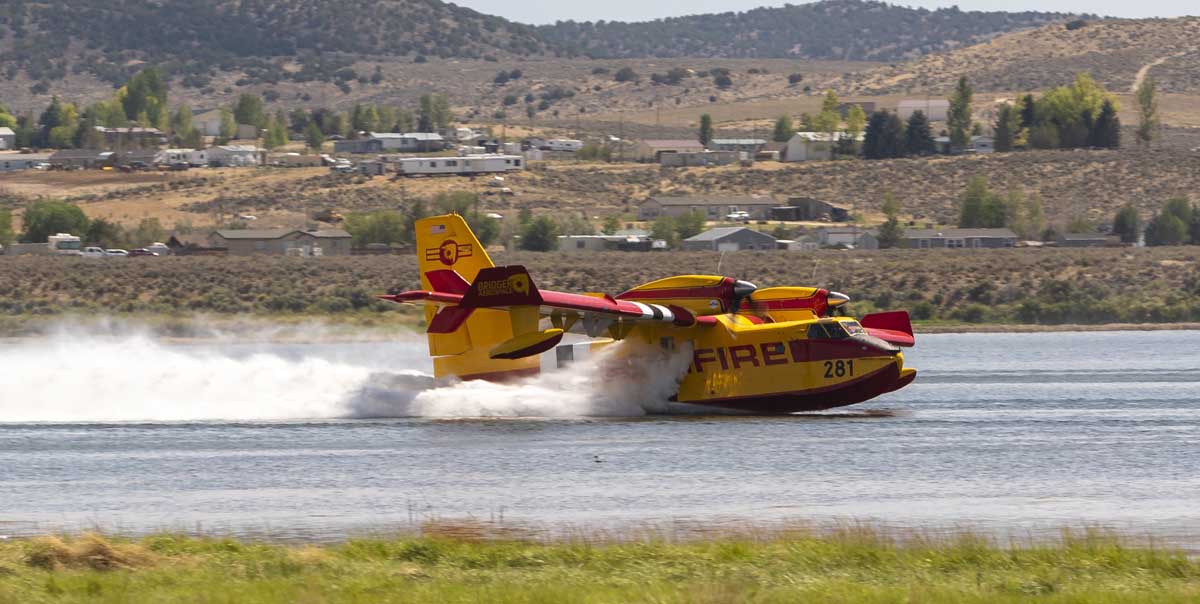
Air Tanker 281 completed over 60 water drops in support of firefighters at the Cedar Fire on its first ever mission. Photo July 21, 2020 by K Mita, Bridger Aerospace.
A CL-415EAF was used for the first time on a fire Sunday, July 19.
The first CL-415EAF was delivered to Bridger Arospace’s facility in Bozeman, Montana in April, 2020 as part of a contract that with all options exercised is valued at $204 million covering the purchase of six of the amphibious scooping air tankers.
The first use of one on a wildfire was Tanker 281 on the Cedar Fire 15 miles south of Elko, Nevada Sunday where it completed over 60 water drops in support of firefighters. The fire has burned 6,000 acres and is being fought by 8 hand crews, 10 fire engines, 2 helicopters, and various air tankers for a total of 258 personnel.
The CL-415EAF modification program consists of converting CL-215 airframes to turbines using Viking-supplied conversion kits and replacing all obsolete components. It features a new Collins Pro Line Fusion® integrated digital avionics suite, Pratt & Whitney PW123AF turbine engines, and increased water tank capacity with a higher delivery two-door water drop system. The work is done in Canada by Longview Aviation Services in collaboration with Cascade Aerospace.
Members of Bridger Aerospace and Frenchtown District Rural Fire Department. Minuteman Aviation photo by Mel Holtz in Missoula.
What started as a modest campaign to provide a couple of hundred face shields to Bozeman Health, has opened doors to assist other first responders in staying safe. In an effort to fight against COVID-19, Ascent Vision Technologies (AVT), a military defense contractor, adapted its production know-how to rapid prototyping and production of the shields. After an outpouring of gratitude and requests for more units, the AVT team is now working to produce up to an additional 5,000 units.
Its sister company, Bridger Aerospace (BA), an Aerial Firefighting company based in Belgrade, Montana, with its fleet of 14 airplanes (mix of Aero Commanders, Kodiak 100’s, and a CL-415EAF), can bypass commercial shipping channels to deliver equipment and personnel on-demand. An opportunity to fulfill a request made by the Frenchtown FD presented such an occasion. The Bridger team used their newly acquired Daher Kodiak 100 to hand-deliver 30 units to a Fire Department crew based in Frenchtown, Montana.
Tim Sheehy, CEO, has pledged to assist any other first responders in need. So far, BA and AVT have delivered over 300 shields to Bozeman Health and first responders and will be delivering masks to other fire departments and healthcare professionals across Montana.
Bridger Aerospace was in the news last month when it was announced they would be acquiring six CL-415EAF scooping air tankers. Longview Aviation in collaboration with Cascade Aerospace, is upgrading Canadair CL-215 air tankers to become CL-415EAFs.
Above: German Army Sikorsky CH-53G Super Stallion (reg. 84+99, sn V65-97) at ILA Berlin Air Show 2016. By Julian Herzog.
There is discussion underway in Germany about the need for additional aircraft for battling vegetation fires. Their military presently has access to numerous CH-53G Sea Stallion helicopters after having purchased 110 in the early 1970s. The huge aircraft can carry water in an external bucket but not all of the military pilots are trained in dropping water on wildfires.
Below are excerpts from a very rough automatic computer translation of an article at the Cockpit website in Germany.
“…According to the European Commission, in 2016 it burned 777 times in Greece, 608 times in Germany. Portugal had 13,261 fires in most European fires, with 8,717 fires behind Spain. According to the German Fire Brigade Association (DFV) was a situation, such as in Greece, but hardly possible. This is because of the different type of vegetation and the preventive measures such as fire cutting. In international comparison, Germany also has a very strong fire brigade with over one million firefighters. There are also more access roads and hydrants in the forest than in Greece, for example. That’s right. But Harald Ebner, Greens Bundestag spokesman for forest policy, nevertheless pleads for extinguishing aircraft, although they may not be needed as often as in other states. “For the possible case of large forest fires it needs sufficient specialists and good equipment, for example with airplanes,” he said.
“Harald Ebner is pushing for a speedy deployment of a squadron with multiple surface aircraft, not only to protect German forests and agricultural areas, but also to provide other countries with the necessary support if needed. Experts even assume that countries like Sweden and Poland could share the costs of a permanent task force with Germany. A service water airport in Brandenburg or Mecklenburg-Vorpommern seems to be the most suitable. The only current handicap: amphibious aircraft may only take off and land in a few German waters. Here, the legislature would first be obliged to make special arrangements, even if it is a matter for the Länder.
“Soon CL-515 in use?
“An airfield in British Columbia is home to eleven used but under-used CL-215 aircraft, which will now receive new Pratt & Whitney turboprop engines and new avionics. The first so-called CL-415EAF Enhanced Aerial Firefighter is to be delivered before the forest fire season 2020 to Bridger Aerospace in US state of Montana. The aviation service provider Viking Air, which specializes in fighting forest fires, has ordered six aircraft. But since most of the CL-415’s, which have been in operation for a long time, are also used in the Mediterranean countries, Viking Air now wants to decide on possibly introducing a new edition of the Canadair firefighting aircraft at the end of this year to be named CL-515.”
On July 11 the Bureau of Land Management activated one of the new CWN drones to map the HUGE Martin Fire that has burned 435,000 acres in Northern Nevada. The company that got the call was Bridger Aerospace, an outfit that also had nine Aero Commanders under contract for Type 1 Air Attack services, used as a platform for coordinating airborne firefighting aircraft. Drones, for Bridger, is a new field, and they have partnered with Silent Falcon UAS Technologies for the use of their Silent Falcon drone.
July 7 was a big day on the Martin Fire.
During its first day on the fire, today, July 13, it has conducted four sorties for a total of 5.6 hours, according to Gill Dustin, the Unmanned Aerial Systems Manager for the BLM. The aircraft is being used to map unburned islands inside the perimeter, look for remaining heat on the fire and outside the fireline, and identify structures and other infrastructure to determine if they have been damaged or not. The company brought four aircraft to the fire, but so far are only using one at a time.
Infrared photo taken by Silent Falcon UAS with Ascent Vision CM-100 Gimbal. Credit: Bridger Aerospace. Screen capture with incident map on the left. Camera keystone (field of view) is the red cone on the right side of the aircraft. Credit (Bridger Aerospace). Camera view is on the right.
The BLM has secured from the FAA an Emergency Course of Action (ECOA) to enable the aircraft to operate within the Temporary Flight Restriction. Kurt Friedemann, Vice President of Bridger Aerospace, said that on the Martin Fire it has been flying at 8,000 feet, which in that area is about 3,000 feet above the ground.
The Silent Falcon is powered by an electric motor drawing its power from a battery. But there are also solar panels on the wings which can add a small amount of additional power to the battery while in flight. With the fuselage made of carbon fiber, it is quite light and energy efficient. Mr. Friedemann said that occasionally the aircraft can take advantage of thermals, like a glider, to extend the amount of time it can loiter over a target. Normally they expect to get at least 5 hours of flight time out of the aircraft. It is launched on a spring-loaded catapult, and has no landing gear. It lands via parachute — upside down to protect the payload. The entire system can be transported in a pickup truck.
File photo of a Silent Falcon drone. Image credit: Silent Falcon UAS Technologies
The payload can be changed to meet the needs of the end user, but for this mission it has electro-optical and infrared sensors.
On the Martin fire, which is almost 60 miles long east to west, the Silent Falcon is operating out of line of sight, which puts it into a different certification category than your typical consumer drone.
To integrate the drone into the management of the incident there are two critical positions that are filled by the incident — an Unmanned Aerial Systems (UAS) Manager and a Data Specialist. The manager helps to integrate the system into the Incident Management Team structure. A drone, especially while live-streaming video, can generate a crap-ton of data. Managing that can be problematic if it’s not figured out in advance and carefully curated as it is collected.
Mr. Friedemann said that just 10 days ago they completed 7 days of training for personnel and carding for the aircraft in West Wendover, Nevada. And now they have their flight crew spiked out miles from the Incident Command Post in one of the most sparsely populated areas of the United States.
Yesterday, the “Silent Falcon”, an Unmanned Aircraft System (UAS) launched for the first time over a wildfire. The UAS will be used for more detailed mapping of the #MartinFire, as well as evaluation of the resources and perimeter. For more information: https://t.co/tDl4ySYnobpic.twitter.com/7hCvQpyqGs
— Bureau of Land Management- Nevada (@blmnv) July 14, 2018
The Department of the Interior is continuing their very aggressive movement into the world of drones. They have held training sessions to get scores of employees certified to operate the devices and are advertising and awarding contracts for call when needed (CWN) drone vendors. The Department has recently published at least four solicitations, awards, or special notices about drones and unmanned aerial systems.
One of them was a justification to skip the process of accepting bids from multiple vendors and so they could
3DR Solo Drone
issue a sole source contract to buy 56 of the 3DR Solo drones (Quadcopters) and associated equipment. We have seen a version of the aircraft with a gimbal but without a camera listed for around $2,000.
Below is information from the Department of the Interior dated May 15, 2018:
BOISE, Idaho – As part of a broader strategy to aggressively combat wildfires, the U.S. Department of the Interior has awarded a Call When Needed contract to four U.S. companies for small-unmanned aircraft systems services. The contract, which is Interior’s first of its kind, will allow the agency to obtain fully contractor-operated and maintained small drones that are ready when needed to support wildland fire operations, search and rescue, emergency management and other resource missions in the Contiguous 48 States and Alaska.
“This contract reinforces our commitment to partnering with industry to provide our employees with the latest technology in carrying out their responsibilities as stewards of our nation’s public lands while also ensuring their safety is paramount,” said U.S. Secretary of the Interior Ryan Zinke. “This capability is key to implementing our new and aggressive approach to combatting the threat of large wildfires that I outlined in my Wildland Fire Directive last September.”
The award follows a lengthy process to develop mission performance requirements and select a range of experienced commercial providers to meet this need. Companies receiving awards included, Bridger Aerospace of Boseman, Montana, Insitu of Bingen, Washington, Pathways2Solutions of Nashville, Tennessee and Precision Integrated of Newberg, Oregon.
“As the recognized leader in the application of unmanned aircraft technology in natural resources, wildland fire, and land management applications, we look forward to supporting our Interior bureaus’ needs and those of our interagency partners with this first-ever contracted small-unmanned aircraft systems resource,” said Deputy Assistant Secretary for Public Safety, Resource Protection, and Emergency Services Harry Humbert. “This strategic contract capability compliments the division and tactical level capabilities of our fleet vertical take-off and landing fixed wing and quadcopter small-unmanned aircraft systems, providing critical enhancements to firefighter safety and effectiveness.”
The contract consists of one base year with four option years. The total potential contract value is $17 million. Aircraft selected under the contract will be able to operate day or night, without a runway in sustained winds up to 25 knots and at altitudes consistent with typical western wildfire environments.
“These contracted small-unmanned aircraft systems will supplement the manned firefighting fleet by providing the capability to operate during dense smoke/inversion situations which often occur and have heretofore hampered the aggressive prosecution of destructive wildfires,” said Jeff Rupert, Director of the Office of Wildland Fire. “Infrared/thermal camera technology onboard these small-unmanned aircraft systems can penetrate smoke and gather/disseminate information to deliver critical situational awareness for incident commander. These sensors also provide us with the first real opportunity to collect, analyze, and archive relevant wildfire suppression and retardant outcome data since aerial suppression began in 1930.”
“Interior has a long history of collaborating and partnering with industry to provide our field and fire personnel with safe, effective, and cost-efficient commercial air services to meet unique mission needs,” said Interior’s Office of Aviation Services Director, Mark Bathrick. “Historically, nearly 70 percent of our manned aircraft missions are supported through commercial air services contracts. The capabilities of these contractor operated small-unmanned aircraft systems will provide our scientists, land managers, emergency managers, and firefighters with additional capacity to obtain enhanced sensing, increase employee and public safety, realize cost savings, and service Interior’s diverse and dynamic mission requirements more responsively. This new capability fulfills another important element in Interior’s Unmanned Aerial Services Integration Strategy.”
Like their Interior small-unmanned aircraft systems fleet counterparts, these aircraft will operate from within the Temporary Flight Restrictions established over most large wildfires. This will enable them to take advantage of Interior’s unique authorities from the Federal Aviation Administration to operate beyond visual line of sight—a critical capability in the smoky wildfire environment. Their longer endurance will provide incident commanders with near real-time access to critical fire boundary, behavior, and hotspot location, enabling them to make faster, more informed decisions than in the past. In conjunction with the tactical and division level fleet small-unmanned aircraft systems Interior has already integrated into the wildland fire environment, these aircraft will enhance firefighter safety through the identification of emerging changes in fire behavior and escape routes.
Interior is currently working to bring small unmanned aerial systems to the hazardous aerial ignition mission, which over the last 13 years has resulted in the loss of two contracted helicopters and five lives. Future initiatives include the continued development of optionally-piloted helicopter technology developed by the Department of Defense to enable safe and effective use suppression of fires during the approximately 16 hours each day when night and reduced visibility currently prevent aerial support. Historically, 20 percent of all wildfires are discovered outside periods of traditional aviation support. Interior believes tripling the amount of active aviation support time on wildfires will have game changing benefits in reducing the time, area, and cost to contain wildfires.