One of the DC-10’s, Tanker 910, visited Rapid City today. On the way back from scheduled maintenance in Michigan, they still have two more stops scheduled for Wednesday, April 24, before they head home to California. These times are approximate and subject to change.
Billings, Montana, 10 a.m. to 1 p.m.
Missoula, Montana, 2 p.m. to 4 p.m.
These photos were taken by Bill Gabbert. Click on them to enlarge.
DC-10 air tanker Captains Jack Maxey (left) and Kevin Hopf will pilot the aircraft to four cities in the United States this week. (Photographed for TheAge by Paul Rovere in Victoria, Australia, December, 2009.)
The schedule for the visits of Air Tanker 910 to airports in Minnesota, South Dakota, and Montana that Wildfire Today told you about last week has been revised due to snow at Rapid City. (An air tanker should not have to suffer the indignity of de-icing.)
The revised schedule for the DC-10 operated by 10 Tanker Air Carrier is as follows, but keep in mind that the times are approximate, subject to change, and could vary by up to 30 minutes or so. All times are local.
Tuesday, April 23
Brainerd, Minnesota, 10 a.m. to 1 p.m.
Rapid City, South Dakota, 2 p.m., and departing the next morning
Wednesday, April 24
Billings, Montana, 10 a.m. to 1 p.m.
Missoula, Montana, 2 p.m. to 4 p.m.
At this time there are no planned tours for the public, but they may be able to see the DC-10 through a fence or from other locations.
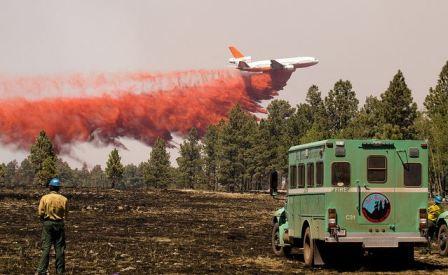
Tanker-911, a DC 10 airtanker, drops retardant on the Wallow fire above Greer, AZ, as the Del Rosa Hotshots wait in a safety zone, June 11, 2011. USFS photo by Kari Greer
Over at Wildfire Today there is an article about plans for one of the DC-10 Very Large Air Tankers to visit airports in Minnesota, South Dakota, and Montana next week.
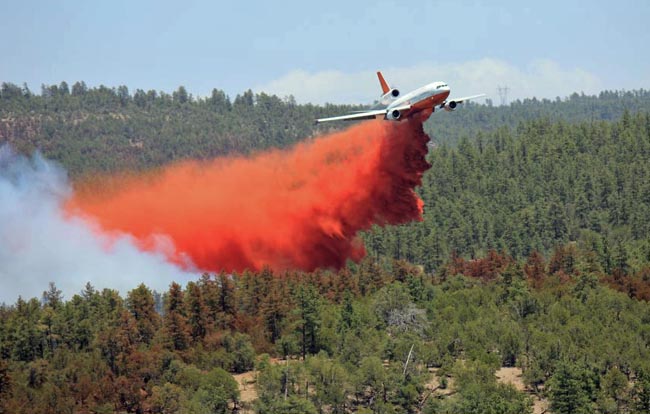
Tanker 911 dropping on the Poco Fire in Arizona, June 15, 2012. Photo by Ian James.
UPDATED at 12:19 p.m. Monday, April 22, 2013:
The schedule for the visits of Air Tanker 910 to airports in Minnesota, South Dakota, and Montana described below has been revised due to snow at Rapid City — everything is being pushed by 24 hours. More details at Wildfire Today.
****
One of the DC-10 Very Large Air Tankers will visit airports in Minnesota, South Dakota, and Montana next week. Air Tanker 910, owned by 10 Tanker Air Carrier, has been in Michigan undergoing heavy maintenance in recent weeks and will leave from there Monday morning, April 22 and head west. On their way home in southern California, their plans are to stop at four cities:
Brainerd, Minnesota, Monday morning;
Rapid City, South Dakota, early Monday afternoon;
Billings, Montana, Tuesday;
Missoula, Montana, Tuesday.
If a DC-10 reloaded at Rapid City it would have to be from a portable retardant base, since it is unlikely that the existing rather cramped Tanker Base could support such a large aircraft, and possibly the weight would be more than the ramp could handle. Rick Hatton, President of 10 Tanker Air Carrier, told us that if they worked out of Brainerd the aircraft would most likely drop water, rather than retardant. Finding a fire hydrant within reach of the three-inch diameter hose the aircraft carries can be easier than accessing a Tanker Base.
The DC-10 always carries 11,600 gallons of fire retardant, about six times more than the 50+ year old Korean War vintage P2V “legacy” air tankers that drop an average of 1,948 gallons according to a 2007-2009 air tanker study.
The U.S. Forest Service has awarded exclusive use contracts for seven P2Vs and one BAe-146 air tanker for 2013. The agency has not yet announced any awards from the solicitation for “next-generation” air tankers they issued 505 days ago. There are indications they will give contracts to 7 next-gen air tankers, bringing the total number of air tankers to 15 for this year. In 2002 there were 44 large air tankers on exclusive use federal contracts. The USFS has said they may again borrow, if needed and available, some old CV-580 air tankers from Canada for a few months that carry 2,000 gallons of fire retardant. The CV-580s were produced between 1947 and 1954.
10 Tanker Air Carrier issued a statement Monday on their Facebook page about the bid protests that they, along with Coulson, filed over the contracts for next generation air tankers that the U.S. Forest Service announced that they were going to award last summer. The company has two DC-10 air tankers that carry 11,600 gallons of retardant, about six times more than a P2V, but they were not going to receive exclusive use contracts for the aircraft. The USFS had to cancel the process just before the contracts were signed. Four months later the solicitation was reissued with 31 changes, requiring responses by November 1, 2012.
The DC-10 air tankers have received excellent reviews from firefighters and aviation managers, but the USFS has in the past only offered them call when needed contracts, meaning they may or may not be used at all, and if they were, it would be intermittently.
10 Tanker’s statement appears to be partially in response to Colorado Senator Mark Udall’s remarks on the issue Thursday, in which he suggests that the protests may be ignored (emphasis added):
Mark Udall, who serves on the U.S. Senate Energy and Natural Resources Committee, urged private contractors to respect the U.S. Forest Service’s upcoming decision to award contracts to several U.S. companies to supply next-generation air tankers. Protests and challenges of past contract awards have already delayed the Forest Service’s acquisition of seven next-generation air tankers — which Udall championed last year. Additional protests could leave Colorado and the West without these tanker resources for the 2013 wildfire season.
“Air tankers are critical firefighting resources that can save lives and prevent small blazes from becoming catastrophic wildfires,” Udall said. “When I met with Northern Colorado firefighting and emergency-management officials this week, they all agreed that we need to ensure that Colorado and the Forest Service have the resources they need to fight fires now. If contractors continue to challenge agency decisions, I will urge the Forest Service to use its emergency authorities to override the challenges and finalize the tanker contracts as soon as possible. Colorado cannot wait.“
Below is the text from 10 Tanker’s statement:
A widely published Associated Press article recently related the story of the long-term decline in the U.S. Forest Service’s aerial tanker fleet to the Next Generation Air Tanker solicitation bid protest last year by 10 Tanker Air Carrier and another bidder. Some members of Congress have expressed support for Forest Service to use emergency authorities to work around the bid protest. What the article omits and members of Congress may not realize is that it was the General Accountability Office (GAO) that found the 10 Tanker bid protest to be valid. That caused the US Forest Service to withdraw from the bid protest process, to amend the solicitation to correct its discriminatory issues, and to reissue the solicitation.
As you may know, GAO is the investigative arm of Congress “charged with examining matters relating to the receipt and payment of public funds.” As a part of that responsibility, GAO is also charged with handling bid protests, but they do not undertake that role unless there is obvious discrimination in an agency’s contract decisions. In this case, they found that the Forest Service used a decision process that discriminated against 10 Tanker Air Carrier. The issues involved cost basis in which 10 Tanker clearly offered the lowest cost per gallon of retardant delivered on fires, and also involved the USFS use of outdated, third party input that, had the well-known facts been used, would have been in 10 Tanker’s favor.
Had 10 Tanker’s bid been awarded, we could have provided the same protection to the public with four aircraft this 2013 wildfire season that is the equivalent of 15 – 16 competing aircraft that will not be available for use for several years.
10 Tanker wholeheartedly agrees that responsible leaders, including the Chief of the USFS, should use emergency procedures and resources to protect the public in an emergency. However, we discourage the declaration of an emergency as a means of providing a long-term solution to this on-going issue. We are confident it will be resolved within the next several months and thank you all for your support as we move closer to the upcoming fire season.
****
It has has been 1 year, 2 months, and 25 days since the USFS first issued a solicitation for next-generation large air tankers, but no contracts have been awarded.
A still image showing Evergreen’s 747 “Supertanker” dropping on a fire (from the video below).
The video below which shows dozens of air tanker drops is very interesting. Most of the video was shot from a lead plane, with views rarely seen by most of us. The technical quality of the video is not great — low resolution and a little shaky — but it’s very worth viewing. Occasionally you can see the smoke generated by a BLM lead plane which marks the target for the air tanker.
Some of the aircraft include: P-3, P2V, S2T, DC-10, C-130 MAFFS, and an air tanker that is very rarely seen, Evergreen’s 747.
DC-10, Tanker 911, departing McClellan. Photo by Nate Allen
The managers of the Facebook page for the DC-10 air tankers have organized a petition drive designed to convince the US Forest Service to award a long-term contract to 10 Tanker Air Carrier, the company that owns the aircraft.
We checked, and the way the petition works is that you complete a form at the site, submitting your name, address, and email address. You can edit the text if you want, part of which includes this:
…For the health of our forests and the safety of our citizens, I urge you to offer a long-term contract to 10 Tanker Air Carrier….
Then it is converted to an email that is sent to Tom Tidwell, Chief of the USFS at his publicly listed email address. Your name and address will appear in the signature of the message.
10 Tanker Air Carrier will retain your name and email address and may use it, according to the company, to “send an e-blast no more than once/month with news, updates etc. Supporters can unsubscribe at any time. Contact information is kept strictly confidential and will NOT under any circumstances be shared or sold to any other party.”
The most recent request for proposal (RFP) for exclusive use contracts for next-generation air tankers had a response due date of November 1, 2012 and awards based on the submissions could be announced within the next few months. So while the USFS is pouring over the submissions from the air tanker companies, 10 Tanker Air Carrier hopes to influence the decisions that are being made by the federal government either on that RFP or those that may be issued in the future.
It does not appear that the USFS will award any contracts for very large air tankers (VLAT) like the DC-10 on this most recent RFP and will most likely limit the awards to smaller “next-generation” air tankers that have a capacity of 2,400 to 5,000 gallons. However the agency has issued a “request for comments” on a draft VLAT RFP for call when needed aircraft only. The two DC-10s operated by 10 Tanker Air Carrier carry 11,600 gallons.
The US Forest Service has not been interested in offering long-term exclusive use contracts for very large air tankers like the DC-10 or 747, and have only made call when needed contracts available.
Williams Fire, Sept 2, 2012. Photo by 10 Tanker Air Carrier
The Williams Fire started in San Gabriel Canyon north of Azusa in southern California Sunday afternoon and through the afternoon and evening grew to 3,600 acres. The origin was between Camp Williams and the shooting range along East Fork Road in San Gabriel Canyon about 3.5 miles east of Highway 39. A map showing the location of the Williams fire is below.
Map of Williams Fire. The red circles represent the location of heat detected by a satellite. Sept. 2, 2012. MODIS (click to enlarge)
San Gabriel Canyon, which will be closed on Monday, Labor Day, typically sees over 10,000 visitors on a holiday weekend.
At least 300 personnel are assigned to the fire, as well as 9 air tankers, 4 helicopters, 30 engines, 2 dozers, and 4 hand crews. It is moving north through very steep terrain toward the Sheep Mountain Wilderness area. As of 2 a.m. Monday morning the fire was listed as 5 percent contained.
All of the photos below were taken by the crew on Air Tanker 911, a DC-10 which earlier on Sunday was repositioned from Casper, Wyoming where it had been based while working the fires in Nebraska, to Sacramento. From Sacramento it was dispatched to this fire, and Sunday night was at San Bernardino. The second DC-10, T-910, was recently released from their Call When Needed contract and sent home.
Williams Fire, Sept 2, 2012. Photo by 10 Tanker Air Carrier Williams Fire, Sept 2, 2012. Photo by 10 Tanker Air Carrier
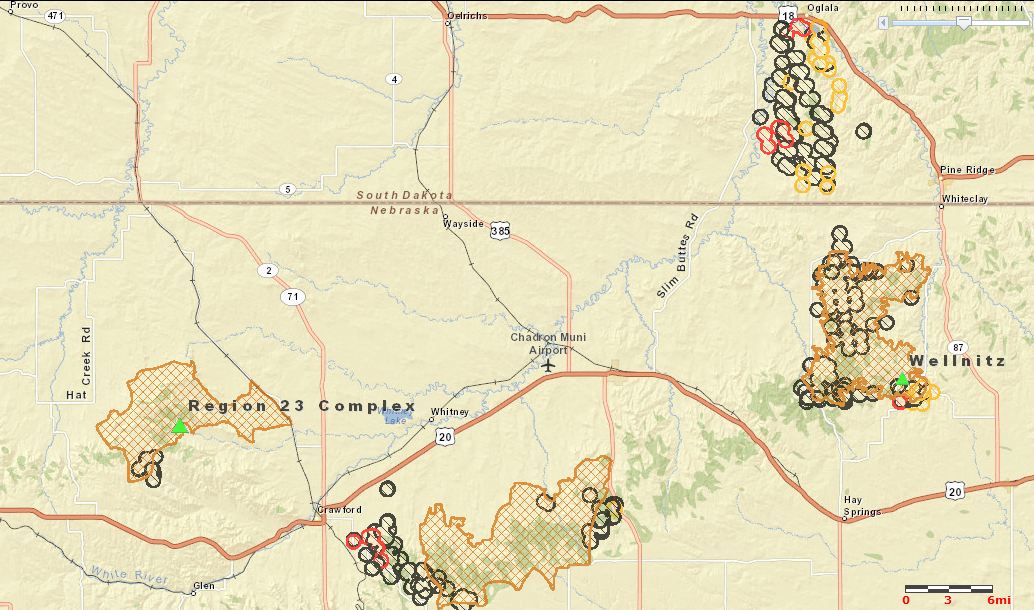
Map of fires in northwest Nebraska and southwest South Dakota, 1:22 a.m. MT, Sept 2, 2012. The brown cross-hatched areas are the latest fire perimeters uploaded by the Incident Management Teams. The small circles represent heat detected by a satellite in the last 24 hours, with the red and yellow circles being the most recent. GEOMAP and MODIS. (click to enlarge)
Firefighters are making progress on the two large fires in the Region 23 Complex that are south and west of Chadron, Nebraska, comprised of the Douthit Fire northwest of Crawford and the West Ash fire southeast of Crawford and south of Chadron.
The Chadron Record reported that Incident Commander Joe Lowe said in a public meeting Friday that the Douthit Fire has a control line around it but could still be susceptible to growing larger if strong winds become a problem.
The Chadron Record also had this interesting bit of information:
Crow Butte [uranium] Mine near Crawford has also been shut down and evacuated, and Lowe said the team is strategizing how to handle the potential hazardous material situation should the fire advance that far. The blaze is currently three to four miles from the mine.
The more active of the two fires, the West Ash Fire, has come close to Highways 385 and 20, requiring the temporary closure of 385. One of the DC-10 air tankers dropped at least three 10,600-gallon loads of retardant near the highways.
The Wellnitz Fire northeast of Chadron has burned about 60,000 acres in Nebraska and South Dakota.
The information below about the Region 23 Complex was sent to us at 10 p.m. September 1 by Beth Hermanson, Public Information Officer for the Rocky Mountain Incident Management Team C:
Region 23 Fire Complex has burned 87,555 acres and is 47% contained as of this evening. Significant progress was made on the Douthit Fire today, while West Ash remains active.
The Douthit Fire crews took advantage of yesterday’s temperatures to complete burnout operations to help secure containment lines. Firefighters worked on constructing and strengthening line, and focused mop up around structures and near the fire line, while mitigating risks.
The West Ash Fire remained active as firefighters worked on constructing and strengthening fire lines which were tested throughout the day by high erratic winds. Significant indirect efforts to provide extra protection to the city of Chadron were completed, including drops from the DC-10 Very Large Air Tanker, (VLAT) of 36,000 gallons of retardant, and heavy equipment completed lines around each home.
Near Crawford, fire officials successfully completed a five-mile burnout operation to help reinforce containment lines.
Resources continued to arrive throughout the day, with a reported 658 personnel now dedicated to the Region 23 Complex. To date, there have been no firefighter injuries.
Fire crews anticipate a busy night operational period with changing weather conditions. A cold front is expected to move in this evening, likely preceded by strong erratic winds and a thunderstorm. The Incident Management Team prepared by staffing a significantly larger night operation shift. Crews plan to take advantage of the predicted cooler temperatures and increased relative humidity to make significant progress on containment, and to continue burnout operations.
EVACUATIONS: Fire and Law Enforcement Officials strive to return evacuees’ home as soon as possible; meanwhile the following evacuations continue mandatory, including:
Residents living west of Highway 385, and south of Highway 20, Highway 385 to Hawthorne Road and all areas north of Buttermilk Road to Highway 20; including Country Club Road, Old County Club Road, and Goffena Road. This also includes Deadhorse Road to Table Road and Flag Butte Road.
Residents living on Highway 385 between Chadron City Dams and Red Cloud Camp area, both the east and west side.
Crawford area residents living from the West Ash Road south on Highway 2 for five miles, across Breakneck Road, east to West Ash Creek Road; including West Ash Creek Road, Squaw Creek Road, Saw Log Road, Horseshoe Road, Breakneck Road, Dyer Road and Crow Butte Road.
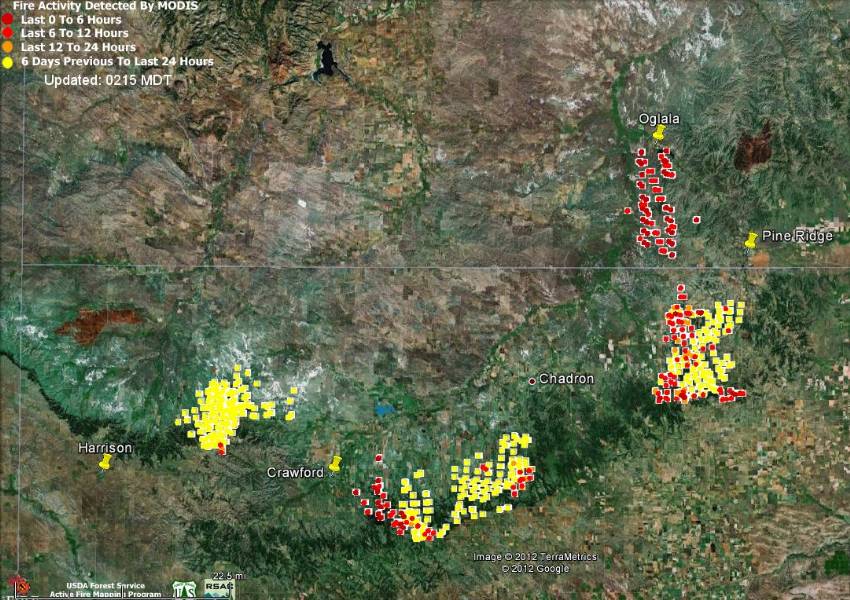
Northwest Nebraska and southwest South Dakota fires, 10:01 pm MT, August 31, 2012 (click to enlarge)
UPDATE at 11:47 a.m. MT, September 1, 2012:
What we thought were four major fires in the northwest Nebraska and southwest South Dakota areas are actually three. The large fire near east of Chadron, northwest of Pine Ridge, and south of Oglala, named Wellnitz, is just one VERY large fire that burned from Nebraska into South Dakota. If you notice the gap in the heat icons at the white SD/NE state line southwest of Pine Ridge, the fire must have burned very quickly through some light vegetation and burned out, between passes of the heat-sensing satellite. The MODIS satellite passes over most areas of the world two to three times a day on an irregular schedule.
The two fires nearest Crawford are part of the Region 23 Complex. Here is an update from InciWeb, which was updated at about 12:30 p.m. MT today:
More than 68,689 acres have burned in the Region 23 Complex fire in northwest Nebraska accordingto Rocky Mountain Incident Management Team C officials.
The complex consists of two fires the West Ash Fire near Chadron and the Douthit Fire near Crawford. The fires started by lightning, Aug. 28. Containment of the fires is estimated at 25 percent. West Ash accounts for 44,354 acres and the Douthit fire has burned 24,335 acres. The fires did not grow overnight.
The fires are in rugged inaccessible terrain burning ponderosapine and grass. Red flag warning is expected to continue,possibly for the next three days. Fire fighters worked through the night preparing areas of the fire likely to be affected by potential high winds over the next couple of days.
The InciWeb site also has information about evacuations.
Five Nebraska National Guard helicopters are assisting with the fires. Models being used include CH-47 Chinook, UH-72 Lakota, and UH-60 Blackhawk.
The weather in the area is very conducive to rapid fire spread. A weather station south of Chadron at 11:22 a.m. today recorded a temperature of 89, relative humidity of 13 percent and a wind speed of 21 gusting to 40 mph.
One of the DC-10 very large air tankers dropped retardant on the fires today and yesterday, and is most likely reloading at Casper, Wyoming with 10,600 gallons of retardant with each flight. Casper is 133 miles from the fire near Harrison, not a long flight when cruising at more than 500 mph. The aircraft dropped three loads of retardant Friday and Saturday on the West Ash fire, totaling approximately 34,000 gallons.
Neptune’s Tanker 40, a jet-powered BAe-146, filed a flight plan to travel from Missoula to Rapid City, and is expected to arrive there at about 3:30 MT today. It is likely that it will also be working on these fires. Maybe someone will send us a photo of it or the DC-10 assisting the firefighters on the ground.
Originally posted at 4:06 a.m. MT, September 1, 2012
We will write more about this later, but now there are four major wildfires burning in northwest Nebraska and southwest South Dakota. The MODIS heat sensing satellite is showing detections in a new area in South Dakota, south of Oglala and northwest of Pine Ridge.
We had more information about the Nebraska fires earlier, including a fatality that may be related to the fires, and Inciweb has information about evacuations.