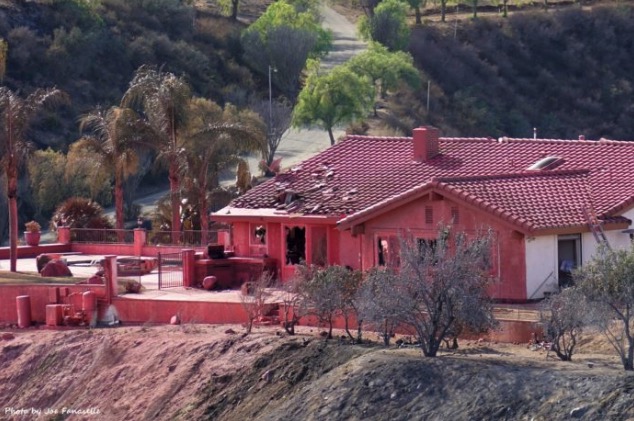
On May 20, 2019 officials within the US Forest Service and the Department of the Interior released a Safety Alert regarding the safe height for retardant drops. This could be related to the fatality following a drop by the 747 Very Large Air Tanker on the Ranch Fire in 2018 east of Ukiah, California, the drop by a DC-10 VLAT on the Liberty Fire in 2017 that damaged the roof and knocked out windows in a home and vehicle east of Murrieta, California, and perhaps also a drop by an MD87 in 2018 on the Boxcar Fire near Maupin, Oregon.

Subject: Retardant Safe Drop Height
Area of Concern: Safety of Ground Personnel
Distribution: All Fire Aviation Operations
Discussion: The optimum release height or safe drop height for fire retardant can be defined as the distance below the airtanker at which the retardant begins to fall vertically (Figure 1). When the retardant is dropped, the velocity of the aircraft is imparted to the retardant. In other words, the retardant is traveling at the same speed as the aircraft. When the retardant has lost all of its forward momentum and is falling vertically as a heavy rain, the danger to firefighters is reduced and effectiveness is increased.
 If a Very Large Airtanker (VLAT) is traveling at 150 knots and is well below the recommended safe drop altitude, the 8,000-19,000 gallons of retardant released will impact the earth at a similar velocity. If personnel are underneath the retardant pattern, they can be struck with the fast moving retardant, broken trees, other debris, or all of it. ¹Figure 2 shows a drop that was released below the safe drop height maintaining considerable velocity as it reached the ground. The force of the retardant dropped from too low of an altitude can topple trees up to 90 feet in height and a trunk a foot in diameter.
Page 2
Drop Safety Considerations
- Aerial drops are hazardous and caution should be used when working in areas with aircraft operations. Serious injury and/or property damage can occur from any excessively low tanker drop, including S2’s and SEATs.
- The Red Book, Interagency Aerial Supervision Guide and the Interagency Incident Response Guide all have slightly different verbiage, but basically state that the Aerial Supervisor/ASM/Airtanker pilot and the identified ground contact/personnel must ensure all fireline personnel are notified of impending aerial drops (fixed wing and rotary wing).
- Pilots must ensure that they have received confirmation that all people and moveable property have been cleared prior to commencing drops of any fire-fighting agent (water, foam, retardant or gel).
- Pilots must ensure they do not drop below a safe drop height. This becomes more difficult in mountainous terrain or if the aircraft is not equipped with a radar altimeter so it’s imperative that pilots develop the site picture and practice proper technique for the appropriate drop height for their respective aircraft.
- Pilots must remember that lower is not always better. Drops that are too low fail to provide retardant in an efficient manner with the desired coverage level. This is not only dangerous, but fails to provide the support ground crews require.
- Fireline personnel must maintain situational awareness. Personnel who are using cell phones to video the aerial retardant drops can easily become distracted by recording the retardant drops which impairs their ability to recognize the hazards and take appropriate action should it be necessary (Figure 3).
- Keep in mind that a pilot will, at any time, jettison the entire load quickly during an in-flight emergency.
Firefighting is not a spectator sport. Be alert, be ready, be safe.
(The document was signed by Keith Raley, Chief, Aviation Safety, Training, Program Evaluation, and Quality Management for the DOI Office of Aviation Services; and by Sean Aidukas, Acting Branch Chief, Aviation Safety Management Systems, US Forest Service.)
1. Firefighter Injuries and Fatality, CAL FIRE GREEN SHEET, August 13, 2018. 18-CA-MEU-008674, 18-CA-MEU-009504. References: Incident Response Pocket Guide, NWCG, April 2018. Greg Lovellette, Safe Drop Height for Fixed-Wing Airtankers, March 2000; PMS 505: Interagency Aerial Supervisors Guide, April 2017; Interagency Standards for Fire and Fire Aviation Operations (Red Book) January 2019.