
The crew declared an emergency and landed at Midland, Texas
Continue readingVideo found of another engine failure on an MD87 air tanker
Chico, California, November 8, 2018
Continue readingVideo found of air tanker takeoff as an engine failed
It occurred at Coeur D’Alene, Idaho in 2018
Continue readingVideo surfaces of engine failure on air tanker during takeoff
Coeur D’Alene, Idaho in 2018
Continue readingMD-87 airtanker experiences engine failure after takeoff

Above: Tanker 101, showing the added external tank, December 12, 2017 at Rapid City Airport. Photo by Bill Gabbert.
(Originally published at 8:38 p.m. MDT August 1, 2018; updated at 6:16 a.m. PDT August 2, 2018)
An engine malfunctioned on an airtanker operated by Erickson Aero Air on July 30 after taking off from the Coeur d’Alene Airport in Idaho. A person we talked with at the airport said they heard a very loud “boom” as the engine failed, and said the aircraft was an MD-87 airtanker. Mike Ferris, a PIO for the U.S. Forest Service, the agency that contracts for the large and very large airtankers used by the federal government, confirmed Wednesday evening that “an Erickson Aero Tanker MD-87 did have an engine upset shortly after takeoff from the Coeur d’Alene Airport on Monday at approximately 1430 PDT.” He said the aircraft landed safely after the incident.
The Coeur d’Alene Post Falls Press reported that unofficial sources told them that hot debris from an airtanker engine started multiple fires after pieces fell to the ground north of the airport. They also wrote that the runway was closed while “unspecified debris” was removed. The newspaper was not able to find any government officials who would comment about the cause of the fires, saying it was under investigation.
Kootenai County government reported on their facebook page that “several small fires resulted from an aircraft incident” at the airport.
(UPDATE at 6:16 a.m. PDT August 2, 2018: Late yesterday Jim Lyon, Deputy Fire Marshal/PIO with Northern Lakes Fire District, confirmed that a jet-powered airtanker under contract to the U.S. Forest Service, at approximately 2:30 p.m., “had mechanical problems on take-off and was able to make an immediate circle route to return to base safely. In so doing, it appears the plane was discharging some sort of material as a result of the mechanical problem, starting several fires throughout the area of approximately a five-mile radius of the airport.” Marshal Lyon said “up to eight fires” started by the incident were under control by the evening of July 30.)
Below is an excerpt from a July 31 article in the Spokesman-Review about the incident:
Jim Lyon with the Northern Lakes Fire District said crews battled about seven fires, but none grew to the size of a major wildfire. The first blazes started about 2 p.m. and spread from there.
Shoshana Cooper with the U.S. Forest Service in north Idaho said the fires burned to the northwest, south and east of the airport near U.S. Highway 95. She said they burned mostly grass and brush and were not affecting structures. As of 3:30 p.m., no structures had been lost.
Multiple aircraft were sent in to drop retardant on the blazes, but firefighters weren’t sure early Monday afternoon how large the fires had grown.
KXLY reported that a firefighter was injured while working on one of the fires near the airport:
A Kootenai County Fire and Rescue firefighter was injured Monday evening when he was struck by a vehicle that was backing up on Dodd Road by Strayhorn while responding to fires burning near the Coeur d’Alene Airport. He was evaluated at the scene. His injuries were not life threatening, but he was transported to Kootenai Health as a precaution.
The airport resumed normal operation at about 6:30 p.m. Monday.
We were not able to find a SAFECOM report about the incident, and very few people are willing to talk about it. Our calls to personnel at Erickson Aero Air late in the afternoon August 1 either were not returned right away or the employees we talked with said they were not able to comment.
This is not the first time that an engine on an Erickson Aero Tanker MD-87 has exploded with falling debris causing problems after hitting the ground. On September 13, 2015 debris from a failed engine landed in a residential area of Fresno, California. One chunk of metal crashed through the rear window of a car, while other shrapnel was found in city streets.
See huge hole in back window? A piece of airtanker dropped onto a woman’s car off Barton & Swift. @FresnoPolice here. pic.twitter.com/x20xt2M9Ok
— Connie Tran (@MissConnieTran) September 13, 2015
There has been concern about retardant ingested into the engines, when the MD-87 is making a drop, since at least 2014. A SAFECOM filed back then considered the possibility after engine surges or intermittent power was a problem for one aircraft after making a drop. Photos were taken of retardant stains on the fuselage caused by retardant flowing over the wing.
The first fix that Erickson Aero Air implemented was in 2014, “a new spade profile that has proved to eliminate this problem by keeping the fluid column much more vertical.”
 Airtanker 101, showing the added external tank December 12, 2017 at Rapid City Airport. Photo by Bill Gabbert.
Then in June 2017 the company took a much more radical step. They had an external tank, or pod, fabricated and installed below the retardant tank doors, which lowered the release point by 46 inches, mitigating the problem, said Kevin McLoughlin, the Director of Air Tanker Operations.
On December 12, 2017 I was given a tour of Tanker 101 by the flight crew while it was in Rapid City, and I noticed there was evidence of retardant flowing over the top of the wing. If you check out the profile photo of Tanker 101 at the top of this article, you will see that the top of the wing is not much lower than the height of the engine intake.
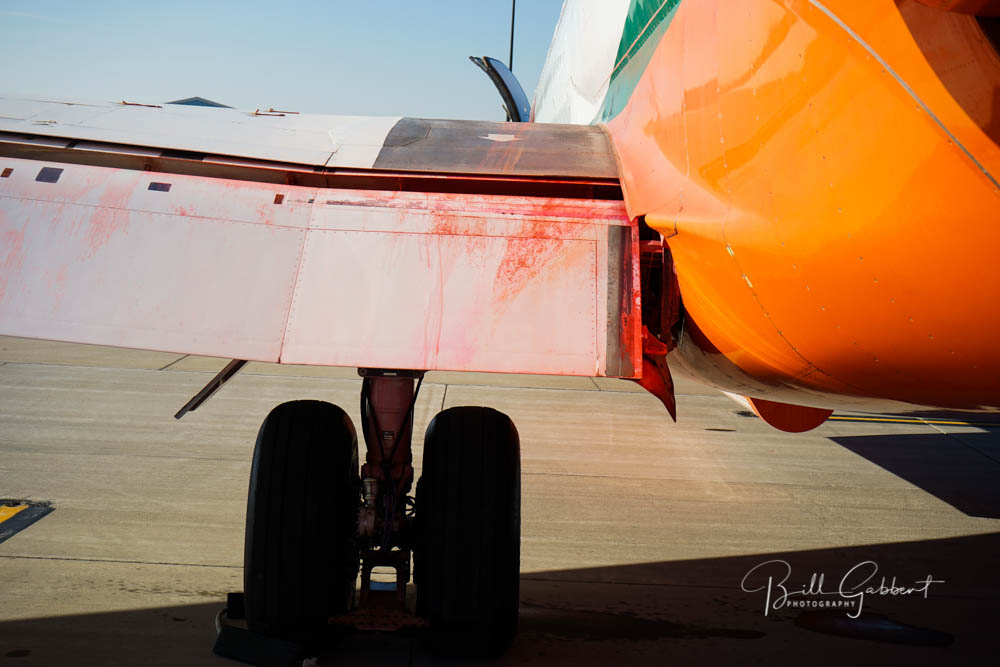 Tanker 101, an MD-87, with evidence of retardant stains on top of the wing, December 12, 2017 at Rapid City Airport. Photo by Bill Gabbert.
Another unique characteristic of the MD-87 is that it is required by the FAA to lower the gear while dropping — in fact it is specified in their Supplemental Type Certificate (STC) issued by the FAA. That 10-page STC uses the words “stall” or “stalling” 60 times, an average of 10 times on every page.
Our view:
How many second chances should an airtanker design get after exploding engines on two occasions and dropping hot shrapnel over a city and at an airport? The FAA and the Interagency Airtanker Board should rescind the Supplemental Type Certificate and the IAB approval and carding of the airtanker before something much worse happens than a car being damaged while parked at a home, or shrapnel closes a runway, multiple wildfires are ignited, and a firefighter is injured putting out the blaze. I fear not only for the safety of the flight crews in the MD-87s, but also people on the ground who have every right to expect that firefighting airtankers on U.S. Forest Service contracts will not kill or injure them with exploding engines — and that an airtanker hired to suppress fires will not start them.
Thanks and a tip of the hat go out to Tom.
Typos or errors, report them HERE.
Report that pieces of metal fell from Erickson MD-87 air tanker over Fresno, California
(UPDATE at 9:20 p.m PT, September 13, 2015)
KMPH reports that the pieces of metal that fell into a Fresno neighborhood Sunday afternoon September 13, breaking a car window, came from an engine that failed on an air tanker, reportedly an Erickson MD-87. Below is an excerpt from their article:
…The plane had departed the Fresno Airport around 3:30 p.m. Sunday when, according to the Federal Aviation Administration and Fresno Firefighters, the pilot reported a left engine failure.
Shortly after, families in a neighborhood near Ashlan and Highway 168 said they heard a boom and saw smoke coming from the plane.
In the process, pieces of the plane’s engine fell into a neighborhood. At least one piece shattered a windshield. Others landed on the streets.
The plane returned to the airport moments later…
****
(Originally published at 5:43 p.m. PT, September 13, 2015)
See huge hole in back window? A piece of air tanker dropped onto woman’s car off Barton & Swift. @FresnoPolice here. pic.twitter.com/x20xt2M9Ok
— Connie Tran (@MissConnieTran) September 13, 2015
Witness says it was a piece of metal from the #EricksonAeroTanker plane that damaged the back of her car! pic.twitter.com/q0ZWjqCQMx — Connie Tran (@MissConnieTran) September 14, 2015
Approximately 20 small pieces of metal found on Swift Ave. Believed to have fallen off of the #EricksonAeroTanker. pic.twitter.com/qVAdSN7MJv
— Connie Tran (@MissConnieTran) September 14, 2015

Thanks and a tip of the hat go out to Barbara and Steve.
Typos or errors, report them HERE.
UPDATE, September 15, 2015: The Fresno Bee published an article on September 14 with additional information.
We don’t know what caused the engine to fail, and it might not be related, but here is a link to a story we ran in June of 2014 about all three of Erickson’s MD-87s being recalled“ due to intermittent engine surges when dropping [retardant at] high coverage levels”.
MD-87 air tankers recalled

All three of Erickson Aero Tanker’s MD-87s have been “recalled” — pulled out of service “due to intermittent engine surges when dropping [retardant at] high coverage levels”. John Kent Hamilton, the Aviation Safety Manager for the U.S. Forest Service Rocky Mountain Region, said the company believes they have a fix for the problem.
Erickson has developed and flight tested a new spade profile that has proved to eliminate this problem by keeping the fluid column much more vertical. They are in the final engineering approval stages and should be able to install with full approval early next week.
Since we ran a photo on January 6 of an MD-87 dropping water in an early test of the retardant system, there have questions raised on our site about retardant being ingested into the engines. That possibility gained further traction on June 9 with a photo of a parked MD-87 with what appeared to be retardant residue above the wing in front of an engine.
When we asked Kevin McCullough, the President of Erickson Aero Tanker, on June 9 if there were any problems with the MD-87s ingesting retardant into the engines, he said there were none.
The first two MD-87s, Tankers 101 and 105, began working June 4 and June 8, respectively. Soon thereafter, a third one, Tanker 103, reported for duty.
A few days after the MD-87s began dropping retardant on fires, a retardant leak inside the aircraft required that they be returned to their home base for repairs.
The last time we can remember an air tanker model being recalled was February 8, 2012 when the Federal Aviation Administration issued an Emergency Airworthiness Directive that required inspections of P2V aircraft after a 24-inch crack was found in a wing spar and skin on one of Neptune Aviation’s P2V-7 air tankers. This grounded the entire fleet of federal air tankers until all 11 of them were cleared the next day. Today we have a mix of five aircraft models, all with different retardant systems, reducing the chance that all of them will be shut down at the same time due to a defect.
Fire aviation briefing, September 10, 2013
Engine failure on S-2
An S-2 air tanker working on the Clover fire southwest of Redding, California experienced a problem that caused the pilot to have to shut down one of the two engines. It occurred while the aircraft was returning to Chico to reload with retardant. The pilot landed the aircraft safely at Chico according to the Willits News.
Last month Tanker 910, a DC-10, lost their #2 engine just after making a drop on the Beaver Creek Fire in Idaho. They also landed safely, but at Pocotello, Idaho, their reload base.
DC-10 photos on the Morgan Fire
Claycord has three excellent photos of one of the DC-10s (or both of them?) dropping on Mt. Diablo during the Morgan Fire 18 miles east of Berkeley, California. When you visit the site, click on the photos to see larger versions. Both of the DC-10s responded to the fire but soon thereafter were diverted to the Clover Fire near Redding, California which was threatening numerous structures.
Tanker 910’s engine problem

It’s just a guess, but what you see in this photo of Tanker 910 over the Beaver Fire in Idaho may be evidence of what led to the replacement of the number two engine last week. The image is a screen grab from the video below which has many excellent still images from the Beaver Creek Fire.
Engine failure on Tanker 910

Tanker 910, a DC-10 Very Large Air Tanker, experienced an engine failure coming off of a drop on the Beaver Creek Fire in Idaho on Thursday, August 15. The pilots flew the tanker back to their reload base at Pocotello, Idaho, making a non-emergency landing, said Rick Hatton, CEO of 10 Tanker Air Carrier. The engine, the number two engine which is in the tail, is being replaced and the aircraft should be back in service today or Monday.
Losing an engine is not unheard of, especially in the P2Vs air tankers which have 16 18-cylinder radial engines with many moving parts. For example in 2012 there were two engine failures in a two day period. One occurred in a P2V just after takeoff from Rapid City. Tanker 43 had to jettison their retardant onto the runway, which required its’ closure, diverting at least one commercial flight to another airport.
10 Tanker’s two DC-10s have both been very busy on fires for the last couple of months. Tanker 911 received a multi-year exclusive use contract on June 7 during the next generation award process. Mr. Hatton told us that on June 14 their other DC-10, Tanker 910, received a 60-day exclusive use contract. We had been told by a spokesperson for the U.S. Forest Service that it was a Call When Needed contract like the one awarded to Evergreen’s 747 on June 14. Mr. Hatton said that at the end of the 60 day period the contract will revert to CWN for Tanker 910. He, of course, is bullish on the capability of the DC-10s, and said:
Any future national fleet composition would be significantly enhanced across all the relevant metrics by having six to nine Next Gen DC-10s on long term exclusive use contracts.
Thanks go out to Clyde