
Click on the photo a couple of times to see a larger version.
Continue readingThree Idaho firefighters injured when gas can falls off truck and ignites
Three firefighters with the Downey Fire Department in southeast Idaho (map) were injured when a gas can fell off their truck while fighting a vegetation fire. They were backing at the time and one of the tires on the five-ton, 6×6 truck ran over the can. The spilled gas ignited from an ember in the burned over area where they were at the time. The intense fire that developed burned all three firefighters, one of them over 40 percent of his body.
All three were transported to a hospital and two were transferred to the University of Utah Burn Center in Salt Lake City where a spokesperson said one was in critical condition and another was in serious condition. The third was treated and released. One of them also suffered a broken leg.
The truck was destroyed and the fire was knocked down after it spread to six acres.
Updated satellite photo of wildfires in Western Montana and Northern Idaho

Above: Satellite photo of smoke from fires in Western Montana and Northern Idaho, August 22, 2017. The red dots represent heat detected by a satellite.
(Originally published at 3:03 p.m. MDT August 22, 2017)
It has been many days since we were able to find a satellite photo free of clouds enough to see smoke from the wildfires in Western Montana and Northern Idaho, but today there were few clouds in the area. This photo from Tuesday afternoon shows less heat (the red dots) than what we were seeing one to two weeks ago.
Dozens of active wildfires in the Northwest U.S.

Above: Active wildfires in Washington, Oregon, Idaho, Western Montana, and Northern California at 4:18 a.m. MDT August 16, 2017.
(Originally published at 10:21 a.m. MDT August 16, 2017)
Dozens of wildfires are active in the Northwest one-quarter of the United States. Many of them have been burning for several weeks under a limited suppression strategy. The states of Washington and Oregon have a total of 32 large uncontained fires that have spread over 810,171 acres.
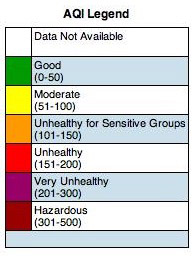 At times the area around Missoula has been heavily affected by smoke. Here are some PM 2.5 readings from Wednesday morning:
- Seeley Lake: 180
- Missoula: 33
- Lolo: 54
- Superior: 180
- French Town: 19
- Clinton: 26


400 firefighter hand crews are deployed on fires in the United States

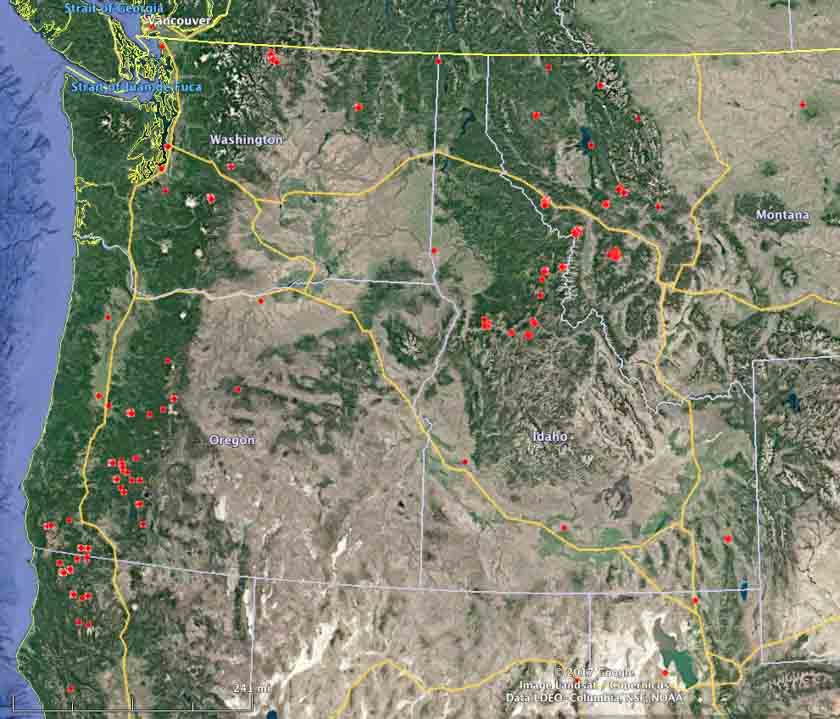
Above: A firefighter ignites a burnout on the Powerline Fire southwest of Pocatello, Idaho. Uncredited Inciweb photo, posted August 6, 2017.
(Originally published at 12:48 p.m. MDT August 6, 2017)
Wildland firefighters are much busier this year than in a typical year. To date, fires have burned 46 percent more acres than the 10-year average — 5,820,802 acres vs. the 3,962,906 average. In some years fire activity in Alaska, where many very large fires are not suppressed, can inflate these numbers, but so far that state can only account for 626,786 acres, not a huge number for Alaska.
400 hand crews, usually comprised of 20 people each, are deployed nationwide, along with 949 fire engines, and 120 helicopters for a total of 16,673 personnel.
Here are brief descriptions of some of the larger or more prominent fires:
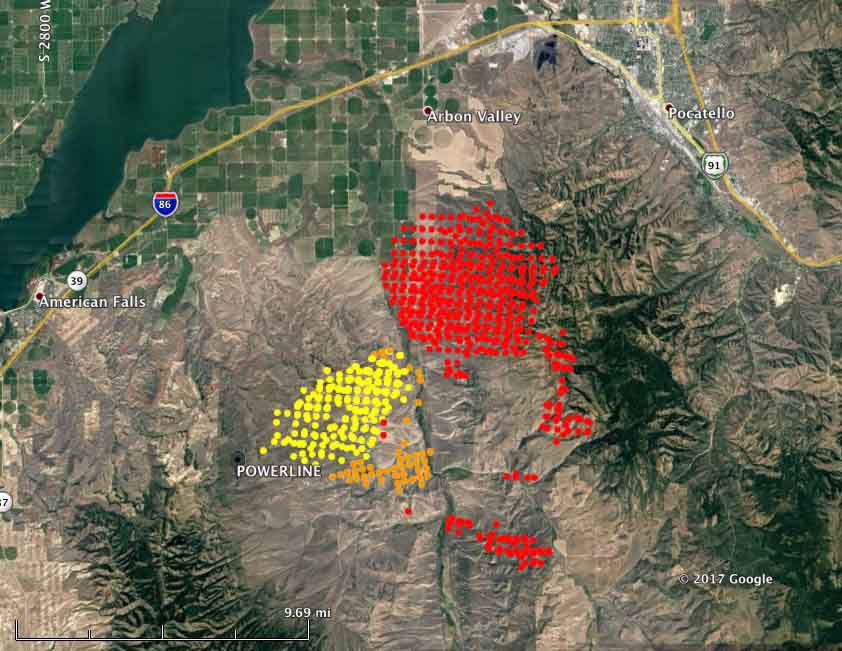
- Powerline (see the map and photo above): Since it was reported Friday night this fire has spread very rapidly. Saturday it was very active on the northeast and southeast sides. Using satellite data the Incident Management Team estimated early Sunday morning that it had burned over 40,000 acres, but that is a very rough guess. More accurate mapping by fixed wing aircraft will provide better numbers. The satellite information indicated that by 4:04 a.m. Sunday it had spread to within 6 miles of Pocatello, Idaho. It is moving into steeper terrain with heavier fuels, offering more resistance to control and is the #2 priority in the Great Basin Geographic Area according to the national situation report.
- Mammoth Cave, southwest of Carey, Idaho. Since it started August 4 it has burned three structures and 30,000 acres. It is the number 1 priority in the Great Basin Geographic Area.
- The Shoestring Fire between Shoshone and Gooding, Idaho has blackened about 12,000 acres since it started August 5. It is the #3 priority in the Great Basin Geographic Area.
- The Rice Ridge Fire northeast of Seeley Lake, MT is the #1 priority in the Northern Rockies Geographic Area and is threatening over 1,000 structures. It added almost 700 acres on Saturday to bring the total to 7,740.
- The Sunrise Fire, 12,900 acres, the #2 priority in the Northern Rockies Geographic Area, grew by 600 acres Saturday. It has been burning since July 16, growing every day, adding several hundred acres daily on the east or northeast sides. It is now mapped at 12,900 acres.
- The Hanover Fire, in a very remote area 15 miles northwest of Riggins, Idaho, was extremely active on Saturday. The Incident Management Team reports that it has burned 4,479 acres.
- Parker 2, 10 miles east of Alturas, California. It was very active Saturday, adding 5,300 acres, growing to 7,100 acres.
- Minerva 5, just south of Quincy, California. It has burned 4,088 acres and the voluntary evacuation of the town has been lifted. Firefighters completed a firing operation Saturday night.
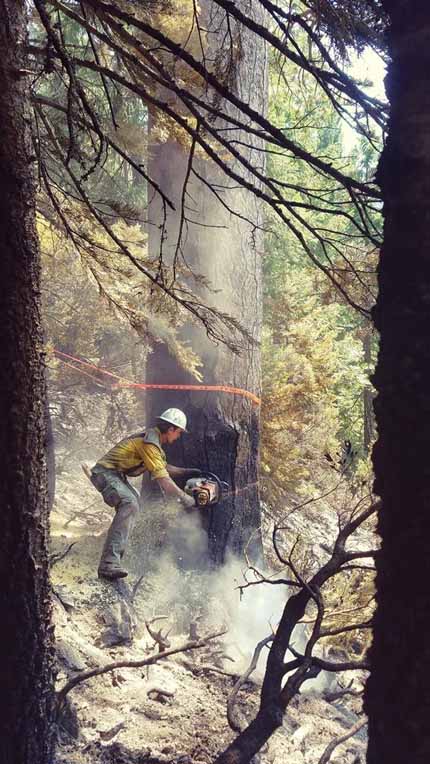
Fires in Western Montana still very active

The fires are consuming thousands of acres each day and producing large quantities of smoke.
Continue readingSatellite view of four wildfires in Idaho and Nevada

Above: Smoke from the Roosters Comb Fire was captured in a photo by the (non-operational) GOES-16 satellite at 7:30 p.m. MDT July 10, 2017.
(Originally published at 7:20 a.m. MDT July 11, 2017)
Four wildfires in northeast Nevada and southern Idaho are large enough that satellites are able, in some cases, to see the smoke and the blackened burned areas. These photos were taken late in the afternoon on Monday July 10.
The one putting up the most smoke Monday was the Roosters Comb Fire which as of Monday evening had burned approximately 25,000 acres in Nevada 17 miles northeast of Battle Mountain. It was reported at 9 p.m. Sunday July 9. The fire is spreading rapidly through grass, sagebrush, and pinyon-juniper.
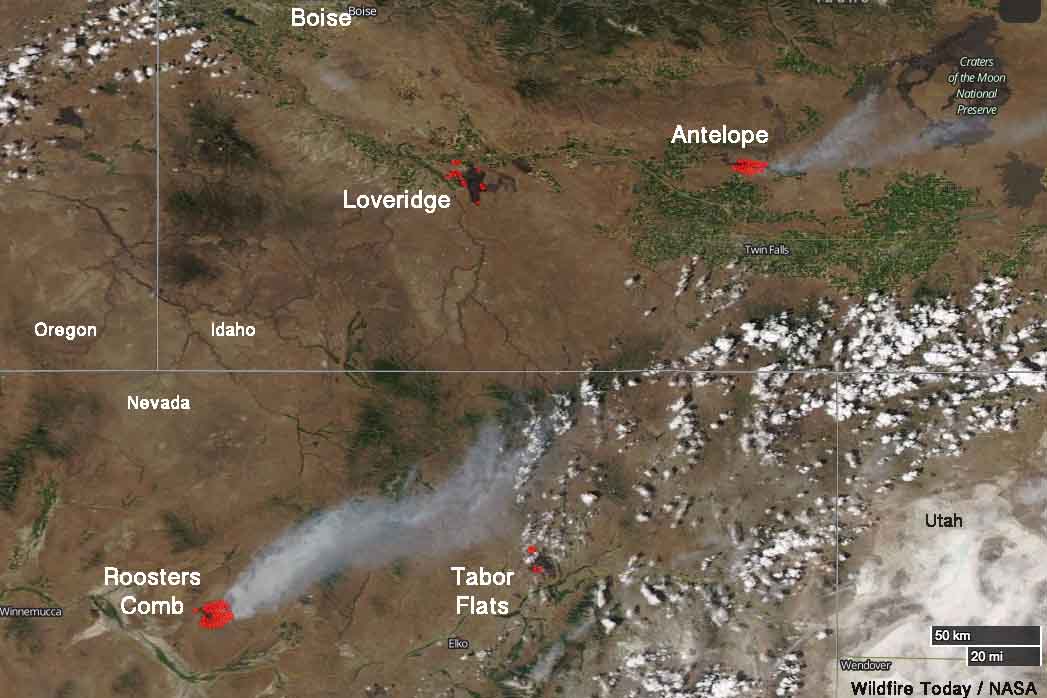
Farther to the east in Nevada is the Tabor Flats Fire 27 miles northeast of Elko close to Interstate 80. The reported size of this fire is also 25,000 acres. The fire behavior in the tall grass is described as “extreme, running, flanking, wind driven runs”.
In Idaho the Loveridge Fire has burned over 38,000 acres 18 miles south of Mountain Home. It was shown as contained in the Tuesday morning national situation report. The heat detected by the satellite in that area (shown as red dots) could either be from the Loveridge Fire or a new fire in the same area.
The Antelope Fire at Shoshone, Idaho just south of Interstate 84 has covered 29,500 acres. It is exhibiting extreme fire behavior with wind-driven runs.
Interview with a Crew Chief on a C-130 MAFFS air tanker
On April 21, 2017 we interviewed Zach Havel an engine mechanic and former Crew Chief on C-130 Modular Airborne FireFighting System aircraft. The MAFFS converts the aircraft into a 3,000-gallon air tanker. We talked with him at Boise during the annual MAFFS training and recertification.
Video interview with the Colonel in charge of MAFFS annual training
Colonel Bryan Allen was interviewed during the annual training and recertification for the Modular Airborne FireFighting System crews at Boise, Idaho on April 21, 2017. The MAFFS converts a military C-130 into an air tanker for battling wildfires.
Col. Allen discussed:
- How playing the recording of the C-130J audible cockpit warning “LANDING GEAR, LANDING GEAR, LANDING GEAR” over the public address system at Lockheed, helped to develop a software modification that enabled the pilots to turn off that voice while they were on final approach to drop retardant on a wildfire.
- The number of sorties and description of the training the MAFFS personnel received during the annual session.
- How the crash of MAFFS 7 in 2012 affected the training.
- The origin of the MAFFS equipment.
Firehawks in Boise
 A Blackhawk helicopter at Firehawk Helicopters in Boise.
I was driving by the Boise airport this week and discovered that Firehawk Helicopters has a facility in the area. They were mostly closed, only Tori the receptionist was in the building, but I talked on the phone with Director of Maintenance Josh Ricciardi who said it was OK if I shot a few photos in their hangar. The Blackhawks ships were all receiving maintenance, getting ready for the fire season.


