CAL FIRE engines cross the border into Mexico to assist firefighters in the suppression of a wildfire west of Tecate, Mexico. CAL FIRE photo.
The California Department of Forestry and Fire Protection (CAL FIRE) has mobilized a strike team of fire engines to cross the international border in order to help firefighters in Mexico. They will be assisting in the suppression of the Border 8 Fire that has burned 1,500 acres very close to the border just west of Tecate, Mexico 23 miles southeast of San Diego.
The fire is a threat to cross the border in an area of the United States with steep topography and limited access. Keeping it from crossing the border would be the preferred option, rather than having to suppress a much larger fire in difficult terrain on the U.S. side.
The fire has been spreading to the east, generally toward the city of Tecate which has a population of 102,000 in its metropolitan area.
Air tankers have been dropping retardant in a few selected locations north of the border off and on since the fire started August 14, including S2T and C-130 aircraft from bases at Ramona and Hemet, California.
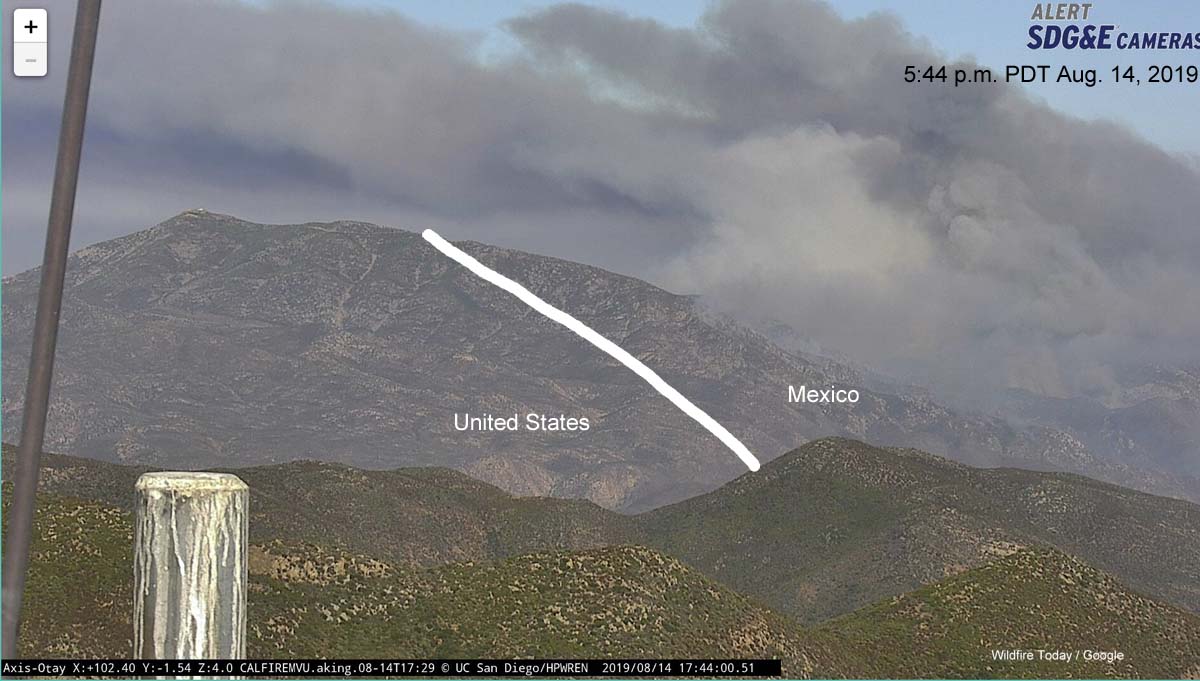
Photo from Otay Mountain showing the Border Fire at 5:44 p.m. PDT August 14, 2019, and the approximate location of the international border (white line).
CAL FIRE may decide to activate the unstaffed air tanker base at Brown Field Municipal Airport which is 1.6 miles north of the border and about 16 miles west of this fire. It is 31 miles south of the Ramona air tanker base and has a 7,972-foot runway which according to information from the USFS “provides ample length to meet safe takeoff requirements for the size and weight of a Next Generation Air Tanker with a full payload”. The runway at Ramona is too short to handle many of the large air tankers. The tanker base at Hemet, which also has a relatively short runway, is 80 miles north of the fire.
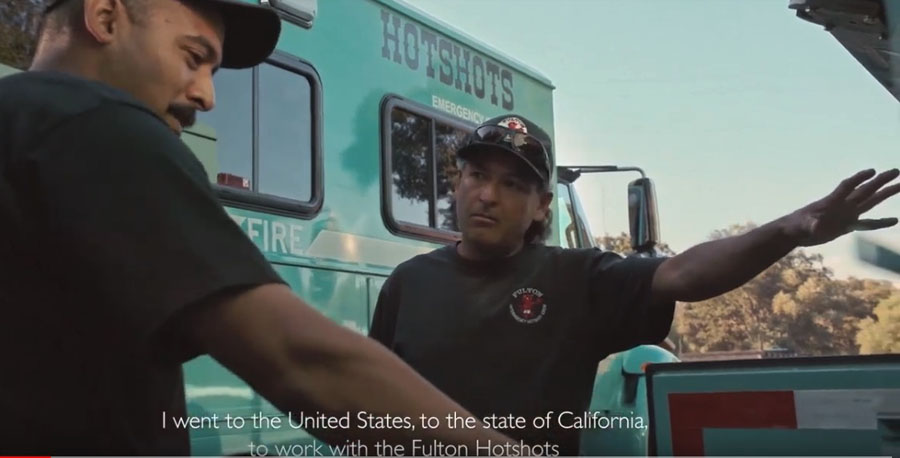
A firefighter from the National Forestry Commission of Mexico trains with the Fulton Hotshots. Screenshot from the video below.
This video features a firefighter with the National Forestry Commission of Mexico (CONAFOR), Fernando Navarro Jiménez, who for several months joined the U.S. Forest Service’s Fulton Hotshots on the Sequoia National Forest in California. It shows the impact of the experience on him and CONAFOR as well as the cooperation between the U.S. Agency for International Development, the USFS, and Mexico.
A fire that straddles the Mexican border in the boot heel of New Mexico has burned thousands of acres. During a satellite overflight at 2:23 a.m. MDT Friday most of the fire was in Mexico but it was well established in the United States.
Our very unofficial estimate based on satellite data put it at approximately 5,000 acres early Friday morning. It was still very active at 2:23 a.m. local time.
The San Luis Fire is 41 miles south of Animas, NM and about 2 miles south of the OK Bar Fire that burned a couple of weeks ago. It is possible that this new fire could burn into the southern edge of the OK Bar Fire.
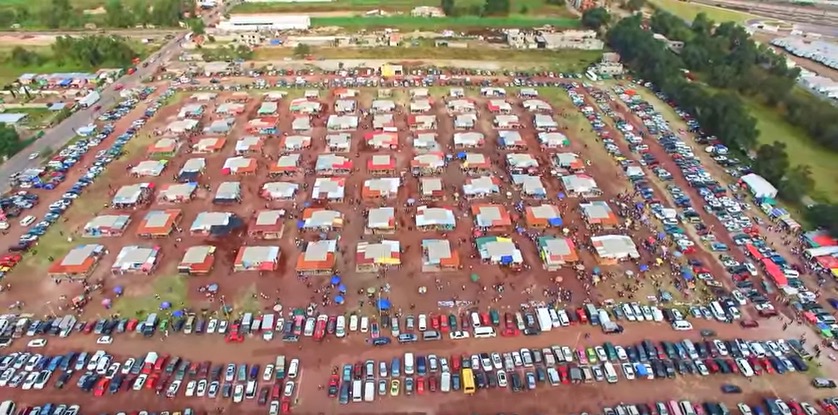
Yesterday a series of explosions at a fireworks market in Tultepec, a city about 40 kilometers (25 miles) north of Mexico City, killed 32 people. The city bills itself as the country’s fireworks capital. The market consisted of approximately 80 small structures from which vendors sold fireworks.
The video above of the scene after most of the explosions had run their course illustrates how a drone could enhance the situational awareness of firefighters.
CNN reports there was a similar disaster at the site 11 years ago:
After the 2005 blast, officials separated stalls at the market in an effort to prevent fires from spreading. Local government officials last week described it as “the safest market in Latin America.” In a statement, Mexican Pyrotechnics Institute Director Juan Ignacio Rodarte Cordero said the market had “perfectly designed stalls with enough space so that there is no chain reaction fire in case of a spark.”
Tultepec fireworks market in 2015. Screenshot from Youtube video. Tultepec fireworks market in 2015. Screenshot from Youtube video.
While performing a stunt on top of a ladder truck during a parade in Tijuana, Mexico, 19 firefighters fell and were injured November 20.
The truck was moving very slowly while firefighters were doing handstands on top of other firefighters. When the truck suddenly stopped, they all fell, with most of them going all the way to the ground. There is one report that first, a firefighter lost his balance at the front of the truck, and the driver hit the brakes so as not to run him over. But very rough Google automatic translations leave some of the details in question.
Below is an excerpt from LaJornada, translated by Google:
Tijuana, 20 November.- The Sunday morning accident was recorded during the parade on November 20 in Tijuana, in which 19 members of the Fire Department were injured.
Firefighters were performing stunts aboard one of its units-above boulevard Paseo de los Heroes, at the height of the Glorieta Independence- when the truck stopped making them off balance.
According to the office manager of the Ministry of Public Security official Jose Luis Lopez, the injured are being treated, none seriously injured, however, two of them have possible fractures collarbone and leg, while others already they were discharged.
When I worked for the U.S. Forest Service, forms that had to be completed after every accident had one section that asked: “How could this accident have been prevented?” Well, I have some ideas about this one.
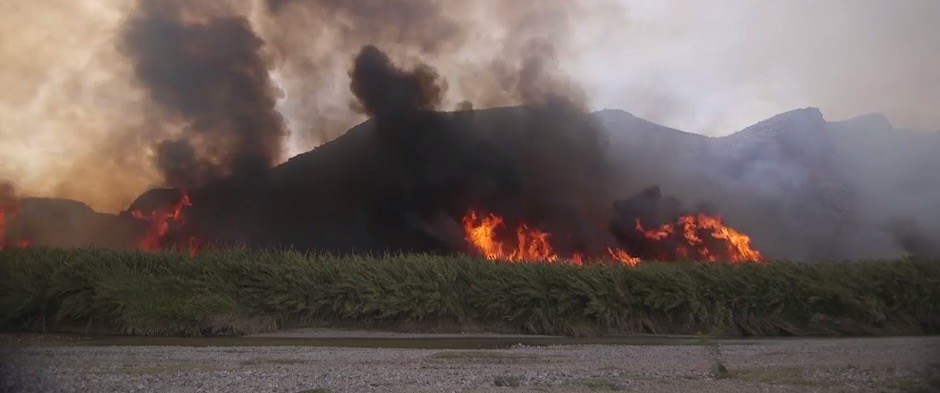
Above: a screen grab from The Atlantic’s documentary about a fire crew from Mexico that assists a U.S. National Park.
The Atlantic produced this seven-minute documentary about Mexican citizens, Los Diablos, that help Big Bend National Park in southern Texas conduct prescribed fires and suppress wildfires. The crew assisted with the Powerline Fire that burned about 1,800 acres in Big Bend in February.
Here is how The Atlantic describes the video:
In Texas, Mexican firefighters are saving the Rio Grande. Known as Los Diablos, or “the devils,” the elite firefighting crew is hired by the National Park Service to fight wildfires and conduct controlled burns along the border. The river provides water to more than 5 million people in the U.S. and Mexico, and sustaining its flow is vital. The water in the Rio Grande is already 150% over-allocated. In this short documentary, The Atlantic follows the group’s conservation efforts to rid the river of giant cane, an invasive plant that narrows the river and threatens native plants and fish.
Since the Evergreen 747 Supertanker may be coming back into our lives it might be a good time to refresh our memories of what it can do with 20,000 gallons.
These two photos was taken by a firefighter in Mexico in 2011. (UPDATE: Walt said in a comment June 20 the two photos below are from an “unpressurized ‘clean out’ (jettison)”. Videos of T979 dropping on fires show appropriate drop altitudes. One of the pilots on the clean-out jettison was a highly regarded 16-year initial attack airtanker pilot that would have mutinied if a drop on a fire was done at that AGL altitude.”)
747 dropping on a fire in Mexico, April 14, 2011 (click to enlarge) 747 in Mexico, April 14, 2011 (click to enlarge)
The first video, below, is a KABC-TV News segment from May 31st, 2006 covering the 747 Supertanker demo in San Bernardino, CA. The video also includes some stock footage of the aircraft dropping during the Interagency AirTanker Board tests.
The second video below shows the 747 dropping water at Central Ciudad Real in Spain, July 21, 2009.
And next we have the 747 dropping on the Crown Fire at Anaverde, which I believe is near Palmdale, California, July 31, 2010.
And finally, below, a water dropping demo at McClellan in California, June 11, 2009.
According to the Latin American Herald Tribune, about 25,000 acres burned last week in the Huasteca Potosina region in the north-central Mexican state of San Luis Potosi. Two people were identified as suspects for starting a fire near the town of Lagunillas. One person died in one of the fires, which have been fought by 600 firefighters.
USFS says naturally occurring asbestos was not a problem on the Chips Fire
The U.S. Forest Service conducted extensive tests of naturally occurring asbestos on the Chips Fire that burned over 75,000 acres on the Plumas/Lassen National Forest last August. The results indicated that firefighters were not exposed to dangerous levels of asbestos particles and confirmed that there is no need to wear high-efficiency particulate air respirators in the area. During suppression activities a Safety Officer, worried that dust might contain asbestos, had raised the issue of firefighter safety in areas where fireline was being constructed by crews and dozers.
Victims of Colorado’s Lower North Fork Fire have filed 95 claims against the government
At least 95 claims have been filed against government agencies in Colorado following the Lower North Fork Fire, a state-run prescribed fire that escaped March 26, 2012, killed three local residents at their homes and burned 27 structures. An article in the Denver Post quotes a local resident who said two previous prescribed fires in the area also escaped or reignited before the state ignited the Lower North Fork project.
Volunteer firefighter charged with arson
Nathaniel Ridgway Schmidt, a former volunteer firefighter with the Timber Cove Fire Protection District in Sonoma County, California, has been charged with setting five fires in Sonoma and San Mateo Counties.
One of the cases occurred on a prescribed fire when Mr. Schmidt was tasked with patrolling a section of fireline. Here is an excerpt from the San Francisco Chronicle:
…A half-hour later, Schmidt yelled that the fire was out of control, but investigators determined he had set a new quarter-acre blaze, [District Attorney Steve] Wagstaffe said. He said authorities believe Schmidt, who has no prior criminal record, set the fires “for excitement.”
The San Mateo County fire happened eight days after the first two of four fires allegedly set by Schmidt in Sonoma County. Prosecutors there charged Schmidt with four felony counts of arson and five misdemeanor counts of falsely reporting emergencies, including a car going over a cliff.
File photo of the Martin Mars and Firewatch 76 at Lake Elsinore, California. Photo: Coulson Flying Tankers
Updated at 1:12 p.m. MT, May 19, 2011
On Wednesday, May 18, the Martin Mars air tanker completed their 20-day contract in Mexico and will be heading back to their home at Sproat Lake near Port Alberni on Vancouver Island. They expect to stop at Lake Elsinore, California for fuel, and to arrive at Port Alberni on Friday. At this link to Google Maps from July, 2005 imagery, you will see the two Martin Mars aircraft floating peacefully in the lake. The giant plane has been working on a firefighting contract with the Mexican government, based at Lake Amistad reservoir near Del Rio, Texas.
Wayne Coulson, the CEO of Coulson Flying Tankers, the owner of the Hawaii Mars and the Philippine Mars, told Wildfire Today that after sitting for a day due to strong winds, the Hawaii Mars on April 30 began flying an average of 6.5 hours a day with up to 10 loads each day until May 15 when they ran out of targets. They flew 104 hours of operations on the assignment dropping exclusively water with 1.5% Thermo-Gel, with excellent results, Coulson said.
The Martin Mars is the only fixed wing platform in the world that has an onboard gel injection system. It can hold 3,100 liters (819 gallons) of gel which gives the Mars the ability to drop approximately 20 loads of water with gel before reloading the gel tank. The aircraft can carry up to 7,200 gallons of water.
Coulson described the gel injection system to us. When scooping on a lake to reload the water tank, the Martin Mars:
..ingests the water into the tank at 200 gallons per second and injects gel at the elbow in the tank causing extreme shearing of the gel that cannot be duplicated by any other gel injection system giving us the ultimate mixing of product.
I did the math for those of us that are familiar with water pumping operations, and 200 gallons per second works out to 12,000 gallons per minute. That amount of water could fill 24 large fire engines each minute.
Coulson described one of the ways they used the Sikorsky S-76 helicopter, called Firewatch, which has mapping and infrared imaging capability, and works with the Martin Mars serving as a lead plane, as well as other functions.
The S-76 was the key to our success going into another country that doesn’t speak English.
Firewatch has two screens with a HD 14″ [TV monitor] in the front and a HD 26″ [TV monitor] in the back so what we were able to do is communicate with the customer using the video images.
We worked on 8 different fire complex’s and what we would do when the Mars was ordered up we would pickup the IC and usually two other members and fly the targets using the camera to identify where the loads were to be dropped then call in the Mars and execute.
Our primary missions were specialty targets protecting ranches and livestock so every drop counted and the results good or bad were instant using the camera.
The Martin Mars has sophisticated hardware and software that keeps track of many different parameters while flying a mission. It can instantly provide the actual costs of the drops after the crew inputs the contract daily and hourly rates and the cost per gallon of the fuel and gel. For example, during a 25-day period in 2009 in California it worked on 6 fires, flew 36.33 hours on the fires, made 40 drops (of water and gel), dropped 193,758 gallons, for a total cost of $3.52 per gallon dropped, including the cost of the gel, fuel, and contract charges. That works out to 0.9 hour per drop, with each drop averaging 4,843 gallons.
In June the Martin Mars will begin a 90-day contract working for the province of British Columbia.
The Alberni Valley Times published an article about the aircraft May 19, 2011.
Martin Mars to be featured on the Discovery Channel
Martin Mars air tanker taking off; a screen grab from the video below.
The Martin Mars air tanker that began a 20-day contract on April 24 to assist the Mexican government with suppression of their wildfires has been busy recently after being grounded for a while by strong winds.
Here is an excerpt from an article at Canada.com, dated May 6, 2011:
…The aircraft and its accompanying Sikorsky helicopter started making drops last Friday, said Wayne Coulson, who owns both aircraft through the Coulson Group of Companies.
The aircraft has been working seven hours a day, dropping up to 10 loads of water, said Coulson. On Monday, the Mars dumped 210,000 litres of water and gel.
“We’re flying her more than we ever have,” said Coulson from his Port Alberni office this week.
The expanse of the wildfires is overwhelming, he added. “A big chunk of the country is on fire – it’s right down to Cancun,” Coulson said. The enemy is the weather. Temperatures have soared to 46 C and then dipped to 10 C, perfect conditions for thunderstorms.
“The lighting strikes are just relentless,” Coulson said.
The helicopter uses infrared cameras to see through smoke and pinpoint the location of the flames. It has been a valuable asset for the Mexicans, said Coulson. They have used the helicopter to map fires and set their priorities on what order they should be attacked. The success of the technological improvements is gratifying.
“We’ve waited almost three years to be able to prove we can go and utilize this technology,” he said. “They really watch their pesos, and for every aircraft that’s working, [the fire bosses] are filming and making determinations.”
Having an aircraft drop water in the middle of a fire does not do any good because the flames are moving out along the edges, he said. A YouTube video of the Martin Mars shows it making its drop along the leading edge of the fire, creating a fire break with surrounding land.
Every drop of water and gel has to be accurate and cost-effective for the customer, said Coulson. A single drop by the Martin Mars can cost the customer $15,000.
A normal day begins with the Sikorsky flying from Texas into Mexico to clear customs and obtain one-day permit to be in the country and pick up Mexican bosses. At the end of the day, the helicopter hands in its permit to Mexican officials and returns to Texas where it again clears customs.
Martin Mars air tanker practice drop; screen grab from the video below.
Check out the video below, uploaded to YouTube on June 24, 2010. It includes several practice drops, some of which were filmed by the infrared camera on the helicopter the airtanker uses as a lead plane, a Sikorsky S-76B.