
Tim Crippin sent us these photos he took on the Green Top Mountain Fire on July 15th near Eagle Point, Oregon about 15 miles northeast of Medford. Started July 15 by lightning, it had burned about 120 acres by July 16.
Thanks Tim!


Tim Crippin sent us these photos he took on the Green Top Mountain Fire on July 15th near Eagle Point, Oregon about 15 miles northeast of Medford. Started July 15 by lightning, it had burned about 120 acres by July 16.
Thanks Tim!

Approximately 2,800 lightning strikes since Friday have caused 163 wildfires in Oregon
Continue reading
Above: Photo by Fire Marshall Jeffrey Pricher
We just found out about another drone that started a wildfire in Oregon. This time time it happened in Scappoose about 25 miles northwest of Portland. According to a press release from the Scappoose Fire District, the drone crashed June 26 in FAA restricted airspace near Scappoose Industrial Airpark. It landed in dry grass and sparked a fire.
After trying unsuccessfully to stomp the fire out, the operators called 911. It burned about a quarter acre before firefighters put it out.
The operators were issued a verbal warning for using the aircraft in restricted airspace. FAA regulations require recreational drone operators to give notice for flights within five miles of an airport to both the airport operator and air traffic control tower, if the airport has a tower. However, recreational operations are not permitted in Class B airspace around most major airports without specific air traffic permission and coordination.
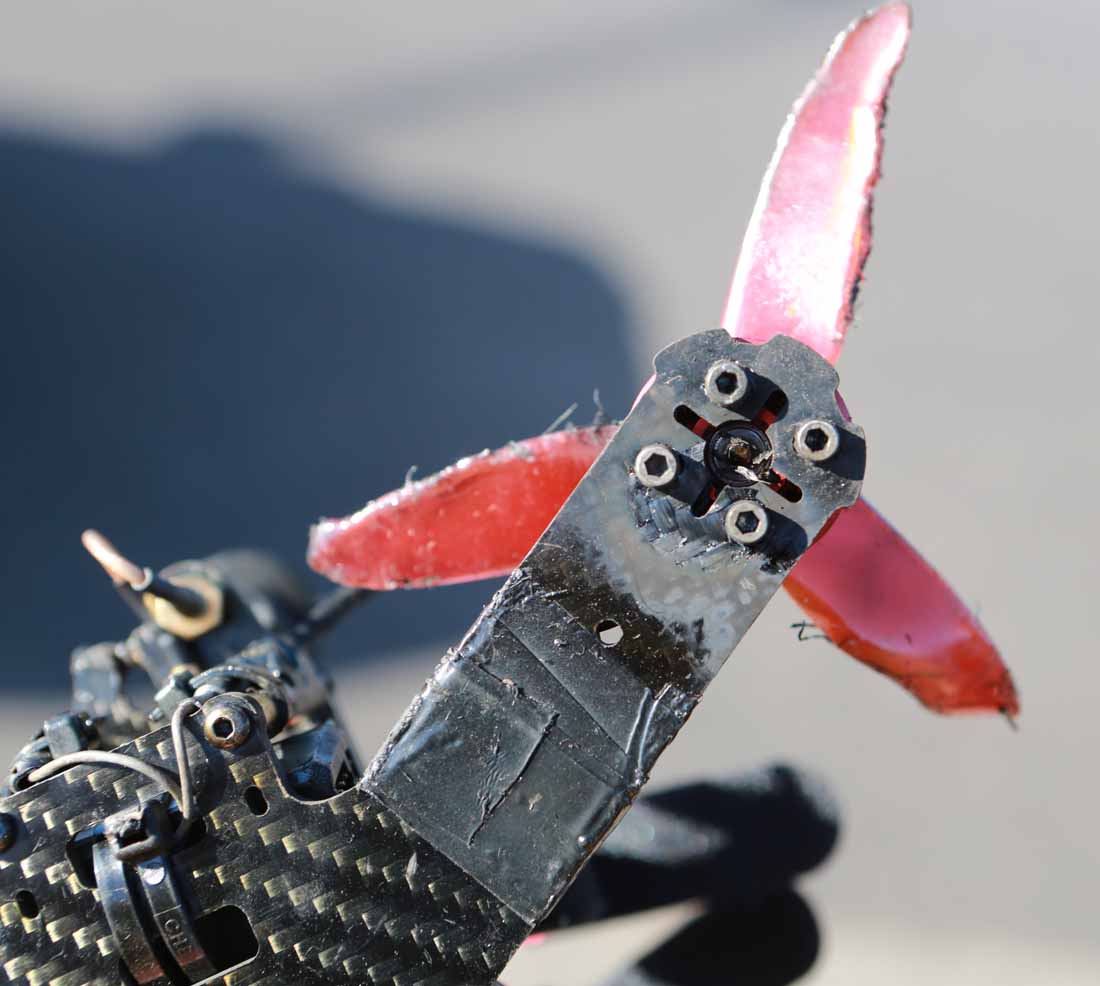 Photo by Fire Marshall Jeffrey Pricher
The Fire Marshall for the Fire District, Jeffrey Pricher, told us that as the drone was flying, a malfunction occurred. The aircraft went out of control and crashed. As for the exact cause of the ignition of the fire, he said that after an initial examination the battery looked intact. So he is considering something related to one of the electric motors, but the investigation is still ongoing. Normally they operate at about 100 degrees, he said, but if there was an anomaly or an object was impinging on one of the moving parts, friction could cause an elevated temperature and failure of the motor.
Mr. Pricher said this was a racing drone, which normally do not have legs, landing gear, or anything that would keep the motors elevated off the ground more than a fraction of an inch when it lands upright. If it did have an overheated motor, landing (or crashing) in a grassy field could put the motor in close contact with flammable vegetation.
On July 12 KEZI reported on a drone battery that caused a small fire in a residence a couple of months ago in Eugene, Oregon. The owner of a Propel X-5 drone had just charged the battery for 15 minutes:
[Tina] Thomas said they unplugged the battery and then noticed it was smoking. That’s when the trouble began.
“Then it just shot out. I mean it was like a missile,” Thomas said.
She said the battery shot right into the carpet and lit it on fire, and then the charger port shot into the dog bed and lit that on fire.
They put out the fire but had to replace the carpet. And thankfully, the dog was not in its bed at the time.
On July 10 a racing drone crashed when a dog jumped on the person flying it near Springfield, causing him to drop the controller. The small aircraft spun out of control, crashed, and as the video kept recording, started grass on fire within three seconds. It burned about two acres before firefighters put it out.
Thanks and a tip of the hat go out to Paul and Kelly.
Typos or errors, report them HERE.
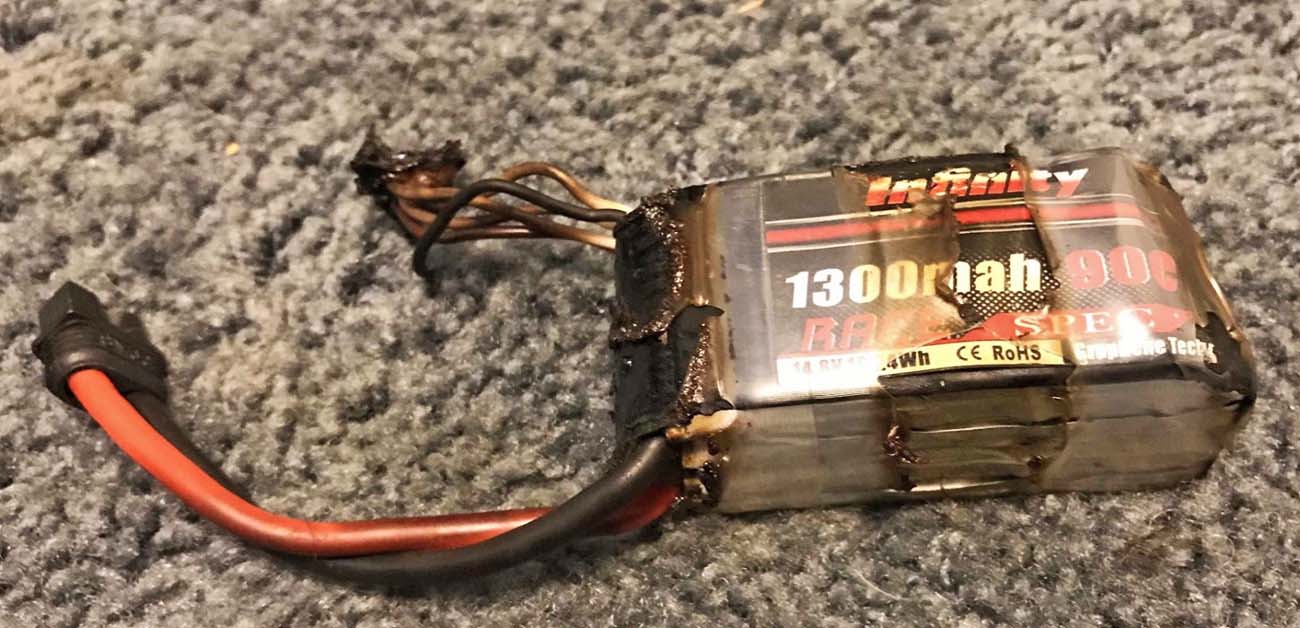
Above: The burned drone. Photo by Cameron Austin-Connolly
(Originally published on Wildfire Today July 11, 2018)
A small drone started a vegetation fire when it crashed near Springfield, Oregon this week. On July 10 Cameron Austin-Connolly was flying his drone over a field when a large unleashed dog left its owner, ran and jumped on him. The impact knocked the controller out of his hands and the drone immediately went out of control and crashed. As you can see in the video (that Mr. Austin-Connolly gave us permission to use) within about three seconds the still operating camera recorded flames.
You can also see two dogs running at Mr. Austin-Connolly.
He wrote on his Facebook page:
My drone crashes and when I go to look for it I saw smoke and flames so I called 911. Springfield FD quickly showed up and put out the flames. They even returned my drone and gopro. The Fire Marshall said that was their first drone fire.
In case you’re wondering about the reaction of the dogs’ owner, Mr. Austin-Connolly said he just kept walking and didn’t say anything.
Mr. Austin-Connolly told us, “it is a hand built first person view drone, or FPV done. Some people also call them racing drones since they are fast.”
He said it was using a lithium polymer, or “lipo”, battery.
Most small consumer-sized drones use lithium ion batteries, while racing drones generally operate with lithium polymer batteries.
In March we wrote about the crash of a drone that started a 335-acre fire on the Coconino National Forest in Northern Arizona. Few details about that drone were available, except that it was about 16″ x 16″. The comments by our readers developed a great deal of information about rechargeable batteries and the possibility of them catching fire. We also learned about several other drone crashes that started fires.
In May we published an article about the fact that electric vehicles with lithium-ion batteries present a complex and hazardous situation for firefighters responding to a vehicle accident.
The fact is, there are many examples of both lithium ion and lithium polymer batteries catching fire. There is no doubt that when a lithium ion battery is subject to an impact, a short circuit can occur in one or more of the cells, creating heat which may ignite the chemicals inside the battery. This can spread to the adjoining cells and lead to the condition known as “thermal runaway” in which the fire escalates. If as in a vehicle, there are thousands of batteries, it can be extremely difficult to extinguish the blaze. And worse, it can reignite days or weeks later.
When compact fluorescent light bulbs were introduced they saved energy but were slow to get fully bright and many people thought the color of the light was unpleasant. I knew then that it was immature lighting technology. There were going to be better options. Now LED bulbs save even more energy, come in various light temperatures (colors), and illuminate at near full brightness immediately. For now, they are expensive, but will still pay for themselves in three to five years.
Lithium ion and lithium polymer batteries are the fluorescent bulbs of battery technology. They are too heavy, don’t hold enough power, and they too often catch fire. No one wants to be on an airplane when flames erupt from an e-cigarette, cell phone, wireless headphones, or laptop computer, all of which can ignite even when turned off.
So until that next major step in battery technology occurs, what do we do about drones? Is the risk so low that we should not be concerned? When land managers enact fire restrictions during periods of high wildfire danger, do we also prohibit the use of drones? Should drones ever be allowed over vegetation in a fire-prone environment during wildfire season? And what about the hundreds of drones owned and operated by the Department of the Interior that flew 5,000 missions last year? Not all are battery operated, but some are.
We thank Mr. Austin-Connolly for providing the information, photos, and the video. When we asked, he said, “If my experience can be helpful I’m all for it.”
Thanks and a tip of the hat go out to Kelly.
Typos or errors, report them HERE.

Above: The burned drone. Photo by Cameron Austin-Connolly
(Originally published at 5:10 p.m. PDT July 11, 2018)
A small drone started a vegetation fire when it crashed near Springfield, Oregon this week. On July 10 Cameron Austin-Connolly was flying his drone over a field when a large unleashed dog left its owner, ran and jumped on him. The impact knocked the controller out of his hands and the drone immediately went out of control and crashed. As you can see in the video (that Mr. Austin-Connolly gave us permission to use) within about three seconds the still operating camera recorded flames.
You can also see two dogs running at Mr. Austin-Connolly.
He wrote on his Facebook page:
My drone crashes and when I go to look for it I saw smoke and flames so I called 911. Springfield FD quickly showed up and put out the flames. They even returned my drone and gopro. The Fire Marshall said that was their first drone fire.
In case you’re wondering about the reaction of the dogs’ owner, Mr. Austin-Connolly said he just kept walking and didn’t say anything.
Mr. Austin-Connolly told us, “it is a hand built first person view drone, or FPV done. Some people also call them racing drones since they are fast.”
He said it was using a lithium polymer, or “lipo”, battery.
Most small consumer-sized drones use lithium ion batteries, while racing drones generally operate with lithium polymer batteries.
In March we wrote about the crash of a drone that started a 335-acre fire on the Coconino National Forest in Northern Arizona. Few details about that drone were available, except that it was about 16″ x 16″. The comments by our readers developed a great deal of information about rechargeable batteries and the possibility of them catching fire. We also learned about several other drone crashes that started fires.
In May we published an article about the fact that electric vehicles with lithium-ion batteries present a complex and hazardous situation for firefighters responding to a vehicle accident.
The fact is, there are many examples of both lithium ion and lithium polymer batteries catching fire. There is no doubt that when a lithium ion battery is subject to an impact, a short circuit can occur in one or more of the cells, creating heat which may ignite the chemicals inside the battery. This can spread to the adjoining cells and lead to the condition known as “thermal runaway” in which the fire escalates. If as in a vehicle, there are thousands of batteries, it can be extremely difficult to extinguish the blaze. And worse, it can reignite days or weeks later.
When compact fluorescent light bulbs were introduced they saved energy but were slow to get fully bright and many people thought the color of the light was unpleasant. I knew then that it was immature lighting technology. There were going to be better options. Now LED bulbs save even more energy, come in various light temperatures (colors), and illuminate at near full brightness immediately. For now, they are expensive, but will still pay for themselves in three to five years.
Lithium ion and lithium polymer batteries are the compact fluorescent bulbs of battery technology. They are too heavy, don’t hold enough power, and they too often catch fire. No one wants to be on an airplane when flames erupt from an e-cigarette, cell phone, wireless headphones, or laptop computer, all of which can ignite even if they are turned off.
So until that next major step in battery technology occurs, what do we do about drones? Is the risk so low that we should not be concerned? When land managers enact fire restrictions during periods of high wildfire danger, do we also prohibit the use of drones? Should drones ever be allowed over vegetation in a fire-prone environment during wildfire season? And what about the hundreds of drones owned and operated by the Department of the Interior that flew 5,000 missions last year? Not all are battery operated, but some are.
We thank Mr. Austin-Connolly for providing the information, photos, and the video. When we asked, he said, “If my experience can be helpful I’m all for it.”
Thanks and a tip of the hat go out to Kelly.
Typos or errors, report them HERE.
Dwight and Steven Hammond will be freed from prison
Continue readingFirefighter suffers severe burns when his engine is burned over
Continue reading
Above: T-93 departs Medford, Oregon for the Klamathon Fire in California. All photos by Tim Crippin July 5, 2018.
Tim Crippin took these photos July 5 of eight air tankers that were fighting the Klamathon Fire and reloading at Medford, Oregon.
As of Friday morning the fire just across the state line in California had burned approximately 8,000 acres and multiple structures. A civilian who has not yet been identified died in the fire.
 T-914
 T-164
I hope no one was under that drop (the video on the left) by an MD-87 on the Boxcar Fire near Maupin, Oregon.
In case the video on the left does not work, try it a this link. But below is a screen grab:
 T-101, and MD-87, make a low drop on the Boxcar Fire near Maupin, Oregon, June, 2018. By Katie Hemphill-Pearcy.
(Originally published at 8:52 a.m. PDT June 22, 2018)
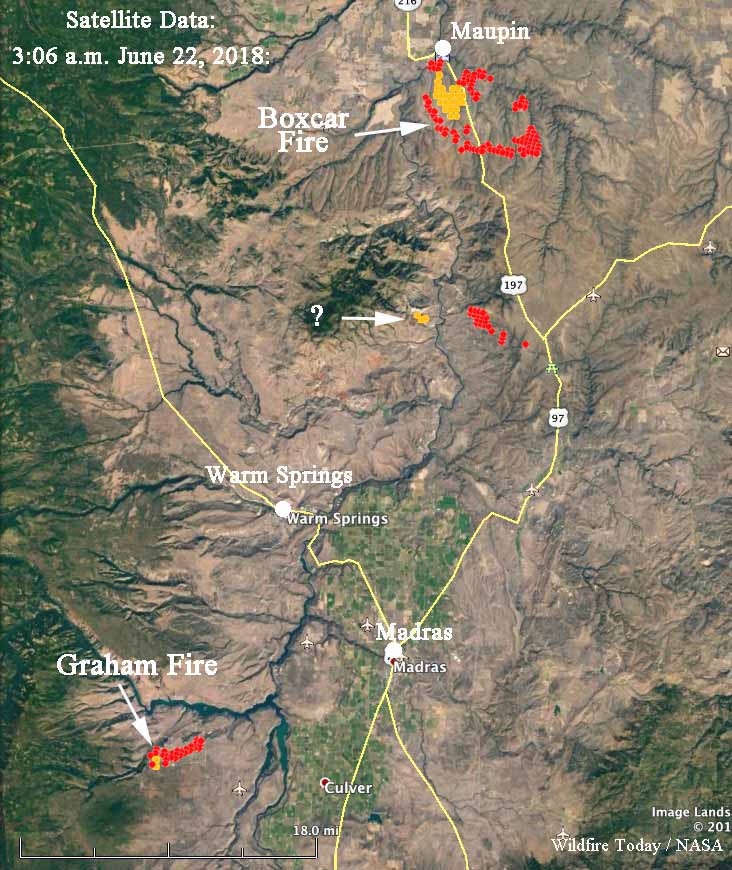
At least three new wildfires grew quickly Thursday in Northern Oregon after hundreds of lightning strikes pounded the area Wednesday. The largest blaze is the Boxcar Fire just south of Maupin which is burning on both sides of Highway 197. Officials estimate Friday morning that it has burned 7,000 acres, but satellite imagery from 3:06 a.m. PDT on Friday, indicates, very, very unofficially, it has exceeded that by several thousand acres. A Type 2 Incident Management Team has been ordered.
NOW: More than 7,000 acres have burned near Maupin on BLM land. It was caused by lightning. Brittany Farrell took this video recently of the #boxcarfire.
Wasco County Sheriff’s Office said they evacuated several campers. No word on if anyone else will be evacuated. pic.twitter.com/phYOMncmrH— Eileen Park (@EileenParkTV) June 22, 2018
Photo from the #BoxcarFire in Maupin. Courtesy of https://t.co/wSLKaSx5wU pic.twitter.com/CeSiwf3XMI
— Andrew Shipotofsky (@KEZIShipotofsky) June 21, 2018
The Graham Fire is threatening structures 12 miles southeast of Madras, Oregon south of the Metolius River arm of Lake Billy Chinook. Numerous residences in the Three Rivers Subdivision are under evacuation orders. The fire has burned approximately 2,000 acres. According to an announcement by the Oregon State Police the Graham Fire as been declared a conflagration by the governor of Oregon. This clears the way for the State Fire Marshal to mobilize firefighters and equipment to assist local resources battling the fire.
A third fire has grown to a significant size nine miles south of the Boxcar Fire, just west of the intersection of Highways 197 and 97. When we obtain more information about the fire we will update this post.