Chetco Bar Fire in Oregon quadruples in four days, approaches 100,000 acres

Chetco Bar Fire

Above: Chetco Bar Fire August 17, 2017. Inciweb.

(Originally published at 9:35 a.m. PDT August 22, 2017)

On July 13, 2002 the Biscuit Fire started in southwest Oregon. Under a limited suppression strategy 7,000 workers fought the fire as it spread into California. By November it had burned up nearly 500,000 acres and $150 million, becoming one of the largest wildfires in the recent history of the 48 contiguous states.
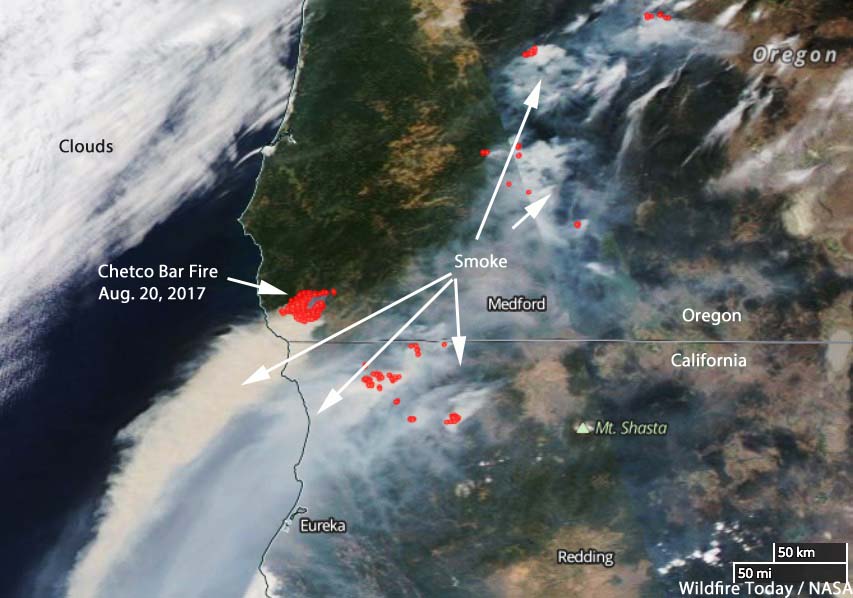
Chetco Bar Fire satellite photo
Satellite photo of smoke from the Chetco Bar Fire, August 20, 2017. The red dots represent heat detected by a satellite. Note that the smoke from the fire is a different color from the other fires in the area to the southeast and northeast.

This summer another very large wildfire, the Chetco Bar Fire, is burning partially in the footprints of the Biscuit and another nearby blaze, the 1987 Silver Fire. Also under a limited suppression strategy, the 788 personnel assigned today are faced with the steep slopes in the Kalmiopsis Wilderness as well as brush and dangerous snags left in the previously burned areas.

Evacuations are in effect and Curry County Sheriff’s Office says at least five homes have been destroyed by the fire.
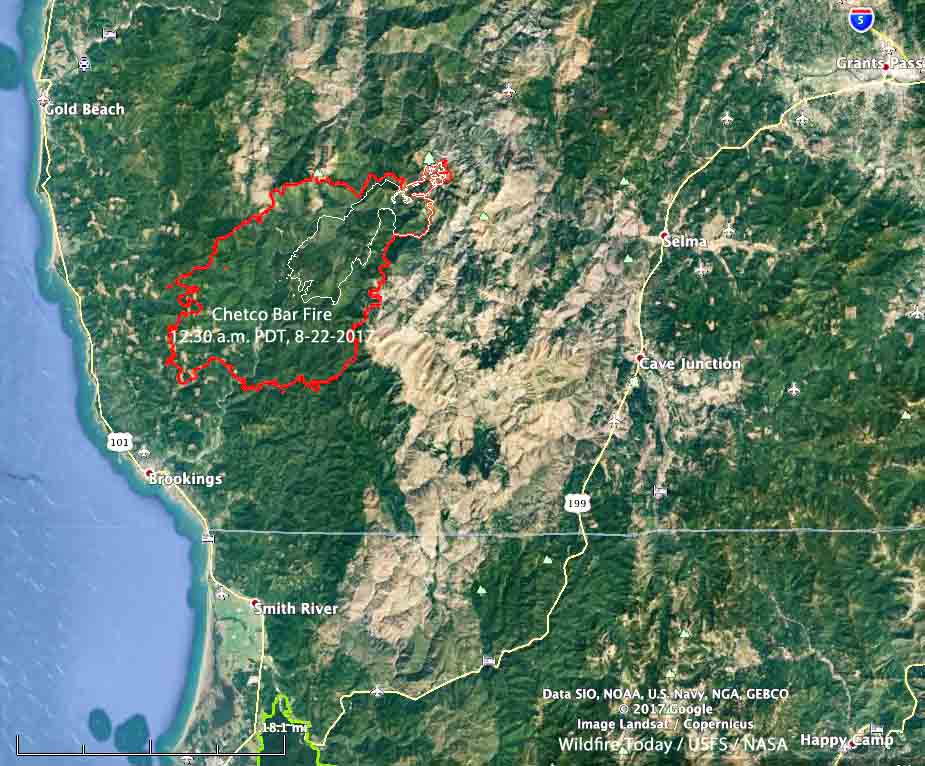
map Chetco Bar Fire
The red line was the perimeter of the Chetco Bar Fire at 2:30 a.m. PDT August 22, 2017. The white line was the perimeter on August 18, 2017.

The Phoenix National Incident Management Organization (NIMO) Team with Incident Commander Bob Houseman, on the fire since July 29, explains their task:

Because of the risk to firefighter safety, low probability of success of a direct attack strategy and minimal values at risk, fire personnel are currently focused on constructing contingency lines, conducting reconnaissance for access, scouting safe entry points, locating natural features for containment opportunities, protecting wilderness values and developing a long term plan for safely engaging the fire.

On August 18 at 4 p.m. the Chetco Bar Fire covered 22,042 acres. Early Tuesday morning August 22 it was mapped at 97,758 acres, approaching the 100,000-acre threshold of becoming a “megafire”.
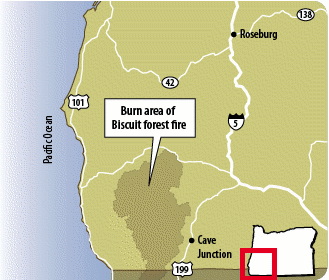
Map of the 2002 Biscuit Fire
Map of the 2002 Biscuit Fire, by Oregon Business.

For the last several days it has been spreading rapidly to the southwest growing to within five miles of Brookings, a community on the Pacific coast. It is 14 miles southeast of Gold Beach.

The Team is using a mixture of direct, indirect and point protection tactics when and where they expect there is a high probability of success. The fire is burning in areas of fire scar and islands that were previously unburned, as well as areas west of the previous fires. The combination of down and dead fuels in the old burns and newly cured grass adds complexity for firefighters.
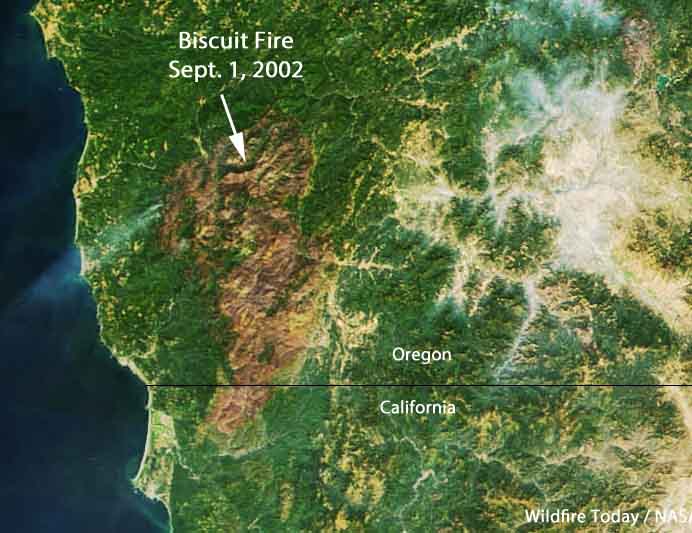
satellite photo Biscuit Fire
Satellite photo of the Biscuit Fire on September 1, 2002. Jacques Descloitres, MODIS Rapid Response Team, NASA/GSFC.

Nena Springs and Whitewater Fires are within Oregon’s total eclipse area

Map Nena Springs Whitewater Fires

Above: Map showing the approximate, not exact, locations of the Nena Springs and Whitewater Fires within the eclipse path of totality. August 19, 2017.

(Updated at 6:29 p.m. PDT August 19, 2017)

Two large Central Oregon wildfires are inside the path of totality (POT) for Monday’s eclipse — the 7,500-acre Whitewater Fire 6 miles east of Idanha and the 66,000-acre Nena Springs Fire 14 miles north of Madras.

The Nena Springs Fire was very active on Thursday and Friday, adding another 19,000 acres. A large airtanker was used Friday evening to strategically place a line of retardant along a ridgeline where the fire crossed the Warm Springs River. The fire ran less than a half mile before this action effectively stopped the run. Two Bureau of Land Management engines also successfully extinguished a fire that had grown to ¼ acre across the Deschutes River.

Ten structures have been destroyed on the Nena Springs Fire.

Whitewater Fire
Whitewater Fire, 6 miles east of Idanha, Oregon. August 19, 2017.

The Whitewater Fire a mile east of Highway 22 is actively burning near the Whitewater Trailhead in the Mt. Jefferson Wilderness east of Detroit. On Friday firefighters conducted both hand and aerial firing operations to reinforce the southwest control lines. On Saturday crews will construct more control lines and continue planned tactical hand and aerial firing operations.

There are no reports of major highways being closed due to the wildfire activity in Oregon except for Oregon Highway 242, near the Milli Fire, which remains closed from Sisters west to Hwy 126. The Milli Fire is just outside the eclipse path of totality.

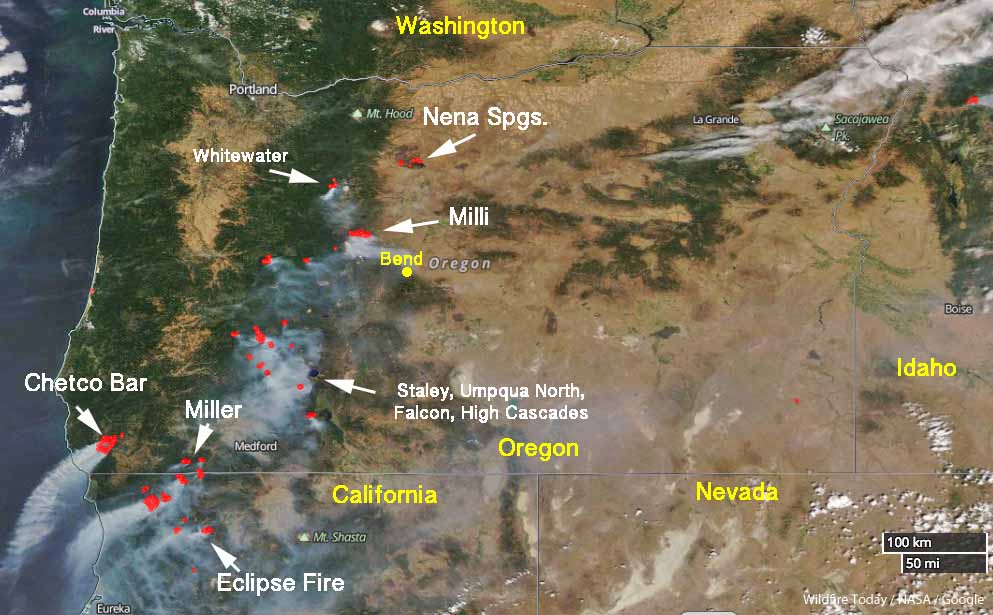
Satellite photo wildfires in Oregon Northwest California
Satellite photo of wildfires in Oregon and Northwest California, August 19, 2017.

Milli Fire mapped at 7,800 acres southwest of Sisters, Oregon

air tanker Milli Fire

Above: An air tanker maneuvers over the Milli Fire, August 18, 2017. Photo by Tommy Schroeder, PIO.

(Updated at 6:32 p.m. PDT August 19, 2017.)

The Milli Fire in Central Oregon was very active Thursday and Friday spreading to the east, growing to 7,800 acres. Friday night it was 4 miles southwest of Sisters and 16 miles northwest of Bend.

Strong winds Friday afternoon led to a spot fire across a containment line, pushing the fire 2 to 3 miles southeast toward the city of Sisters. The run triggered evacuations affecting approximately 600 people.

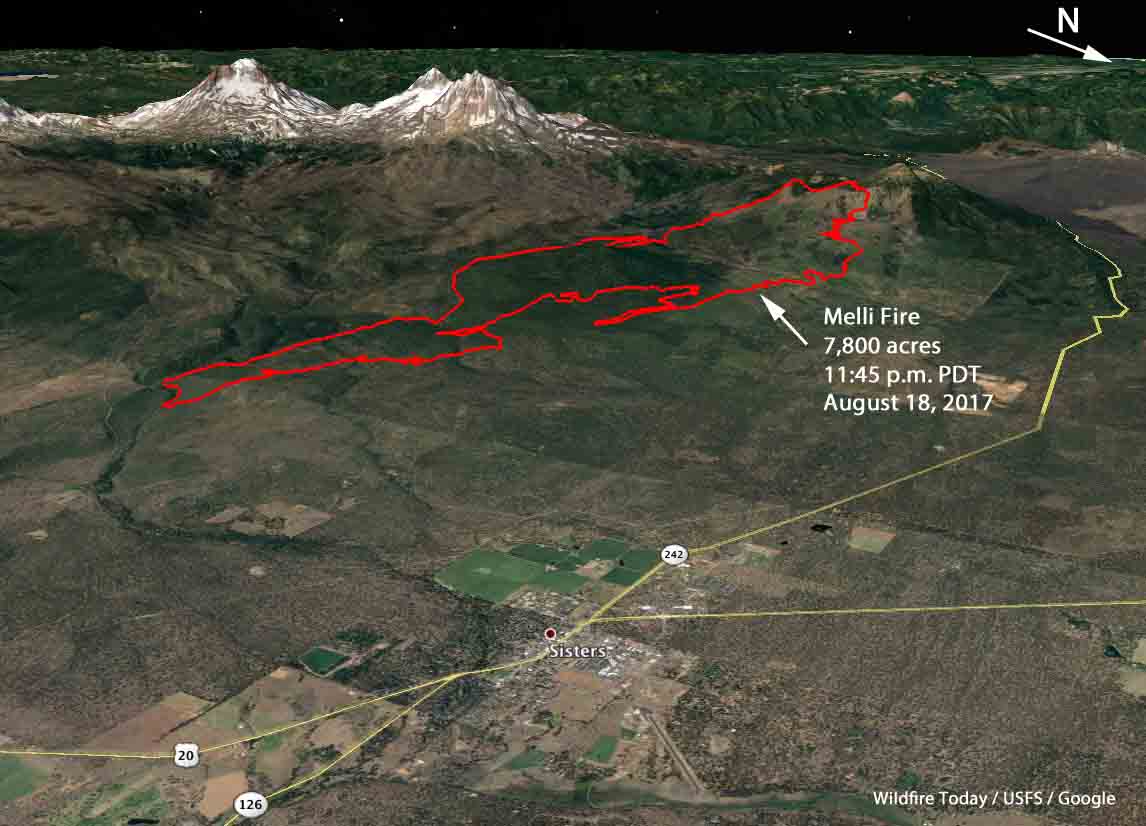
Map of the Milli Fire
3-D map of the Milli Fire looking southwest at 11:45 p.m. PDT August 18, 2017.

Crews overnight worked to build a direct line on the leading edge of the fire, with engine crews patrolling the area and dozer crews constructing fireline. Temperatures today (Saturday) are expected to be a few degrees cooler with higher humidity. However, the winds that pushed the fire on Friday will be back, with gusts up to 22 miles an hour, from around 10 am to 9 pm. Temperatures should range from 70 – 75 degrees, with humidity ranging from 22 to 26%.

The wind could cause more spot fires to develop and firefighters will be actively identifying them and containing them where possible. Also, today firefighters will be working to contain the area where the fire extended yesterday and will be constructing new containment lines between the fire’s edge and the communities that are threatened.

Engine task forces from the Oregon State Fire Marshal’s office will be working in the evacuated neighborhoods, treating spaces around homes to provide better defensible space.

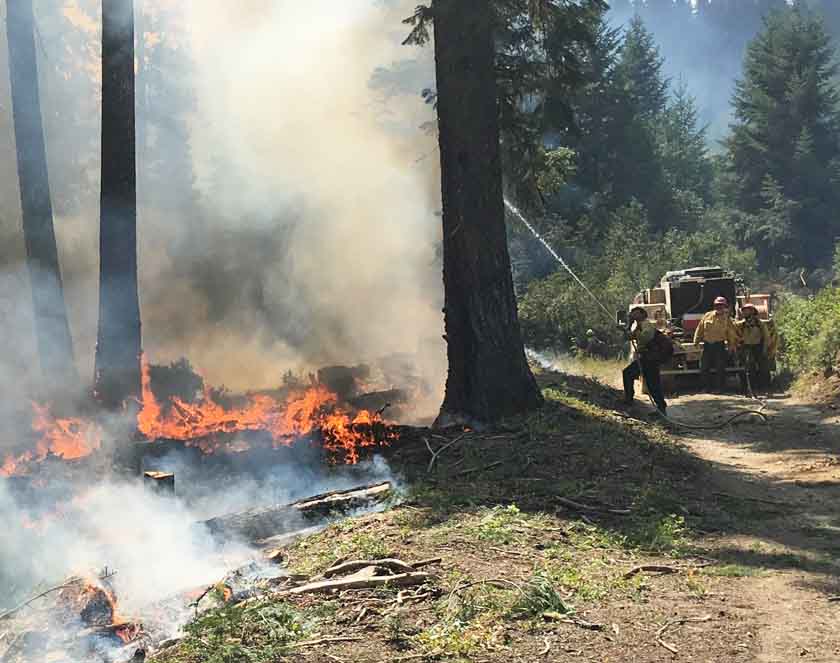
Aviation resources have been very important in fighting this fire. Three air tankers and one VLAT (very large air tanker) have been making repeated drops of fire retardant, creating fire lines and assisting our crews in inaccessible areas.

Oregon Highway 242 remains closed from Sisters west to Hwy 126. There are no reports of structures being destroyed in the fire.

The fire is just south of the eclipse path of totality. Highway 20 between Bend and Sisters is still open, but if it closes it could have an impact on eclipse viewers.

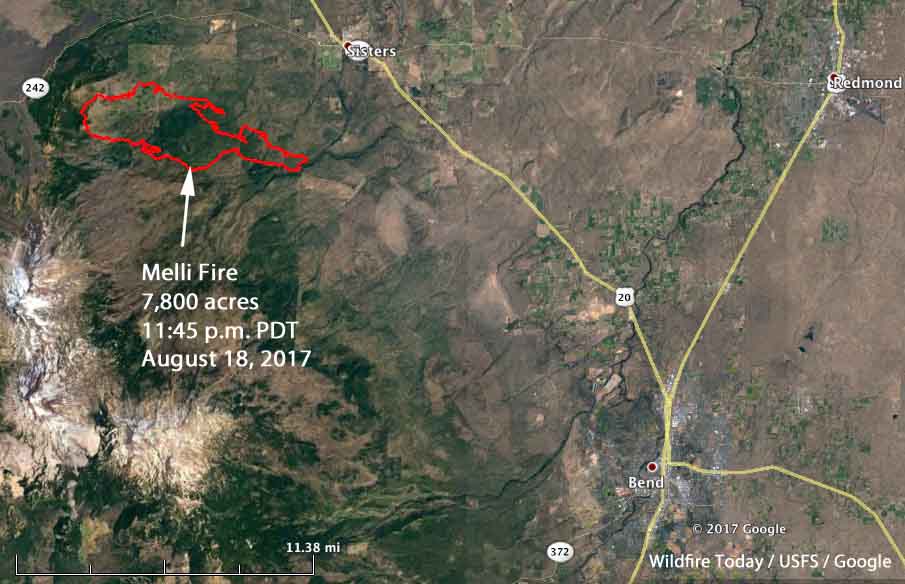
Map of the Milli Fire
Map of the Milli Fire at 11:45 p.m. PDT August 18, 2017.

Satellite photo wildfires in Oregon Northwest California
Satellite photo of wildfires in Oregon and Northwest California, August 19, 2017.

Firefighters make preparations for the eclipse

eclipse oregon wildfire path

Above: The path of eclipse totality in Oregon and Idaho on August 21, showing the locations of large wildfires that were active August 18, 2017.

(Revised at 9:08 a.m. MDT August 19, 2017)

Most of the wildland firefighters that will be deployed on wildfires Monday August 21 will have never seen a solar eclipse, or especially a total eclipse that will be seen in parts of Oregon, Idaho, Utah, Wyoming, Nebraska and other states. We began to wonder what fire organizations will do when in the middle of the day they are plunged into nighttime conditions.

It will be dark for up to 2.5 minutes in the path of totality (POT) but outside that track and immediately before and after the total eclipse within the track there will be plenty of light. So the actual physical effect for ground-based firefighters will be minimal.

However, as Traci Weaver, Public Affairs Officer for the U.S. Forest Service’s Pacific Northwest Region told us, the event will likely be a once in a lifetime event for most of the firefighters and will be extremely distracting, at least. Firefighters will be asked to take a break during the totality and cautioned against being near snags or slopes that could have rolling rocks.

solar eclipse in France in 1999
Total solar eclipse in France in 1999. Luc Viatour https://Lucnix.be

The USFS Pacific Northwest Region, known as Region 6, includes Oregon, and the 60-mile wide path of totally will pass all the way across the state. It will include or almost include at least four large active fires, Nena Springs (46,000 acres), Whitewater (6,791), Whychus (2030), and Milli (4,565).

Region 6 did not just start thinking about the eclipse this week. They have been planning for a year on how to handle it safely. Five Central Oregon counties held a tabletop exercise that involved not only firefighters but law enforcement, hospitals, the Department of Transportation, and other agencies.

The Whitewater Fire, Ms. Weaver said, has established an Eclipse Branch. Remote spike camps on fires will have enough supplies to be self-sufficient for at least four days.

The normal tourist season combined with a busy firefighting environment and eclipse watchers flocking in from distant locations could mean ground and air traffic and logistics on fires will be affected.

A briefing paper distributed by R-6 included this analysis:Continue reading

Wildfires in Northwest California and Southern Oregon were very active Thursday

satellite photo fires california oregon

Above: satellite photo of fires in Northwest California and Southern Oregon, August 17, 2017.

(Originally published at 11:30 a.m. MDT August 18, 2017)

Wildfires in Northwest California and Southern Oregon were very active on Thursday. Three of the largest fires on the Klamath National Forest in California are the Salmon August Complex (4,418 acres), Eclipse Complex (17,501), and Clear Fire (6,701).

The Ruth and Orleans Complexes on the Six Rivers NF have burned 4,617 and 6,943 acres respectively.

Eclipse Complex firefighters
Eclipse Complex firefighters on Division D. Photo by B. Patton. InciWeb.

Oregon and Washington have a total of 24 large fires; 15 are being suppressed and 9 are being managed with less than full suppression strategies. Some of the more active fires in Southern Oregon on Thursday were: Chetco Bar (8,500 acres), Miller (4,668), Jones (2,703), Milli (4,565), Umpqua North (3,414), and High Cascades (10,460).

Milli Fire
Milli Fire at 4 a.m. PDT August 16, 2017. Inciweb.

Air Force reconnaissance aircraft is being used to detect and map wildfires in the Northwest


Warning: Trying to access array offset on value of type bool in /home/customer/www/wildfiretoday.com/public_html/wp-content/themes/jupiterx/lib/api/image/functions.php on line 61

Deprecated: ltrim(): Passing null to parameter #1 ($string) of type string is deprecated in /home/customer/www/wildfiretoday.com/public_html/wp-content/themes/jupiterx/lib/api/utilities/functions.php on line 206

Deprecated: preg_replace(): Passing null to parameter #3 ($subject) of type array|string is deprecated in /home/customer/www/wildfiretoday.com/public_html/wp-content/themes/jupiterx/lib/api/image/class-image-editor.php on line 177

Warning: Undefined array key "extension" in /home/customer/www/wildfiretoday.com/public_html/wp-content/themes/jupiterx/lib/api/image/class-image-editor.php on line 179

Deprecated: preg_match(): Passing null to parameter #2 ($subject) of type string is deprecated in /home/customer/www/wildfiretoday.com/public_html/wp-includes/functions.php on line 3089

Deprecated: is_file(): Passing null to parameter #1 ($filename) of type string is deprecated in /home/customer/www/wildfiretoday.com/public_html/wp-includes/class-wp-image-editor-gd.php on line 95

Deprecated: preg_match(): Passing null to parameter #2 ($subject) of type string is deprecated in /home/customer/www/wildfiretoday.com/public_html/wp-includes/class-wp-image-editor-gd.php on line 95

Warning: Trying to access array offset on value of type bool in /home/customer/www/wildfiretoday.com/public_html/wp-content/themes/jupiterx/lib/api/image/functions.php on line 61

Deprecated: ltrim(): Passing null to parameter #1 ($string) of type string is deprecated in /home/customer/www/wildfiretoday.com/public_html/wp-content/themes/jupiterx/lib/api/utilities/functions.php on line 206

Deprecated: preg_replace(): Passing null to parameter #3 ($subject) of type array|string is deprecated in /home/customer/www/wildfiretoday.com/public_html/wp-content/themes/jupiterx/lib/api/image/class-image-editor.php on line 177

Warning: Undefined array key "extension" in /home/customer/www/wildfiretoday.com/public_html/wp-content/themes/jupiterx/lib/api/image/class-image-editor.php on line 179

Deprecated: preg_match(): Passing null to parameter #2 ($subject) of type string is deprecated in /home/customer/www/wildfiretoday.com/public_html/wp-includes/functions.php on line 3089

Deprecated: is_file(): Passing null to parameter #1 ($filename) of type string is deprecated in /home/customer/www/wildfiretoday.com/public_html/wp-includes/class-wp-image-editor-gd.php on line 95

Deprecated: preg_match(): Passing null to parameter #2 ($subject) of type string is deprecated in /home/customer/www/wildfiretoday.com/public_html/wp-includes/class-wp-image-editor-gd.php on line 95

Deprecated: ltrim(): Passing null to parameter #1 ($string) of type string is deprecated in /home/customer/www/wildfiretoday.com/public_html/wp-includes/formatting.php on line 4558

An RC-26 from Fairchild Air Force Base in Spokane is assisting with situational awareness in the firefighting effort.

Continue reading

Dozens of active wildfires in the Northwest U.S.

wildfires northwest united states

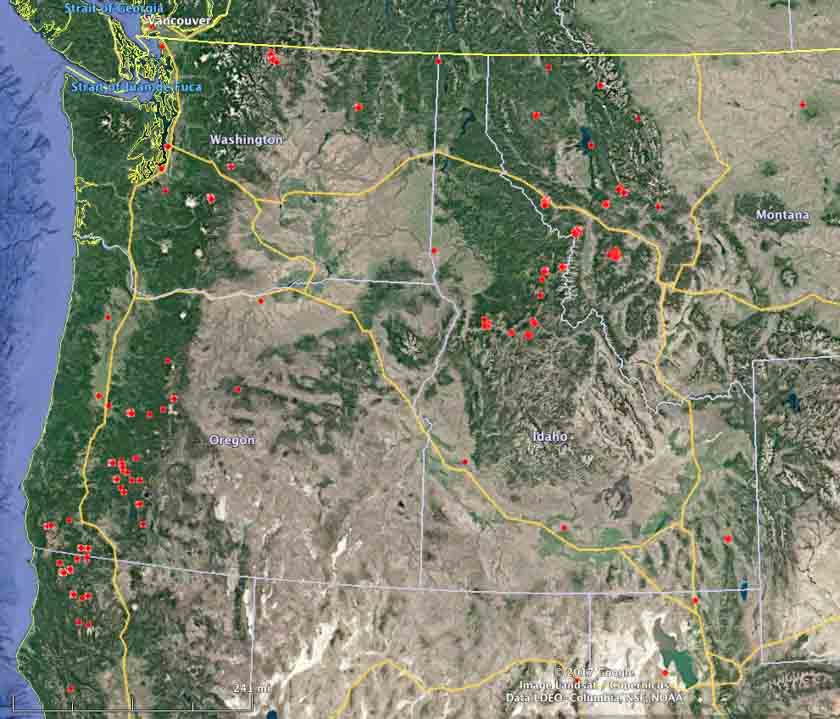
Above: Active wildfires in Washington, Oregon, Idaho, Western Montana, and Northern California at 4:18 a.m. MDT August 16, 2017.

(Originally published at 10:21 a.m. MDT August 16, 2017)

Dozens of wildfires are active in the Northwest one-quarter of the United States. Many of them have been burning for several weeks under a limited suppression strategy. The states of Washington and Oregon have a total of 32 large uncontained fires that have spread over 810,171 acres.

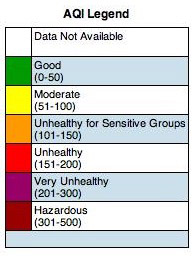
Air Quality Index LegendAt times the area around Missoula has been heavily affected by smoke. Here are some PM 2.5 readings from Wednesday morning:

  • Seeley Lake: 180
  • Missoula: 33
  • Lolo: 54
  • Superior: 180
  • French Town: 19
  • Clinton: 26
wildfires near Missoula, Montana
Satellite photo showing smoke from wildfires near Missoula, Montana, August 15, 2017.
wildfires northwest california
Satellite photo showing smoke from wildfires in northwest California, August 15, 2017.
wildfires northwest united states
Active wildfires (without added name tags) in Washington, Oregon, Idaho, Western Montana, and Northern California at 4:18 a.m. MDT August 16, 2017.

A variety of C-130 air tankers at Medford

MAFFS 5 Medford Oregon

On June 30 there was a variety of C-130 air tankers working out of Medford, Oregon, and Tim Crippin was able to capture them on celluloid an SD card. It kind of boggles the mind to see three C-130 air tankers at the same air tanker base, all operated by completely different organizations.

There was one privately owned tanker, Coulson’s T-132, and two government-owned. T-116 will eventually, one of these days, way down the road, perhaps, be officially transferred from the Coast Guard to the U.S. Forest Service. And MAFFS 5 is from the Colorado Springs Air Force Reserve base.

Two other MAFFS C-130’s are also activated — one each from Air National Guard units at Cheyenne and Reno.

Tanker 116 Medford Oregon
Tanker 116 at Medford, Oregon, June 30, 2017. Photo by Tim Crippin.

Coulson T-132 Medford Oregon
Tanker 132 at Medford, Oregon, June 30, 2017. Photo by Tim Crippin.

Wildfire smoke produces “unhealthy” conditions in some areas of the US Northwest and British Columbia

wildfire smoke map

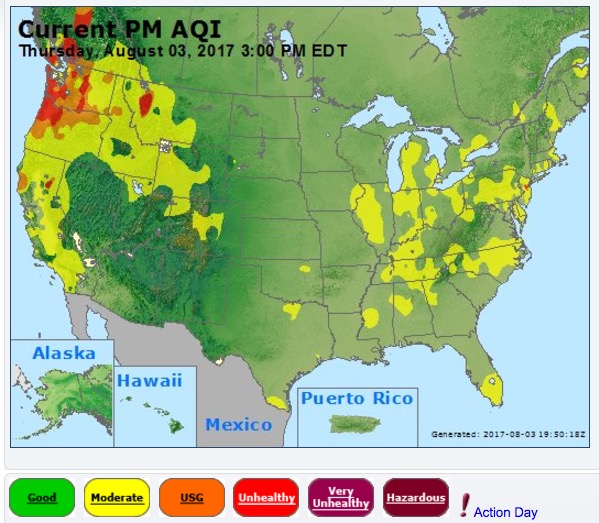
Above: The distribution of wildfire smoke, current as of 2:09 p.m. MDT August 3, 2017.

(Originally published at 2:50 p.m. MDT August 3, 2017)

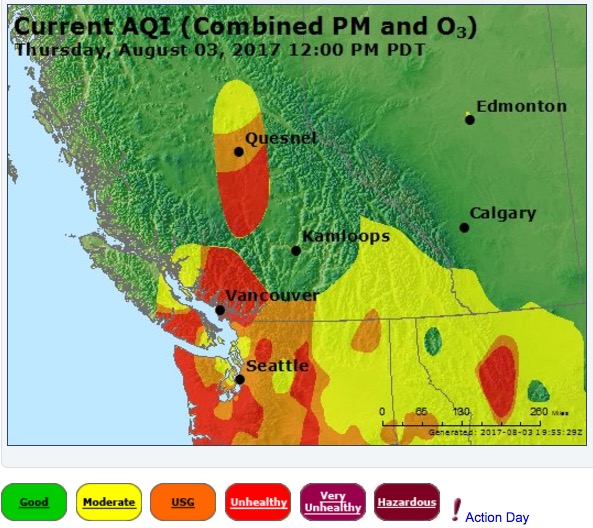
Smoke from wildfires in the United States Northwest and southern British Columbia is accumulating in those areas causing, in some areas, significant degradations in air quality. In British Columbia many massive fires combined with light winds has resulted in the smoke not being transported out of the area.

air quality smoke united states
Air quality August 3, 2017 for western Canada and parts of Washington, Idaho, and Montana.

Some areas in BC, western Montana, and the western portions of Washington and Oregon have “unhealthy” air quality today, according to Air Now.

air quality smoke west canada

Continue reading