Thoughts about the Air Force report on the crash of MAFFS #7

(Revised at 9:22 MT, November 30, 2012)

It takes a while to digest the 49-page report on the July 1 crash of MAFFS #7, the military C-130 air tanker, in which four crew members were killed. Earlier we posted a summary of the report, but here are some additional thoughts.

MAFFS crash, radar at 1733L
MAFFS crash, radar at 1733, five minutes before the crash.

The radar image above, 5 minutes before MAFFS #7 impacted the ground at 1738 local time, recorded a very large thunderstorm cell southwest of the crash site. The middle of the concentric circles is the location of the crash. The circles indicate 5, 10, and 15 nautical miles from the impact site. The light green areas may have been virga, rain that was not reaching the ground. The red, light brown, dark green, and possibly the yellow areas were most likely rain, accompanied by strong winds. The longest east-west line is the South Dakota/Nebraska state line. The longest north-south line is the boundary between Wyoming and the states of South Dakota and Nebraska.

In addition to the C-130 working on the fire, there was also a Bureau of Land Management Air Supervision Module aircraft which was flown by a lead plane pilot and also carried an Air Tactical Group Supervisor. It was acting as the lead plane at the time of the accident.

Wildfire Today was the first to report the day after the crash that:

The ASM/Lead experienced a severe downdraft while approaching the intended retardant drop zone with the C130 in trail. This is being investigated by the US Forest Service as a separate Incident With Potential.

The third fixed wing aircraft to arrive at the White Draw fire that was mentioned in the report served as Air Attack. It was piloted from the left seat by Air Attack 3 (AA3 in the report), and in the right seat was the Air Tactical Group Supervisor. Both were employed by the State of South Dakota.

Before the crash, the air attack aircraft encountered sudden updrafts and downdrafts with airspeed fluctuations between 20 to 40 knots, which forced the aircraft into bank angles of approximately 90 degrees.

Here are some interesting passages from the report that discuss the weather conditions:

At 17:38:18L, MP1 ordered an e-dump of the retardant, which was immediately conducted. At the same time, Firefighter 1 (FF1) a ground firefighter, was located approximately 1.5 miles west-southwest of the future mishap site. FF1 witnessed the MA [mishap aircraft] jettison their retardant load, at which time she experienced variable surface winds with estimated gusts up to 50 miles per hour. At the same time, in Air Attack, ATGS observed the smoke lying down and “sheeting” of the fire, indicating to him “hellacious” surface winds. ATGS and AA3 lost altitude, experienced updrafts and downdrafts with airspeed fluctuations of 20 to 40 KIAS and severe turbulence. Air Attack lost an estimated 1,000 ft due to the weather conditions. ATGS did not see the MA jettison the retardant load.

Between 1730L and 1745L, Incident Commander 1 (IC1), a member of the Army National Guard, was traveling on a motorcycle, southbound on Highway 18 approximately seven miles north of Edgemont attempting to get to an 1800L meeting at the White Draw Fire incident command center in Edgemont, South Dakota. While heading towards Edgemont, IC1 witnessed the MA flying to his right, approximately one mile away, making a bank as the MA prepared for their approach to the drop area. IC1 lost sight of the MA while going down the hill towards Edgemont, at that same instant, IC1 was “hit with this extreme, fierce wind”. IC1 described it as side wind because it “pushed me over to the other side of the highway”.

The MAFFS crew received a briefing on the weather for the Arapahoe fire they dropped on earlier in Wyoming, but they did not have any specific weather information on the weather for the White Draw fire in southwest South Dakota and no update was requested when they were diverted to that fire.

From the report:

On 1 July 2012 at 1650L, the National Weather Service issued a severe thunderstorm watch for northeast Wyoming and western South Dakota encompassing the area surrounding Edgemont, South Dakota and the White Draw Fire. The severe thunderstorm watch, valid from 1650L to 2300L, was issued for potential hail up to two inches in diameter and wind gusts up to 70 miles per hour. However, there was no evidence the MC requested or received forecast weather information for South Dakota or the White Draw Fire area at any time on 1 July 2012.

After dropping on the Arapahoe fire in Wyoming, the MAFFS was dispatched to the Highlands fire west of Custer, South Dakota. But en route they were diverted to the White Draw Fire which was 24 miles southeast of the Highlands Fire.

At that time I was taking photos at the Highlands Fire and the Oil Creek Fire, the latter being farther west  across the state line near Newcastle, Wyoming. Between 1730 and 1830 I remember seeing massive, very dark thunderstorm clouds to my southeast. The photo below taken at 1715 is looking south toward the Highlands Fire. In the background the dark clouds farther south can be seen.

Highlands Fire
Highlands Fire, 1715 MT, July 1, 2012. Photo by Bill Gabbert

From 1630 until 1645 a Canadian “Bird Dog” and a CV-540 were over the Highlands fire. They were asked to drop, but refused, saying there were too many people on the ground in the intended drop area. It would be interesting to know where they went after being released from that fire, or if the weather affected the decision about their destination.

CV-540, T44, over Highlands Fire
CV-540, T44, over Highlands Fire, at 1708 MT, July 1, 2012. Photo by Bill Gabbert

The MAFFS has a capacity of 3,000 gallons, but each time MAFFS #7 reloaded that day they refilled with less retardant. At the White Draw fire it was only carrying 2,346 gallons which it split into two drops on the fire.

Crew rest or fatigue were not issues, according to the report.

Regarding the radio transmissions from the lead plane pilot saying “I got to go around” after encountering the downdraft and coming within 10 feet of the ground, and a few seconds later calmly advising the MAFFS to “drop your load when you can”, (meaning an emergency release of retardant to lighten the load, enabling the aircraft to more easily maneuver) the report said:

MAFFS aircrew members attested that a call for a go around is most commonly heard regarding misalignments for drops rather than urgent situations. It is possible that [the lead plane’s] call for a go around while meant to abort the mishap drop, was not interpreted by the [MAFFS Crew] as significantly urgent, based on their prior experience.

According to the report the overall flying experience of the MAFFS crew was high.

However [the pilot, the aircraft commander] had limited experience as a MAFFS aircraft commander and [the navigator] was participating in his first MAFFS mission. [The pilot] was a current and qualified Senior Pilot with over 1,900 total C-130 hours, however prior to the day of the mishap he had accomplished only seven drops as a MAFFS copilot and zero drops as a MAFFS aircraft commander.

The second pilot was more experienced with MAFFS and served as a MAFFS instructor pilot for this sortie.

The emergency locator transmitter (ELT) failed to activate when the C-130 crashed. One of the survivors called 911 on his cell phone and reported the crash but he said he didn’t know where he was.

The flight data recorder for the C-130 was found and shipped to the Air Force Safety Center for data retrieval and analysis. The report said the last 12.8 hours of data on the device were corrupt and unusable for investigation purposes.

There was no evidence that aircraft weight or the MAFFS unit in the cargo hold were factors in the crash. “Prior to the mishap, the MAFFS unit was operating at 100 percent capability and an emergency dump was successfully completed.”

About 34 minutes after the crash, firefighting helicopter crews assigned to the fire that were on the ground at the nearby Edgemont Municipal Airport were notified about the crash. But they were unable to fly at that time due to heavy rain, gusty winds, and a low ceiling. While waiting, an EMT loaded medical equipment on N935CH, call sign 5CH.

At the time of the crash the air attack ship was at 1,500 feet above the ground and following the MAFFS aircraft, observing the drop. On that pass the air attack ship had their hands full, experiencing extreme turbulence which resulted in bank angles of approximately 90 degrees. After the crash it had to leave the area due to the strong turbulence and the approaching thunderstorm. It loitered at a safe distance for about 30 minutes before it was able to access the area again, after which it led one of the fire’s helicopters, H-535, to the site.

During the last pass, the lead plane over-temped (or “smoked”) the aircraft engines while attempting to recover from being pushed down to within 10 feet of the ground and had to go to the Rapid City Airport.

When the weather improved, the two helicopters, N911FS, call sign H-535 (from the San Bernardino National Forest in southern California), and 5CH, departed and proceeded toward the mishap site. When they landed at the site at approximately 1850, the EMT on 5CH met the survivor who was still talking to the 911 operator on his cell phone. The EMT assessed and began treating him while the other helicopter crewmembers searched for other survivors, eventually finding the second survivor “wandering near the mishap site”. Helicopter 5CH transported both survivors to the Custer Airport, about 10 minutes away. One of them was then flown by an emergency medical helicopter to Rapid City while the other went by ground ambulance to a hospital.

As Wildfire Today reported on September 17, the pilot and at least two crewmembers of H-535 were given awards for their actions related to the crash. It is possible that others involved in the emergency response to the incident also received awards.
MAFFS 7 awards
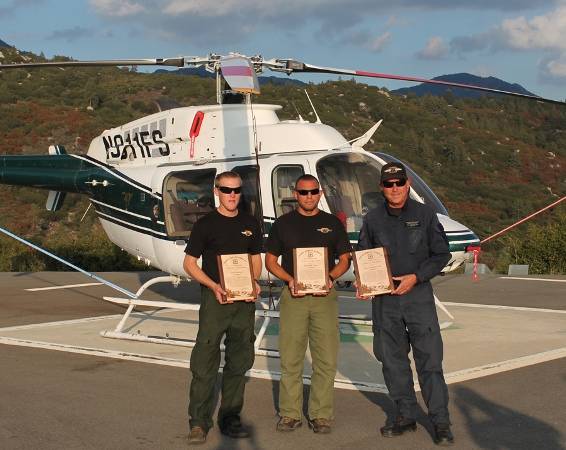
Firefighters Daniel Diaz (center), Kevin Walters (left), and pilot Chuck MacFarland (right) receive their awards for their actions following the crash of MAFFS 7. Photo credit: San Bernardino National Forestx

Wildfire Today has an article about the differences between a military and a US Forest Service accident investigation.


A paragraph in this article was revised November 30, 2012 to clarify the actions of the air attack and lead plane immediately after the crash.

Senators want more timber sales to protect urban areas

Stage Hill Fire
Stage Hill Fire
Stage Hill Fire near Cascade, SD, June 16, 2012. Photo by Bill Gabbert

The six US Senators in Colorado, Wyoming, and South Dakota have signed a letter sent to Agriculture Secretary Tom Vilsack recommending an increase in the number of timber sales on national forests in areas prone to wildfires. In the letter dated November 8 the senators said overgrown forests, drought, vast stretches of trees killed by beetles, and more people living in fire zones have left the West at a critical juncture. They urged the US Forest Service to conduct more forest thinning near critical infrastructure and in areas where urban areas are up against forests.

The letter was signed by Senators Mark Udall and Michael Bennet of Colorado; Mike Enzi and John Barrasso of Wyoming; and Tim Johnson and John Thune of South Dakota.

Colorado Senator calls for modernization of air tanker fleet

Air tankers at Rapid City
50-year old P2V air tankers at Rapid City, July 21, 2012. Photo by Bill Gabbert

A Colorado Senator has issued a press release stating that he is in favor of the modernization of the firefighting air tanker fleet. Senator Michael Bennet is quoted as saying:

After a wildfire season that has wreaked havoc in Colorado, it is clear that we need adequate resources in order to fight these fires and prevent extensive damage to our forests and surrounding communities in our state and across the country. With the average Forest Service aircraft more than 50 years old, I am committed to modernizing our aerial firefighting capacity and working with my Senate colleagues to pursue every avenue available, including possible legislation, to ensure that the necessary resources are available to fight future wildfires.

Mr. Bennet wrote a letter to Senators Jack Reed and Lisa Murkowski who serve as chairman and ranking member, respectively, of the Senate subcommittee that oversees the Forest Service’s appropriations. In the letter Bennet wrote, in part:

…the Secretary of Agriculture needs flexibility and options to renew a viable and effective fleet to protect the nation.”

Statements like that are very nice. Who is NOT in favor of more air tankers after learning the startling fact that the fleet has declined from 44 in 2002 to the 11 we have today. Most of us are also in favor of more apple pie and walks on the beach. But saying, like others have said over the last year, that he wants more air tankers and making a vague reference to legislation will not rebuild the fleet. Actions speak louder than words.

One of the primary reasons the number of air tankers is not scheduled to exceed 16 in the foreseeable future is that Congress and the President have cut the budget for fire suppression to the point that we can’t afford any more. When Congressmen and Senators whine about having too few air tankers, they need to look in the mirror.

Senators and Congressmen have the power to actually INTRODUCE and PASS legislation that would increase the U.S. Forest Service aviation budget that could provide funding for more air tankers. The agency only has the money now to add seven to the fleet over the next two years, and that will happen only if they can get their contracting house squared away so that they can award the contracts that have been advertised.


Thanks go out to Bean

Photos of the Fork and Glenerin Fires

Glenerin Fire


Fork FireWe checked out the Fork Fire west of Custer, SD, and the Glenerin fire east of Custer this afternoon and shot some photos. The Fork Fire was pretty quiet and had a fire line around it. There was still some interior burning going on and quite a bit of mop-up left to do, but thanks to the good work of the firefighters the prognosis is good.

These first photos are of the Fork Fire. The Glenerin photos are farther down.

(More information about these fires.)

Fork Fire
There were a handful of structures within and adjacent to the fire that were protected and saved.
Fork Fire
Much of the area that burned had been thinned. There was virtually no torching or crowning anywhere in the fire due to the thinning, the wide spacing of the trees, the lack of ladder fuels, the low Haines Index, and the very strong wind that did not allow heat to build up in the crowns, keeping the fire on the ground.

More photos are below.

Continue reading

NIFC wraps up the 2012 fire season

Careless Match Sign at Myrtle fire
“A careless match destroys”. Sign in the Myrtle fire in South Dakota, July 23, 2012. Photo by Bill Gabbert

On a day that we published articles on Wildfire Today about numerous fires in South Dakota, several fires in Nebraska that burned a total of 58,000 acres Wednesday, and towns in North Dakota and Idaho that were virtually wiped out by fires this week, the National Interagency Fire Center posted an audio recording by Public Affairs Specialist Ken Frederick wrapping up the 2012 fire season. You can check it out HERE.

Wildfire news, October 8, 2012

White Draw fire
White Draw fire
White Draw fire, Black Hills of South Dakota, July 7, 2012. Photo by Bill Gabbert

U.S. Forest Service ran out of money for fires

Because the federal government only appropriates funds for firefighting based on a 10-year average, and with this year having more than the average number of fires, the U.S. Forest Service ran out of money. The agency had to take funds from other accounts to continue to suppress fires. Congress dealt with the issue, providing $400 million from the 2013 Continuing Resolution.

The Washington Post has a straight forward article on the subject, and if you like a little commentary thrown in, you can check out how FireDogLake reported the story.

Air tanker company busier than usual

And speaking of more fires than average, New Frontier Aviation which operates single engine air tankers, has been much busier this summer than in an average fire season. Andy Taylor, the owner of the company told a reporter for the Capitol Journal, that the last time he remembers a fire season being this busy was in 2006.

Nebraska official says better forest management could have lessened impacts of recent fires

A District Forester for the Nebraska Forest Service said better forest management could have lessened the adverse impacts of some of the recent fires that burned forest lands in the northwest part of the state. In the article attributed to the Associated Press, Chadron based District Forester Doak Nickerson suggested that land owners could concentrate more on “active management, a term that includes activities such as logging, grazing, thinning out diseased and insect-infested trees, and purposely setting controlled fires to clear brush that can feed a fire”.

Interestingly, the article was published by many organizations around the country with a misleading headline reading “Logging Could Have Eased Neb. Fires”, found on The Weather Channel, the Scotts Bluff Star Herald, and My San Antonio. To their credit, The Republic, an Indiana publication, had the following headline: “Official says Nebraska forest struck by wildfire was overgrown, could have been better managed”.

The Associated Press probably distributed the article with the suggested headline about logging, but The Republic must have actually read the article and composed a headline that more accurately reflected what the District Forester was reported as saying in the article. Good work by The Republic.

Happy National Coffee Day

Wildfire Today coffee mug

So what are you doing to celebrate National Coffee Day?

Wildfire Today coffee mug

Yep, that’s what today is. It’s a real thing. So real, in fact, that some businesses are actually giving away coffee on this very special day — for example Krispy Kreme, McDonalds, Caribou Coffee, and Dunn Brothers. Not all chain locations are participating, so ask first.

And another reason to enjoy your cup of coffee today; researchers this year found that java drinkers who average several cups per day had the lowest risk of death during the study.

I’m going to enjoy this cup and then watch some football. What are you doing today?


Six single engine air tankers ready for fires in South Dakota

Air Tanker 466 at Hot Springs
Air Tanker 466, a Dromader, at Hot Springs, SD, March 14, 2012. Photo by Bill Gabbert

In what is unprecedented in the state, six Single Engine Air Tankers (SEATs) are staged and available to help to fight wildfires in South Dakota this week. The aircraft are positioned at  Pierre, Mobridge, Valentine, Hot Springs and two in Lemmon.

Part of the reason for the surge in the numbers of air tankers is the opening of pronghorn antelope season on Saturday.

There have been quite a few fires in western South Dakota this year and the SEATs have been busy.

Squirrel causes vehicle fire

Vehicle fire south of Wind Cave National Park
Vehicle fire south of Wind Cave National Park, 1:15 p.m. MT, September 26, 2012. Wildfire Today photo by Bill Gabbert

Wednesday afternoon an older couple was driving their Dodge pickup truck on US Highway 385 just south of Wind Cave National Park in South Dakota when they smelled smoke. The driver told us that it smelled like a forest fire but they could not see any nearby — until the interior of the truck filled with smoke. They pulled over and called 911 on their cell phone and then stood on the side of the road several hundred feet away with their two dogs as the truck burned, waiting for what they thought was the inevitable explosion — just like they have seen so many times in movies.

Vehicle fire south of Wind Cave National Park

When they received the dispatch to the fire the engine crew from Wind Cave was only about four miles away doing some training. Already wearing their Nomex shirts, they responded in Engine 628 (the white truck) and saw that the burning vehicle was on the side of the road parked at a driveway, which provided more clearance than if the truck had stopped anywhere else. With the strong wind that was blowing, one burning ember in the grass alongside the road and the fire would have been over the hill quickly. The National Park Service engine crew quickly knocked down the fire, keeping it from spreading into the vegetation, and then turned it over to firefighters from Hot Springs when they arrived from their station about 6 miles away.

Congratulations to the Wind Cave crew for preventing what could have become a large vegetation fire. The weather at the Elk Mountain weather station a few miles away recorded a 10 mph wind with gusts up to 22 at the time of the fire. Darren Clabo, a fire meteorologist for the state of South Dakota, sent out this tweet earlier today:

Extreme Fire Danger for many West River counties today. Gusty southeast winds with RHs falling below 20%


Vehicle fire south of Wind Cave National Park

The occupants told us that after they pulled over they saw pine cones dropping out of the engine compartment as the truck burned. They figured that while they had been camping, a squirrel had designated their truck as a storage facility for its’ winter food supply. The pine cones must have been close to an exhaust pipe which caused them to ignite.

After I downloaded these images I noticed some pine cones in the picture above. Below is an enlargement of the area below the truck’s engine, with arrows pointing out some of the pine cones that were still recognizable.

Pine cones at vehicle fire south of Wind Cave National Park
Pine cones at vehicle fire south of Wind Cave National Park (click to enlarge)

We are adding this to our articles that are tagged “animal arson” — the 10th in the series — so far.

Wildfire briefing, September 17, 2012

MAFFS cockpit

US Forest Service deactivates the last two MAFFS air tankers

MAFFS cockpit
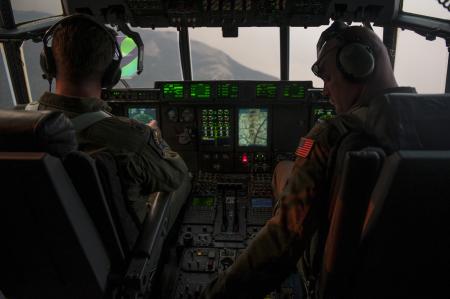
From the cockpit of a MAFFS C-130, Lt. Col. William Wilson (left) and Maj. Matthew Ringlein (right) of the 146th Airlift Wing, Channel Islands, Calif., prepare to drop retardant on a wildfire in northern California, August 24, 2012. Photo by Master Sgt. Adrian Cadiz.

The US Forest Service has released from fire duty the last two Modular Airborne Fire Fighting System-equipped military C-130s. At one time this summer all eight were active, which was the first time since 2008 eight C-130s had been activated simultaneously.

According to 153rd Air Expeditionary Group officials based in Boise, Idaho, this season has become the second-highest in MAFFS history for gallons of fire retardant dropped, surpassed only by the MAFFS season of 1994 when about 5 million gallons were dropped. This season, through Sept. 14, the MAFFS fleet released almost 2.5 million gallons of fire retardant during 1,011 drops on fires in 10 states.

Awards presented for actions following the crash of MAFFS air tanker

MAFFS 7 awards
Firefighters Daniel Diaz (center), Kevin Walters (left), and pilot Chuck MacFarland (right) receive their awards for their actions following the crash of MAFFS 7. Photo credit: San Bernardino National Forest

One of the MAFFS C-130s mentioned above, MAFFS 7, crashed on July 1 while working on the White Draw Fire west of Hot Springs, South Dakota, killing four people and injuring two. Recently awards were presented to at least three helitack crew members honoring them for their efforts in the rescue and recovery of the crew members of the C-130. Awards were given to Firefighters Daniel Diaz, Kevin Walters, and pilot Chuck MacFarland from the San Bernardino National Forest. There may also have been awards given to other firefighters that were involved in the incident.

Helicopter 535 from Keenwild Station on the San Bernardino National Forest and a helicopter from Wasatch, which were both assigned to the White Draw Fire, responded to the crash and effected the rescue of the two surviving crew members and initiated the search for the deceased. Media reports at the time said the two survivors were picked up by helicopter from the crash site and flown to the Custer airport approximately 25 miles north of the fire. From there one was flown by a life flight helicopter to a hospital in Rapid City and the other went by ground ambulance to the hospital.

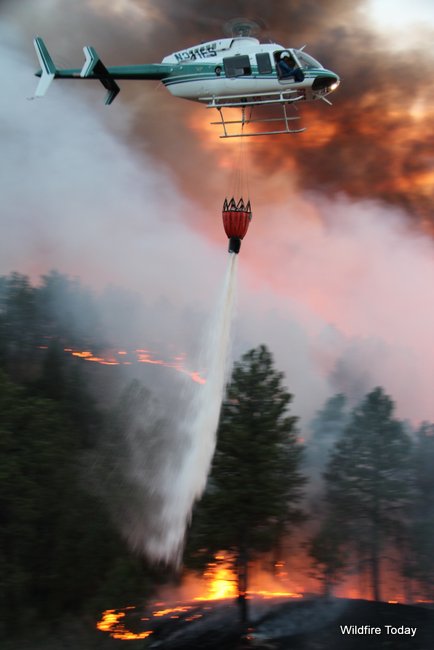
Below is a photo that we shot on June 29 of Helicopter 535 dropping on the White Draw Fire two days before the crash of MAFFS 7.

H-535 dropping on White Draw Fire
H-535 dropping on the White Draw Fire, June 29, 2012. Photo by Bill Gabbert


Canadian firefighters helping out in United States

More than 100 firefighers from Canada will be helping to suppress wildfires in the state of Washington. They were expected to arrive on Monday, September 17 to assist the 3,500 firefighters currently working on fires in Washington and Oregon.

Report examines residential wildfire risk in 13 states

The CoreLogic company has released an interesting report that analyzes the residential wildfire risk in 13 states. One fact they point out is that living within a city boundary does not prevent a wildfire from reaching a home, since all it takes is one burning ember that could be transported for thousands of feet before it lands in a gutter full of leaves at an otherwise well-maintained home.

The graphic below from the report was news to me… that in the previous five decades there has been such a significant increase in homes destroyed in wildfires.

Structures destroyed by decade CoreLogic and Blue Ribbon Panel on WUI

USFS Deputy Chief says they do not have enough firefighting resources 

In spite of the annual spring press releases that claim there will plenty of firefighting resources for upcoming season, Jim Hubbard, the US Forest Service Deputy Chief, is quoted in an article in the San Francisco Examiner as saying the agency does not have enough resources to cover long-duration wildfires. This was the reason given for their policy this summer of full suppression of all fires, rather than letting some fires burn through remote areas for weeks or months with only minimum intervention by firefighters.

Air tanker videos from Canada

Josh sent us these videos of air tankers in action in Canada, saying:

The aircraft models in both videos were a mix of the L188 Electra (the quad) and a couple of AT802’s (SEAT). The yellow Electra is Airspray of Edmonton AB (they have 3 on exclusive use with the BCFS), the rest are Conair’s (Abbotsford BC). They also provide several CV580’s (not in these videos) along with one Electra and a group of 802’s.


Thanks go out to Ken, Kelly, and Dick