
The fire in North Dakota has burned about 5,000 acres
Continue readingNorth Unit of Theodore Roosevelt National Park still closed due to wildfire
The Horse Pasture Fire has burned about 5,000 acres in North Dakota
Continue readingDry, windy conditions put North Dakota firefighters in a precarious position Saturday
Extreme fire behavior near Williston, results in a destroyed fire engine
Continue readingWildfire forces closure of North Unit of Theodore Roosevelt National Park
The Horse Pasture Fire has burned about 3,000 acres in the North Dakota park
Continue readingFirefighter injured in rollover in North Dakota
Elevated and critical fire weather predicted for large areas of the central U.S. on Thursday
Continue readingRainfall in western states slows wildfire season in many areas
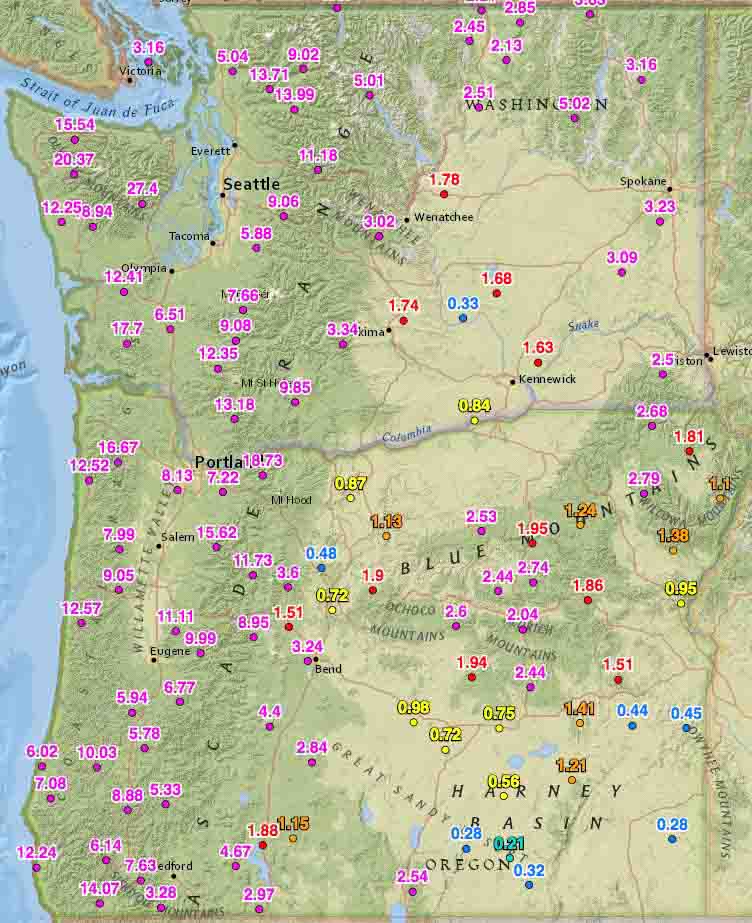
Rainfall over the last two weeks has slowed or in some cases, ended the wildfire season in some areas.
On October 19 we ran the numbers for the accumulated precipitation for the last 14 days in the western states. These maps show amounts that exceeded 0.05 inches at some of the Interagency Remote Automatic Weather Stations (RAWS).
Washington, Oregon, and northern California have received a good soaking and I would imagine that local fire officials may be declaring an end to the fire season. Of course this is not unusual for these areas this time of the year, and some locations had already seen their season end. But what IS unusual, is the high amount of moisture that occurred in just two weeks.
You can click on the images to see larger versions.

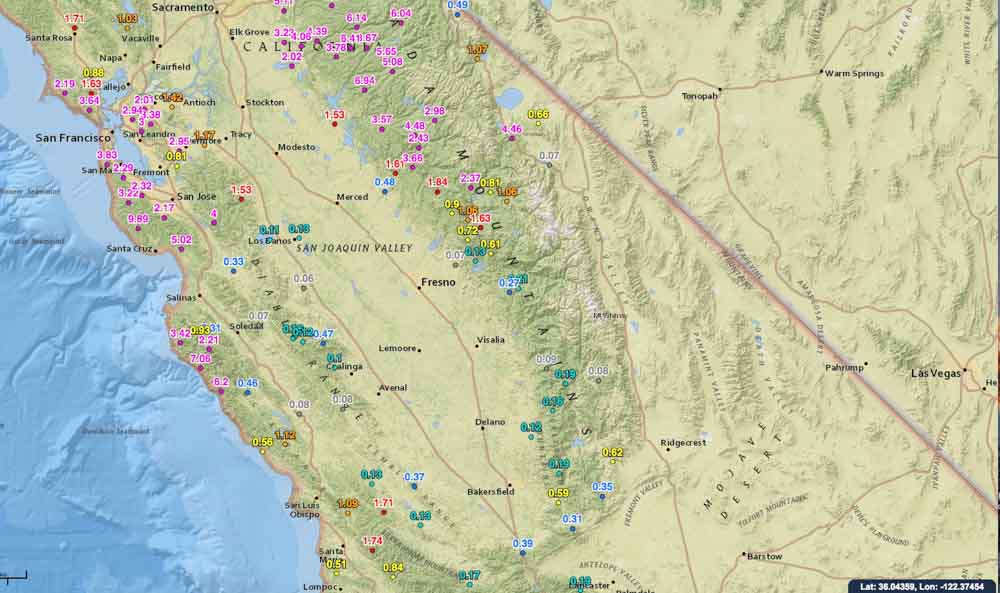
Continue to see maps for the other western states.
Continue reading
$50 million in claims over escaped prescribed fire reportedly denied

The Associated Press is reporting that the Department of Agriculture, in a letter signed by Department Secretary Tom Vilsack, is denying $50 million in claims filed by sixteen ranchers and landowners over a prescribed fire that escaped and burned 10,679 acres in North Dakota and South Dakota.
The “Pasture 3B” prescribed fire was planned to be 210 acres on the Dakota Prairie National Grasslands, but strong winds on April 3, 2013 caused by the predicted passage of a cold front pushed the fire across a mowed fire line into tall grass and ultimately burned 10,679 acres, (3,519 acres federal and 7,160 acres private). The wildfire, named Pautre Fire, was stopped at 11 p.m. that night.
In explaining the denial, Secretary Vilsack said the Forest Service relied on forecasts from the National Weather Service in Rapid City, South Dakota, that ultimately proved inaccurate.
In February, 2014 the US Forest Service released a report about the fire, called a “Facilitated Learning Analysis. The issues listed by the document included:
- Improved weather forecasts are needed.
- Consider additional research on methods to predict effects of drought on fire behavior in grass fuel models.
- The nearest remote automated weather station (RAWS) is more than 90 miles away.
- The project was conducted at the critical edge of the prescription.
- Consider gaming out worst case scenario “what ifs” during the planning process, and discuss with participants during the on-site briefing.
- There were problems with radio communications [note from Bill: I don’t remember EVER seeing a report like this that did not cite radio communications as being an issue].
Fire threatens campus of University of Mary

On April 14 a wildfire burned up to the campus of the University of Mary in Bismarck, North Dakota. The entire campus and 20 nearby homes were evacuated. The staff cleared out the school buildings and dorms, and school buses were on hand to transport students without vehicles to the Lewis Goodhouse Wellness Center, at the United Tribes Technical College. The University remained closed overnight. There were no reports of damage to any structures on the campus.
Wildfire force U of Mary, Bismarck to evacuate. Fire raged all around, the sacred cemetery left untouched. pic.twitter.com/EjM3uMrMY6
— Maureen O’Leary (@mroleary08) April 20, 2015
Caption contest! Respond with your best caption. #UMaryFire pic.twitter.com/EuTpOAF2jC
— Thomas Stromme (@tommy_stromme) April 13, 2015
Here’s a closer view of the fire by @umary. #BismarckFire pic.twitter.com/Ph1bQSaFFL
— Markus (@MarkTweetless) April 17, 2015
Our gratitude to all those who had our back this week. http://t.co/N78Y59CFaL photo by Jerry Anderson pic.twitter.com/rbBI1CdMJx
— University of Mary (@umary) April 16, 2015
Burning coal falling from truck may have started multiple fires in North Dakota
If this story is true, it is completely new to me as an ignition source for a wildland fire. Why would burning coal be on a truck?
Below is an excerpt from an article at TwinCities.com:
GRAND FORKS, N.D. — Grass fires along a roughly 60-mile stretch of Interstate 29 Wednesday could have been caused by burning pieces of coal falling from a truck’s conveyor and onto the road, according to Walsh County Sheriff Ron Jurgens.
The truck was traveling south from Walhalla, N.D., toward Grand Forks, he said.
“Every time the wind would gust, it would blow some … onto the roadway,” said Jurgens Thursday.
Jurgens said a vehicle dragging its chains “had nothing to do” with fires along I-29, as had been reported earlier.
Fires popped up all along the route the truck took, Jurgens said, from Walhalla, along North Dakota Highway 5, south down I-29, to Grand Forks.
Smoke from North Dakota wildfire causes pileup on interstate highway
From the AP:
BISMARCK, North Dakota — Authorities have blamed smoke from wildfires for a multiple-vehicle pileup on Interstate 29 in northeastern North Dakota that sent eight people to the hospital.
Injuries in the crash Wednesday ranged from minor to critical, the North Dakota Highway Patrol told KFGO radio. Hospital officials told WDAZ-TV early Thursday that seven people were admitted and one has been released.
Seven vehicles were involved in the crash, and two semitrailers collided nearby. It happened close to Manvel while hundreds of firefighters were working to contain multiple grass fires along a 60-mile stretch of the highway, KFGO reported.
“The reduced visibility is what caused the crashes to begin with, and people not slowing down to the conditions of the road,” Highway Patrol Trooper Ryan Mugan told WDAZ.
State transportation officials shut down the interstate from Grand Forks to the Canadian border for a time due to the smoke. The highway reopened Wednesday evening.