The fire burned 619 acres.
Continue reading
The fire burned 619 acres.
Continue readingApproximately six homes have burned and a Type 1 Incident Management Team has been ordered.
Continue readingDon’t let a day at the range turn into a nightmare! Remember, exploding targets,tracers and incendiary ammo are NOT allowed on public lands! pic.twitter.com/amQ3IfOqHC
— Utah Fire Info (@UtahWildfire) July 1, 2017

The fire has burned over 58,000 acres.
Continue reading
The fire has now burned over 54,000 acres.
Continue readingThe fire has now burned almost 50,000 acres.
Continue reading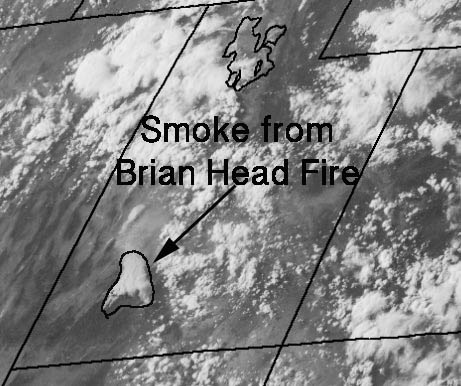
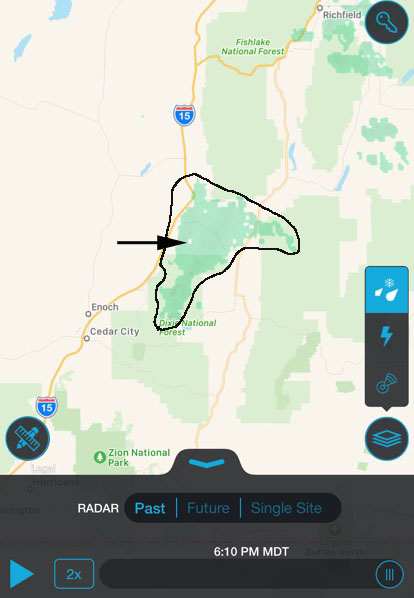
The Brian Head Fire east of Cedar City, Utah was influenced by strong winds from the southwest that at times gusted over 40 mph while the relative humidity dipped to five percent.
The intense burning caused a pyrocumulus cloud to develop as the fire and the smoke moved to the northeast. As you can see here, a satellite photographed the smoke plume and it was also detected by radar.
Only judging from the fire intensity shown in these images, I would be surprised if the indirect contingency firelines constructed Sunday by dozers northeast of the fire were able to constrain the blaze as hoped.
#BrianHeadFire pyrocumulus cloud looking east from Cedar City pic.twitter.com/leMtCYAlTu
— Craig (@Craig_Marchant) June 27, 2017
In this very interesting video posted on June 22, 2017 several firefighters in the southwest part of Utah (where the Brian Head Fire is burning) talk about the current weather and vegetation conditions and how they deal with the extreme heat as they battle wildfires in the Southwest United States. It was produced by Community Education Channel, which “provides students of Dixie State University hands on learning experiences while producing quality Television and LIVE stream community content”.
The spread of the Brian Head Fire east of Cedar City, Utah slowed on Sunday adding only 636 acres which was much less than in recent days. It has now burned a total of 43,436 acres.
The fire was still advancing Sunday on the north and south sides. The east flank has moved into lighter fuels (vegetation) which offers less resistance to control than heavier fuels found on the north and south sides. The west flank in the Brian Head area has been fairly stable for a couple of days except for an area northeast of town inside the Dixie National Forest.
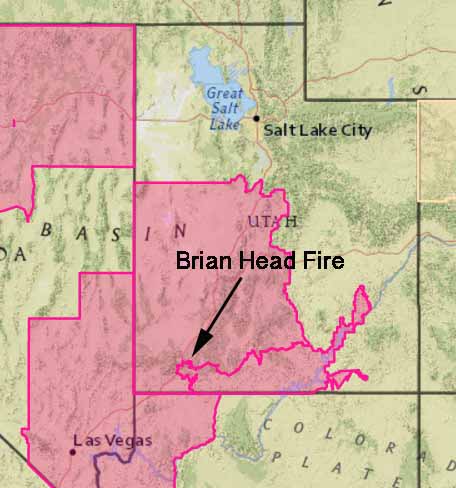
The weather will change on Monday, with Red Flag Warnings in effect for southwest winds gusting up to 39 mph in the afternoon while the relative humidity bottoms out at 12 percent. This could challenge firefighters on the north side and test the contingency lines constructed in that area on Sunday.
Evacuations are still in place for many areas. Highway 143 is closed from the cemetery in Parowan to milepost 50 outside of Panguitch. Mammoth Creek Road is closed at the junction with Highway 143.
The crew in the photo below is from Colorado and usually consists of only five people.
#BrianHeadFire God bless our #firefighters. My colleagues daughter in pic. ? pic.twitter.com/4goudbuSBc
— Christine (@Christi19127023) June 24, 2017
Here is some video of the #BrianHeadFire from @KSLChopper5. More than 7 minutes posted at https://t.co/kGIgvLfwGp pic.twitter.com/KJNL5kvfKW
— Alex Cabrero (@KSL_AlexCabrero) June 24, 2017

Above: The red line on the map represents the perimeter of the Brian Head Fire at 2:30 a.m. MDT June 25, 2017. The white line was the perimeter about 28 hours earlier.
(UPDATED at 9:28 p.m. MDT Sunday June 25, 2017)
There was only minimal growth Sunday on the Brian Head Fire east of Cedar City, Utah. The weather cooperated with firefighters who were able to work on securing firelines.
Incident Commander Tim Roide described the activity on the fire today:
It was a good day for firefighters, who were able to have success securing areas of particular concern, including the many structures affected by the Brian Head Fire.
A Red Flag Warning is in effect for southwest Utah through 10 p.m Monday night.
With the weather forecast for Monday predicting southwest winds of 12 to 15 mph with gusts in the mid-20’s and humidities in the mid-teens, the Incident Management team made the decision to use dozers to build indirect contingency firelines out ahead of what could be additional growth in the Horse Valley area. Air tankers bolstered those new lines by dropping fire retardant adjacent to the dozer lines expecting that if the fire makes a run in that direction the combination of the bare dirt line and the retardant would increase their chances of preventing the fire from crossing their freshly prepared defenses.
Fire retardant is normally wet, of course, and if conditions are right with few airborne embers travelling far in advance of the main fire front, retardant can slow the spread, giving firefighters on the ground a chance to move in and take direct action. But even when it has dried, the chemicals still interfere with the process of combustion and can affect the rate of spread of the flames.
The plans for crews on Monday include continuing to secure the southern perimeter of the fire to slow its progression toward Mammoth Creek.
Kim Martin’s Type 1 Incident Management Team will assume command Monday morning of the east half of the fire. The existing Type 2 Team will remain on the West side working out of Parowan.
Evacuations are still in place for many areas. Highway 143 is closed from the cemetery in Parowan to milepost 50 outside of Panguitch and Mammoth Creek Road is closed at the junction with Highway 143.
****
(UPDATED at 12:24 p.m. MDT Sunday June 25, 2017)
The Brian Head Fire in southwest Utah continued to grow on Saturday, adding another 5,000 acres, to bring the total to 42,800 acres. Evacuations are still in effect for several areas.
A significant development Saturday was the spread of the fire across Highway 143 in two places burning approximately 700 acres south of the highway as of 2:30 a.m. on Sunday. No doubt the firefighters were counting on using the highway as a fireline, hoping to stop it at that point. One factor in their favor is that east of the 406/050 road and south of Highway 143 the fuel (vegetation) is sparse in many areas and is not continuous. West of that road and south of Highway 143 more fuel is available and the fire will offer more resistance to control.
Sunday morning the Incident Management Team provided some information about the spread of the fire across the highway:
Firefighters quickly responded and minimized the spread of these fires. Through the night, resources continued work on containment of these spot fires.

There has been no change in the number of structures reportedly destroyed; it remains at 26.
Either on Sunday or Monday a Type 1 Incident Management Team will assume command of the eastern half of the fire. The Type 2 Team will remain in Parowan and the Type 1 Team will be based at the Triple C Arena in Panguitch. The two organizations will work together to protect the values at risk and coordinate the full suppression of the fire.
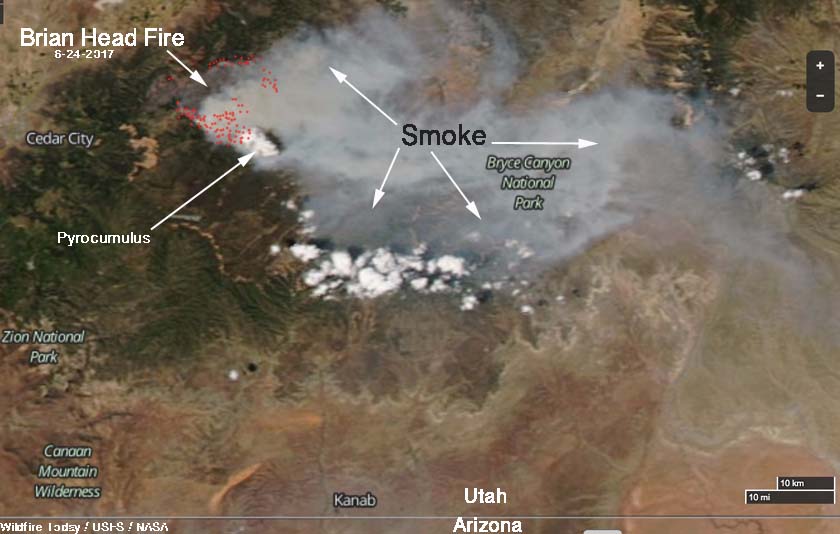
Resources assigned to the fire include 29 hand crews, 41 engines, 10 helicopters, a variable number of air tankers, and a total of 996 personnel.