European countries intend to purchase 22 twin-engine scooping air tankers

DHC-515
DHC-515. Image by De Havilland Aircraft of Canada.

As drought and unprecedented heat waves result in a surge of wildfires in Western Europe, attention is drawn to the resources available to assist firefighters, especially fixed wing aircraft.

The European Union budgeted about 900 million euros in 2021 for civil protection, preventing and responding to crises, and expects that amount to increase.

Currently the EU coordinates and funds the deployment of 12 fixed wing firefighting airplanes and one helicopter pooled by EU countries. Reuters reports that as assistance is expected to rise due to climate change and more frequent wildfires, the EU plans to purchase crisis-response aircraft, EU Commissioner for Crisis Management Janez Lenarcic said.

From Reuters:

“These planes will be technically bought by the member states but they will be 100% financed by the European Union,” said Lenarcic.

Lenarcic declined to name the companies involved as contracts have not yet been signed, but said plans are to relaunch production of amphibious planes that scoop up water to douse fires.

In a March 31, 2022 press release, De Havilland Aircraft of Canada announced a new twin-engine water scooping aircraft, the DHC-515, formerly known as CL-515. The CL-515 was first teased in December 2018, but the actual production has been delayed.

De Havilland wrote that they “launched the De Havilland DHC-515 Firefighter program, which will involve negotiating contracts with our European customers and ramping up for production,” said Brian Chafe, Chief Executive Officer of De Havilland Canada.

“European customers have signed letters of intent to purchase the first 22 aircraft pending the positive outcome of government-to-government negotiations through the Government of Canada’s contracting agency, the Canadian Commercial Corporation,” the announcement read. “De Havilland Canada expects first deliveries of the DHC-515 by the middle of the decade, with deliveries of additional aircraft to begin at the end of the decade, providing other customers the opportunity to renew existing fleets or proceed with new acquisition opportunities at that time.

“The final assembly of the aircraft will take place in Calgary, Alberta where work on the CL-215 and CL- 415 aircraft currently takes place. It is anticipated that more than 500 people will need to be recruited over the coming years to successfully deliver this program.”

Meanwhile there may be disagreement in Portugal about which type of firefighting airplane to purchase. The Portugal Resident reports that the Council of Ministers approved a resolution to purchase 12 helicopters and two “heavy duty” amphibian airplanes. The report is that the country intends to spend a total of €60 million to buy two CL-415s which are no longer in production. They are most likely looking at the soon to be manufactured DCH-515.

The Council of Ministers’ resolution that approved the purchase of the two scoopers, according to the Portugal Resident, “chose to finance the operation with PRR money coming from Brussels, and from money available through the European Mechanism for Civil Protection.”

The Portugal Resident wrote that João Marques, president of the association of Portuguese Volunteer Firefighters, recommends that they spend the money instead on Fire Boss single engine scooping air tankers that he said cost about €3 million each.

Thanks and a tip of the hat go out to Gerald.

News from the Aerial Firefighting Conference in Sacramento

aerial firefighting Conference Keynotes MCC
Keynote addresses. Tangent Link photo.

The two-day Aerial Firefighting North America conference just wrapped up at Sacramento McClellan Airport in Sacramento. It began Tuesday with a series of keynote and welcoming addresses delivered by Chief Thom Porter, Director of CAL FIRE, Brian S. Marshal, State Fire and Rescue Chief and Director of the California Governor’s Office of Emergency Services, followed by Jeffrey Rupert, Director of the Office of Wildland Fire in the U.S. Department of the Interior.

Conair confirmed at the conference that they expect to open the world’s first Aerial Firefighting Training and Tactics Centre early this spring. It will have five fully Networked Flight Training Devices that are reconfigurable to simulate the cockpit and flight dynamics for eight aircraft platforms performing different roles during an aerial firefighting mission.

Viking Air Limited introduced the Canadair CL-515 First Responder, a new production multi-mission scooping amphibian and purpose-built aerial firefighting aircraft.

Coulson Aviation announced they have installed a large capacity internal helicopter tank in a CH47 Chinook. It will be able to carry up to 3,000 gallons.

Columbia Helicopters introduced a Type 1 multi-mission Standard Transport Category helicopter – the Columbia Model 234 LR Chinook. It can be configured to carry up to 19 passengers, a 2,800 gallon internal tank, a 2,600 gallon bucket, or internal and external cargo.

Trotter Controls recorded a video tour of some of the exhibits at the conference.

Eleven CL-215’s to be converted to CL-415EAF

CL-215T

Above: Viking Air photo

Longview Aviation Asset Management (LAAM) of Calgary, Alberta, in cooperation with Viking Air Limited of Victoria, British Columbia, has launched the Viking CL-415EAF (“Enhanced Aerial Firefighter”) Conversion Program.

To initiate the program, LAAM will be hiring up to 150 technical and support staff members at its Calgary facilities, where eleven specially selected CL-215 aerial firefighting aircraft owned by LAAM will undergo the modification process utilizing Viking-supplied conversion kits.

To support development of the conversion kits, Viking has hired 50 employees to date and has launched a recruitment campaign to hire an additional 50 staff at its Victoria, BC location. Viking will also be reinstating its “Viking Academy” paid-training program to provide successful applicants with the targeted technical training required for these positions.

After acquiring the CL-215, CL-215T and CL-415 Type Certificates in late 2016, and based on feedback from the operator group, Viking elected to introduce an “Enhanced Aerial Firefighter” (EAF), mirroring the CL-215T conversion program and updating it with the addition of operator requested enhancements.

Both the CL-215T and CL-415EAF include the winglets, finlets, higher operating weights, increased capacity firebombing system, and foam injection system of the CL-415.  In addition to these standards, other improvements introduced with the Viking CL-415EAF conversion upgrade include:

  • Full modern Avionics package,
  • Component modernization improvements to address all fleet obsolescence issues,
  • Corrosion protection enhancements based on operator feedback,
  • Flight deck air-conditioning system,
  • Customized external paint scheme, and
  • Humanitarian relief and special mission options (e.g. stretcher rack, large cargo door, spray boom system)

The Viking CL-415EAF Conversion Program forms part of a staged approach to utilize the advancements made with the LAAM converted aircraft as the basis for the proposed Viking CL-515 new-production amphibious aerial firefighting aircraft.

Thanks and a tip of the hat go out to Roman.
Typos or errors, report them HERE.

News from the Aerial Firefighting conference in Sacramento, Part Two

Ron Hooper CEO of Neptune Aviation

Above: Ron Hooper, CEO of Neptune Aviation

Earlier we posted Part One of  a few notes that I scribbled in a notebook at the Aerial Firefighting conference in Sacramento this week. Here is Part Two.


Neptune Aviation
Ron Hooper, CEO of Neptune Aviation, said their air tankers in 2016 averaged 180 hours while working on wildfires. In 2017, a very busy year, that number increased to 276. Their P2V’s have retired from firefighting, leaving the company with nine air tankers, all BAe-146’s.

No one outside the U.S. Forest Service knows when the agency will issue the next round of exclusive use and call when needed next-generation air tanker contracts, affectionately called Next-Gen 3.0. When forced to guess, Mr. Hooper said the aircraft receiving those new contracts may not be activated until 2019. He may know more than most, since his former job was supervising air tanker contracting for the FS.

Phos-Chek
One of the major suppliers of fire retardant, Phos-Chek, is changing hands again. In a matter of days its parent company will be Perimeter Solutions. But as in the previous four iterations it will retain the brand name Phos-Chek.

Here is the product’s history of parent companies:
1963-1997: Monsanto
1997-2000: Solutia
2000-2005: Astaris
2005-2018: ICL
2018- ???? : Perimeter

Global Supertanker

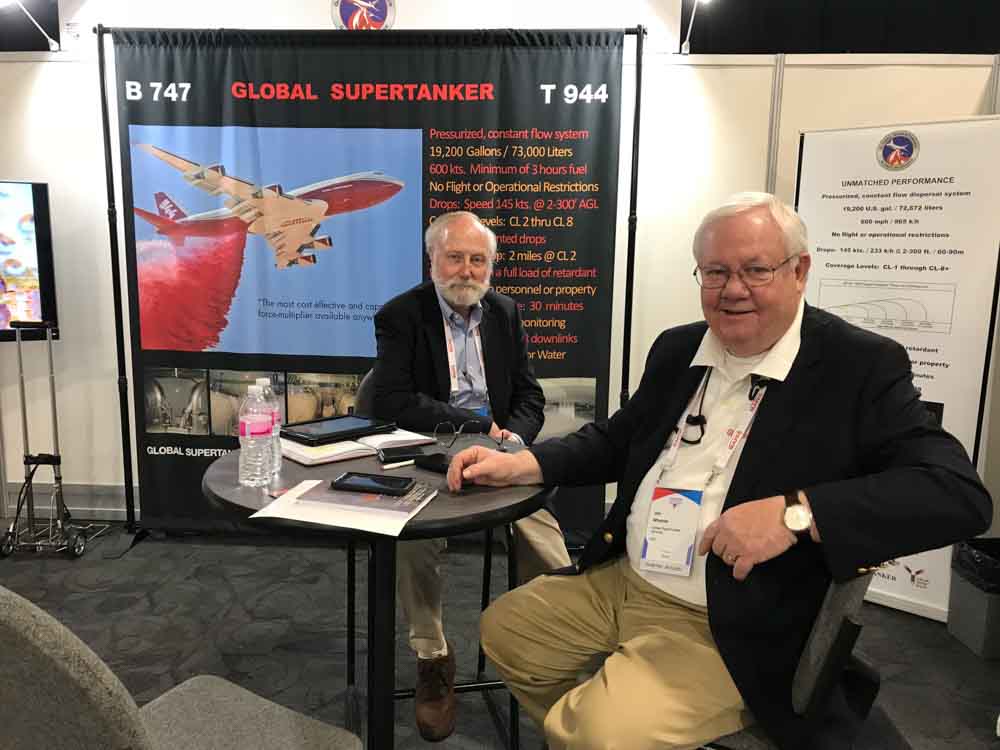
Global Supertanker bob soelberg jim wheeler
L to R: Bob Soelberg and Jim Wheeler of Global Supertanker

Jim Wheeler, CEO of Global Supertanker Services, said the company currently has CWN contracts with CAL FIRE and two counties in Colorado — Douglas (just south of Denver) and El Paso (Colorado Springs). Other pending contracts that they hope to sign later will be with the states of Colorado, Texas, and Oregon.

Colorado

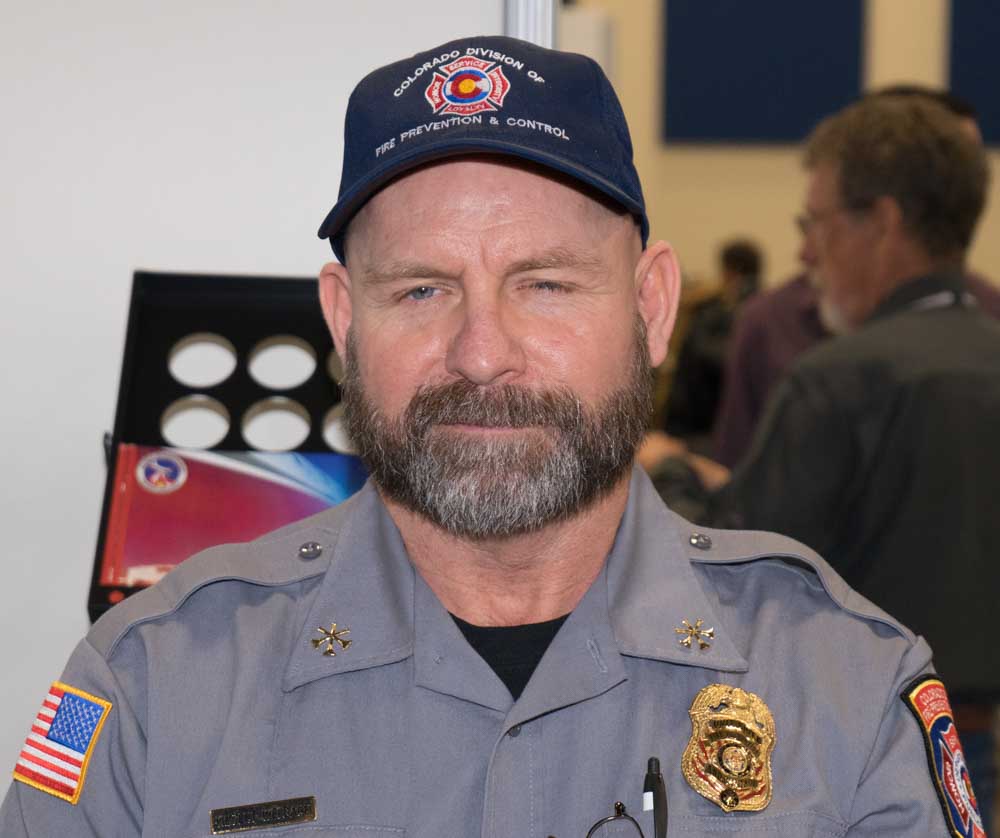
Vincent Welbaum, Colorado Aviation Unit Chief
Vincent Welbaum, Colorado’s Aviation Unit Chief

Vincent Welbaum, Colorado’s Aviation Unit Chief, said they are talking to vendors and expect to award a call when needed contract to at least one vendor that can supply large or very large air tankers. The state has been operating their own two Pilatus PC-12 Multi-mission aircraft for several years, using it to detect and map wildfires.

Colorado will have two Single Engine Air Tankers on exclusive use contracts supplied by CO Fire Aviation and Aero Seat as well as four other vendors on call when needed contracts. The state will also have two Bell 205’s on exclusive use contracts.

Helimax

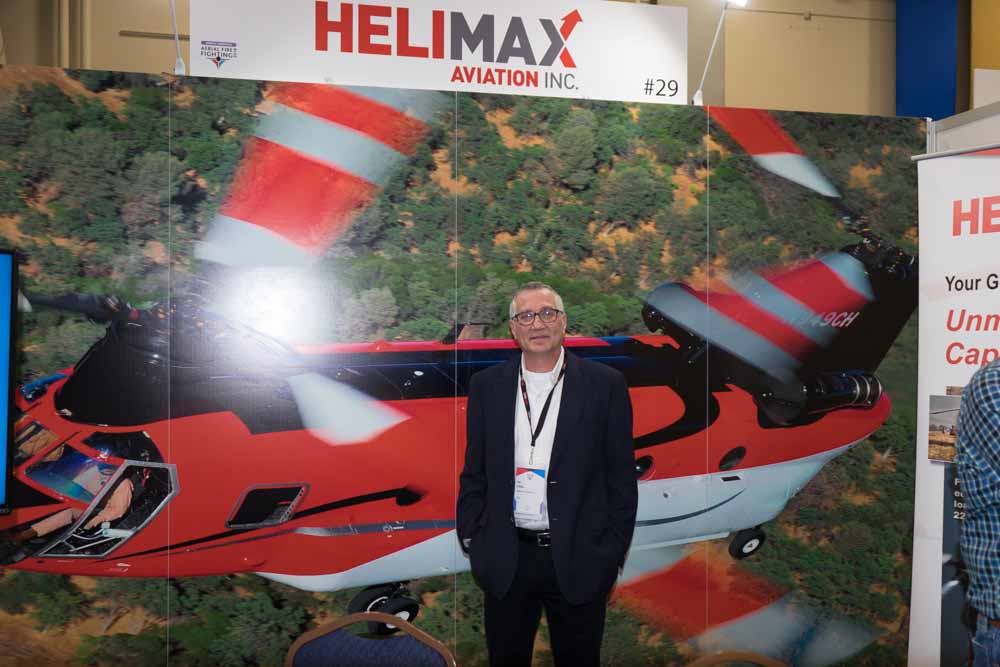
Helimax Pat Pilolia
Pat Pilolia, of Helimax

Helimax Aviation is one of two subsidiaries of Heligroup Holdings. The other is CHI at Howell, Michigan which concentrates on heavy lift, while Helimax, at Sacramento McClellan Airport is in involved in aerial firefighting.  Helimax recently sold all of their Type 2 helicopters, and now have six Type-1’s, Chinook CH-47D’s.

MAFFS Group
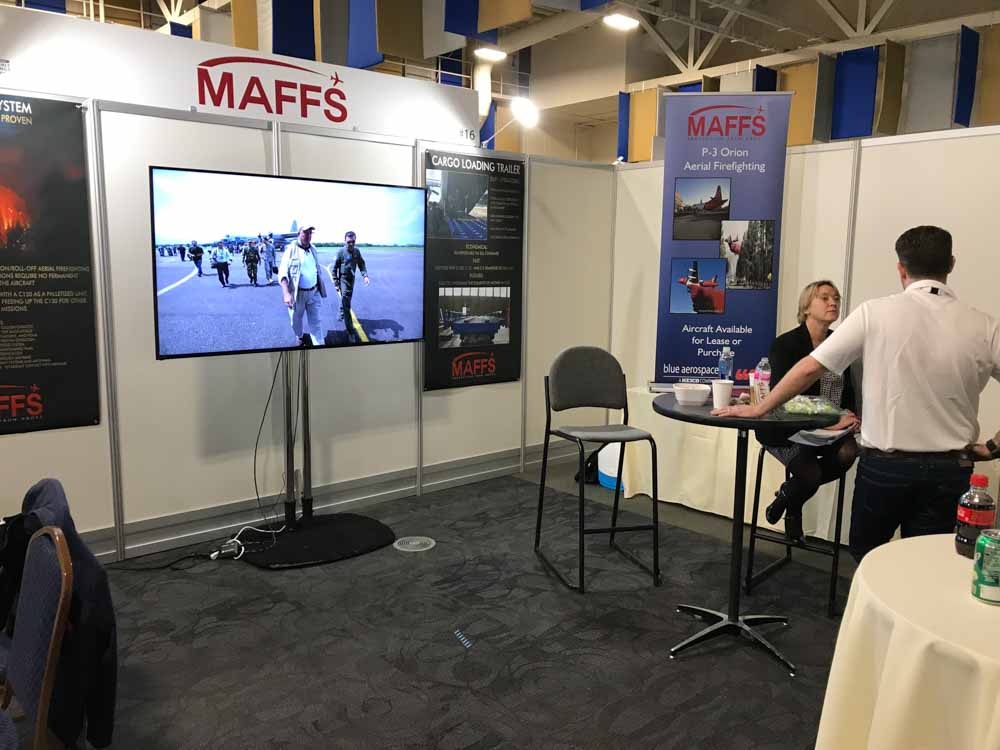
MAFFS GroupBradford Beck, COO of MAFFS Group said the company recently sold a MAFFS II system to the Tunisia Air Force in Northern Africa. The country has operated two of the original versions of the MAFFS for 10 to 15 years. They will continue to operate the MAFFS I systems on a C-130B and will use a C-130H for the new MAFFS II which will be delivered in the third quarter of this year.  The most challenging wildfires in Tunisia occur in the Atlas mountains.

This is the second MAFFS II that the MAFFS Group has sold. The first is now being used in Columbia, South America.

Viking Air

Viking Air
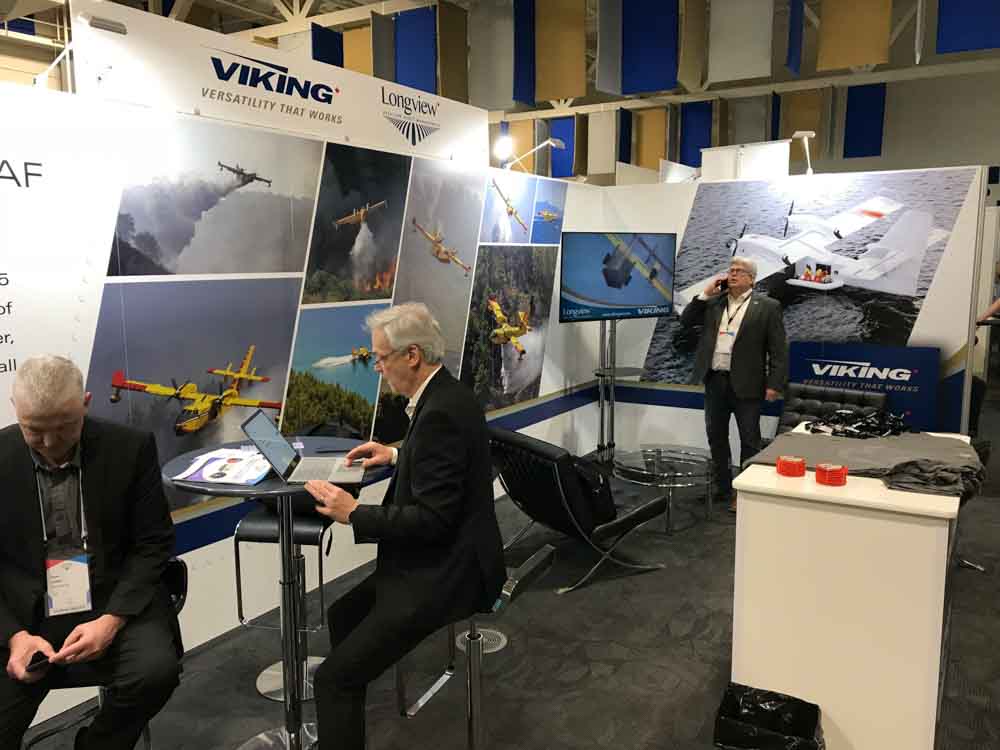
The Viking Air display at the conference.

Viking Air director of Special Projects, Sales, and Marketing Christian Bergeron said the company is currently gathering information from potential customers about what they would like to see on a new version of the CL-415 water scooping air tanker.  The company expects to decide by the third quarter of this year if they will proceed with the project, which will be named CL-515. At this stage, Mr. Bergeron said, they expect it to have a larger cargo door, glass cockpit, updated avionics, and will be able to land with a full load of water. Available options will include an infrared camera system and night vision compatibility. Viking’s manufacturing facility is in Calgary, Canada.

Bombardier sells their air tanker business

T-260 at Sacramento McClellan Airport
T-260, a CL-415, at Sacramento McClellan Airport, March 23, 2018. Photo by Bill Gabbert.

Bombardier has agreed to sell their air tanker manufacturing business to Viking Air Ltd.

The transaction will see Viking acquire the Type Certificates (manufacturing rights) for all variants of Bombardier’s amphibious aircraft, and assume responsibility for product support, parts and service for the fleet of 170 air tankers in service with 21 operators in 11 countries around the world.

Below is an excerpt from an article at CTV News:

…Victoria-based Viking manufactures the Twin Otter as well as spare parts for several planes originally made by de Havilland. It also has manufacturing rights for all out-of-production de Havilland aircraft, including the DASH-7 regional airliner, a predecessor to Bombardier’s Q400 turboprop.

Viking employs just under 90 people in Calgary and more than 330 at its headquarters and facilities in Victoria. The company said it expects to add up to 40 people to its workforce in Victoria and Calgary with the new program.

Bombardier said Monday it plans to transfer 50 employees from the amphibious aircraft program based in North Bay, Ont., to other parts of its business.

The Montreal-based company hasn’t produced an amphibious plane since December 2015…

Canadair began manufacturing the amphibious CL-215 air tanker in 1967 and in 1986 sold the manufacturing rights for the aircraft to Bombardier. In 1993 Bombardier introduced the upgraded CL-415, replacing the piston engines with Pratt & Whitney Canada PW123AF turboprops as well as introducing an updated cockpit and aerodynamics enhancements.

Thanks and a tip of the hat go out to Mike.