How the name of the film Wildland evolved

film "Wildfire" firefighters
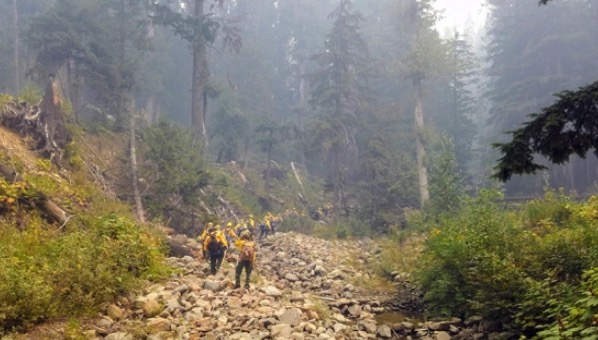
Screenshot from the film, Wildland.

Last month when filmmakers Alex Jablonski and Kahlil Hudson first screened their new film about a crew of wildland firefighters at  the Camden International Film Festival it was titled Young Men and Fire. (Yesterday we wrote about how the film was made.)

Wildland firefighters will recognize that name as the title of a book published in 1993 by Norman Maclean that told the story of the 13 firefighters, 12 of whom were smokejumpers, that died in Montana in 1949 on the Mann Gulch Fire. Not only is the book a classic of the American West and an excellent read (it won the National Book Critics Circle Award) it tells the story of a well known landmark in the history of wildland firefighting — a very meaningful and emotional event for some wildland firefighters.

It was the last book written by Norman Maclean, and was not quite finished when he passed away. His son, John N. Maclean, a former journalist, assisted in the final editing process. Since then, John has written five books about wildland fire including Fire on the Mountain and his latest, River of Fire.

Norman also wrote A River Runs Through It, which in 1992 was adapted for the big screen, directed and narrated by Robert Redford and starring Brad Pitt.

Since the Camden Film Festival, the name of the Young Men and Fire film changed to Wildland.

I reached out by email to John N. Maclean and asked for his thoughts about the name of the film. His response:

“I thought the use of Young Men and Fire as a movie title was a very bad idea. I did wonder how serious the filmmakers were, considering they had not contacted the University of Chicago Press, publisher of the book, or the family before deciding to use a famous title. (Alex has apologized for this.) I put a notice up on my Facebook page when I first learned what was afoot, and a rash of very negative comments flooded in. Alex and I then got in direct touch and he offered to change the title if I asked him to. I’d like to add that our exchanges were civil and respectful despite the considerable distress on both sides. At that point I bowed out and took down the Facebook posting. If they wanted to use the title and take the consequences on their heads, so be it. The decision to change the name was entirely the responsibility of the movie producers. I’m glad they did it, but I made no such demand.”

I asked Alex Jablonski, one of the co-directors and co-producers, about the name change. Below are my questions (in bold) and his responses, by email:

–Originally it was titled Young Men and Fire. The book of the same name and the deaths of the 13 firefighters in 1949 are part of a very meaningful and emotional subject among wildland firefighters. I assume when you selected that title you were familiar with the book by Norman Maclean. Why did you choose that title? 

“I actually wrote about this when we were using that title so I’m going to put some of what I wrote here:
Obviously Maclean’s book is big for just about everyone in fire, and it’s an investigation into the deaths of [13 firefighters] in the
Mann Gulch fire in 1949. But, it is multi-layered and the book is many other things – an examination of the souls of young men, an attempt at understanding our own mortality, a story about covering the same ground over and over, searching for new answers to old questions, and an effort to understand fire in terms both scientific and theological.

“This is exactly what we felt we were doing in making this film. It was looking at this question of, what is this connection between young men trying to prove themselves and fire? How is it that the same draw that brought those smokejumpers to Mann Gulch seventy-years ago is just as powerful as the draw that finds our characters in training in Grants Pass, Oregon? How is it that young men come to this line of work and what changes within them when they confront something as elemental as fire?

“These are the same questions that Maclean was wrestling with, and while we’re asking them using a different medium and in a different time, they are still the same questions. And moreover, our entire approach to this film — the very way we set out to examine both the interior and exterior lives of our characters — is directly descended from the way Maclean wrote and how he saw the world.”

–Why did you change the title to Wildland?

“In short – we listened to people in the fire community. There were really two prongs of reaction to the original title. The first was from John Maclean (Norman’s son). He knew that we meant it to honor his father but we had not reached out to him before the film was announced – and that was a mistake on our part… People hold that book near and dear and people did not feel that it was honoring the book but taking something from it.

“The second reason was that a lot of women in the fire community felt that the title was exclusionary because of the number of women in wildland fire, and to have ‘men’ in the title, completely erased them. Our film is very much about men and masculinity and a certain type of camaraderie, but it didn’t sit well with me that the title had this impact on the women in the community. I can only imagine the kind of things that women in fire have had to deal with and I hated the idea that our title would be one more thing, one more moment where the felt they didn’t belong or weren’t part of this world. So given all that the decision was pretty clear. I think that the title Wildland is still evocative and still speaks to the uncultivated parts of us ourselves and the world.”


The television version of Wildland will be shown on the PBS television series Independent Lens October 29 at 10 p.m. ET. Check your local listings — not all stations will carry it at that time; I saw it scheduled for 3 a.m. October 30 in one city. The full-length feature film version will appear in a limited number of theaters beginning January 16, 2019. That website has instructions on how you can bring it to your city. Mr. Jablonski said all screenings will help raise money for the Wildland Firefighter Foundation, helping families of firefighters.
A physician describes “smoke induced depression” in Oregon

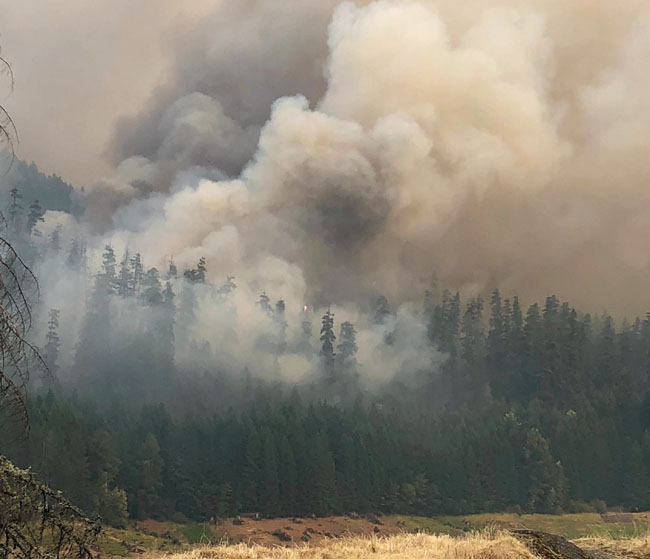
Terwilliger Fire
Terwilliger Fire in western Oregon, August 24, 2018. Inciweb photo.

The Mail Tribune posted a video about how in recent years the occurrence of wildfire smoke seems to be more frequent in Oregon.

Some of the short term effects of smoke are well known, such as how it can affect people with pre-existing respiratory conditions, but not much research has been completed on the long term effects on residents or firefighters.

In the video, Doctor of Nursing Practice Matt Hogge introduced a condition called smoke induced depression.

“You see a lot of people coming in with mild mental health concerns”, he said, “that might not have those in their day to day life, but the anxiety of not being able to go outside and do the things that they are normally able to do really affects some people’s moods.”

Helicopter pilot killed while battling wildfire in South Africa

A helicopter pilot died in a crash October 23 while helping firefighters extinguish a wildfire in South Africa.

Nico Heyns, 65, was flying a Huey owned by Kishuga Aviation that was under contract to the firefighting agency Working On Fire.

The accident occurred the Vermaaklikheid area, about 40km from Riversdale, around 9:50 a.m.

Mr. Heyns was supposed to be off duty that day but interrupted his leave to help with the fire. The cause of the crash has not been determined.

Police spokesperson Captain Malcolm Pojie said, “Police had to arrange for the speedy removal of the body to save it from the fire that was engulfing the area.”

Mr. Heyns, a veteran pilot with more than 20 years experience, formerly owned Heyns Helicopter Service and was well known in the aviation community.

Our sincere condolences go out to his family, friends, and co-workers.

Firefighter physical exams can save lives

Physical exam firefighter save life
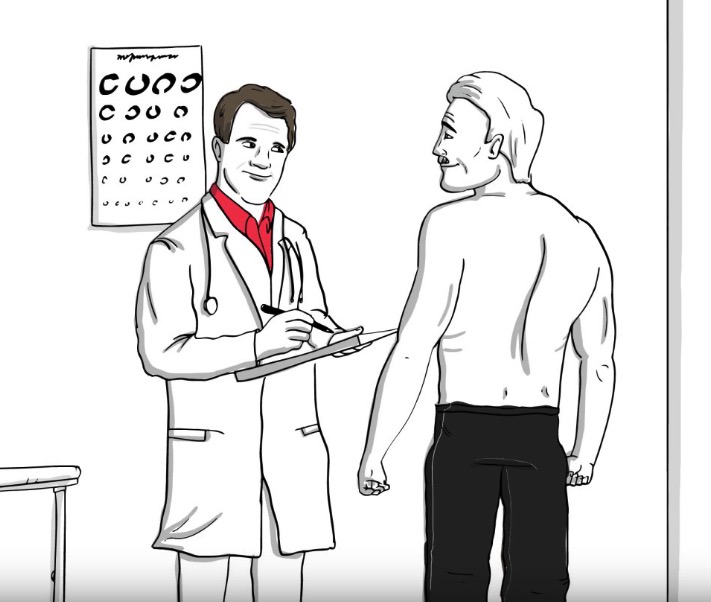
Screen grab from the video.

As we reported earlier today, the Bureau of Land Management is beginning to provide medical exams for federal Emergency Firefighters (EFFs) in Alaska. The goal is to increase safety by identifying pre-existing conditions that could be aggravated by the arduous duty of wildland firefighting.

These two videos, each about two minutes long, tell the stories of firefighters who discovered during the physicals that they had life-threatening medical conditions. They were then able to take actions which probably saved their lives.

Alaska emergency firefighters to undergo medical exams starting in November

Alaska EFF firefighters
The Kobuk River #2 Type 2 EFF Crew working on a fire in the Lower 48 in 2018. AFS photo.

The Bureau of Land Management Alaska Fire Service in partnership with the Department of Interior Medical Standards Program (DOI MSP) will soon provide medical exams to federal Emergency Firefighters (EFF). The goal of the exams is to increase safety by identifying pre-existing conditions that could be aggravated by the arduous duty of wildland firefighting.

The medical exams will be provided in approximately 28 Alaska villages through mobile medical units and by scheduled appointments at 18 facilities throughout the state.

Starting in November EFFs in Alaska who are hired on an as-needed basis will need medical exams once every three years and self-certify in between years. The medical screening established by the DOI MSP will screen EFFs for any disqualifying medical conditions prior to participating in the Work Capacity Test (WCT), otherwise known as the pack test. Only wildland firefighters performing arduous duties are required to undergo medical exams and pass the WCT.

Schedules for the exams will be posted on the BLM AFS EFF webpage .

For the past two years, Alaska EFFs were granted exemptions to these medical screening requirements. The first phase of implementation of the medical exams began in 2015 and only included regularly employed Department of the Interior wildland firefighters. Applying the requirements to Alaska EFFs was originally planned to begin in 2017, but implementation was delayed until measures were in place to provide mobile units in rural Alaska to conduct the medical examinations. The exams do not include drug testing or affect State of Alaska EFFs.

There is no cost to the EFF for the examination, however, if the individual chooses a location other than their local village BLM AFS will not cover the associated travel costs. After the exam is completed, a determination will be made regarding the candidate’s eligibility to participate in the pack test and the arduous duty of wildland firefighting.

The BLM AFS provides wildland fire management for the Department of the Interior and Native Corporation lands in Alaska and provides oversight of the BLM Alaska aviation program. Firefighter safety and the safety of the public are core values and are fundamental in all areas of wildland fire management.

For more information, EFF candidates can email AFS_EFF@blm.gov or call EFF Program at 1-833-532-8810 or (907)356-5897.


Fire whirl recorded on video in the UK

Fire Whirl
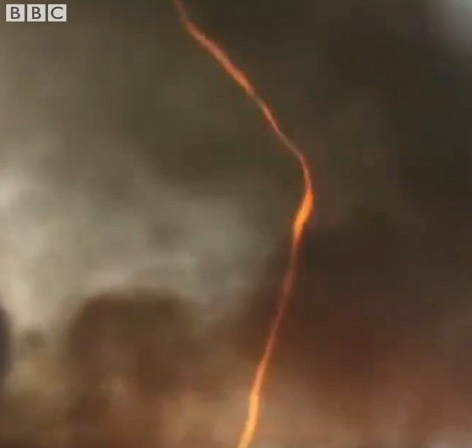
Fire Whirl — Leicestershire Fire & Rescue Service

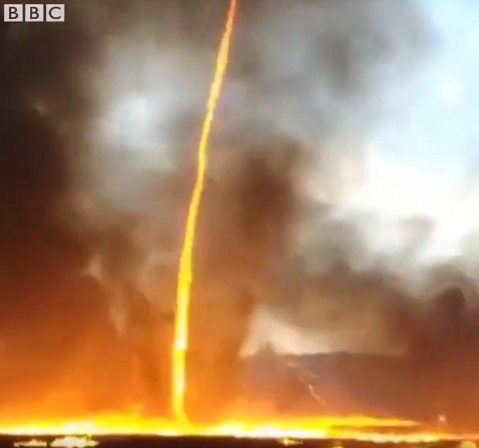
I don’t often associate extreme wildland fire behavior with the United Kingdom, but firefighters with the Leicestershire Fire and Rescue Service grabbed some video of this impressive fire whirl near Swadlincote, a town in Derbyshire, England.

Fire Whirl

Fire Whirl
Fire Whirl — Leicestershire Fire & Rescue Service

We have written about similar phenomenons several times on Wildfire Today. Here is an excerpt from a 2016 article, “Defining fire whirls and fire tornados”:


The news media sometimes calls any little fire whirl a “fire tornado”, or even a “firenado”. We found out today that these and related terms (except for “firenado”) were, if not founded, at least documented and defined in 1978 by a researcher for the National Weather Service in Missoula, David W. Goens. He grouped fire whirls into four classes:

  1. Fire Devils. They are a natural part of fire turbulence with little influence on fire behavior or spread. They are usually on the order of 3 to 33 feet in diameter and have rotational velocities less than 22 MPH.
  2. Fire Whirls. A meld of the fire, topograph, and meteorological factors. These play a significant role in fire spread and hazard to control personnel. The average size of this class is usually 33 to 100 feet, with rotational velocities of 22 to 67 MPH.
  3. Fire Tornadoes. These systems begin to dominate the large scale fire dynamics. They lead to extreme hazard and control problems. In size, they average 100 to 1,000 feet in diameter and have rotational velocities up to 90 MPH.
  4. Fire Storm. Fire behavior is extremely violent. Diameters have been observed to be from 1,000 to 10,000 feet and winds estimated in excess of 110 MPH. This is a rare phenomenon and hopefully one that is so unlikely in the forest environment that it can be disregarded.”

Make a Smokey Bear Jack O’Lantern

smokey bear jack o'lantern
Smokey Bear Jack O’Lantern by Louie and his grandson, October, 2017.

Would you like to have Smokey Bear looking at your trick or treaters from a Halloween Jack O’Lantern?

Here are instructions and a template for carving yours.

Send us photos of your 2018 Smokey Bear Jack O’Lantern and we will put some of them here.

Below are photos sent to us after this article was published. We’ll update it with more as they come in:


Smokey Bear Jack O'Lantern
By Enoch
Smokey Bear Jack O'Lantern
Smokey Bear Jack O’Lantern by Natalie

911 call from entrapped dozer operator: “Don’t risk anybody’s life for mine”

(Published at 8:30 a.m. PDT October 22, 2018)

During the Carr Fire earlier this year at Redding, California a dozer operator entrapped by the rapidly spreading fire told a 911 operator, “Don’t risk anybody’s life for mine”.

The Redding Searchlight obtained the recording of the July 26 call in which the dozer operator said there were two other dozers with him and, “There’s a CAL FIRE pickup just exploded right in front of me. I think the guy didn’t get out.”

“I don’t know if the two guys behind me are alive,” the man told a dispatcher, possibly referring to the other two dozers working with him.

There were two deaths that day on the Carr Fire, but the 911 caller who identified himself as “Don”, was not one of them. Redding Fire Department Inspector Jeremy Stoke was burned over in his truck on Buenaventura Boulevard, not far from the location of the caller. On the other side of the Sacramento River, the west side, Don Ray Smith was entrapped and killed in another dozer.

The caller said the windows in his dozer had been blown out and he had lowered his curtains, referring to the drop-down curtains made of fire shelter material that can reduce the amount of radiant heat entering the cab.

Below are excerpts from an article at the Redding Searchlight:

“Don’t risk anybody’s life for mine, but as soon as it lays down…” he trails off in a 911 call obtained by the Record Searchlight on Friday in response to a California Public Records Act request. “As soon as it lays down, send somebody for me, please?”

“I’m in a dozer. All the windows got blown out. I got my curtains down,” he starts off telling the dispatcher.

“OK, sir, I need you to get out of there,” she tells him with urgency.

He’s still calm as he tells her the horrifying truth.

“I can’t.”

‘I don’t know how long I can last’

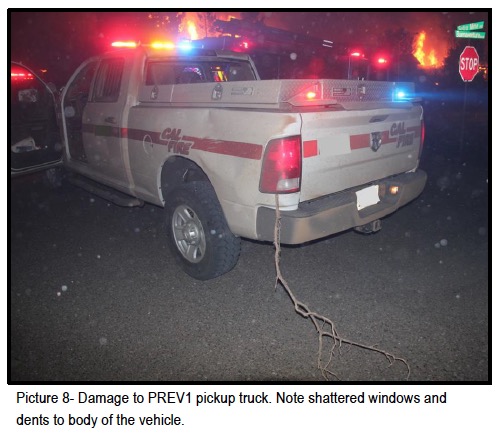
According to a Green Sheet report by CAL FIRE, the conditions that resulted in the entrapment of the three dozers and the Redding Fire Department Fire Inspector that day were due to a fire tornado — a large rotating fire plume that was roughly 1,000 feet in diameter. The winds at the base were 136-165 mph (EF-3 tornado strength), as indicated by wind damage to large oak trees, scouring of the ground surface, damage to roofs of houses, and lofting of large steel power line support towers, vehicles, and a steel marine shipping container. Multiple fire vehicles had their windows blown out and their bodies damaged by flying debris.

The strong winds caused the fire to burn all live vegetation less than 1 inch in diameter. Peak temperatures likely exceeded 2,700 °F.

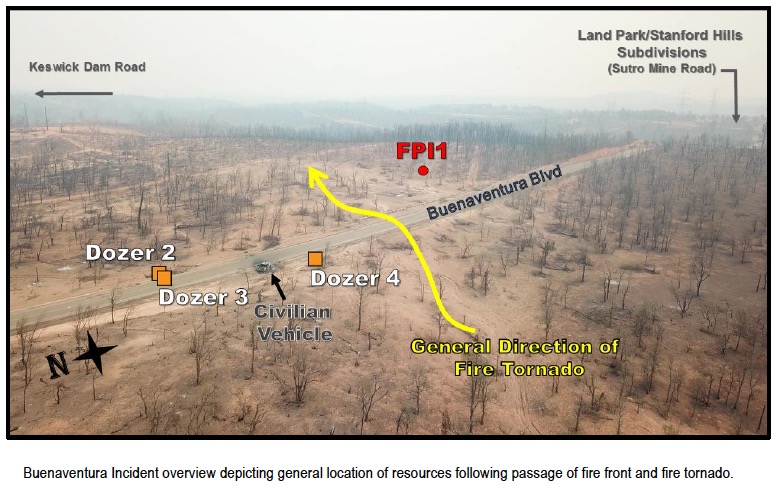
The conditions described by the 911 caller, including his location and the fact that he was with two other dozers, are consistent with the section of the Green Sheet report describing the entrapment of  three pieces of equipment identified in the document as Dozer 2, Dozer 3 and Dozer 4. Wildfire Today covered this report on August 20. Below is an excerpt from the section about the three dozers:


(From pages 13-14)
At approximately 8:02 p.m., Dozer 2, Dozer 3, and Dozer 4 continued northbound on Buenaventura Boulevard toward Keswick Dam Road. Approximately one-half of a mile from Land Park, all three dozers were violently impacted by flying debris, rocks, embers, smoke, and intense heat. The flying material shattered windows on all three dozers. As hot air entered the cab of Dozer 2, the operator repositioned the dozer and parked next to Dozer 3. When Dozer 3’s windows shattered, airborne glass entered the operator’s eyes. Dozer 3 stopped on Buenaventura Boulevard and deployed his fire curtains.

Carr Fire fatality report
From the CAL FIRE Green Sheet Report.

Dozer 4 became disoriented when impacted by the flying debris. As a result, the dozer hit a civilian vehicle that was stopped along Buenaventura Boulevard. The impact caused the dozer operator to land on the floor of his cab. The dozer continued to travel until it came to rest against a tree. Once stopped, the operator tried to drop the fire curtains. Due to burn injuries on his hands, he was unable to manipulate the straps, and had to cut the straps with a razor knife to deploy the curtains. He successfully dropped three out of the four curtains. The operator then deployed a fire shelter. In order to escape the intense heat, he exited the cab and sought refuge under the dozer, but saw a tree blocking his route. When the dozer operator reentered the cab, he saw emergency vehicle lights on Buenaventura Boulevard. He ran up to the vehicle where PREV1 directed him into the backseat. Once in the pickup truck, the dozer operator noticed there was also a civilian in the vehicle.

Prior to the rescue of the Dozer 4 operator, at approximately 8:01 p.m., PREV1 and SUP1 exited north on Buenaventura Boulevard from Land Park and Stanford Hills. SUP1 was now travelling back out of the subdivision with the evacuated family members.

Both PREV1 and SUP1 drove slowly, due to the heavy smoke conditions. Both vehicles were in close proximity to each other. As they approached the general area where the three dozers were stopped, PREV1 saw a civilian vehicle on fire. SUP1 passed PREV1 as he slowed to a stop. SUP1 continued north approximately 150 feet when both of their pickup trucks were suddenly impacted by flying debris, rocks and embers.

SUP1’s vehicle began to shake violently, and the passenger windows shattered. SUP1 ducked down to avoid being hit by flying debris and he momentarily drove off the road. SUP1 regained control of his vehicle, drove back onto the road, and exited the area to the north.Carr Fire fatality report

As PREV1 slowly approached the burning vehicle, he felt his pickup truck get “pushed” from the west. All the windows in his pickup truck except the windshield shattered. PREV1 took refuge in his vehicle. Approximately 30 seconds later PREV1 observed a male civilian attempting to get in his pickup truck. PREV1 directed the civilian to get in the back seat. Moments later, PREV1 saw a second individual (Dozer 4 operator) running toward him wrapped in a fire shelter. PREV1 directed the dozer operator into the back seat. PREV1 asked if they were injured. The dozer operator indicated that his hands were burned. PREV1 notified Redding ECC that he had a burn victim.

CHP helicopter makes one-skid landing during rescue

helicopter one-skid landing rescue
Screengrab from the CHP video.

California Highway Patrol’s Helicopter 70 made a one-skid landing October 14, 2018 while rescuing a young man at McWay Cove in Julia Pfeiffer Burns State Park.

The gentleman had been swept off a rock and into the ocean. He was able to get himself out of the water but not to safety. After the one-skid landing he was loaded onto the helicopter then transported to a near-by turnout on Highway 1.