On December 18 the National Wildfire Coordinating group published a 4-minute video that gives a brief overview to the contents of the Crash Rescue Kit. It can be ordered like any other fire equipment through the fire cache system, as NFES #1040. If you desire to purchase it, the cost is $724.75.
The video implies it would be appropriate to have the kit available at an incident helibase.
(This article was first published at Fire Aviation.)
Left to right: Tanker 46, a second BAe-146, and Tanker 55 (a P2V) at the Minden Air Corp facility at the Minden, NV airport. Photo: Google Street View, April, 2015. Tanker 55 was damaged in 2012 when it landed with only partially lowered landing gear possibly due to a hydraulic system failure.
For more than 15 years Minden Air Corp has been working on the concept of transitioning from their Korean War vintage P2V air tankers to a jet, the BAe-146. They acquired two or three of them and had nearly completed their work on what was going to be Air Tanker 46 when they ran out of money. Problems with hydraulic systems led to landing gear failures on two P2Vs, T-48 and T-55, taking out Minden’s last two operational air tankers, which no doubt affected their incoming revenue stream. Thankfully there were no serious injuries reported in those two accidents, unlike the crash of the company’s T-99 on October 3, 2003 that killed the two pilots, Carl Dobeare, 54 and John Attardo, 51. A lookout staffing a fire tower saw that P2V fly into a cloud bank as it was preparing to land at San Bernardino. It did not emerge and shortly thereafter they saw what appeared to be smoke at the top of the cloud. The NTSB described it as “controlled flight into mountainous terrain”. The two pilots had a combined total of more than 15,000 flight hours.
In October AvGeek filmed a report about Minden Air Corp at the Minden Airport 45 miles south of Reno, Nevada.
Tim Cristy, Flight Operations for Minden, said in the video when explaining why the conversion of T-46 came to a stop, “We ran out of money. Well, the engineering got expensive as all get-out”.
We attempted to call Mr. Christy and Minden’s CEO, Len Parker, to get more information but the number we had used before no longer works.
The T-46 project had progressed to conducting a grid test, which involves dropping retardant over a grid of more than 3,000 cups on the ground. In the video Mr. Cristy said the test went well. We are not sure if the aircraft ever received a Supplemental Type Certificate from the FAA which is a major hurdle to overcome in addition to approval from the Interagency Airtanker Board. After that they would have had to deal with the bewildering and unpredictable Forest Service contracting system before they ever received a dime from their large monetary investment.
The retardant tank inside Minden’s T-46. Screenshot from the AvGeek video.
The video below, published June 17, 2014, shows T-46 making its first test drops of water and retardant.
Tanker 46, a second BAe-146, and Tanker 55 (a P2V) at the Minden Air Corp facility at the Minden, NV airport. Photo: Google, June, 2018.
Thanks and a tip of the hat go out to Brian. Typos or errors, report them HERE.
Left to right: Tanker 46, a second BAe-146, and Tanker 55 (a P2V) at the Minden Air Corp facility at the Minden, NV airport. Photo: Google Street View, April, 2015. Tanker 55 was damaged in 2012 when it landed with only partially lowered landing gear possibly due to a hydraulic system failure.
For more than 15 years Minden Air Corp has been working on the concept of transitioning from their Korean War vintage P2V air tankers to a jet, the BAe-146. They acquired two or three of them and had nearly completed their work on what was going to be Air Tanker 46 when they ran out of money. Problems with hydraulic systems led to landing gear failures on two P2Vs, T-48 and T-55, taking out Minden’s last two operational air tankers, which no doubt affected their incoming revenue stream. Thankfully there were no serious injuries reported in those two accidents, unlike the crash of the company’s T-99 on October 3, 2003 that killed the two pilots, Carl Dolbeare , 54 and John Attardo, 51. A lookout staffing a fire tower saw that P2V fly into a cloud bank as it was preparing to land at San Bernardino. It did not emerge and shortly thereafter they saw what appeared to be smoke at the top of the cloud. The NTSB described it as “controlled flight into mountainous terrain”. The two pilots had a combined total of more than 15,000 flight hours.
In October AvGeek filmed a report about Minden Air Corp at the Minden Airport 45 miles south of Reno, Nevada.
Tim Cristy, Flight Operations for Minden, said in the video when explaining why the conversion of T-46 came to a stop, “We ran out of money. Well, the engineering got expensive as all get-out”.
We attempted to call Mr. Christy and Minden’s CEO, Len Parker, to get more information but the number we had used before no longer works.
The T-46 project had progressed to conducting a grid test, which involves dropping retardant over a grid of more than 3,000 cups on the ground. In the video Mr. Cristy said the test went well. We are not sure if the aircraft ever received a Supplemental Type Certificate from the FAA which is a major hurdle to overcome in addition to approval from the Interagency Airtanker Board. After that they would have had to deal with the bewildering and unpredictable Forest Service contracting system before they ever received a dime from their large monetary investment.
The retardant tank inside Minden’s T-46. Screenshot from the AvGeek video.
The video below, published June 17, 2014, shows T-46 making its first test drops of water and retardant.
Tanker 46, a second BAe-146, and Tanker 55 (a P2V) at the Minden Air Corp facility at the Minden, NV airport. Photo: Google, June, 2018.
Thanks and a tip of the hat go out to Brian. Typos or errors, report them HERE.
Airport firefighting is a very specialized niche — there are not many similarities in what they do compared to most other firefighters. For example, one of the Los Angeles Fire Department’s rigs at the city’s airport can apply by the push of a button on the dash, water, foam, dry chemical, or Halotron (a clean agent). That truck also has a penetrator device which can pierce the fuselage of an aircraft in order to apply one of the four suppressing agents in the interior of the aircraft.
A penetrating nozzle on a Los Angeles Fire Department airport rescue truck. Screen grab from LAFD video.
Much more information is in the video below about the Los Angeles Fire Department Airport Rescue Firefighting organization.
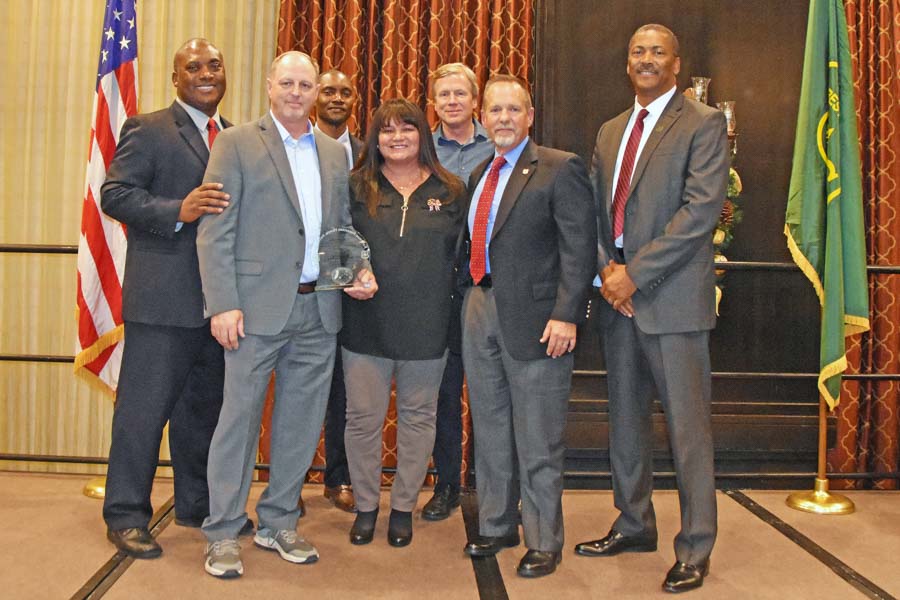
Lead Plane Pilot David Spliethof (2nd from left) receives award. Left to right: Deputy Regional Forester Barnie Gyant, Spliethof, Acting DRF Edward Hunter, Region 5 Aviation Officer Yolanda Saldana, Acting DRF Larry Sutton, Region 5 Fire Director Bob Baird, Regional Forester Randy Moore. USFS photo by Paul Wade.
A U.S. Forest Service lead plane pilot whose home was destroyed in the Carr Fire near Redding, California earlier this year continued to work each day guiding large air tankers as they made their retardant drops on the fire. On December 12 David Spliethof received a 2018 Regional Forester’s Honor Award for the work he did on the fire. The award is given to those who went above and beyond their scope of duty to perform an act of service of rare or exceptional character that reflects an uncommon degree of concern for the well-being of others.
Mr. Spliethof continued to fly as a lead plane pilot for days after he knew he lost his home and all of his family’s belongings. The Spliefthof’s had nothing but the clothes on their backs. He said in an interview that there is no place he would rather be than flying and helping others instead of feeling sorry for himself. He had his family, so he continued to fly to minimize the loss of more homes. Several air tanker pilots stated that for a while they had no idea Mr. Spliefthof lost his home because he was professional and never missed a beat.
There is a critical shortage of lead plane pilots and he had every reason to forgo his duties and focus on his personal situation. However, he chose to serve the agency and the public.
AgustaWestland AW139. Screenshot from the LAFD video.
The Los Angeles Fire Department(LAFD) aviation program started in 1962 with one Bell 47. Today they have six helicopters, four AgustaWestland AW139’s and two Bell Jet Rangers. To work as a pilot with the Department, you can’t simply walk in off the street. The minimum qualifications are:
Private helicopter license,
At least 100 hours of flight time in a helicopter, and,
Four years experience as a firefighter with the LAFD.
Screenshot from the LAFD video.
After a pilot is accepted into the program they are shipped over to the Los Angeles Police Department aviation program where they receive training with 150 hours of flight time, a commercial license, and an instrument rating. If successful there, they go back to the Fire Department and get another 200 flight hours of training. Then there is additional schooling at AgustaWestland to fly their 139.
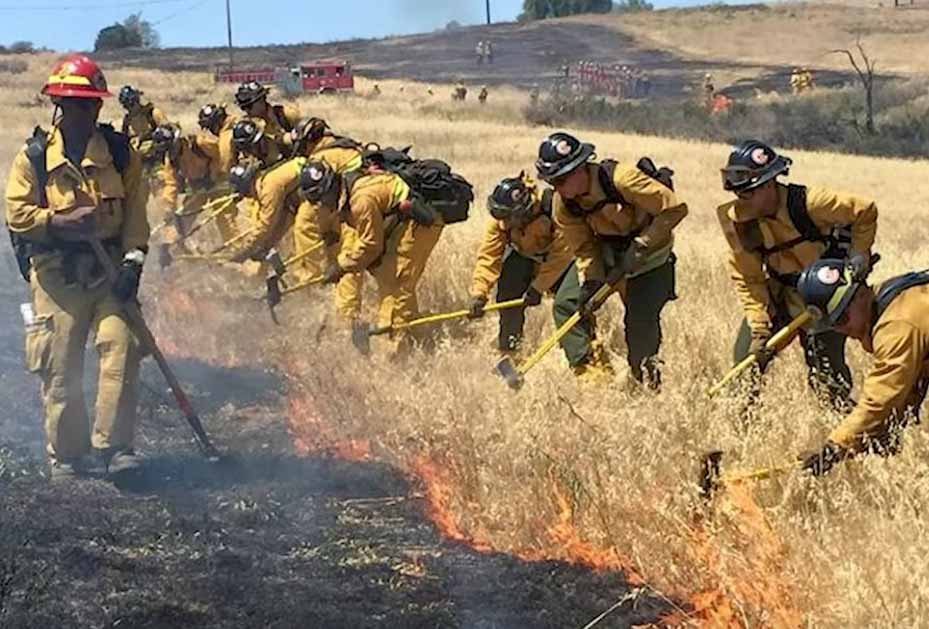
Los Angeles Fire Department Crew 3 constructs fireline. Screenshot from LAFD video below.
Volunteer firefighters are the backbone of many fire departments around the world — many active departments have no paid personnel. Usually volunteer firefighters are found in small or perhaps medium-sized towns and cities, especially in rural areas.
I have to admit — I was surprised to discover that the second most populous city in the United States has volunteer firefighters. Los Angeles, with a population of almost 4 million people, uses volunteers in their Fire Department on what they call Crew 3, a crew that uses hand tools to construct fireline on the edge of fires in order to stop the spread.
Every member on the crew must take the required online training courses, pass the Pack Test, and then participate in two weeks of field training.
Most of the crew members hope the experience on the crew will pave the way to a full time job with the fire department.
The Ravalli Republic has an uplifting story about the recent graduates of the firefighter training program at the Trapper Creek Job Corps center south of Darby, Montana. The nine individuals that were recognized on December 10 are in addition to the 20 that previously graduated and left the facility. The graduates were given coats as a symbol of their achievements.
Below is an excerpt from the article:
…This past summer they learned that struggle can lead to something good. They learned that what they thought were their limits weren’t really where it stops at all. They discovered that they had much more buried deep inside of themselves than they ever imagined.
“You learned to embrace the suck,” said Trapper Creek’s Fire Training Specialist Danny Atkinson. “You found that struggle can become the goal. When it sucks the most, life is good. You discovered that you are a lot damn tougher than you ever thought you were.”
As a team that started with 44 members, they put in 71,774 hours on 277 assignments that took them to 11 states as far away as Wisconsin. Along the way, they and others at Trapper Creek Job Corps earned $1.2 million in gross pay. There is only one other Job Corps Center that’s broken the $1 million mark before. Trapper Creek has done that two years in a row.
“Some of our students have between $5,000 and $20,000 in their bank accounts,” said Justin Abbey, Trapper Creek’s Fire Management Officer. “That’s the money that they’ll be able to tap into to relocate, buy a car and pay for that first and last month’s rent. It helps set them up for success…”
Thanks and a tip of the hat go out to Paula. Typos or errors, report them HERE.
During a 90-day detail to Nevada this year Micah Booze recorded video which he put together in the finished product below. It appears that he had an active three months. The video shows some pretty fancy editing. Thanks Micah.


 Problems with hydraulic systems led to landing gear failures on two P2Vs,