Meg Gallagher named branch chief for NPS aviation

Margaret “Meg” Gallagher
Meg Gallagher. Photo by Tina Boehle.

By Tina Boehle

Margaret “Meg” Gallagher has been named as the new branch chief for the National Park Service (NPS) Aviation Program, succeeding Jon Rollens, who retired at the end of 2017. Meg is currently the acting aviation branch chief, having previously served as the national helicopter specialist for the NPS Aviation Program.

Meg began her career in the federal government as a Student Conservation Association (SCA) volunteer for Olympic National Park as a backcountry ranger. Over the next five years, she worked in wildland fire management for the U.S. Forest Service, NPS, and Bureau of Land Management as a seasonal wildland firefighter on hotshot crews, in fire dispatch, fire prevention, and as a helitack crewmember.

In 1992, two years after completing the Joint Apprenticeship Committee (JAC) Wildland Firefighter Apprenticeship Program, she moved to the Toiyabe National Forest as the assistant helicopter manager in Las Vegas, NV. In 1995, she became the helitack program manager of the Bridger-Teton/Grand Teton interagency rappel/shorthaul program in Jackson, WY. The following year, Meg spent a season on the “Ice,” as a helicopter specialist for Antarctica Support Associates at McMurdo Station in Antarctica.

In 1998, as a warranted contracting officer, she became the aviation resource specialist for the Department of the Interior Office of Aircraft Services (OAS), then five years later stepped into the role of aviation training specialist for the thirty-seven states in the OAS’s Eastern Region. In 2009, Meg was hired by the NPS as an aviation management specialist. Among her diverse duties, she filled the role of regional aviation manager for NPS’s three eastern regions.

Most recently, Meg became the national helicopter specialist for the NPS Aviation Program in 2014. For the past four years in Boise, ID, she has built national operational plans for NPS’s high-risk programs with the experts in the regions and parks, as well as kept the Service up-to-date on quickly changing policy that shapes the Service’s aviation operations.

NPS Division of Fire and Aviation Chief, Bill Kaage stated, “With Meg’s understanding of the many aspects of aviation within the National Park Service, her focus on policy and safety, as well as her experience at local, regional, national, and departmental levels, I have great confidence that the NPS Aviation Program will continue to excel as it moves forward.”

Meg stated, “I look forward to leading the National Park Service’s Aviation Program into the future with evolving technology, while building on our current excellent safety record. I also look forward to filling vacancies so we can provide the best customer service to all National Park Service employees who use aviation to meet the mission.”

Meg and her partner reside near Boise. When not working, she enjoys travelling, riding her motorcycle, snowshoeing, and enjoying fine Idaho vintages.

She will begin her new position on April 15, 2018.

Air tanker traffic in Abilene heavier than average

Abilene Air Tanker Base
Air tankers at the Abilene Air Tanker Base. Screen grab from the KTAB video.

The air tanker base at Abilene Regional Airport has been busier than usual so far this year.

The four large air tankers stationed there Wednesday is the most they have had in one day since 2011.

California burn projects wrap up before major precipitation event

rain forecast northern california

Above: Forecast published Thursday April 5 by the National Weather Service.

National Forests in California have been busy in recent days completing pile burning and prescribed fire projects as they prepare for heavy precipitation through Saturday.

Most areas in the northern part of the state should expect at least two inches with as much as three to five inches in some locations.

Thursday brought showers but the heaviest rain and snow will occur Friday, transitioning to light showers on Saturday.

rain forecast northern california
Forecast published Thursday April 5 by the NWS.


More research indicates some forests are not growing back after wildfires

Rim Fire, August 21, 2013.
Rim Fire, August 21, 2013. Photo by Robert Martinez.

Recent research in the Rocky Mountains has found what others also determined in a 2013 study in Oregon — significant decreases in post-fire tree regeneration. In a paper titled “Evidence for declining forest resilience to wildfires under climate change”, eight researchers noted reductions in tree regeneration in the 21st century.

Below are some excerpts:

Annual moisture deficits were significantly greater from 2000 to 2015 as compared to 1985–1999, suggesting increasingly unfavourable post-fire growing conditions, corresponding to significantly lower seedling densities and increased regeneration failure. Dry forests that already occur at the edge of their climatic tolerance are most prone to conversion to non-forests after wildfires. Major climate-induced reduction in forest density and extent has important consequences for a myriad of ecosystem services now and in the future.

Climate change is already affecting multiple ecosystem properties, leading to shifts in species composition and state changes (Walther et al. 2002; Donato et al. 2016). In the US Rocky Mountains, we documented a significant trend of reduced post-fire tree regeneration, even over the relatively short period of 23 years covered in this analysis. Our findings are consistent with the expectation of reduced resilience of forest ecosystems to the combined impacts of climate warming and wildfire activity. Our results suggest that predicted shifts from forest to non-forested vegetation (e.g. Bell et al. 2014) may be underway, expedited by fire disturbances (Kemp 2015; Donato et al. 2016; Harvey et al. 2016; Johnstone et al. 2016; Rother & Veblen 2016).

Regeneration failures, as measured by both seedling presence/absence and regeneration thresholds, occurred across all forest types (Figs 3 and 4d). Low-elevation forests, dominated by tree species near the warm, dry edge of their climatic tolerance may be particularly vulnerable to shifts to non-forest vegetation, because of the absence of any tree species that could reestablish under warmer, drier conditions (Harvey et al. 2016). Meanwhile, moist forest types may experience a shift in species dominance and a decrease in tree density. And while only 15% of the moist forest sites we studied lacked seedling after 21st-century fires, 35% of these sites did not meet the recruitment threshold. This represents a substantial increase (300%) relative to the 1985–1999 period, highlighting the impacts of warming in moist forests as well.

Red Flag Warnings in six states, April 4, 2018

wildfire red flag warning fire

The National Weather Service has issued Red Flag Warnings for areas in Colorado, Kansas, New Mexico, Oklahoma, Texas, and Nebraska.

The Red Flag Warning map was current as of 7:45 a.m. MDT on Wednesday. Red Flag Warnings can change throughout the day as the National Weather Service offices around the country update and revise their forecasts.

Waterborne Hotshots

Sierra Hotshots boat Santa Cruz fire

Above: USFS photo.

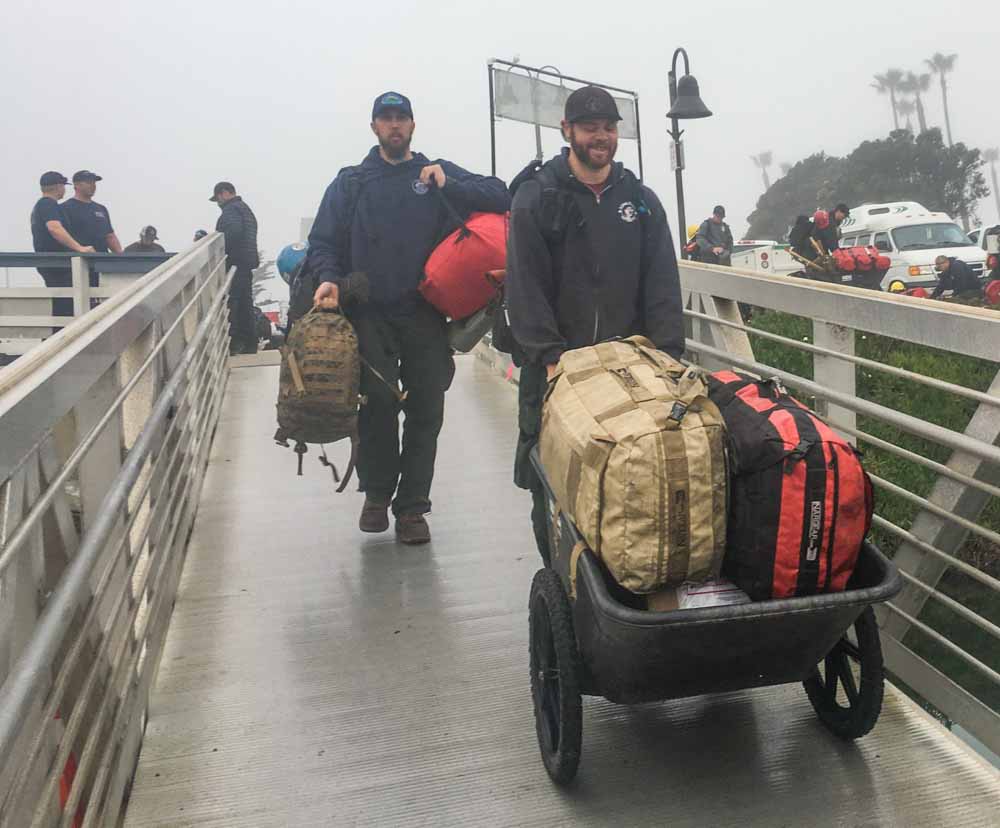
When 10 members of the Sierra Hotshots travelled to the fire on Santa Cruz Island 20 miles off the Southern California coast March 28, the last leg of their journey was on a boat.

The fire started March 27 most likely from an escaped burn pile and at last report on April 2 it had burned 250 acres. On March 29 there were 95 firefighters assigned from California and Arizona but that number has been reduced significantly.

Sierra Hotshots boat Santa Cruz fire
10 members of the Sierra Hotshots en route to the Santa Cruz Fire. USFS photo.
Sierra Hotshots boat Santa Cruz fire
10 members of the Sierra Hotshots en route to the Santa Cruz Fire. USFS photo.

The first large fire I was on was the Safety Harbor Fire in Washington with the El Cariso Hotshots. Our last travel leg was on a boat that took us across Lake Chelan.

CAL FIRE’s acquisition of new helicopter fleet still up in the air

CAL FIRE Firehawk
Model of CAL FIRE Firehawk, by Sikorsky. Photo by Bill Gabbert.

After several false starts over several years, CAL FIRE selected a variant of the Blackhawk to replace its aging fleet of 12 Super Huey firefighting helicopters, but that acquisition is stalled. In what appeared to be the final hurdle an administrative law judge ruled in December against a protest filed by a competing company clearing the way for CAL FIRE to purchase up to 12 new Sikorsky S-70i’s (Firehawks), from Air Methods/United Rotorcraft (AMUR).

When the effort began years ago to replace the fleet of aircraft that is now at the end of its useful life, the legislature was told each new helicopter would cost around $12 million, but they realized the price could escalate. The new Firehawks will run $24 million each with the additional features recently added by CAL FIRE and the Department of General Services.

Below is an excerpt from an article in the Sacramento Bee:

The Governor’s Office and Cal Fire are ready to start buying the new machines. “We believe we have provided the Legislature with all the necessary and requested information to move forward on this project,” Finance Department spokesman H.D. Palmer said.

Thanks and a tip of the hat go out to Jim.
Typos or errors, report them HERE.