New regulations will require employers in Washington State to protect outdoor workers from wildfire smoke. KING5 News reported that the new regulations will take effect next month, making Washington the third state to establish year-round smoke protections for people who work outdoors. California and Oregon were the first two states to enact regulations.
“Wildfire smoke events have continued to happen in Washington state over the last five-plus years, seeming to be very consistent throughout the state each summer,” said Ryan Allen, senior program manager for the Division of Occupational Safety and Health (DOSH) at the Washington State Department of Labor and Industries.
Wildfire smoke can cause short and long-term health problems. “Our primary pollutant of impact is the PM2.5,” Allen said. “It can get into the small recesses of your lungs and start causing damage within the lung itself.”
Starting in January the department will be enforcing year-round workplace protections for those who work outdoors in Washington. The primary petitioner in this case was the United Farm Workers Union; the initiative was advocated primarily by the community of agricultural workers. Emergency rules were enacted in several states during smoky conditions, but now the rule in Washington will be in effect all year round.
Efforts that employers must make during smoky conditions range based on air quality, and they include providing respiratory protection, requiring N95 masks, and requiring immediate medical attention and relocating the person to clean air when experiencing symptoms of smoke exposure.
Source NM reported that a study published in the American Journal of Public Health found that 87 percent of Americans experienced more days of heavy smoke in 2021 than they had in 2011. The change was marked east of the Mississippi River in states including New Jersey, New York, Ohio, and Pennsylvania — and Western states including Arizona, California, Colorado, and Washington. Eastern and Midwestern states this year were subjected to far more smoke than usual from the record-breaking fires in Canada.
Wildfire smoke contains an unpredictable mix of vaporized chemicals and microscopic particles that can enter the bloodstream when inhaled. The dangers have increased from the days of “forest fires” burning mostly trees and other vegetation; wildland/urban interface fires now often include smoke from burning plastics, construction materials, vehicles, outdoor equipment, and other hazardous fuels.
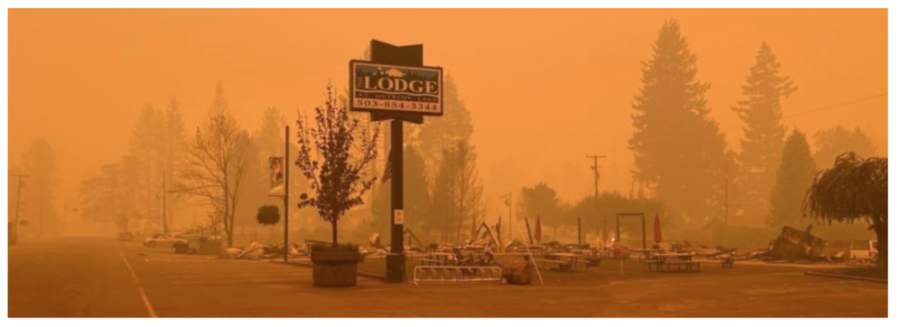
Dense smoke from the 2020 Beachie Creek Fire in Oregon. Inciweb photo.
Even at low levels, pollution from wildfire smoke can irritate the eyes and respiratory tracts of particularly sensitive people including children, older adults, and those with preexisting respiratory or cardiovascular conditions. At higher levels, pollutants in smoke can cause heart attacks and damage lung function.
Cal Fire is now one big step closer to getting seven military transport planes from the Coast Guard to fight fire after Congress passed legislation this week to speed up the transfer.
According to a Politico report, the National Defense Reauthorization Act contains language to expedite the legal transfer of seven C-130 aircraft from the Coast Guard to Cal Fire. Senator Amy Klobuchar (D-MN) said Minnesota’s 133rd Airlift Wing was selected to receive 8 new C-130J aircraft; the new aircraft will replace decades-old C-130H aircraft, which were supposed to have been transferred over to California years ago.
In a move by Senator Alex Padilla (D-CA), Senator John Boozman (R-AR), and Congressman Ken Calvert (CA-41), the final version of the 2024 National Defense Authorization Act includes an effort that recognizes the work of Governor Newsom and Cal Fire Chief Joe Tyler, who pushed the effort over the finish line.
Aerial Fire Magazine reported back in October that it was nearly five years ago that Congress told the U.S. Air Force to convert the seven surplus USCG C-130s aircraft into firefighting tankers for California. It never finished the job, and now California just wants the planes. Period. “We were fortunate this year to have a fire season that wasn’t like we’ve had in previous years,” said Ken Pimlott, now-retired chief of Cal Fire. “But it’s coming back — this is only one year. We can’t afford to lose any more time getting these aircraft retrofitted.”
So California Sen. Alex Padilla and Rep. Ken Calvert added a provision in the 2024 defense spending bill to hand over the C-130s to Cal Fire immediately — whether they were finished or not.
In service for more than 60 years, the C-130 is a workhorse of military aircraft, used for decades for troop transport, medical evacuations, search and rescue, and weather reconnaissance. As airtankers they have a drop capacity of 3000 gallons.
“This transfer will save lives, improve air quality, protect forestlands, and reduce carbon emissions,” said Matt Dias with Calforests, the California Forestry Association. “Adding seven C-130s to California’s aerial firefighting force is a truly remarkable advancement.”
Cal Fire Director Joe Tyler said the C-130s will help reduce loss of life and property to California wildfires. “I look forward to these aircraft joining our world-renowned aerial firefighting force,” he said. “Between earthquakes, wildfires and other natural disasters, California is one of the most costly and challenging states for property insurers and owners.” He said California can’t prevent earthquakes, but it can fight fire.
When Biden signs the defense bill into law, the planes will be transferred, and California will enter into a contract for the work. The first of the seven planes will likely be ready in time for the 2024 fire year, adding immediate value to the state’s fleet.
Matt Dias, president and CEO of the California Forestry Association, said the new aircraft will have the capacity to drop 3,000 gallons of retardant in less than five seconds, which is more than twice the load dropped by Cal Fire’s current S-2Ts.
“To be able to use aerial deployment of retardant for initial attack and suppression is really critical,” Dias said.
Retired Chief Ken Pimlott said the planes should give firefighters a big boost in future fire seasons, noting the engines on the C-130s. “In general they’re a bigger aircraft, they’re a four-engine aircraft where the S-2 is a two-engine,” he said. “Since it flies faster, it can return to the base and reload more quickly as well.”
The transfer has been delayed for years and became a priority for California’s firefighting agency. Coulson Aviation’s Retardant Aerial Delivery System (RADS) can be installed on virtually any C-130. The Coulson RADS-XXL is half the cost of competing systems — and one-sixth the weight — and it requires no additional crew or equipment. The RADS-XXL systems were selected for the Hercules C-130 aircraft fleet operated by Cal Fire.
The heart of the historic town of Lahaina that burned in a deadly August wildfire that killed at least 100 people on the Hawaiian island of Maui is reopening to residents and business owners holding day passes, according to an Associated Press story, and the renewed access marks a big milestone for the victims of the fires. Safely clearing properties and rebuilding will still take a long time, and residents are worried about where on the island the remaining fire debris will be discarded.
Banyan Tree Park, home to a treasured 150-year-old Banyan tree that burned in the fire but is now producing new sprouts, is re-opened, along with the public library, an elementary school, and some restaurants.
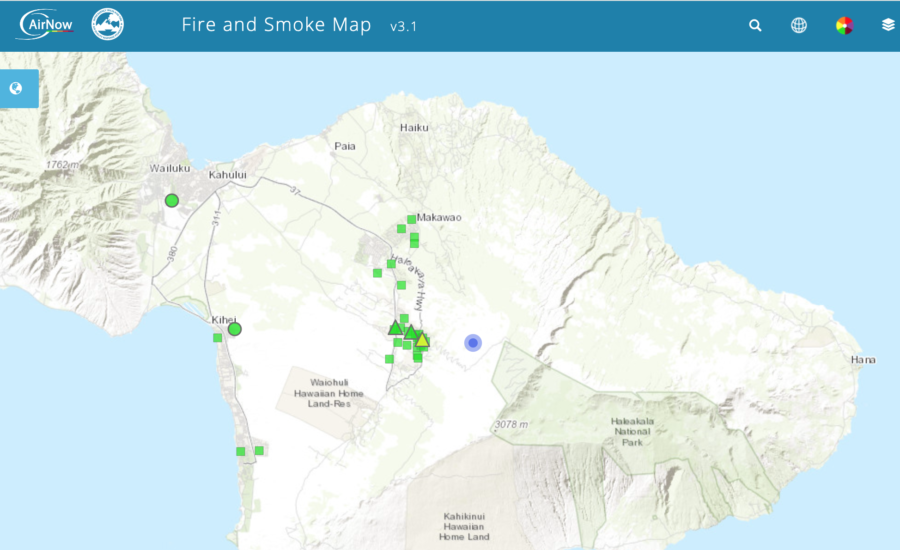
Maui air quality map
The state Department of Health has confirmed that the ash and dust left by the fire is toxic — and that arsenic is the biggest concern. Arsenic is a heavy metal that adheres to wildfire dust and ash and can be harmful. Samples collected in early November from dozens of sites on the island also showed high levels of lead, commonly used in house paint for buildings constructed before 1978.
The federal EPA is removing risks such as batteries, pesticides, propane tanks, and other hazards and chemicals from local buildings. Residents and property owners can visit their sites after the EPA has cleared them. The U.S. Army Corps of Engineers is hauling debris to a landfill after property owners grant permission, using lined dumpsters that are then wrapped and sealed before they are dumped at the landfill.
Maui air quality map
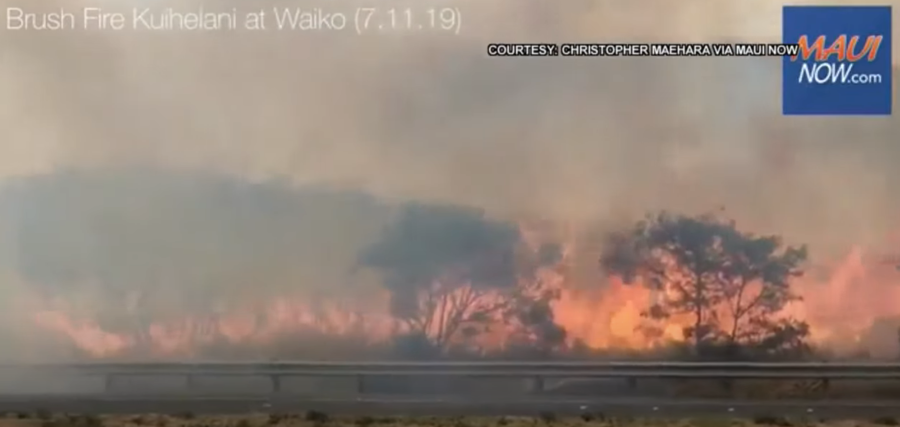
The EPA and the state health department have installed dozens of air monitors in Lahaina and upcountry Maui, where another fire burned in early August. The FIRE AND SMOKE MAP is online; residents snd visitors are advised to avoid outdoor activity during times of elevated air pollution.
This was posted by the BLM three years ago but I have not seen a better fire aviation photo for 2023. If you have a contender, please contact us. Meanwhile, enjoy this!
WELL, it didn’t take long to get another contender, and I doubt anyone will beat this one. … See below … !
First up for our 12 Days of Employee Photography, the winning photo for the aviation category, taken by Mike McMillan during #FireYear2020, shows a CL415 dropping water on the 2020 Cedar Fire south of Elko, Nevada. Follow along as we showcase favorites from the first ever BLM Wildland Fire Employee Photo Contest. What a great way to say Happy Holidays!
Aero-Flite CL-415 airtanker
Sorry scoopers, but you may have been outdone. This is from the ATGS on the Wallowa-Whitman — Todd Pease, Air Attack 616 out of La Grande in an Aero Commander 690b flown by Mike O’Brien. Pease says this photo was taken September 18, 2023 on the Fremont-Winema’s Morgan Fire northwest of Lakeview, Oregon. It’s Erickson’s T-104 — on a load-and-return out of Klamath Falls — putting down the last load of retardant for the day, in support of a Forest Service engine crew trying to hold the road.
On this day Tanker 104 was piloted by Capt. Del Hunt with SIC Ron Carpinella.
I asked Todd if that fire later burned over to the headlights on the road. He said it did, and it crossed the road later that night, but everyone was safe — and they were able to pick up the slop across that road the next day, with dozers and the air show.
09/20/23 evening inciweb map, Fremont-Winema National Forest.
The 09/21/23 map on inciweb is one of the few files still there. There used to be this federal regulation that said federal agencies had to keep their website stuff available and/or archived after they replaced it or timed it out, but interagency inciweb files tend to go *poof* not long after the fire’s controlled — even if it’s transitioned to local personnel and/or a BAER team.
Here’s another couple photos from Todd Pease, same fire earlier in the evening.
Shannon De Wit with Conair tells us that this photo was taken in Osoyoos BC in early August where the fire had skirted the edge of town. It started in Washington State and then blew across the border in high winds — along with high temps and low RH — and airtankerS from both sides of the border responded. In this photo the Dash 8 is dropping retardant between homes and the fire, slowing the spread so ground crews can work on containment. This fire skirted neighborhoods, a golf course, and the industrial park.
This sunset photo, on the Cameron Bluff Fire, is a poignant capture of the maintenance that occurs every evening after a day of flying wildland fires, with maintenance crews often working late into the night. In this image, one of Conair’s aircraft had been working the Cameron Bluff Fire on Vancouver Island back in June of 2023.
Attorneys for Hawaiian Electric Company, who face dozens of lawsuits over the utility’s liability for the Maui fires, are trying to move the cases to federal court and not have the trials set on the island. Most of the lawsuits claim that MECO either caused the fires when high winds hit downed powerlines, or didn’t do enough to prevent damage once the fires were burning.
Maui’s power was out before the fires started — but then Hawaiian Electric switched it back on. In congressional testimony, President and CEO Shelee Kimura confirmed what many had already suspected — that the utility re-energized its lines just before the early morning fire took off. Honolulu Civil Beat reported that the power was already out in West Maui at 5 a.m. — caused by the hurricane storm winds on August 8 — and it could have stayed off if Hawaiian Electric had not decided to re-energize the lines.
Ignoring or re-prioritizing the danger, the company rebooted a tripped transmission line, in order to keep the power on to some customers in Lahaina despite the high winds and extreme fire danger. The power was back on about 6 a.m. and within an hour a downed powerline near Lahainaluna Road ignited a fire that was likely the origin of the firestorm that ripped through Lahaina and killed over 100 people. Numerous lawsuits have been initiated since then, and Hawaii News Now reports that HECO is asking the federal courts to try the case in Honolulu with a federal judge.
They argue that federal jurisdiction is possible because one of the defendants being sued is out of state.
“I don’t think that there’s authority for what they’re doing,” said Lance Collins, a lawyer for the wildfire victims. “And this just seems to be one huge waste of everybody’s time. It’s a delaying tactic.”
Collins doesn’t believe Hawaiian Electric is trying to avoid a jury made up of Maui residents — a logical assumption — because he says a federal jury would still be sympathetic to the victims. Hawaiian Electric argues that the federal courts have more resources for a case of this magnitude.
All the lawsuits are expected to be combined into a single trial.
Reuters, meanwhile, reports that Hawaiian Electric is already advancing a plan to replace six of its fossil-fuel generators with renewable energy sources, which will add more around-the-clock renewable generation. The utility company has begun contract negotiations for 15 renewable energy projects, advancing toward Hawaii’s goal of 100 percent renewable energy by 2045.
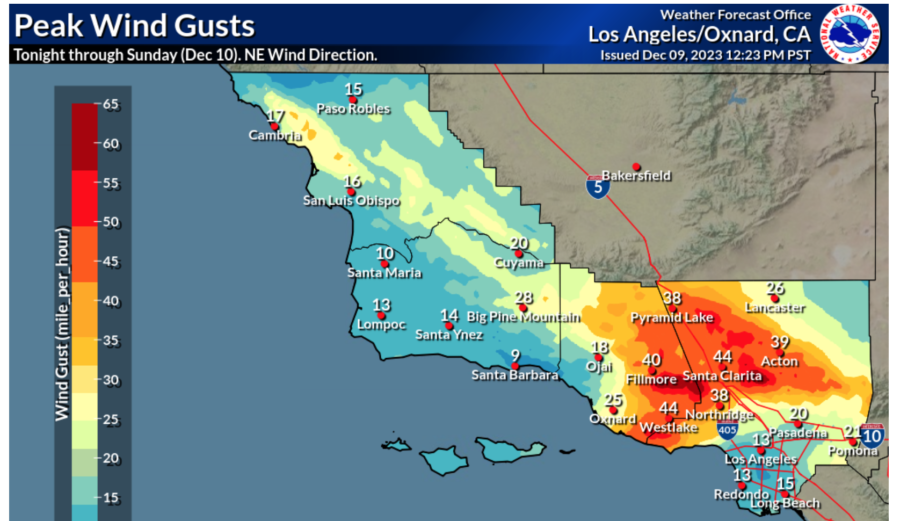
Officials issued evacuation orders yesterday after a brushfire took off in southern California’s Ventura County. The South Fire burned over 2400 acres by Saturday evening, according to Ventura County Fire Department.
KCAL News reported that heavy winds were pushing the fire.
Santa Anas December 10 2023
“Right now it’s light, flashy fuels,” said VCFD Captain Steve Kaufmann. “Most of it is the regrowth that we’ve had from the Maria Fire (2019) a few years back. It’s still erratic conditions, the firefighters are seeing hot flames and the fire kinda goes anywhere it wants to.”
Late last night, evacuation orders were in place for people on the south side foothills of South Mountain; evacuation warnings were issued for the area near S. Mission Rock Road north of Highway 118, south of the Santa Clara River and east of S. Briggs Road; numerous other road closures were in effect. Evacuation orders are posted on the Ventura County Emergency website. A temporary evacuation center was established at Ventura College. Airtankers and helicopters were en route this morning, and by noon over 100 firefighters were on the fire.
#1 CANADIAN NATIONAL BESTSELLER • WINNER OF THE BAILLIE GIFFORD PRIZE FOR NONFICTION • SHORTLISTED FOR THE HILARY WESTON WRITERS’ TRUST PRIZE FOR NONFICTION • FINALIST FOR THE NATIONAL BOOK AWARD IN NONFICTION • ONE OF THE NEW YORK TIMES’ TOP TEN BOOKS OF THE YEAR
A stunning account of a colossal wildfire, and a panoramic exploration of the rapidly changing relationship between fire and humankind from the award-winning, best-selling author of The Tiger and The Golden Spruce.
In May 2016, Fort McMurray, the hub of Canada’s petroleum industry and America’s biggest foreign supplier, was overrun by wildfire. The multi-billion-dollar disaster melted vehicles, turned entire neighborhoods into firebombs, and drove 88,000 people from their homes in a single afternoon. Through the lens of this apocalyptic conflagration — the wildfire equivalent of Hurricane Katrina — John Vaillant warns that this was not a unique event but a shocking preview of what we must prepare for in a hotter, more flammable world.
Below are two reviews of Vaillant’s book, from two well-qualified writers, one in Canada and one in the U.S., written from two divergent perspectives yet reaching similar conclusions and opinions about the book.
How Fort McMurray’s wildfire became the devil of our own creation
ALBERTA, CANADA: Fort McMurray helped fuel its own demise and serves as a heavy-handed lesson in irony. Kind, surreally hard-working Albertans never dreamed of such payback.
The best book of the year is easily Fire Weather: The Making of a Beast, and not just because the planet spent most of 2023 in flames. Canadian author John Vaillant’s story, which begins with the 2016 fire that destroyed most of Alberta’s Fort McMurray, presents modern fire as a force of nature so implacable, so malevolent, that it might as well be the devil himself.
Like babies who can’t consciously recall trauma, Canadians seem to have forgotten that terrible summer, an odd form of self-defense. Vaillant’s magic is describing this new kind of fire, the unstoppable kind. He uses the word “infandous,” meaning a thing too horrible to be named or uttered. Recall for future use.
Infandous fire will haunt us until we change course on using fossil fuels. As we are seeing with COP28, it’s too late now.
Canada contains 10 percent of the world’s forests. It was once charming to sigh about Canada being an inveterate hewer of wood and hauler of water. But as global heating advances and fires pop up worldwide, the presence of wood endangers humans (and vice versa) and water becomes merely unhelpful.
The only thing that could be done when a distant wee fire got noticed by somebody on May 1 2016 at 4 p.m. was to watch aghast as the thing blew up in hot weather, worsened by drought and high winds. Spraying, soaking, or even waterbombing the blaze was pointless.
Like so many built places, Fort McMurray was in crossover territory, on the border between city and forest — and that’s where trouble lives. Much of it contains black spruce, a tree firefighters refer to as “gas on a stick.” Fire spreads almost instantly with embers shooting into the air like a cloud of kamikazes or a swarm of drones.
Vaillant’s story is plot-driven. Humans found fossil fuel and, hungry for the last dollar-drop, they found a use for Alberta’s tar. It’s not even “bitumen,” Vaillant points out, it’s “bituminous sand. It is to a barrel of oil what a sandbox soaked in molasses is to a bottle of rum.”
Fort McMurray built a dubious industry based on making a lousy version of oil with huge wastage. Americans bought it cheap, and that’s how the city grew out of Canada’s huge boreal forest. Fort McMurray helped fuel its own demise and serves as a heavy-handed lesson in irony. Kind, surreally hard-working Albertans never dreamed of such payback. And here’s irony to burn: Fort McMurray is filled with the kind of houses suburbanites know by heart: big, poorly built, overpriced, family-friendly homes made of oil. Vinyl siding is made of petroleum, as are flooring, veneered furniture, polyester fabrics, plastic appliances, food packaging, everything. They wait, off-gassing.
When fire arrives, “houses stop being houses. They become, instead, petroleum vapor chambers.” I will underuse the phrase “what made things worse” but technology made the horror more visible.
Sensors, nanny cams, CCTV, and central control mechanisms captured the sight of steel-beamed, 45-tonne homes vanishing. “Fully there, totally normal, to fully gone was five minutes,” one firefighter said. Wait until Vaillant introduces “fire tornadoes,” fires so huge they have their own weather systems.
“Fire Weather” is beautifully handled, full of that rare and valuable quality in non-fiction, context. A New York Times reviewer didn’t like this, bemoaning Vaillant’s unnecessary history, fancy philosophical wanderings, and “climate science, activism, and denialism.” This is exactly the kind of narrow American thinking that created climate change — that there are only individual narrowly defined stories rather than collective ones.
Climate change in the Petrocene Age is the most collective story ever told, Vaillant says, and certainly the biggest story since the Permian-Triassic Extinction Event 250 million years ago, which scientists call “the worst thing that’s ever happened.” And we did it to ourselves. What a species.
Heather Mallick is a staff columnist with the Toronto Star whose subjects range widely. She has published two non-fiction books — a diary and an essay collection — and has worked for CBC.ca, the Globe and Mail and other media. With a BA Hons and MA in English Literature from U of T plus a Ryerson journalism degree, she writes with courage and candour, and is an accomplished public speaker.
Fire Weather is the story of the Fort McMurray Fire and several other wildfires that attained heroic size in the past 30 years. But it is mostly about climate conditions that have created the perfectly cured fuels which are enabling wildfires to burn uncontrollably and attain immense sizes. It’s a very well-written book and is likely of interest to anyone in the fire service, wildland or municipal, regardless of country. The scope is huge, the story is sad, and the ending isn’t very nice.
The author, John Vaillant, was born in the U.S. but lives in British Columbia. Fire Weather is his fourth book and last month it received the Baillie Gifford Prize for Nonfiction. He has also written articles for The New Yorker, The Atlantic, National Geographic, and Outside magazines.
He clearly went all out in researching what has been written about wildfire and climate change, and interviewed many people who were intimately affected by the fires he writes about in this book. The result is impressive in scope, provocative, and disturbing. This is not bedtime reading.
Fire Weather launches right into the heart of the Fort McMurray Fire, writing “Choices that day were stark and few: there was Now, and there was Never.”
This sums up what firefighters and residents faced in early May 2016, when a wildfire overran the city of Fort McMurray, located in the boreal forest of northeast Alberta. It was unremarkable in this era of megafires — marked by wildfires with stunningly rapid growth, and which have become virtually unstoppable despite relentless suppression efforts from air and ground. However, 100,000 people lived in Fort McMurray, and on May 3 everyone was ordered to leave.
A significant problem was the options for escape. There were two. The road north ended in 30 miles at Fort McKay. The other was the highway that headed south, AB-63S, which, after four hours of driving, led one to the city of Edmonton. There were other small towns to the south but the problem was the fire. The Fort McMurray Fire originated southeast of the city of Fort McMurray and the wind was blowing toward the northwest. The highway going south was blocked, so residents were advised to go north.
This was a decision made by firefighters and emergency management officials after it became clear that efforts to contain the fire on any flank were unsuccessful. “Even if your equipment and manpower are inadequate to the task at hand, even if your adversary is disintegrating entire houses like a Martian death ray, your duty is to somehow stand between it and the citizenry and infrastructure you’re charged with protecting,” writes Vaillant, following his conversation with firefighter Lucas Welsh.
“It was chaotic and it was personal,” Welsh said. “I love this city. It’s my home and that was my neighborhood; my kids and my wife were five hundred yards away from me and evacuating.”
Map of the Fort McMurray Fire, (Horse River Fire). The red line was the approximate perimeter the morning of May 16, 2016. The dots represent heat detected by a satellite within the last 24 hours, with red being the most recent, as late as 2:29 a.m. MDT May 17, 2016. Click on the map to see a larger version.
Firefighters were seeing homes go from ignition to complete destruction in five minutes’ time. Crews didn’t know which way to turn. There wasn’t any anchor point. “A lieutenant named Damian Asher compared these frantic efforts to cats chasing a laser pointer.”
While the firefighters chased the conflagration from neighborhood to neighborhood, fire and emergency managers faced the fact that the core problem was the weather. The forecast called for temperatures in the high 80s. “This wasn’t just a little bit warmer than normal — it was almost 30 degrees hotter than the average high for that time of year. Meanwhile, the forecast for relative humidity — 15 percent — was also record-breaking for that date; 15 percent humidity is not typical of the boreal forest in May; it is typical of Death Valley in July.”
“Given the long-term forecast,” writes Vaillant, “this fire could burn as long as the fuel held out, and in these conditions, the boreal forest was nothing but fuel.”
The forest in this part of Alberta is composed of aspen, poplar, and black spruce. Fort McMurray is a city within the wildland/urban interface where just a few steps beyond a home on the edge of town was a “virtually limitless expanse of dog-hair forest and muskeg — moose and beaver country that favors the amphibious and well insulated, and discourages casual exploration. Once beyond the tenuous membrane of suburbia, you were bushwhacking — all the way to Buffalo Head Prairie, two hundred miles to the northwest.”
It probably isn’t coincidence that Vaillant chose the Fort McMurray Fire as the keystone incident in Fire Weather — the city exists because of the oil sands mine and the bitumen extraction plant located right next to Fort McMurray.
Vaillant wastes little time underscoring the irony behind an unstoppable wildfire consuming a city that was built to serve the bitumen extraction industry. Bitumen “is a kind of degenerate cousin to crude oil, more commonly known as tar or asphalt. Surrounding Fort McMurray, just below the forest floor, is a bitumen deposit the size of New York State.” Extracting bitumen is one part of the international petrochemical industry that, decades earlier, authored definitive research papers that precisely predicted the continued warming of the planet largely due to the burning of fossil fuels.
The people mining the fossils and creating the fuels clearly chose to ignore their own research and continued making fuel for internal combustion engines and other products, such as the stuff plastic is made from.
Wildfires in the boreal forest were not unusual for much of Canada’s history, wildfire being a natural agent of change. But really, really big ones were a late-20th-century-to-early-21st-century phenomenon. And it wasn’t unique to North America. Huge fires in boreal forests had blackened millions of acres in Siberia — and Alaska. Elsewhere on the globe, in non-boreal landscapes, vast wildfires burned across Australia, South Africa, Portugal, France, Greece, and Italy. And the United States, mostly in the arid West.
Clearly, something new and different and very dangerous had overtaken much of the world. Call it Global Warming or climate change, and the age in which this is occurring will be called the Petrocene or the Pyrocene. “One among many ways to quantify these changes is through fire behavior: now, virtually every year, on every continent where anything grows, records are being broken for ambient temperature as well as for acres burned and homes destroyed,” writes Vaillant.
To solidify his argument about the violence the new fire environment can present, Vaillant turns to the Carr Fire, which burned near Redding, California in 2018. This part of Fire Weather reads like something from the Old Testament.
“In the rising light of dawn was revealed the aftermath of an atmospheric tantrum so violent it looked as if the Hulk and Godzilla had done battle there,” writes Vaillant of the aftermath of a fire tornado. “A pair of hundred-foot-tall steel transmission towers were torn from their concrete moorings and hurled to the ground. … Trees were torn limb from limb. In the branches of those that survived, where plastic bags might flutter, 10-foot pieces of sheet metal roofing were twisted like silk scarves. A camshaft, a flywheel, a kitchen sink, an oven door, and countless other objects were scattered through the charred forest. There was no glass anywhere. Grass, bark, and topsoil were gone.”
“Nothing, no matter how sturdy or how small, was left intact. Even the stones were broken.”
This is not breaking news for people intimately involved with fire management in the 21st century. But some may have need for further understanding about how this new and dangerous environment was created. Fire Weather does this and merits a look by those seeking answers. But don’t expect a happy ending.
Brian Ballou
Brian Ballou retired after 20 years with the Oregon Department of Forestry. He was a PIO and fire prevention specialist, and was stationed for 8 years at ODF’s headquarters in Salem and 12 years at the Southwest Oregon District headquarters in Central Point. For 7 of those years, Ballou was a lead information officer on one of ODF’s incident management teams. In 2015 he received a Bronze Smokey award for his service to wildland fire prevention in southwest Oregon.
Prior to joining ODF, Ballou was a seasonal firefighter with the U.S. Forest Service, working on the Willamette, Siuslaw, Winema, and Rogue River national forests. He was also the founding editor of Wildland Firefighter Magazine.
This animation is showing the fire spreading in Fort McMurray, Alberta from May 1st to 20, 2016. Credit: @NRCan. pic.twitter.com/cLea70sSOQ
Got an interesting email today from Delaware.
Ted Waltz, Kenny Chapman, Steve Whitby, Tom Wenk?
Can anyone help this guy out with some history or photos?
Some info is available online from Warbird Alley.
From: Dennis Krepil <fairchildboxcar@gmail.com> Subject: C-119B Tanker 87 is alive and well. Message: Hello Fire Aviation: Allow me to introduce myself. My name is Dennis Krepil. I am currently the volunteer crew chief in the restoration project of Tanker 87 — N13746 from the Hemet Valley Flying Service.
This C-119B is currently at the Air Mobility Command Museum in Dover, Delaware. It is in its original status as USAF C119B : S/R # 480352. It is in the color scheme of its time in the Korean War. I am unable to send any pictures; however, it can be seen on the Air Mobility Command, Dover Delaware website progress report.
I am trying to honor this aircraft for its military and civilian service. Researching its history has led me here. Can you help me? I have looked on the Hemet Valley and Cal Fire websites but have been unsuccessful so far. I am trying to find out how this aircraft was set up as a firefighter, how the fire retardant was loaded, where it was located in the aircraft, and how was the fire retardent disbursed? The jet engine is removed. The bomb bay doors are sealed. The lower half of the cargo bay is off limits due to the fire retardant. Any reference to documents, procedures, or other organizations would be greatly appreciated.
Thank you for your time. Dennis Krepil C-119B crew chief AMC Museum Dover DE
When lightning ignited fires in California’s Big Basin Redwoods State Park north of Santa Cruz in August 2020, the fire spread quickly. Redwoods naturally resist burning, but these fires reached the canopies of trees over 300 feet tall. “It was shocking,” says Drew Peltier, a tree ecophysiologist at Northern Arizona University. “It really seemed like most of the trees were going to die.”
Yet many of them lived, according to a report in Science magazine, and in a paper published in Nature Plants, Peltier and his colleagues explain why: The burned trees, despite losing their needles, mobilized their long-held energy reserves, the sugars that were produced from sunlight decades ago. The trees routed this energy into dormant buds under the bark.
“This is one of those papers that challenge our previous knowledge on tree growth,” says Adrian Rocha, an ecosystem ecologist at the University of Notre Dame. “It is amazing to learn that carbon taken up decades ago can be used to sustain its growth into the future.”
When the wildfires in 2020 burned through Big Basin Redwoods State Park, reported the San Francisco Chronicle, they left some of the oldest trees on the planet badly burned; researchers now have estimates of just how old the energy reserves of those redwoods are. Researchers studying a stand of severely burned old-growth redwoods found the buds were more than 1,000 years old.
Mild fires burn through coastal redwood forests about every decade, and the giant trees resist flames in part because the bark is up to a foot thick on the lower trunks, and it contains tannic acids that are fire-resistant. But in 2020 even the uppermost branches of many trees burned and their ability to photosynthesize went up in smoke along with their needles. Giant sequoias — which are different from the redwoods — can live for up to 3000 years, but in 2020 about 10 to 14 percent of the giant sequoias in the Sierra Nevada that were at least four feet in diameter were killed in the Castle Fire on the Sequoia National Forest.
A sprout emerges from thick redwood bark in Big Basin Redwoods State Park — 2021 photo by Drew Peltier, Northern Arizona University
Fire managers weren’t sure the trees on the Sequoia and in Big Basin would make it, but visiting the state park a few months after the fires, Peltier and his colleagues found fresh growth emerging from the trunks of blackened redwoods. They knew that shorter-lived trees can store sugars for several years. Because redwoods can live for more than 2000 years, the researchers wondered whether the trees were drawing on much older energy reserves to grow these new sprouts.
Within about 5 months, ancient trees had mobilized their old stores of carbohydrate to resprout. LISSY ENRIGHT/USFS photo
Melissa Enright with the USFS covered parts of 60 blackened tree trunks with black plastic to block out sunlight, ensuring that any new sprouts would grow with only stored energy, not new sugars produced from current photosynthesis. After 6 months, the team brought some sprouts back to the lab, and they radiocarbon-dated them to calculate the age of those sugars. At 21 years, they are the oldest energy reserves shown to be used by trees. But the mix of carbohydrates contained some carbon that was much older, and Peltier calculated that the redwoods’ carbohydrates were photosynthesized nearly 6 decades ago.
“They allow these trees to be really fire-resilient because they have this big pool of old reserves to draw on,” Peltier says. These redwoods have formed new sprouts, but Peltier and other forest researchers wonder how the trees will cope with far less energy from photosynthesis, considering that it will be many years before the trees can grow as many needles as they had before.
“It is likely that other long-lived trees also harbor carbon reserves that are much older than previously recognized,” said Peltier. The carbon stores observed in the trees, he told a Forbes reporter, date back as far as 1500 years, and they may provide hope for other ancient trees “destroyed” by fire.
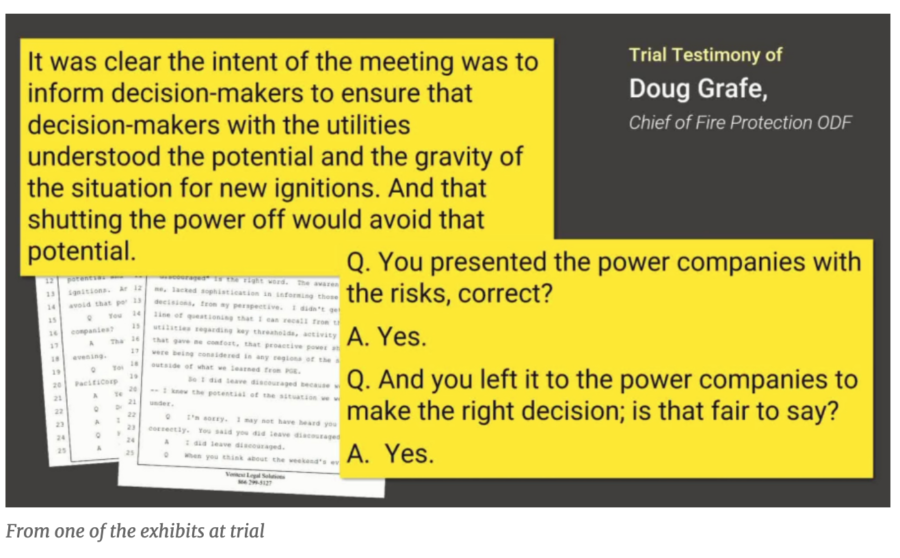
PacifiCorp, an electric utility provider in the Pacific Northwest that was found guilty of gross negligence and recklessness in the 2020 Labor Day fires in Oregon, has agreed to pay $299 million to victims of fires in southern Oregon, according to a report by the Oregonian.
PacifiCorp, which owns Pacific Power, lost a similar lawsuit back in June for causing fires in the northern part of the state. The jury in Multnomah County Circuit Court in Portland found the utility liable for four of the Labor Day 2020 fires, after its powerlines ignited fires that burned about 2,500 properties in western Oregon. The 12-person jury determined that PacifiCorp was negligent for causing the Santiam, Echo Mountain, South Obenchain, and 242 fires after a 7-week class action trial. (The final verdict in that trial is posted on our DOCUMENTS page.)
GOES-17 photo of smoke from wildfires in Washington, Oregon, and California at 5:56 p.m. PDT Sept. 8, 2020. This image was captured during the strong east wind event. NASA photo
A year ago, PacifiCorp settled another case out of court with two families who sued over the Archie Creek Fire, which burned more than 130,000 acres in Douglas County in 2020.
Tuesday’s settlement is unprecedented in Oregon and wraps up a 3-year legal battle that has financially and emotionally exhausted residents who lost homes and property in the firestorm.
The Archie Creek Fire leveled communities along the North Umpqua River east of Roseburg, and it was just one of numerous huge fires ignited during the Labor Day weekend windstorms.
The Labor Day fires collectively burned more than 1.2 million acres in Oregon, destroyed upwards of 5,000 homes and structures, and killed nine people. PacifiCorp, Oregon’s second largest utility, did not shut down power to any of its 600,000 customers during the windstorm — despite the fact they were repeatedly warned by emergency officials to power down their lines, which were implicated in six separate fires.
Archie Creek Fire map, 2:35 p.m. PDT Sept. 22, 2020.
Some 220 families and individuals sued, alleging negligence that caused the Archie Creek Fire. The $299 million settlement amounts to an average of about $1.35 million per family in the lawsuit, though individual claims vary widely. Victims will pay attorneys’ fees, estimated at 30 to 40 percent of the settlement. The settlement agreement avoids a consolidated trial that was scheduled for January 30 and shields PacifiCorp from much larger jury awards that would likely have included punitive damages.
The company had asked state regulators to protect it from the costs of future lawsuits over destructive wildfires; in the request to the Oregon Public Utility Commission in June, PacifiCorp also wanted ratepayers to pay for $90 million the jury found the company liable for. That request drew harsh criticism from wildfire victims, lawyers, and ratepayer advocates, who questioned the company’s motives and the proposal’s legality.
According to a report by The Hill, PacifiCorp said the settlement amounts are consistent with those previously estimated and established in accounting reserves for the wildfires. “PacifiCorp has settled and is committed to settling all reasonable claims for actual damages as provided under Oregon law,” the company said in a statement.
09/13/2020 — the Labor Day fires were among the worst natural disasters in Oregon’s history. They killed nine people, burned more than 1,875 square miles (4,856 square kilometers) and destroyed upwards of 5,000 homes and other structures.
Plaintiffs’ lawyers in the Labor Day fires’ litigation have criticized the utility for legal obstruction — instead of promptly settling with victims. They’ve sought legal sanctions against the company for withholding information about the origins of the fires, denying access to investigations after the fires, and limiting what employees could say in depositions.
The company still faces numerous lawsuits related to the 2020 fires, including a trial scheduled for January for seven timber companies that lost property in the Archie Creek Fire — their claims were not part of this week’s settlement.
Multnomah County Circuit Court Judge Steffan Alexander has scheduled three trials early in 2024 to consider damages for another 20 plaintiffs; he has ordered the company and more than 1000 other plaintiffs into mediation — which could dramatically increase the utility’s financial liability. Total damages sought in lawsuits related to the 2020 fires is about $8 billion.








 AMAZON CANADA