North Carolina Forest Service flying drones to map hotspots

News 13 out of Asheville recently got up close and personal with a piece of firefighting technology when a news crew joined a North Carolina Forest Service drone pilot on a grid mission to map hotspots. Firefighters are tracking daily progress in heat reduction across the 434-acre Poplar Drive Fire. It is now about 45 percent contained.

“We can give the guys in the field a list or a map; we have tablets that we put the dots on and they can walk right to the dot and see it’s a stump hole or something and they can put water on it,” said Matthew Bishop, a drone pilot based out of New Bern. He explained that the drone flies overnight and shoots infrared photos that feed to a computer program that produces location data.

“We used to call it gridding by hand, and you would literally use the back of your hand,” Bishop said. “This makes it a little easier on everybody.”
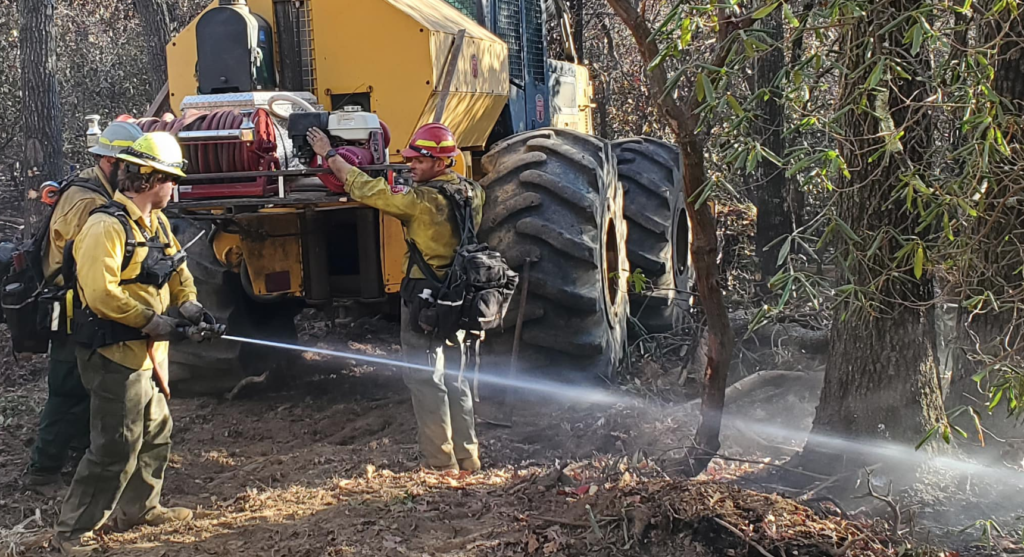
Firefighters drowning hotspots on the fire in North Carolina

The grid mission was mapping the area where Green Mountain Road meets Kyles Creek Road. Bishop said there could be thousands of hotspots the drone sees that may not be visible to firefighters on the ground, but they can check them the next morning. “We all can see smoke with the helicopters or the regular camera,” said Bishop, “but it’s hard detecting the heat without the thermal imagery.”

Drones can fly in most weather and are water-resistant; they’re equipped with a wide-angle camera, a camera with 200x zoom, and a thermal imaging camera, along with a laser rangefinder to pinpoint precise locations.

News 13 also reported that temporary flight restrictions (TFRs) were established over the fire to keep the public from interfering with firefighting operations.

“On this fire, we’ve got one helicopter that’s providing drops,” North Carolina Forest Service Public Information Officer Philip Jackson said. “We have a scout plane looking for hotspots. If there’s other drones in the area, it might make us ground our own pilots for safety concerns.” Persons violating the TFR are subject to hundreds of dollars in fines.

The TFR up to 7,500 feet was established by state forest officials last Wednesday.
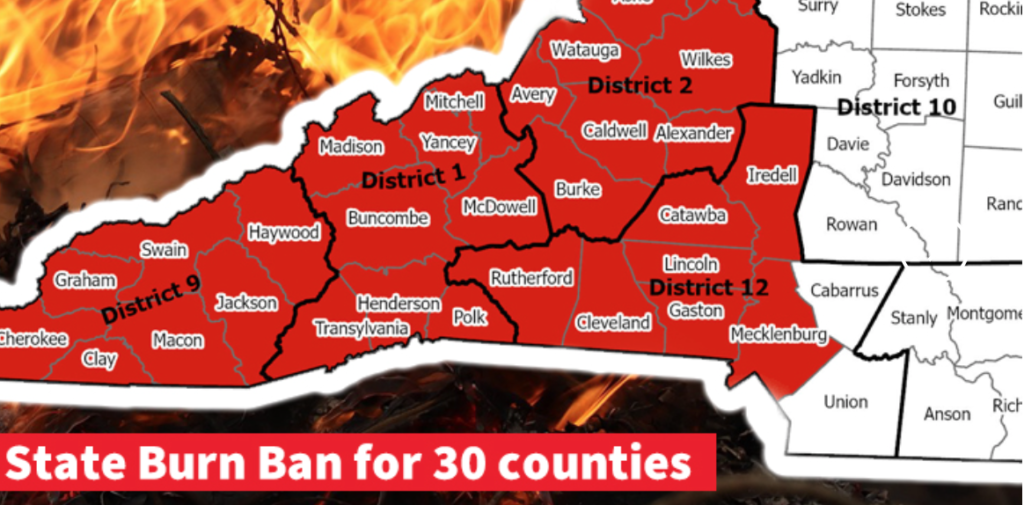
Burn ban in North Carolina

Two state burn bans in 30 western North Carolina counties: Last week, because of increased fire risk, the N.C. Forest Service issued a ban on all open burning and also canceled previous burning permits for many counties until further notice.
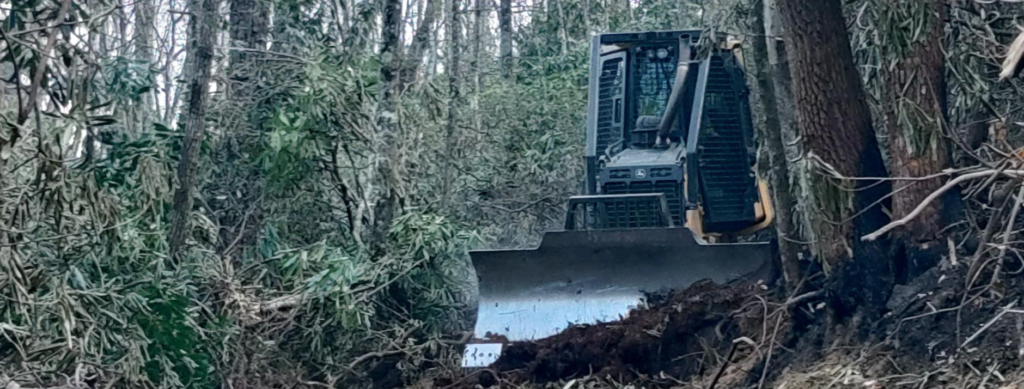
A dozer cutting line on the Poplar Drive Fire

“With the long-range forecast and conditions on the ground showing no improvement, expanding the ban on open burning to additional counties is a necessary precaution,” said Agriculture Commissioner Steve Troxler. “We keep a close eye on weather, fire danger, and fuel conditions, especially this time of year. We’re making daily assessments, and the burn ban will be expanded into Piedmont counties and farther east if needed. If you’re in a county that does not fall under the ban, think twice about any outdoor burning until we see significant soaking rain across the state.” He said anyone violating the burn ban faces a $100 fine plus $183 in court costs, and anyone setting a fire may also be liable for the costs of suppressing the fire.

Details on burn bans are online [HERE].

Jackson cautioned against violating the burn ban or the flight restrictions prohibiting flying a drone over or near the Poplar Drive Fire.

“Drones can and have collided with aircrafts before,” Jackson said. “It’s a real safety hazard for the pilots and significantly impedes our ability to do our job.”

PacifiCorp now wants protection from fire victims

Oregon’s second-largest electricity provider wants state regulators to protect it from the costs of future lawsuits seeking reimbursement from destructive wildfires.

The Oregonian reported that PacifiCorp’s request to the Public Utility Commission (PUC) was made just months after the utility lost a massive lawsuit in Multnomah County over its negligence in Oregon’s catastrophic Labor Day fires of 2020. More lawsuits are still pending with plaintiffs seeking billions of dollars in damages. In June after the trial, the company wanted ratepayers to pay for $90 million a jury found PacifiCorp liable for, after it had started numerous fires and burned miles of forest and thousands of homes in the 2020 fires. (The final verdict [PDF] in the PacifiCorp trial is posted on our DOCUMENTS page.) The jury in Multnomah County Circuit Court in Portland found PacifiCorp  — which owns Pacific Power — liable for four of the devastating Labor Day 2020 fires that burned about 2,500 properties in western Oregon.

One of the 2020 fires overran the ICP.

PacifiCorp’s new request drew harsh criticism from wildfire victims, lawyers, and ratepayer advocates, who questioned the company’s motives and the proposal’s legality. The financial protections PacifiCorp is seeking, in addition to assuming that future fires will be started by the utility company, would “only apply prospectively,” the company told state regulators. Simon Gutierrez with PacifiCorp said the request would have no impact on ongoing litigation.

PacifiCorp has already asked state regulators to let it pass the cost of damages it owes for wildfires in 2020 on to its customers.

2020 Labor Day fires in western Oregon
09/13/2020 — the Labor Day fires were among the worst natural disasters in Oregon’s history. They killed nine people, burned more than 1,875 square miles (4,856 square kilometers) and destroyed upwards of 5,000 homes and other structures.

A report by OPB back in June said that PacifiCorp had asked the PUC to allow the utility to defer the wildfire liability costs  through June 2024, which would give the company the option to add those costs to customers’ rates in the future.

“The deferred accounting application enables Pacific Power to preserve its ability to seek recovery in the future in the event the outcome could impact the financial stability of the company, which would result in higher costs to customers,” said the PacifiCorp attorneys.

A class action lawsuit is still ongoing; jurors found that PacifiCorp could be liable for punitive damages to thousands of Oregonians who lost property in the Echo Mountain Complex and the Santiam Canyon, South Obenchain, and 242 fires. The company estimates those costs could total billions of dollars.

PacifiCorp has now asked the Oregon PUC to limit future lawsuit awards  to “actual” damages for property and loss of life. As a condition of receiving electric service, customers would have to waive their right to other damages (such as non-economic and punitive awards by juries), like the awards that the county jury stung the utility with in June after it found Pacific Power’s  conduct was grossly negligent, reckless, and willful.

courtroom exhibit in the PacifiCorp trial

The utility filed the same request in Washington, California, Idaho, and Wyoming — where it also provides power. PacifiCorp says limiting damages from wildfire lawsuits would protect customers from higher costs.

Meanwhile, PacifiCorp is one of three energy suppliers receiving $450 million in funds from the federal government. OPB reported that two Oregon utilities and the Confederated Tribes of the Warm Springs together will receive nearly $450 million from the federal government to modernize the region’s power grid and incorporate more renewable energy. The investment will allow PacifiCorp, Portland General Electric, and the tribe to boost transmission capacity and job training and fortify the electric grid from the dangers of wildfires.

2020 Beachie Creek Fire

PacifiCorp will match the federal funds allocated for its projects, according to Rohit Nair, the company’s director of engineering standards and grid modernization.

“This is a once-in-a-generation opportunity to secure significant federal funding for programs that support our customers,” he said, “especially those in historically underrepresented and marginalized communities.” The funding is part of a total $3.5 billion the Biden administration announced in mid-October for states to upgrade their electric grids to make them more resilient to climate disasters and to support clean energy development.

2020 Beachie Creek Fire

But while PacifiCorp moves forward with upgrading its infrastructure, it’s also asking the PUC to protect it from future lawsuits after utility-caused wildfires.

“This proposal is grossly beyond the pale,” said Sam Drevo, one of 17 named plaintiffs who were collectively awarded $90 million in economic, non-economic, and punitive damages in back in June. “As a wildfire victim who lost everything in fires that were caused by PacifiCorp’s equipment, non-economic and punitive damages are the only punishment available in the legal system to stop negligent behavior from happening again,” he said. “I am shocked by this disgusting proposal and hope it falls flat with the PUC.”

Lee Beyer, a longtime Oregon legislator and former PUC chair, said PacifiCorp’s assertion that the request would benefit ratepayers is questionable. He believes it’s unlikely the commission would allow PacifiCorp to pass the legal costs on to customers.

“Any costs coming out of a court case are generally the responsibility of the utility and its shareholders,” Beyer said.

Bob Jenks, executive director of the ratepayer advocacy group Oregon Citizens’ Utility Board, questioned whether the PUC even has the legal authority to grant PacifiCorp’s request. Asking ratepayers to waive their legal remedies as a condition of accepting service from a local monopoly is pretty extreme, he said. “It’s incredibly broad and raises a number of fundamental legal questions.”

Firefighting Commander crash in Australia’s outback

A Turbo Commander “Bird Dog” under contract with the Queensland Fire and Emergency Services crashed in Australia on Saturday afternoon, November 4 and it’s being called a possible structural failure at high altitude. Flight tracking data from FlightRadar24 indicated that a Gulfstream Aerospace Jetprop Commander had  departed from the Toowoomba Aerodrome at 10:54 a.m.

The twin-engine Commander was the same type that’s used as a lead plane for large airtankers on bushfires. Commanders have a bit of history of structural failure, even though more frequent inspections and modifications have attempted to address structural issues.

The Australian Associated Press reported that AGAIR, an aviation company out of Victoria, confirmed that one of its planes had crashed while engaged in fire surveillance in remote northwest Queensland and killed three of its “dearly loved” staff.

Queensland map

The crash occurred near the Eloise Copper Mine northwest of McKinlay.

“They’d observed a plane go down, and then they observed a plume of smoke,” Superintendent Tom Armitt told journalists during a briefing on Sunday. He said the plane was  completely destroyed by fire.

AGAIR has a fleet of fire bombers and the company’s chief executive Rob Boschen confirmed that the Turbo Commander was engaged in fire surveillance operations. “Authorities have confirmed three of our valued and dearly loved staff were the only occupants of the aircraft, and there were no survivors,” he said.


Queensland announcement


The Independent reported that Premier Annastacia Palaszczuk  said the incident had occurred while firefighters and support teams were working to control bushfires throughout the state. “I am terribly saddened by what has happened,” Ms. Palaszczuk said. “The crew onboard this aircraft have been doing everything they could to protect Queenslanders, and I send my heartfelt condolences to the many people who have been impacted by this shocking incident.”

The Aviation Safety Network posted a report that a Gulfstream 695A Commander owned by Agair Logistics with three persons onboard crashed southeast of Cloncurry, resulting in three fatalities. The Commander took off from Toowoomba Airport and was headed toward the Mount Isa Airport. Birddog 370 crashed about 70km southeast of Cloncurry, Queensland.

Purpose of the flight was for mapping recent bushfire activity in western Queensland. The Commander was cruising at about 28,000 feet when it started a rapid and out-of-control descent, and according to official reports the aircraft at one point had an average rate of descent of ~9,600 ft/min.

Deputy Commissioner Mike Wassing with Queensland Fire & Emergency Services said that other firefighting aircraft had been grounded as part of standard practice after an incident, but he said this was not limiting the ability to deal with the 52 fires still burning across the state. “The aviation community is in mourning,” he said. “And part of that aviation community includes our own personnel from the Queensland Fire and Emergency Services, as well as the New South Wales Rural Fire Service and right down into Victoria.”

A Sydney Morning Herald report said AGAIR is based in the regional town of Stawell in western Victoria, and the company was “utterly devastated” by the incident. Company executives said they will provide full assistance and support to all authorities in the course of the investigations. The Herald has a news report online:

Sydney Morning Herald report~ A tip of the flight helmet to Max,
with our condolences to family and friends of the flight crew.

ONLY YOU — and all your friends — can fight forest fires!

“All open federal firefighting jobs are posted at usajobs.gov and  applications must be submitted online. At USAJobs, you can search for these positions using the terms ‘forestry technician’ or ‘wildland firefighter.’ The search will return all firefighting positions open for application within both the Department of the Interior and the Agriculture Department.”

The National Interagency Fire Center (nifc.gov) has this and more information online, and the Forest Service has many inspirational videos online explaining the benefits of a “career” as a firefighter.

“The majority of firefighter positions are seasonal in nature,” according to NIFC, “with a typical season lasting from May to September or October. If you are interested in one of these positions, you will need to begin looking and applying for these jobs several months prior, typically in November through early January, as the hiring process can be lengthy.”

NIFC jobs promo

What the people at NIFC don’t tell you is why the applicant numbers have fallen off this year — again — badly enough that some hotshot crews may not be able to send out a full crew, some engines are unstaffed, and IMTs are having trouble filling positions and are even considering combining T1 with T2 positions to make up a fully staffed team.

USFS hiring officials say that only about 6,000 applications were  submitted for fire positions and close to 11,000 applications for non-fire positions — before any sort of qualification check is run on the applicants.  Announcements for temp seasonal positions have been extended to November 13; they were set to close November 8, but the agency has had very low numbers on all announcements nationwide. High school students who are currently 17 but will be 18 by the start dates next spring are encouraged to apply, and numbers of applicants for Forest Service jobs now are so low that chances of a hire are pretty good.

sample federal firefighter jobs currently open
A random sample of federal firefighter jobs currently open

Most of the current openings are for temporary low-pay seasonal jobs. AND — new this year — seasonals will be drug tested. Used to be just permanent hires were, and this new barrier to employment probably has nothing to do with the falling numbers of applicants and other recruitment difficulties. In the table above, most of those with no wage listed are paid on an annual salary basis or are permanent jobs. New applicants with no experience who are willing to move anywhere and really rough it can probably get on this year.

And really rough it might mean living in your car or your own tent dozens of miles from the nearest “town” which is dozens of miles from a real town. They say that doing without the basics will build character, but it can also build issues with your physical and mental health.

Then there’s pay — or the lack of it. Fast-food workers in California are now paid a minimum of $20 an hour. The U.S. sent over $3.3 billion in foreign assistance to Israel in 2022, and $1.4 billion to Afghanistan, but starting jobs for federal firefighters in the U.S.  still pay about 16 bucks, and far too many of those firefighters can’t afford even basic housing.

This is by no means a new issue. Nearly three years ago in the spring of 2021, Bill Gabbert wrote that hundreds of permanent firefighting positions were vacant — just in California. The agency’s difficulties back then in recruiting and hiring seasonal and permanent firefighters meant that multiple hotshot crews did not qualify to respond to a fire with 18 personnel — the minimum required by interagency standards.

“More than a dozen FS fire engines in the state are completely unstaffed,” he wrote, “or instead of seven days a week coverage they have cut back to only five. Thirty modules of FS hand crews, dozers, or water tenders in California have been shut down due to a shortage of employees.” He said then that the gaps in staffing were caused by two main factors — difficulty in hiring new personnel, and loss of experienced firefighters leaving the agency for better pay and working conditions elsewhere. 

From a report released May 13, 2021 by the Incident Workforce Development Group (IWDG):

Today, critical challenges in rostering and managing IMTs is leading to a decrease in the number of teams available for an increasing number of complex incidents.

In the past five years there have been multiple occasions where all available IMTs have been assigned to large fires. Local units have had to face the consequences of managing a complex incident without the services of an IMT.

The situation now has certainly not improved since 2021; fire season is not likely to somehow get cooler and shorter in 2024 and there’s not likely to be a big pay raise either.

For 2022 the IWDG reported that we had just over 3,500 IMT members, with 1,140 of them classed as Command & General Staff.

IMT Command & General staff by position and employment type

The real eye-opener is team membership by agency. Unless other federal and state agencies are going to greatly boost their personnel numbers on the federal incident management teams, the drops in USFS hires may put a serious pinch on the numbers (and qualifications) of those teams.

IMT membership by agency
U.S. Forest Service employees make up just about half of all the members of incident management teams, with the BLM and state and local government employees combined not even close to that.

State and local government employees account for not quite 25 percent of IMT members, and AD hires account for about 17 percent.

A diminished capacity in fielding and assigning IMTs for megafires (and/or those that threaten major clusters of residential areas, e.g. the 2018 Camp Fire or the 2020 Labor Day fires) will mean that the burden will fall more on local and state resources for management of those fires, which in many cases will mean larger fires and larger safety risks for crews, aircraft, and other resources — not to mention local residents.

Officials declare emergency in North Carolina, big fire in Virginia

Officials have declared a state of emergency in a western North Carolina community where a wildfire has burned hundreds of acres and is threatening dozens of homes. It was estimated at 5 percent containment this afternoon.

According to the North Carolina Forest Service there was  one home damaged and two homes destroyed, along with one outbuilding and one uninhabited cabin; wyff4.com reported that the cause of the Poplar Drive Fire is  under  investigation. There have been no reported injuries.

The 431-acre fire in Henderson County threatens at least 75 other threatened structures; North Carolina Forest Service is focusing on putting in firelines.

CBS-19 out of Charlottesville reported that crews are also  fighting several separate fires in forested areas of Virginia, Tennessee, and Kentucky as wide swaths of those states face moderate to severe drought conditions and warmer-than-normal temperatures.

Several counties in western North Carolina are currently in a severe drought, with wildfire activity increasing in the dry conditions. The North Carolina Forest Service issued a burn ban Sunday for 14 counties in the western part of the state because of hazardous conditions and said the ban  would stay in effect until further notice.

Q code: aim your camera here.Meanwhile, the Virginia Department of Forestry and the National Park Service are managing the 2800-acre Quaker Run Fire under unified command with Madison County Emergency Management. Their goals this afternoon included keeping the fire east of Rapidan Road and prepping both Rapidan Camp and Camp Hoover. Another priority is protecting power poles in the fire area.  Resources include Type 3 and Type 1 helicopters, and listed hazards included rolling rocks and continued falling snags.

Shenandoah National Park fire
Quaker Run Fire 11/06/2023 — NPS map by Justin Shedd

Park officials cautioned that visitors will encounter smoke in some areas; the fire is  burning on private, public, and park land on the eastern boundary near Whiteoak and Old Rag. The Quaker Run Fire includes about 670 acres within the Shenandoah National Park boundary. Updates on the air quality status is available online through the Wildland Fire Air Quality Response Program. Updates are published daily by 8:00 a.m.

The powerline that supplies the Big Meadows area has been de-energized for firefighter safety. Big Meadows Wayside, the visitor center, and the campground are open and using generators. Some visitor amenities may be limited, and Big Meadows Lodge is closed for the season.

Virginia fire
Helicopters offer a good vantage point for monitoring the fire’s progression, especially in steep, mountainous terrain.  Virginia DOF photo

Fire weather forecast: High pressure is overhead but should slide offshore late Monday. Gusty south winds should return as the warm front lifts into the region. Gusts of 20-30 mph are possible at the fire location, and winds will be even higher on the ridges through Tuesday evening. Minimum humidities will remain around 35-40 percent across the Shenandoah Valley, with a predicted 40-45 percent east of the Blue Ridge. By Tuesday, these values are expected to improve as moisture builds back into the region.

Smoke is heaviest in the communities of Syria and Madison, which are closest to the fire, and in the central portion of the Park near Big Meadows, Whiteoak, and Old Rag. Smoke typically settles into low-lying areas in the evening and overnight, remains heavy in those areas in the morning, then lifts out in early afternoon. Smoke at Big Meadows is usually most noticeable in early afternoon as it is lifting or in the evening when smoke begins to settle. Hikers are encouraged to avoid the central part of the park.

 ~ Thanks and a tip of the hardhat to Matt and Cary.

PHOTOS: Air show on the Highland Fire

Fire photographer Ryan Grothe sent over some eye candy from the Highland Fire south of Palm Springs, California, which forced evacuations of over 4000 people earlier this week.

On Tuesday October 31, the second day of the fire, L-55 Travis Strahan — a USFS lead based in Redding — was working out of Santa Maria. Air Attack over the incident at the time of these drops was Tony Duprey, with a trainee up front in USFS Air Attack 12 out of San Bernardino.
“On Monday, the first day of the fire, we did not fly it,” says Duprey. “The Cal Fire ATGS out of Hemet (AA-310) and Ramona (AA_110) flew the Highland Fire that day. The jurisdiction is Cal Fire, Riverside Unit.” He added that Cal Fire S-2 tankerss from Hemet and Ramona, as well as fed contract airtankers, flew it on Monday, along with a Cal Fire lead and ASM C-5 — Charlie 5, an OV-10.

“The Highland Fire was started on October 30 around 12:30,” wrote Grothe.  “Fueled by strong Santa Ana winds, the fire was moving at a dangerous rate of spread. Numerous structures and houses have been destroyed, and one firefighter was injured while fighting the fire. As of now, the fire is 20 percent contained. Crews have been fighting the fire from both the ground and air.”

Ryan Grothe
Instagram: Palomar_airportfire_photo

Retardant drops were critical to the quick containment of the October 30 Highland Fire in southern California. Photo ©2023 Ryan Grothe
Retardant drops were critical in the rough and steepo country where the Highland Fire burned in southern California. Photo ©2023 Ryan Grothe
Retardant drops were critical to the quick containment of the October 30 Highland Fire in southern California. Photo ©2023 Ryan Grothe
Retardant drops on the Highland Fire helped slow the fire spread, increasing both safety and effectiveness for the firefighters on the ground.  Six crews and 52 engine companies responded.  Photo ©2023 Ryan Grothe
Retardant drops were critical to the quick containment of the October 30 Highland Fire in southern California. Photo ©2023 Ryan Grothe
One of Neptune’s BAe 146 airtankers on the Highland Fire.  Photo ©2023 Ryan Grothe
Retardant drops were critical to the quick containment of the October 30 Highland Fire in southern California. Photo ©2023 Ryan Grothe
One of the homes lost to the Highland Fire — on the east side, not far from the point of origin. The wind was causing all sorts of chaos out there and had destroyed just 7 structures out of more than 2300 threatened.  Photo ©2023 Ryan Grothe
Retardant drops were critical to the quick containment of the October 30 Highland Fire in southern California. Photo ©2023 Ryan Grothe
Lead plane brings in another airtanker drop on the fire. Photo ©2023 Ryan Grothe
Retardant drops were critical to the quick containment of the October 30 Highland Fire in southern California. Photo ©2023 Ryan Grothe
One of Neptune’s BAe 146 airtankers drops retardant on the Highland Fire. October 30 photo ©2023 Ryan Grothe
Retardant drops were critical to the quick containment of the October 30 Highland Fire in southern California. Photo ©2023 Ryan Grothe
Neptune’s Tankers 1 and 2 were among the five airtankers responding to the  Highland Fire in southern California. Photo ©2023 Ryan Grothe
Retardant drops were critical to the quick containment of the October 30 Highland Fire in southern California. Photo ©2023 Ryan Grothe
Erickson Aero Tanker:  Md87 airtankers 106, 107, and 108 were a major part of the air show over the Highland Fire.  Photo ©2023 Ryan Grothe
Retardant drops were critical to the quick containment of the October 30 Highland Fire in southern California. Photo ©2023 Ryan Grothe
At least 5 helicopters also worked on the October 30 Highland Fire, pushed hard by Santa Anas, in southern California. Here Helicopter Transport Services 79R makes a drop over  rough ground.  Photo ©2023 Ryan Grothe

Cal Fire estimated containment at 25 percent by mid-day today, November 2, and said the fire, now just under 2500 acres, may be fully contained by November 8. More than 1200 personnel were working on the fire today, and it was hoped that power could soon be restored to powerlines that were shut down along Highway 79.

THANKS FOR THE PHOTOS, RYAN GROTHE!

Kelowna hosts Canadian Wildfire Conference

The annual Canadian Wildfire Conference was held October 26 in Kelowna, British Columbia, at the KF Aerospace Centre for Excellence. The 2023 program showcased an expanded version of the conference hosted by Wings and Helicopters magazines for the past three years. The new conference highlighted a partnership between the aviation magazines and Firefighting in Canada and Canadian Firefighter, two other brands controlled by parent company Annex Business Media. It’s planned that this expanded partnership will provide a national platform uniting leaders in both ground and air wildfire suppression.

WINGS Magazine reported that what began as an aerial firefighting virtual event in 2020 — after it was dampened down by COVID — was followed by a 10-booth show in Canadian Wildfire ConferenceAbbotsford, BC the next year in 2021. Last year’s show in Kelowna included 25 booths and was one of the first events staged at the then-new KF Aerospace Centre. Kelowna is well-suited for such a conference because about 60 percent of all Canadian helicopter operators are within a few hundred miles of the city.

The expanded 2023 Canadian Wildfire Conference featured an impressive lineup of expert speakers, and attendees and exhibitors enjoyed the facilities at the KF Centre.KF Aerospace Centre for ExcellenceExhibit space included 50 booths and numerous air and ground wildfire vehicles on the KF Centre ramp. The static display included a Super Puma AS332 Firecat from Coldstream Helicopters, Kodiak 900 from Daher Aerospace, and a Coulson Aviation modified Boeing 737-300 owned by the Argentine Government of Santiego Del Estero. Just weeks away from certification and delivery, the 737-300 is currently the largest airtanker in Canada with a payload of 15,141 litres — about 4000 (US) gallons. Six ground vehicles were on display, including modified wildfire trucks from Perimeter Solutions, Safetek Profire and Commercial Emergency Equipment, as well as a heliskid and two wildfire protection trailers.


A day before the conference at KF Centre, on October 25, an appreciation dinner welcomed fire managers who worked through the record-breaking season in Canada. Sponsored in part by Waterax, the dinner at the Summerhill Pyramid Winery in Kelowna also served as a fundraiser for SickNotWeak, an organization dedicated to mental health awareness.

The conference program on October 26 included more than 250 attendees and valuable discussions among air and ground professionals and government agencies. Read the full story (with photos) online by WINGS Magazine.

SoCal fire evacuates thousands

A wildfire fueled by gusty Santa Ana winds raced across rural land southeast of Los Angeles and has forced 4,000 people from their homes. The Highland Fire started not long after noon Monday in dry brushy hills near the community of Aguanga in Riverside County, about 60 miles south of Palm Springs. The Associated Press reported today that the fire has grown to 3½ square miles, or 2200 acres with zero containment.

Cal Fire reported that resources included 5 airtankers and 5 helicopters, along with 52 engine companies and 6 ground crews.

NBC Los Angeles reported that evacuation orders are in effect for thousands after the fire doubled in size overnight.

The brush fire started Monday in the Aguanga area of Riverside County, about 60 miles southwest of Palm Springs.

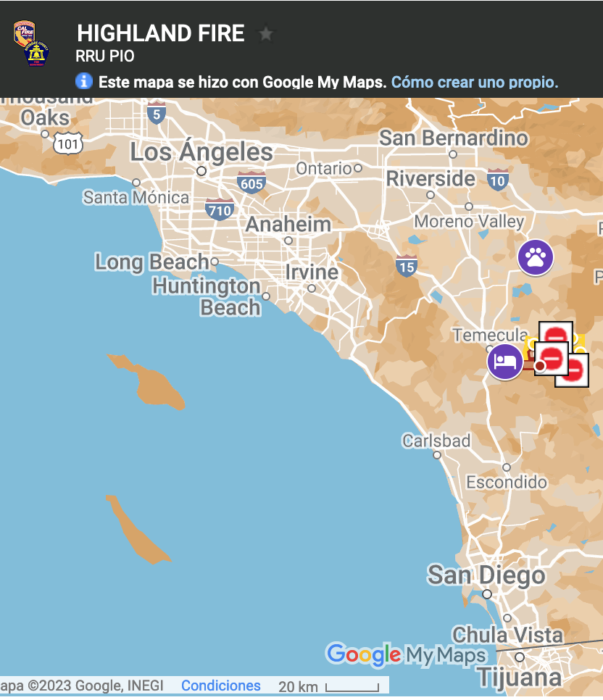
Cal Fire PIO map:

Cal Fire evacuation maps, Highland Fire
Cal Fire evacuation maps, Highland Fire. The fire doubled in size to more than 2,200 acres by Tuesday morning. Thousands of people were under evacuation orders, which were updated early Tuesday.

KTLA5 has video from yesterday:

At least 1,300 homes and 4,000 residents were under evacuation orders, which were still in effect this morning. The fire burned across a sparsely populated area that includes horse ranches and a large mobile home site; Cal Fire said this morning that only 15 or so homes were threatened.

Southern California Edison was reportedly looking into cutting power to nearly 150,000 customers in six counties — to prevent new starts from downed trees or wind-damaged electrical equipment — but fewer than 300 customers thus far were affected by power shutoffs.

The NWS issued a wind advisory for the region through Tuesday night, predicting winds of 15 to 25 mph and gusts up to 50 mph, particularly in the foothills and adjacent valleys.

These are the first major Santa Anas of the season; the strong, hot, dry, dust-bearing winds typically blow down to the coastal areas from inland desert regions in the fall. Santa Ana winds have fueled some of the largest and most devastating wildfires in California history.

* EVACUATION UPDATE *
An updated evacuation map from Cal Fire is [HERE].

November 15 deadline for IAWF conference workshops

IAWF 7th fire behavior + fuels conferenceCall for Workshops at Boise — deadline is November 15

SEND YOUR PROPOSALS NOW:  Conference workshops will be scheduled for Monday, April 15 and Wednesday, April 17 at the 7th International Fire Behavior + Fuels Conference in Boise, Idaho.

Workshops provide a forum for researchers and other professionals working in wildland fire to discuss and exchange interests in fire. Conference workshops are an opportunity for technology transfer, ensuring that scientific and technological developments are accessible to a wider range of users who can use and develop them.

IAWF banner


Conference organizers are particularly interested in hosting technology-related workshops if you or your organization are working with new technology used in wildland fire, or using technology in new ways in fire. Workshops that were particularly well-received at previous conferences included one focused on Soil Moisture and Wildfire Prediction and another on Fire and Fuels Management Tools.


There will be a nominal registration fee for conference participants who attend workshops in April; this fee will cover the cost of meeting rooms, refreshments, and audio-visual equipment. Instructors will not be required to pay a fee.

The IAWF is now encouraging proposals for workshops. Please include in your proposal:

    • Workshop title
    • Names, affiliations, and emails of instructors
    • Short bio for each instructor, including qualifications related to the topic
    • Proposed duration (2, 4, 6 or 8 hours)
    • One-paragraph description of workshop
    • Minimum/maximum number of participants (if applicable)
    • Any special facility needs (e.g. LCD projector, computer lab, wifi)

7TH INTERNATIONAL FIRE BEHAVIOR + FUELS CONFERENCEEvaluation criteria include overall quality and the fit with respect to the conference topic: Fuel, fire and smoke: evolving to meet our climate challenge. 

The IAWF is interested in workshops that connect research and management. The workshops can also be used to discuss administrative techniques, challenges, and strategies, and may include roundtable brainstorming.

Deadline for proposals is November 15. Previous conferences are listed [HERE].

APPLY HERE

Questions? Contact Mikel Robinson at
execdir@iawfonline.org or (406)625-7059.