Skip to content

Author: Kelly Andersson

Chico has a busy season

CAL FIRE Chief Joe Tyler back in July said he was concerned about California’s heightened wildfire risk set up by the abundance of fuels from winter and spring rains; he compared this season to the critical fire season of 2017. ActionNewsNow reported that Tom Bahr, Chico’s airport manager, said that Chico Regional Airport was one of 14 designated airtanker bases statewide for aerial firefighting, and it has indeed been busy.

Erickson Aero Tanker's MD-87 at Chico
Erickson Aero Tanker’s MD-87 at Chico. Smoke in the background is from the Camp Fire at Paradise, November 2018.

The airport this year played a role in heavy air attack operations, extending its reach as far north as the Oregon border, and hosting several contracted airtankers including Coulson’s 737 Fireliner and Erickson Aero Tanker’s MD-87 tanker.

Coulson 737Overseeing the air attack base at Chico Regional Airport, CAL FIRE Battalion Chief Shem Hawkins says the location is strategically important; CAL FIRE aircraft can reach the most remote State Responsibility Area (SRA) fires within approximately 20 minutes, with the goal of keeping 95 percent of fires at 10 acres or under.

Earlier in the summer, Chico’s Airport hosted training ops for Aero-Flite, and CAL FIRE had installed a new water tank, providing local helitack with immediate response capabilities. The City of Chico Airport Manager’s Office, along with local entities operating at the airport, worked with the Forest Service to ensure that airtanker and helitack operations had solid support.

At the northern end of the airport, the Chico Air Attack Base hosted a CH-47 Chinook, operated by Billings Flying Service under contract, which assisted ground crews throughout the summer.

Chico Fire Chief Steve Standridge commended the partnership between the Chico Fire Department and CAL FIRE Butte. He noted the economic benefits to the local area from the air attack base, along with immediate access to CAL FIRE air resources for fires in interface areas. In return, the Chico Fire Department provided firefighting support to CAL FIRE, the USFS, and military air assets at the airport during the fire season.

Built in 1969, Chico Air Attack Base (CAAB) is home to an OV-10A air attack and an S2T airtanker. The S2T can carry 1,200 gallons of retardant and provides fast, aggressive initial attack. The OV-10A is a command-and-control aircraft, coordinating the S2T with other aircraft from other airtanker bases.

OV-10

Any airtanker landing at Chico can load with retardant in one of three drive-through pits, and within minutes depart with a fresh load. CAAB can supply 100,000 gallons of retardant per day, and because of its long runway, can also service and support most of the large airtankers currently in use. It’s not uncommon to see as many as seven tankers moving through the pits at Chico.

Personnel assigned to the base include one battalion chief, two fire captains, one fire apparatus engineer, seven firefighters, two contract pilots, and one contract aircraft mechanic. For more info on the base, check out their county page or this video by KRCR-TV.

Washington governor requests federal aid

Governor Jay Inslee this week sent a letter to President Biden asking for a major disaster declaration and federal assistance to help survivors recover from damages incurred by wildfires in Spokane County from August 18 to 25. During that week, the Wanes Gray and Oregon Road fires killed two people and destroyed more homes than any other fire in state history.

Spokane County
Spokane County, Washington

KREM-2 reported that the Gray Fire started August 18 near Gray Road in Medical Lake and quickly spread to the east and southeast through town and across I-90. The fire (also known as the Wanes Gray Fire) caused a town-wide evacuation for Medical Lake and multiple surrounding areas.

The Oregon Road Fire started the same day on E. Oregon Road in Elk. The fire resulted in Level 3 evacuation orders and drew resources from all over Washington state. It burned almost 11,000 acres, killed one person, and was determined to be human-caused; the fire destroyed 126 homes and 258 outbuildings.

Gray Fire 08/19
Gray Fire 08/19/2023 — WSDOT photo

Spokane Public Radio reported that Inslee said Spokane County’s population has an average lower income and higher unemployment rate than state averages. He said the damage has overwhelmed state and local resources, and asked the president to make financial assistance for wildfire survivors available through FEMA’s Individual Assistance program. Financial assistance and direct services would be available to eligible individuals and households who had uninsured or underinsured necessary expenses and serious needs.


Oregon Road Fire, post by Spokane redditor pilot37.

Inslee also requested the U.S. Army Corps of Engineers and the Environmental Protection Agency assist with debris management and disposal to reduce negative effects on local waterways.

Inslee earlier made available $2.5 million from his office’s emergency assistance fund to help with individual assistance as well as testing and removal of debris for uninsured homeowners affected by the fires. Additional funds will also be available for debris removal from state Department of Commerce emergency response funds.

Read the letter [PDF] here.

Army helicopter starts fire in Washington

On your list of weird starts to wildland fires, you can now add military helicopter accidents.

Beverly, Washington mapAn aviation mishap involving an Army AH-64E Apache occurred in Grant County, Washington about 4:30 p.m. on the evening of September 29.

The helicopter was assigned to 4-6 Air Cavalry Squadron, 16th Combat Aviation Brigade during a training exercise near Beverly, and it struck powerlines over the river and had to make a hard landing.

Both pilots are okay; they were returned to the Yakima Training Center for medical evaluation. The accident caused a small fire near the Columbia River, according to KREM 2 in Spokane.

State Route 243 was closed at Milepost 18 for less than an hour as a result of the incident. Later in the evening, lines were reportedly still down in the river.
Apache after Columbia River incident
Apache after Columbia River incident — Grant County Sheriff photo

The Grant County Sheriff’s Office provided initial information. “Army helicopter made a hard landing after striking power lines over the Columbia River,” they said. “Crew is OK.”

Prescribed burning underway in western Oregon

The U.S. Fish & Wildlife Service last weekend participated in prescribed burns for habitat improvements and ecological health at the Howard Buford Recreation area near Eugene.

KEZI-TV reported that the Friends of Buford Park and Mt. Pisgah, Lane County Parks, and other conservation partners including the FWS and Rivers to Ridges worked on the burn; about 30 firefighters burned some 65 acres.

“Fire has been a really important component of the landscape,” said Ed Alverson, coordinator for Lane County Natural Areas. “And the native species that live here — the plants and the animals — are adapted to fire. In fact, burning by Calapooia People over thousands of years has helped create this species-rich landscape.”

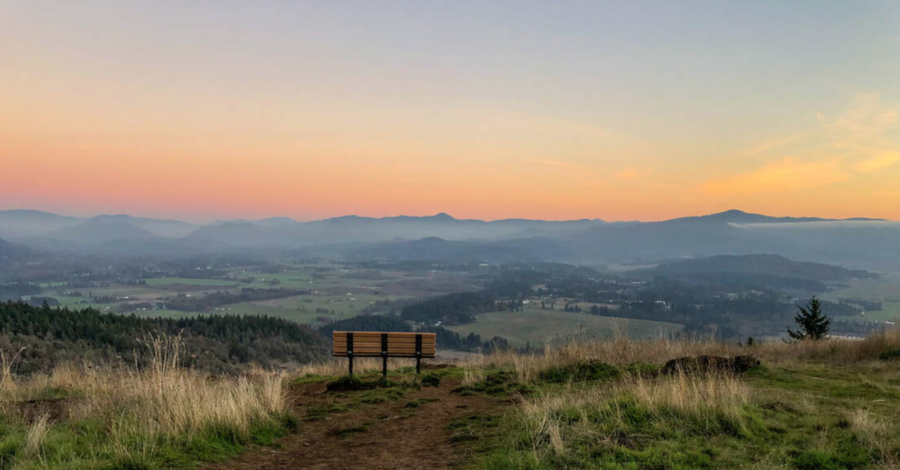
Mt. Pisgah summit at sunset -- HikeOregon photo
Mt. Pisgah summit at sunset in Lane County, Oregon — HikeOregon photo

Mt. Pisgah is within the recreation area and is visible for miles  across the Eugene-Springfield area. It’s a favorite local destination; along with the 118-acre arboretum, the park includes some of the last remaining sizable, contiguous, native oak savannah prairie in the valley. Approximately 17 miles of trails lead up and around the 1,518-foot butte, with 360-degree views of the surrounding valley and mountains. Some trails are open for equestrian use; some are closed during seasonal prescribed fires.

The South Bottomlands burn on Sept. 19, 2023. (Photo courtesy Lane County Parks)

Prescribed fire helps maintain native species in the area and helps prevent the open prairie conversion to closed forest land. Fire improves soil fertility and removes the buildup of thatch, along with reducing the risk of high-intensity fires in the future. A small wildfire near Mt. Pisgah was quickly contained early in August; the area of a 50-acre fire in 2019 now illustrates the habitat resilience in a post-fire area.

“Howard Buford Recreation Area supports one of the largest remaining blocks of prairie and oak habitats in the Willamette Valley,” said Alverson. “Fire is a regular and natural part of the environment of these habitats. We work closely with Lane Regional Air Pollution Authority and our Rivers to Ridges partners throughout the area to make sure the burn is safely implemented and will not disrupt the community.” More than a dozen prescribed fires have been conducted in the area since 1999 and more are planned in the upcoming weeks.


The annual Mt. Pisgah fall plant sale is scheduled for this weekend —  native plants will be sold on Saturday from 9 a.m. to 1 p.m. at the Native Plant Nursery. The Friends of Buford Park and Mt. Pisgah nurture over 100 native plant species in their nursery. (541)674-3257

Buford Park map
Buford Park, 34639 Frank Parrish Rd., Eugene, Oregon

USFS awards 28 companies on a 5-year contract

The USDA Forest Service has awarded 28 spots on a potential $2 billion contract to provide light fixed-wing aircraft and personnel to support for 5 years the administration and protection of public lands.

According to GovCon Wire, the light fixed-wing national air attack multiple-award contract has a 1-year base period and 4 option years and was competed as a total small business set-aside program. Aircraft will support a variety of missions, including fire support, law enforcement, and project and administrative flights, according to a solicitation published in December 2021.

The contract will require relief personnel to provide daily coverage during the mandatory availability period.

According to the solicitation, an aerial supervision mission’s standard configuration includes a pilot, an air tactical group supervisor, and a second ATGS or instructor.

Contract awards, Light Fixed-Wing National Air Attack
Primary Point of Contact:

El Servicio Forestal del USDA ha adjudicado 28 plazas en un contrato potencial de 2.000 millones de dólares para proporcionar aviones ligeros y personal para apoyar durante 5 años la administración y protección de tierras públicas.

Canadian fire pilot loves his work

After 21 years as a fire pilot, Williams Lake’s Guy Ridler still enjoys his job flying an airtanker. Besides the obvious benefit supporting firefighters on the ground, he says he enjoys the constant variety that aerial firefighting entails.

“No fire is the same,” he recently told Ruth Lloyd with the Williams Lake Tribune. With changing geography, winds, fuel types, and fire activity, he says it is always a challenge to put retardant where the client wants it — and do it safely.

2020 photo by BC Wildfire Service
2020 photo by B.C. Wildfire Service

How did he end up where he is, an aerial firefighter who spends his time off in the Cariboo region of British Columbia?

When Guy Ridler was just a young boy, he flew with his parents to Ontario from Newfoundland to visit family. It was his first flight — and he loved it. When he spotted a uniformed pilot in the airport, he approached the “grizzled” pilot and asked him,  “How do I get your job?”

The pilot replied with a question of his own. “Well kid, do your parents have a lot of money?”

When Guy said no, the pilot told him, “Then join the Air Force.”

Years later when he was applying to universities, with grades good enough to go anywhere he chose, a teenage Guy applied and was accepted to the Canadian Armed Forces and a spot at Royal Roads Military College near Victoria, B.C.

But he also had his heart set on competing in the Canada Summer Games that year as a cyclist on Team Newfoundland, and the military would not grant him leave to attend. Against the advice of his advisor, Guy turned down his spot at Royal Roads to compete in the Summer Games and instead attend Memorial University of Newfoundland (MUN) for one year, planning to reapply for the military the following year.

He was accepted at MUN, and all these years later, he says his military college experience was very different from what he’d experienced at MUN, and despite the challenges, he considered it  a job he had to do to get the education and training he wanted.

After completing military pilot’s training — and obtaining a degree in physics — Ridler graduated and landed a job at the Comox Air Force Base, where he flew a Buffalo for the Search and Rescue team. He flew to airshows all over the continent to drop parachutists and also flew them on SAR missions on Canada’s coast.

After his 11 years of required military service, he left for commercial flying. Ridler was hired on as a copilot on a Conair DC-6, and his captain told him, “You are no longer a pilot, you are now a museum curator,” given that the now-retired DC-6 tankers were first built in the 1940s.

Conair DC-6
The Convair replaced the DC-6 and Grumman S-2 Tracker airtankers and now the modern Dash 8-400 airtanker replaces the Convair, bringing with it speed, advanced avionics, fuel efficiency, and tactical flexibility.

He says the job is 100 percent operational — it’s all about safety and a focus on hazards, to be as effective and as safe as possible — for the airtanker, the crew, and those on the ground. And it’s all VFR. “People think it’s some big high-tech operation,” he says. “But in the end, it’s a lot of experience, on-the-job experience.”

Over the years, Ridler has worked alongside forestry agencies in Alaska, Alberta, British Columbia, Washington state, and even Australia. He’s flown not only airtankers but also birddogs — referred to as lead planes in the U.S.

In 2004 he moved to Williams Lake for his first year as a copilot flying a Convair. He later become a captain, which sent him to Alaska for a number of seasons, but returned to Williams Lake seven years later as the captain of the birddog aircraft.

Conair RJ85
Conair RJ85

He thinks the smaller and more maneuverable birddog, which carries the air attack officer, is the best way to learn the job. He completed training as a pilot on the 4-engine RJ85 jet airtanker, and began spending his summers based in Kamloops, then moved back to Williams Lake in 2020.


Williams Lake is a city in the Central Interior of British Columbia, in the central part of a region known as the Cariboo. The feature on Guy Ridler was written by Ruth Lloyd with the Williams Lake Tribune and is highly recommended.  There’s also a PDF file posted [HERE] that details the Convair’s celebrated history of aerial firefighting with Conair in Canadian Aviator Magazine.

CALL FOR PRESENTATIONS: 7th Fire Behavior and Fuels Conference

The 7th Fire Behavior and Fuels Conference is scheduled for April 15–19, 2024 and will be held  simultaneously in Boise, Canberra, and Tralee, Ireland. Conference organizers are now calling for presentations, and each location is inviting presentation proposals.

The IAWF Fire Behavior and Fuels Conference provides a forum at which fire management experience and lessons learned are documented, and current work is showcased. Emerging research, innovation, and management techniques are shared, to develop integrated solutions to wildfire challenges.

IAWF

This conference on three continents will showcase several countries’ development and integration of fire management policies and frameworks at national, regional, and local levels to address fire risks and build resilience.  The conference brings together policy makers, scientists, fire managers, and indigenous land stewards for a shared purpose and a different future living with fire.

DEADLINE extended to 31. October

The International Association of Wildland Fire (IAWF) is a non-profit 501(c)(3) professional association committed to a non-partisan approach for uniting the global wildland fire community. We were formed in 1990 as a global professional membership association. For 30 years IAWF has grown from a fledgling organization to the foremost global wildfire-focused association spanning 26+ countries. The IAWF was built on the belief that an understanding of this dynamic natural force is vital for natural resource management, for protecting the health, safety, and welfare of firefighters and the public, and for harmonious interactions between people and their environment. IAWF is dedicated to communicating with the entire wildland fire community and providing a global link for people with shared interest in wildland fire and associated topics of this multifaceted community. To accomplish these goals, we create networks across sectors, fields, and disciplines to connect the wildfire community through multiple platforms including conferences, our website, the International Journal of Wildland Fire, Wildfire Magazine, and social media outlets.

Poor Timing for Government Shutdown and Federal Firefighters

Guest Post
By Billy Durst


Another government shutdown looms. No one knows whether it will happen, or how long it might last if it does happen. Based on the current conflicts in Congress, particularly between House Republicans and their speaker Kevin McCarthy, many people’s gut instinct tells them that it will. The last government shutdown, in 2019, was 35 days (the longest in U.S. history), and if that is any indication of how long this might last, government employees could be facing another record-breaking furlough.

The timing couldn’t be worse for one particular group of federal employees — federal wildland firefighters, who are anxiously hoping that Congress will pass legislation that would permanently raise firefighter pay. The proposed legislation is not all that they’d hoped for, and not all that they need to make their pay commensurate with their work, but it is clear that it is all they are going to get — if they get it.

A potential worst-case scenario exists for two reasons. Reason one: temporary cash bonus payments put in place by the Biden administration, amounting to a 50 percent raise, have been in place for over a year. These temporary “retention allowances” targeting the federal wildland workforce’s retention issues, amid historically devastating fire years, are set to expire in October.

Numbers Fire Nevada wildfire Carson City Minden
Numbers Fire, July 6, 2020. Photo by Tallac Hotshots.

Reason two: if the government shutdown occurs as the existing government funding regime expires, also come October, federal wildland firefighters will be forced to continue working throughout the furlough, knowing that when the shutdown itself eventually expires, they will be returning to a 50 percent pay cut.

The best-case scenario is that the government does not shut down, that Congress passes and Biden signs the legislation in a timely manner, and that federal wildland firefighters receive the 30 percent permanent pay increase proposed by the pending legislation. No matter what happens come October, these federal firefighters will receive at least a 20 percent reduction in pay. This inevitable pay reduction of 20-50 percent will occur despite the fact that firefighters’ work is more necessary than ever before, while it is common knowledge among firefighters that the majority of, for example, California federal firefighters could earn higher hourly wages working as fast-food employees.

Redding Hotshots Trail Mountain Fire
The Redding Hotshots conduct a safety briefing before beginning their assignment on the Trail Mountain Fire. U.S. Forest Service photo.

Morale among the workforce is low. Cynicism abounds regarding the intentions of agency leaders to be sensitive to our needs, of their competency to advocate on our behalf, and of Congress to perform their responsibilities required not only to keep the government functioning, but also to pass the legislation needed to partially counteract the federal firefighter retention crisis. These federal employees feel righteous indignation in the face of attacks on the value of their labor, and the words-not-action stance of their leaders.

To make a distressing situation darkly comedic, a recent “system error” saw federal firefighters across the country receive notices through their government personnel system that they were to receive pay raises of nearly 100 percent. Had the agencies somehow decided to work around Congress and come through with the necessary pay increases just in the nick of time, before the temporary bonuses ran out? An agency email a few days later clarified that they had not, and a bureaucratic apology followed the inexplicable “system error.” The ironic timing of this mistake was not lost on federal firefighters.

Whether or not these public servants will endure another record-breaking furlough in the face of record-breaking wildfires, or whether their permanent pay increase will be lost within the machinations of a Congressional “system error,” remains to be seen.

No excuse for neglecting firefighter pay

Grassroots Wildland Firefighters

This week Grassroots President Luke Mayfield sent a letter to USDA leadership and key Congressional members concerning the lack of movement on the Wildland Firefighter Pay Protection Act — here’s an excerpt from the letter.

“The debate over the remaining funds from the Bipartisan lnfrastructure Law is a distraction to conjure false narratives; one is administrative mismanagement and the other that the federal wildland workforce is not facing a fiscal cliff. Rather than action to address the crisis at hand, these arguments try to avoid accountability for the lack of leadership, which could bring thousands of wildland firefighters to the brink of a pay cliff.”

The federal wildland firefighter workforce can no longer be sacrificed without long-term and catastrophic consequences. Workforce and systemic reforms must become congressional and administrative priorities.

The purpose of the letter is to clearly outline and document our intent for agency leadership and Congressional decision-makers.

To read the entire letter for perspective on what’s going on in the Capitol, click [HERE]. Our organization wants to make sure stakeholders are not misguided by rumors or false narratives from named or unnamed sources.

Thank you,
Grassroots Wildland Firefighters
PO BOX 51253
Sparks, Nevada 89435