
Looking back 45 years at large fire organization charts, “support teams”, and hair requirements in California
Continue readingFour-helicopter Quick Reaction Force begins 165-day availability
The retardant-dropping firefighting helicopters in Southern California are crewed 24/7
Continue readingFirst annual National Wildland Firefighter Day
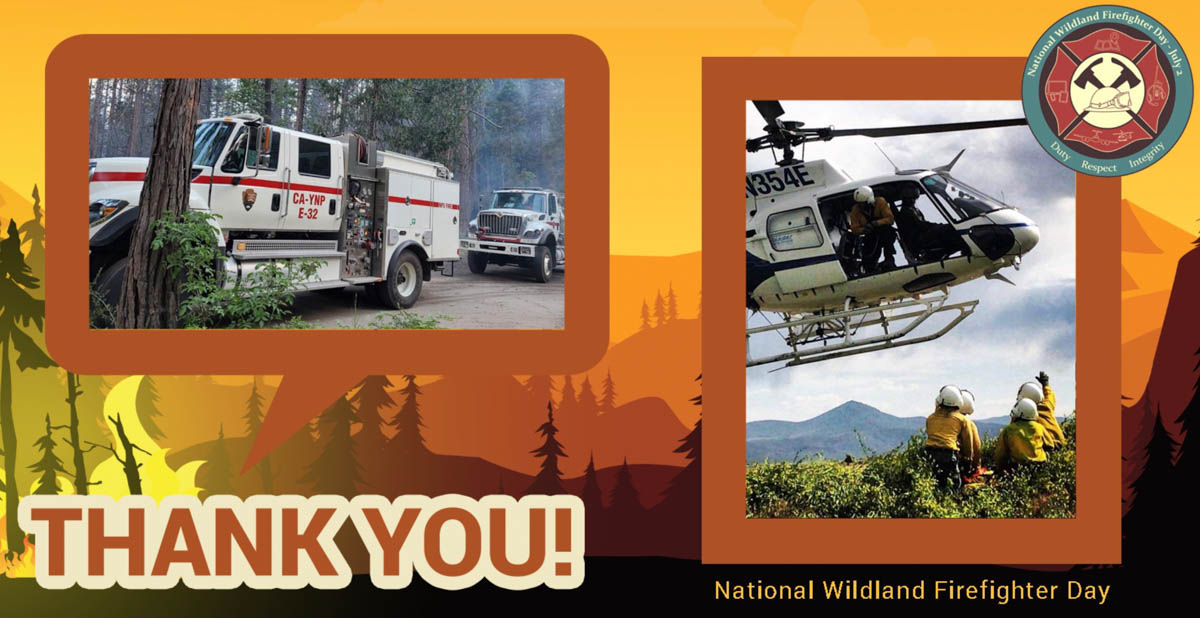
Each year we experience more extreme and longer wildland fires, and the wildland firefighting community rises to the challenge to protect life, property, and natural and cultural resources. On July 2, for National Wildland Firefighter Day we show appreciation and recognize the hard work and dedication of every wildland fire responder. Thank you also to the supporting families and friends of wildland fire responders who make it possible for responders to be away for weeks or months at a time.
President Biden issued a statement this morning about the commemoration:
Today, on the first annual National Wildland Firefighter Day, I join Americans across the country in expressing deep gratitude for our wildland firefighters who heroically protect our communities and natural resources from wildfires.
Recognizing their service and sacrifice on this day is especially important because we continue to ask more of them year after year. In the past year and a half, I’ve met firefighters in Idaho, California, Colorado, and New Mexico who work night and day to keep people safe, all while fires are getting larger, more intense, and more difficult to control because of climate change, the accumulation of hazardous fuels in our forests, and evolving land development patterns.
Firefighters can spend months away from their loved ones, courageously working to save lives, homes, schools, businesses, natural resources, and wilderness areas. Beyond fighting fires, these dedicated women and men also work year-round to protect us from wildfires before they start by doing the important fuels management work needed to reduce the likelihood of catastrophic fire. This work is tough and extremely dangerous.
That’s why my Administration continues to make supporting this workforce a top priority. Building on what I initiated last year, the Bipartisan Infrastructure Law authorized historic new initiatives and resources for wildland firefighters that we are implementing now. This includes a substantial pay increase, new programs to support wildland firefighter mental and physical health, and the creation of a wildland firefighter job series that will improve recruitment, retention, and opportunities for professional growth.
We are also building our firefighting workforce, including converting more temporary firefighting positions to permanent jobs. And we’re further supporting our brave firefighters by doing everything we can to help reduce the risk of catastrophic fires, including proposing a nearly 60 percent increase in hazardous fuels management funds in my Fiscal Year 2023 Budget Request, and investing another $2.5 billion in this work over the next five years through my Bipartisan Infrastructure Law.
National Wildland Firefighter Day will occur annually during the previously established wildland firefighter Week of Remembrance. I’ve attended too many memorial services for the fallen, including almost nine years to the day, *honoring 19 Granite Mountain Hotshot firefighters who died fighting the Yarnell Hill Fire in Arizona. They were some of the strongest, most disciplined, tenacious, physically fit firefighters in the world. So, this week we will also reflect on those firefighters who have fallen in the line of duty and renew our commitment to wildland firefighter safety. We pause to remember them, commemorate their selfless service, and thank their loved ones for their service and many sacrifices.
May God bless firefighters and their families across our Nation.
*Link to coverage of the memorial service for the Granite Mountain Hotshots added by Wildfire Today.
Prediction issued for this summer’s wildfire potential
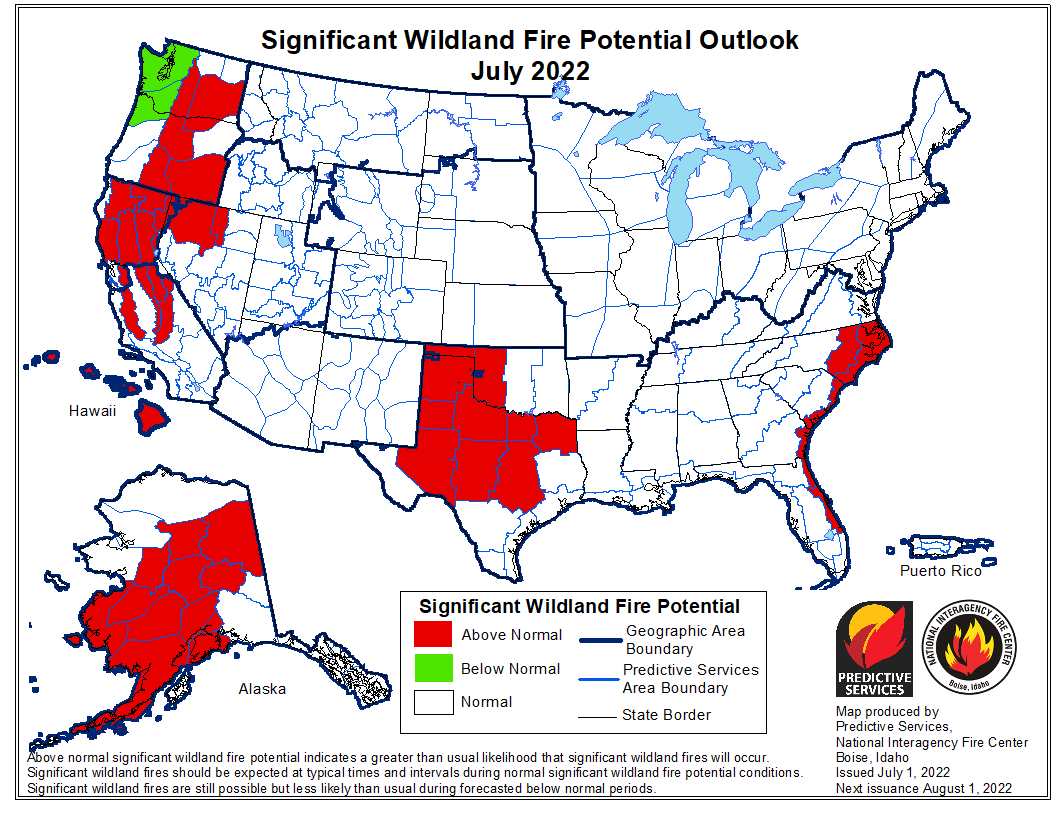
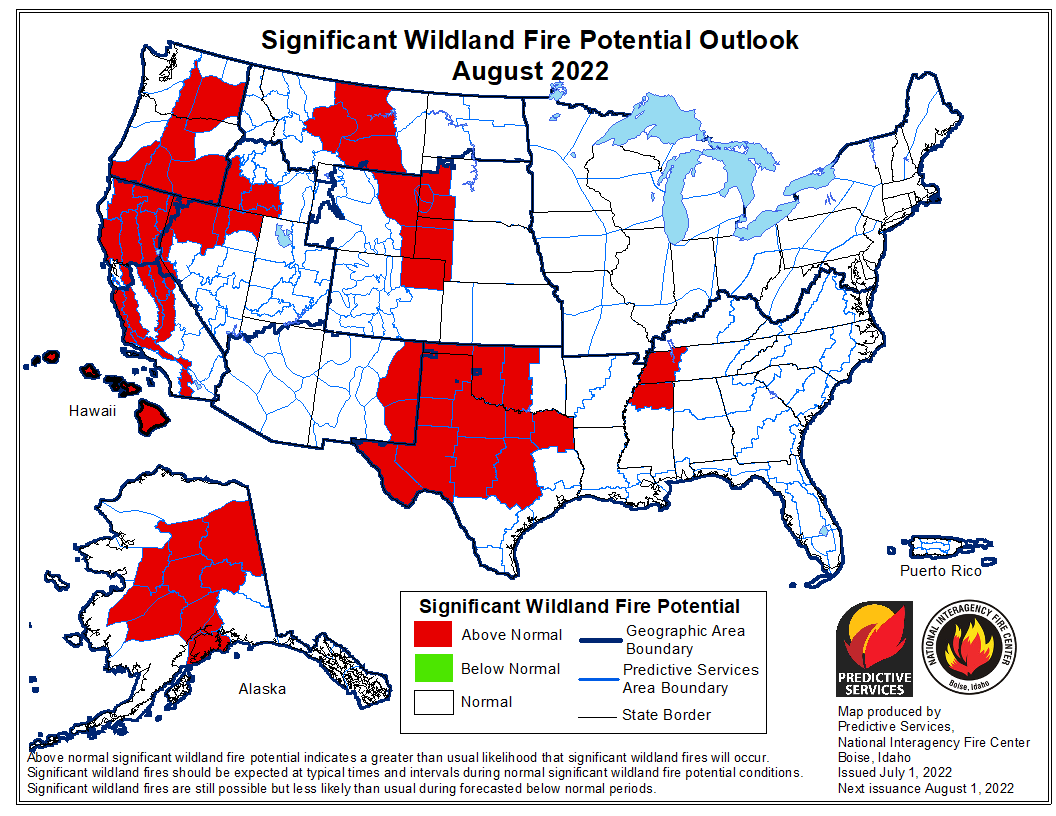
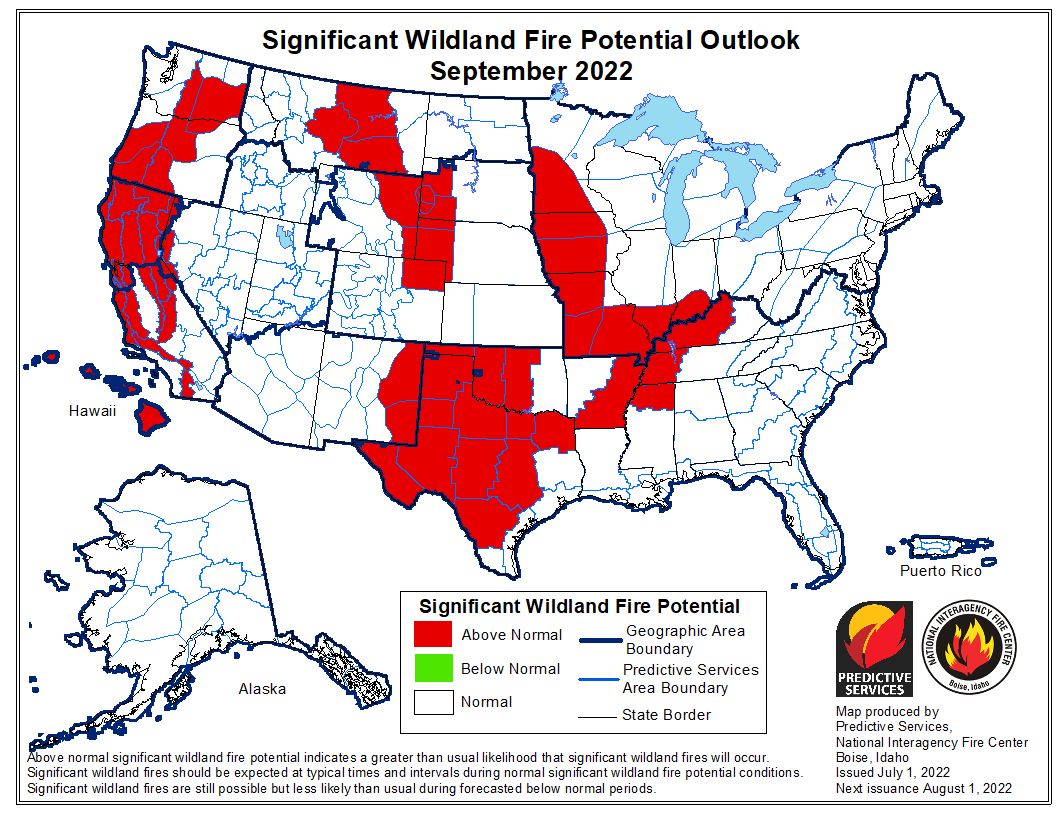
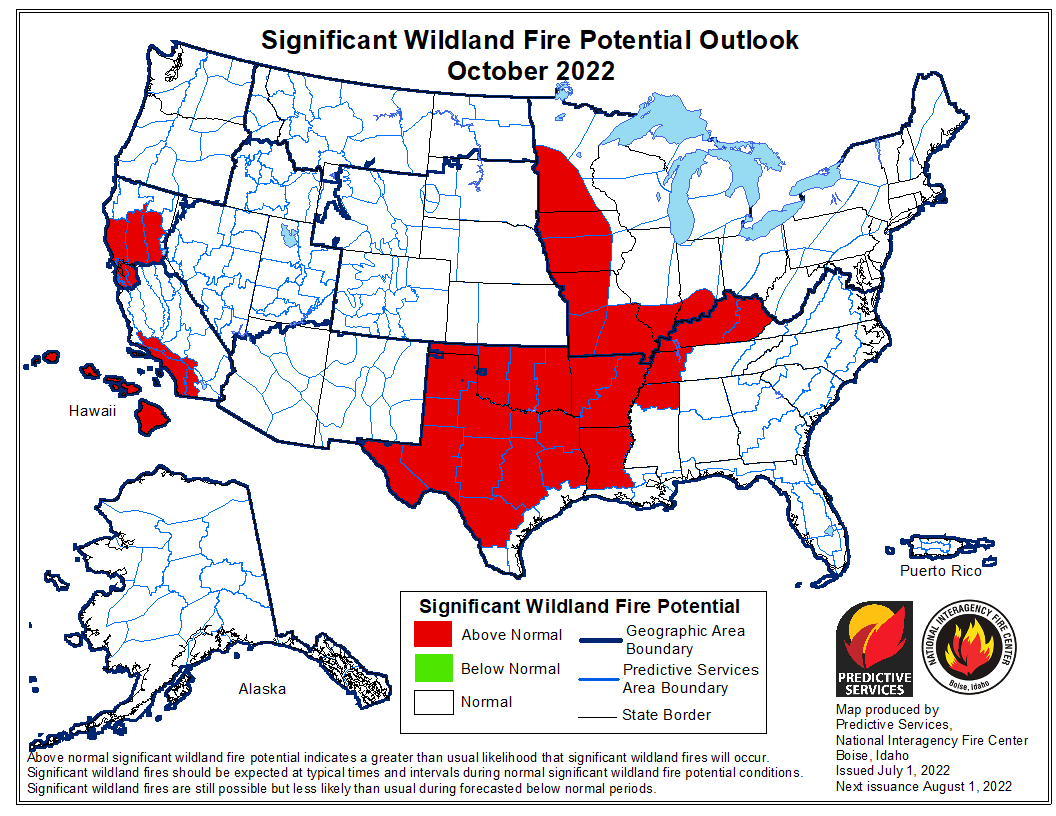
The forecast for wildland fire potential issued July 1 by the National Interagency Fire Center predicts that in July it will increase to higher than “normal” this summer in Alaska, Texas, Northern California, and the eastern portions of Washington and Oregon. In August added to the list will be parts of Montana, the Black Hills, and the Northern Plains. Hawaii will be above normal for the next four months.
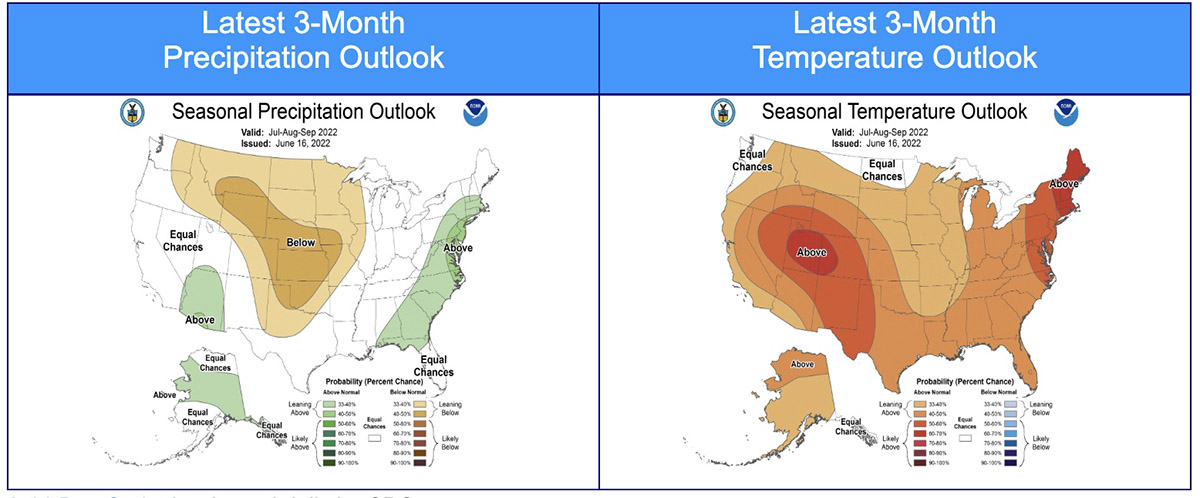
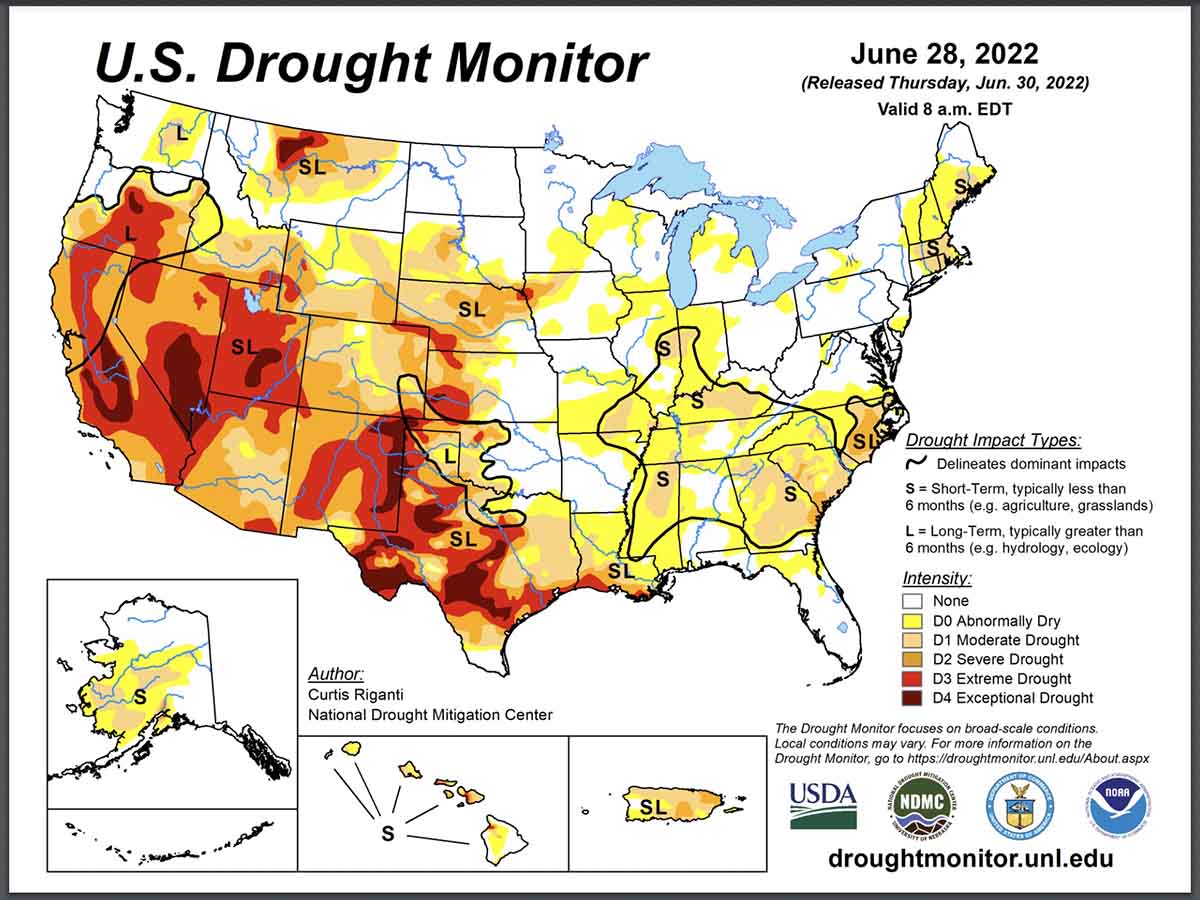
The fire potential text and maps from NIFC shown here represent the cumulative forecasts of the ten Geographic Area Predictive Services Units and the National Predictive Services Unit. Additional graphics are included from other sources.
Below:
- Excerpts from the NIFC narrative report for the next four months;
- Additional NIFC monthly graphical outlooks;
- NOAA’s three-month temperature and precipitation forecasts;
- Drought Monitor;
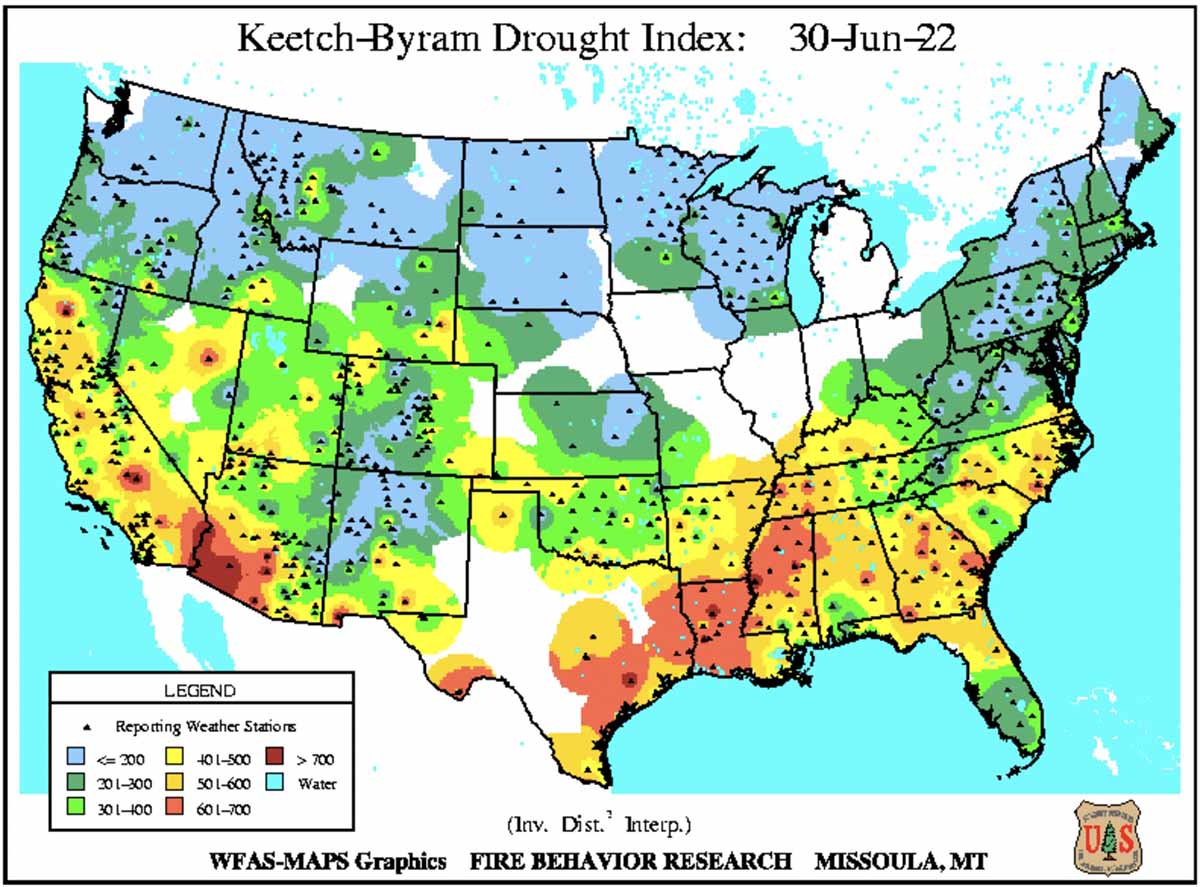
- Keetch-Byram Drought Index;
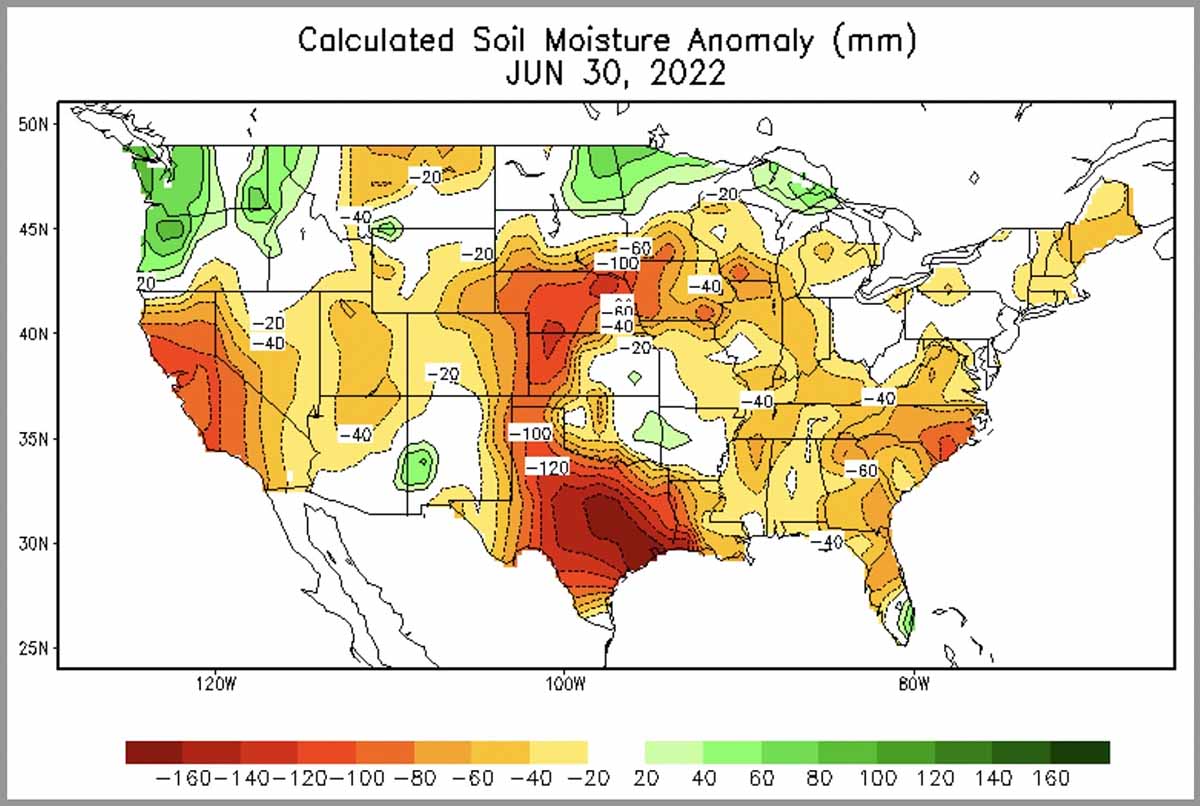
- Soil moisture.
“Most of the West, Plains, and Texas remain in drought, with areas of extreme to exceptional drought across the southwestern US. Drought developed across southwest Alaska and expanded or increased in severity across the Southeast and Hawai’i. Temperatures were above normal across the southern tier of the US and the Plains, with near to below normal temperatures across the northwestern US and the Northeast.
“Climate outlooks indicate below normal precipitation is likely across much of the Plains through the central Rockies into the Inland Pacific Northwest, with above normal temperatures likely across most of the contiguous US (CONUS) through summer. A robust North American Monsoon is expected to continue through July into August across the Southwest and portions of the broader Four Corners region. Alaska is likely to remain warm, with near normal precipitation likely through summer.
“Above normal significant fire potential is forecast for the southern Plains through October, spreading across Texas, the Lower to Mid-Mississippi, Missouri, and Ohio Valleys by fall. Much of the central and northern High Plains, including the Black Hills, are likely to have above normal potential through summer. The Southwest, southern Great Basin, and Colorado Rockies have returned to near normal potential.
“Southwest, south-central, and Interior Alaska will have above normal significant fire potential through August, although portions of southwest Alaska will likely return to near normal potential during August. Much of the Sierra and Coast Ranges in California will have above normal significant potential by August, continuing through September. Offshore wind prone areas in California will likely retain above normal potential in October as well. Along and east of the Cascades into much of the western and northern Great Basin is expected to have above normal potential this summer due to above normal fine fuel loading and long-term drought, with southwest Oregon likely to have increasing potential by August. Leeward sides of the Hawai’ian Islands will have above normal potential through October due to ongoing drought and likely enhanced trade winds.”
With near-record setting wildfire activity, Alaska moves to Preparedness Level 5
This weekend temperatures in the state could be 20 degrees above average
Continue readingTwo San Diego County Sheriff helicopters drop on a wildfire in Oceanside
 San Diego County Sheriff helicopter 12 drops on a wildfire in Oceanside, CA June 29, 2022. Photo by Ryan Grothe.
Ryan Grothe got some additional photos of San Diego County Sheriff Office helicopters yesterday as they dropped on a small wildfire in Oceanside, California that started near train tracks.
The Sheriff’s Office has two Bell 205A-1 ships used for firefighting and other missions — H-10, N449BZ manufactured in 1973; and H-12, N107BZ manufactured in 1968.
 San Diego County Sheriff helicopter 12 drops on a wildfire in Oceanside, CA June 29, 2022. Photo by Ryan Grothe.
 San Diego County Sheriff helicopter 10 drops on a wildfire in Oceanside, CA June 29, 2022. Photo by Ryan Grothe.
In addition to the San Diego County Sheriff’s helicopters, San Diego Fire Rescue has a new Sikorsky S-70i. After being retrofitted by United Rotorcraft it was delivered at Montgomery Field (map) November 23, 2019. It is now known as a Firehawk after being reconfigured with an aerial firefighting mission package including extended landing gear, a 1,000 gallon firefighting tank, and a retractable snorkel system. The FAA registration number is N283SD.
San Diego Fire Rescue has two other helicopters that assist firefighters, a Bell 212 (N800DM) and a Bell 412EP (N807JS) manufactured in 1980 and 2008, respectively.
Video of precision drop by an S2 air tanker
 S2T precision drop by T-72, Border #19 fire, June 24, 2022.
Check out the video below of a precision retardant drop by Tanker 72, an S2T, a CAL FIRE air tanker based in Southern California. It occurred in very difficult terrain on the Border #19 wildfire near the US/Mexico border June 24, 2022. The video was shot by the FIRIS intelligence-gathering aircraft.
Rices Fire prompts evacuations in Nevada County in Northern California
Updated at 5:18 p.m. PDT June 29, 2022
 Map showing the progression of the Rices Fire, by FIRIS, at ~9 a.m. June 29, 2022
OCFA’s Intel 12 on the #RicesFire, NEU. Fire is mapped at 877 acres at 13:25 hours. pic.twitter.com/EYrK68ZNbU
— FIRIS (@FIRIS) June 29, 2022
At 1 p.m. Wednesday cameras pointed at the Rices Fire show that it is not putting up much smoke.
 Rices Fire as seen from the Barr Ranch camera, looking north at 1:02 p.m June 29, 2022.
Mapping at mid-morning on Wednesday found it had burned 820 acres.
Updated at 9:07 a.m. PDT June 29, 2022
 Rices Fire map, estimated perimeter, June 28, 2022.
Updated at 8:03 a.m. PDT June 29, 2022
 Rices Fire, as seen from the Barr Ranch camera looking north at 7:29 a.m. June 29, 2022.
The spread of the Rices Fire in Northern California north of Bridgeport west of French Corral slowed overnight. The latest size estimate from CAL FIRE is 769 acres.
Tuesday night the relative humidity went up to 36 percent after reaching 6 percent Tuesday afternoon. Very early Wednesday morning the wind was from the northeast at 4 mph gusting to 10.
The spot weather forecast for Wednesday issued Tuesday afternoon, predicted 91 degrees, east winds 3 to 7 mph shifting to the southwest at 5 to 8 mph after 9 to 10 a.m., with 10 percent relative humidity. Without strong winds this is not considered extreme conditions, but with ultra low humidity and fuel moistures there will still be considerable resistance to control.
8:15 p.m. PDT June 28, 2022
A wildfire in Nevada County in Northern California is prompting evacuations near Birchville. Since it started at about 2 p.m. Tuesday it had burned approximately 520 acres by 6:30 p.m. It was reported near Rices Crossing and Cranston Roads and is believed to have originated from a structure fire that spread into vegetation.
Evacuation information is at CommunityZonehaven.com.
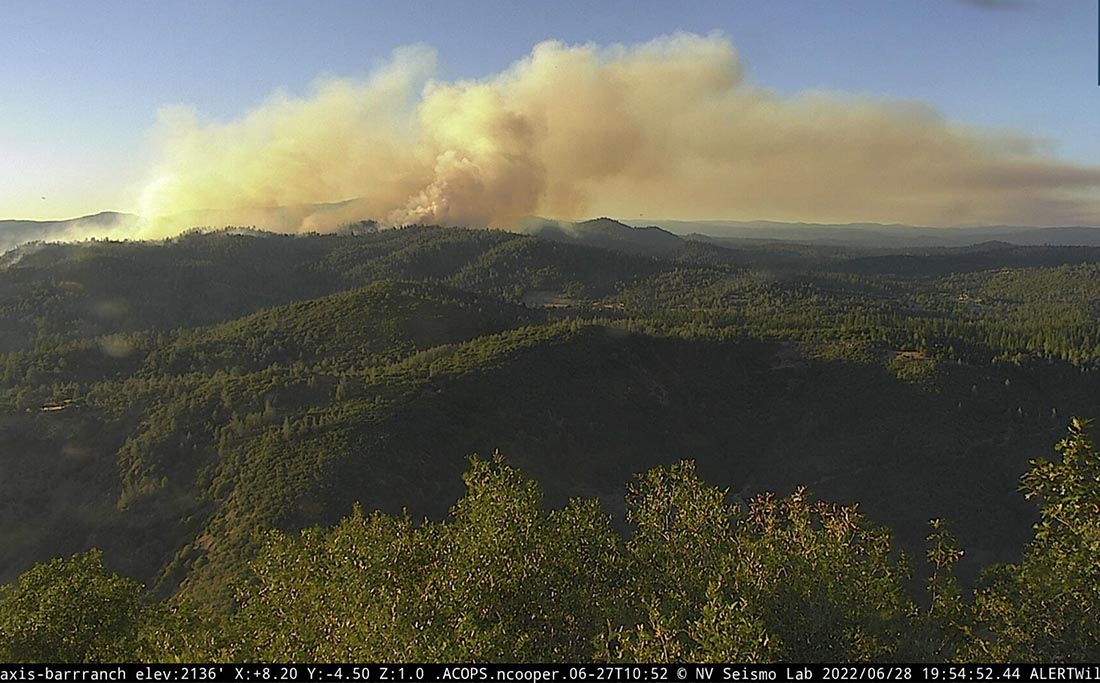 Rices Fire, as seen from the Barr Ranch camera, looking north at 7:54 p.m. June 28 2022.
A nearby weather station Tuesday afternoon recorded a high of 100 degrees recorded, relative humidity as low as 6 percent with 6 mph southwest winds gusting to 15 mph. The forecast for Wednesday calls for 91 degrees, east winds 3 to 7 mph shifting to the southwest at 5 to 8 mph after 9 to 10 am., with 10 percent relative humidity.
We will post more information as it becomes available.
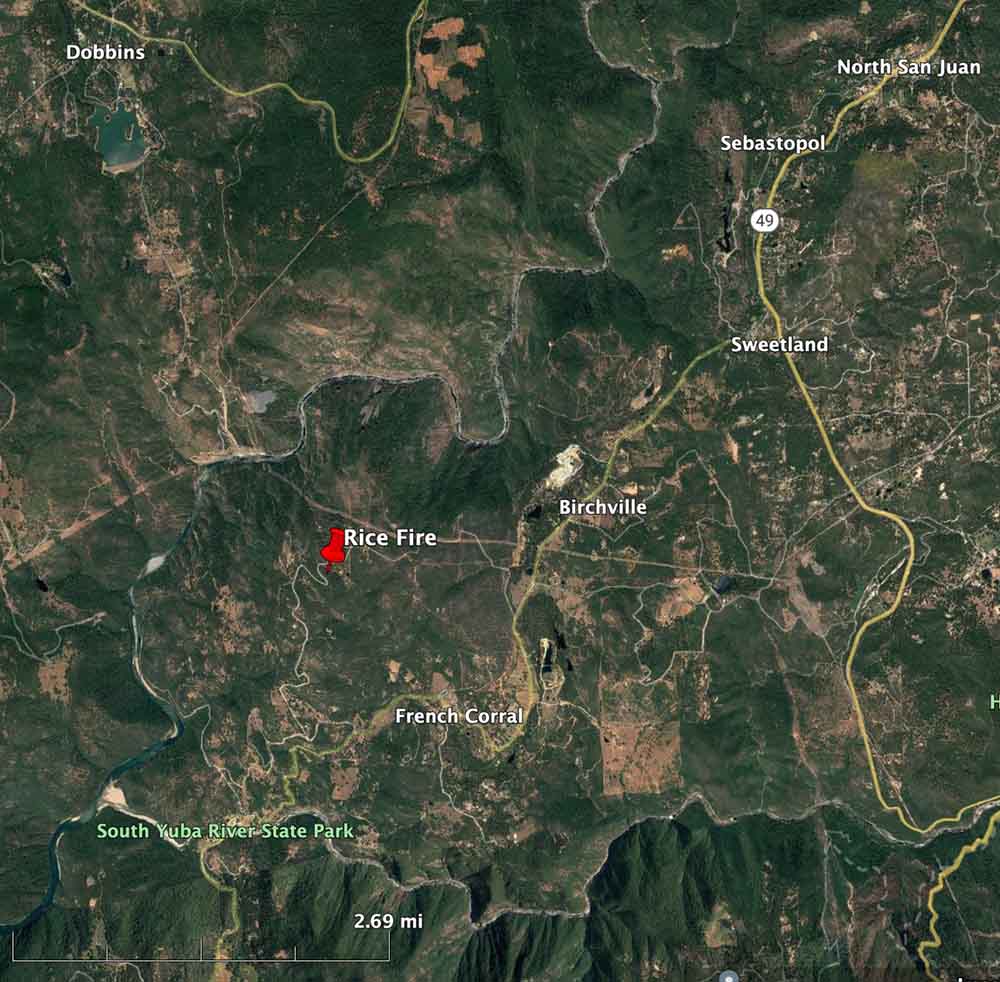 Approximate location of the Rices Fire, June 28, 2022.
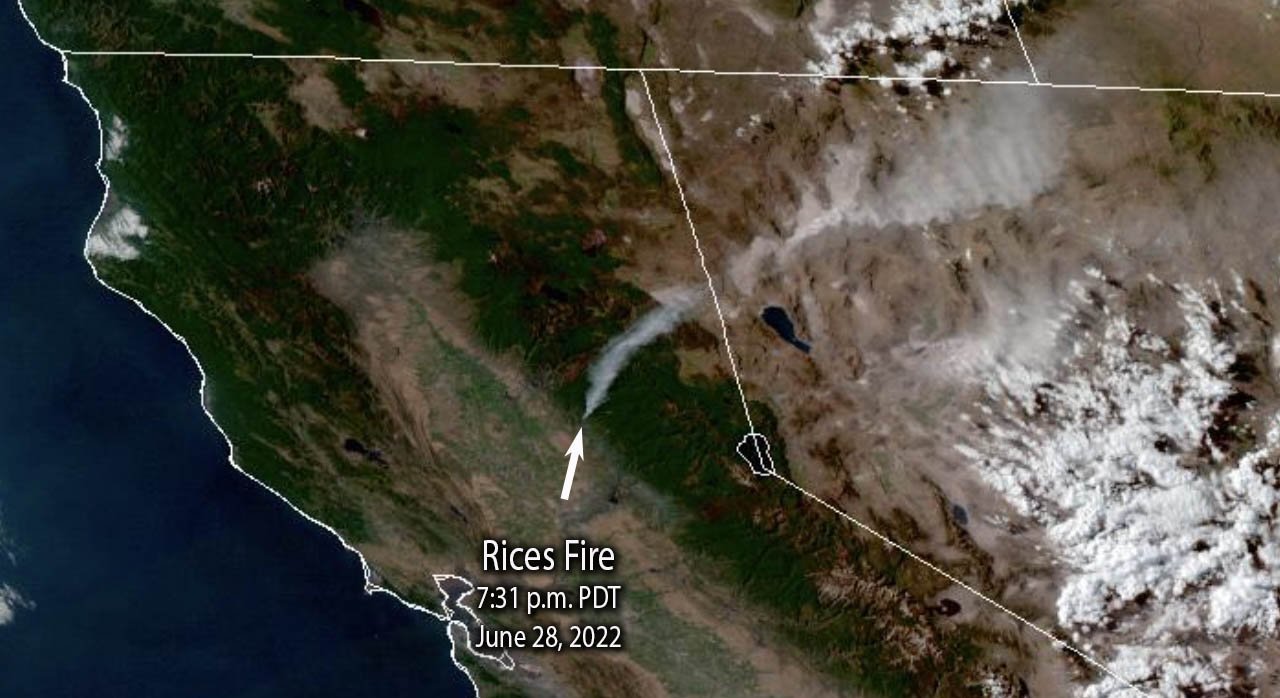 Rices Fire, satellite photo, 7:31 p.m. PDT June 28, 2022
Flight crews in Alaska having trouble finding lodging
 Single engine air tankers at Ladd Field at Fort Wainwright, AK June 22, 2022. AGray/BLM Alaska Fire Service.
The fire season in Alaska is on track to become one of the busiest on record. The number of acres burned so far this year, 1.4 million, is already more than the 30-year average of the total burned each year, 1.2 million.
The Alaska Division of Forestry (DOF) published an article on their AK Fire Info page saying that with the increased fire activity and the additional firefighting aircraft being used in the state they were having trouble finding lodging near airports for all of the pilots and their flight crews. Facilities were available in other locations throughout the state but the long travel distances between lodging and airports was decreasing flight time, and limiting how much the pilots could assist the firefighters on the ground.
The DOF wrote that in the Mat-Su area they were in need of help and were looking for services similar to a hotel or vacation rental. They were hoping to find hotel rooms, vacation rentals by owner, or bed and breakfasts for the pilots, air crews and aviation mechanics.
Later that same day they reported that the response was overwhelming and secured rooms for all of their fire personnel. “We couldn’t do this without you”, they wrote. “Thank you Alaska for making a difference!”
July 2 will be the first “National Wildland Firefighter Day”
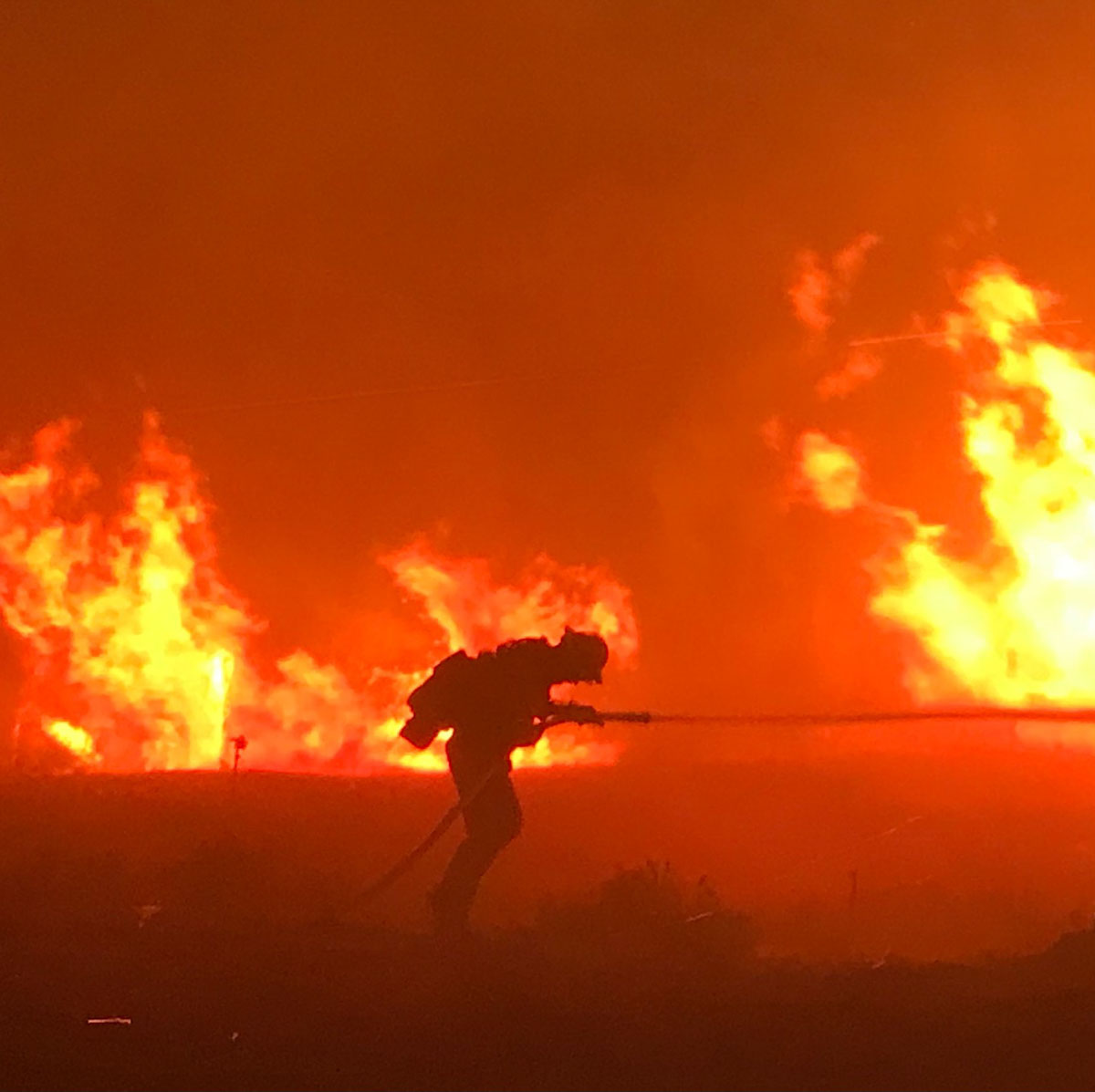 Firefighter at the Dixie Fire near Greenville, CA, 2021. Jay Walter.
On Tuesday June 28 at 11 a.m. MDT there will be an event live-streamed on facebook announcing the designation of July 2 as National Wildland Firefighter Day.
(Following is a news release from the National Interagency Fire Center:)
The newly established National Wildland Firefighter Day (July 2) recognizes the dedication of wildland firefighters, including federal, state, local, rural, contract, and support personnel. The selected date is especially meaningful as it occurs during the Week of Remembrance, which is held annually June 30 to July 6, and serves as an opportunity to renew our commitment to wildland firefighter safety as we remember those who have fallen in the line of duty.
National Wildland Firefighter Day is designed to recognize the hard work and devotion of all wildland firefighters and support personnel who are the backbone of the wildland fire community. These men and women work to save lives, property, infrastructure and precious natural and cultural resources every year, and we are incredibly thankful for their professional skills and efforts.
The National Wildland Firefighter Day was also created to support The U.S. Department of the Interior (DOI) and U.S. Department of Agriculture’s (USDA) efforts to implement the Bipartisan Infrastructure Law (BIL) for DOI and USDA Wildland Fire Management programs. The Bipartisan Infrastructure Law provides significant funding to expand a workforce reform initiative designed to further reinforce wildland fire management staff.
Over the next five years, the Interior and Agriculture Departments will receive $8 billion to fund forest and land management activities, including $600 million for firefighter pay – providing about 1,500 additional firefighters and supporting President Biden’s commitment that no federal firefighter will make less than $15 an hour. The Law also provides for critical wildland firefighter workforce improvements, ranging from a new wildland firefighter classification series to mental health support, and improved compensation to additional training.